 Photograph · Mike Cassano · CC BY 2.0
Meteorite · Deep guide
Cape York Meteorite (Ahnighito)
Also called: Ahnighito · Innaanganeq meteorite · Cape York
Greenland's giant iron, used for centuries by the Inughuit to make tools, now displayed in New York.
What is it?
The Cape York meteorite is one of the largest iron meteorites known. At least eight big pieces, together about 58 tonnes, have been recovered from northwest Greenland, along with many small fragments. The largest piece, called Ahnighito, weighs about 31 tonnes and is on display at the American Museum of Natural History. For centuries the local Inughuit people chipped iron from these rocks to make blades and harpoon tips. The fall itself probably happened within the last few thousand years, though the exact date is debated.
The deep dive
Researched for the Atlas from Wikipedia — Cape York meteorite (9,887 characters read) · updated Nov 15, 2026
01 A Cosmic Visitor Claimed by the Ice Age
Pinning down exactly when the Cape York meteorite struck Greenland is surprisingly difficult, and the debate has even produced an embarrassing museum error. A placard accompanying the Agpalilik fragment at the Natural History Museum of Denmark states the fall happened roughly 58 million years ago — a figure wildly inconsistent with every other line of evidence. Published terrestrial-age estimates place the meteorite's time on Earth at 1 to 2 million years, while archaeological and historical clues push the fall date much later still, perhaps within the last 1,000 to 10,000 years. The placard's number is suspiciously close to Cape York's cosmic-ray exposure age of 93 ± 16 million years — the time it spent traveling through space as a meteoroid — suggesting someone accidentally conflated journey time with landing time. The fragments were found sitting at or near the surface, some on unstable terrain of flowing gravel and clay-like sediments over permafrost, which fits a relatively recent fall rather than tens of millions of years of burial and erosion.
02 Did Glaciers Carry These Stones, or Did They Fall in Place? Deeper
Because all recovered Cape York fragments were found at the surface — partly buried but never deeply entombed — geologists have argued about two competing delivery stories. In the first hypothesis, the meteorite landed somewhere unknown in Greenland's interior and was subsequently transported to its current coastal positions by glacial movement over millennia. In the second, the rocks fell roughly where they now lie, after the glaciers of the last ice age had already retreated from that coastline. Neither hypothesis has been conclusively ruled out. The character of the terrain around the largest fragment complicates matters further: it rested in an area described as landscape consisting of 'flowing' gravel or clay-like sediments on permafrost, a dynamic substrate that could shift, tilt, and partially rebury a multi-tonne iron mass over centuries without any glacial involvement at all. Resolving this question matters for reconstructing the meteorite's strewn field and estimating how many fragments remain undiscovered.
03 The Inughuit and Centuries of Metalworking
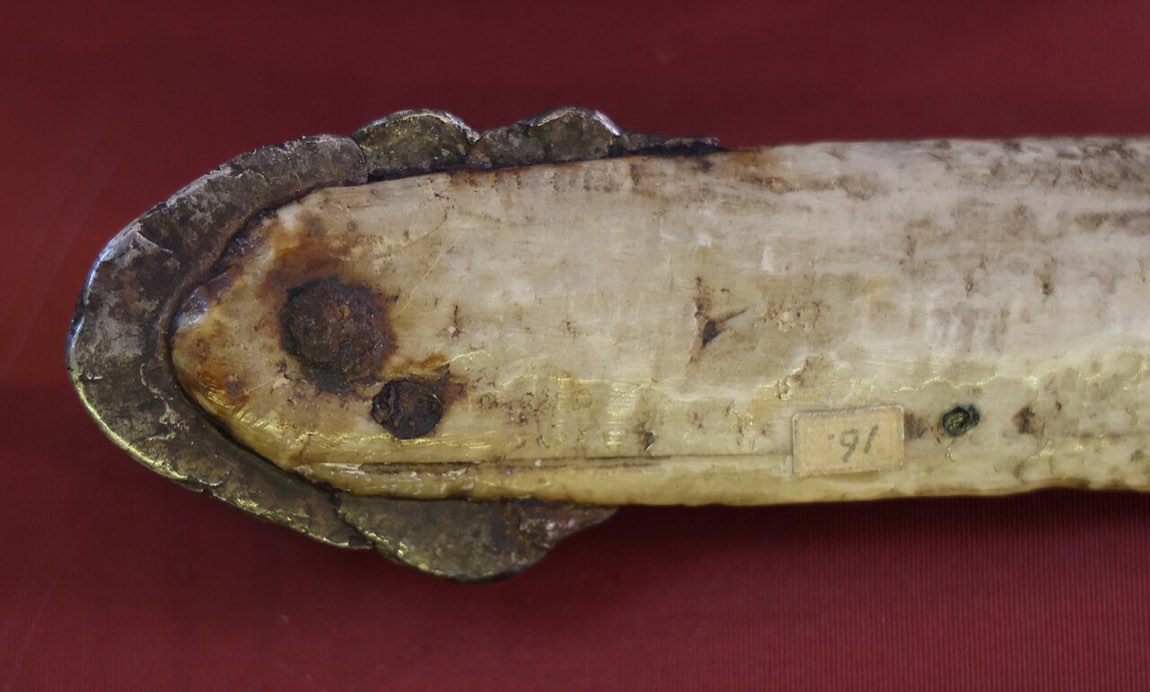
Long before any Western explorer arrived, the Inughuit — the local Inuit people of northwestern Greenland — knew about the meteorite and treated it as a practical industrial resource. They called the known fragments collectively Saviksue, meaning 'Great Irons,' and worked the metal using cold forging: hammering it into shape with stones, without fire or smelting. The resulting blades were used for tools and harpoons, making Cape York iron essential to daily survival in one of the world's harshest environments. How far this iron traveled is extraordinary: Cape York meteoritic iron dating to before 1450 AD has been recovered throughout the Arctic Archipelago and on the North American mainland. A medieval Norse farm excavated near modern-day Nuuk in 1976 yielded an arrowhead made from Cape York iron, evidence of trade or contact between Greenlandic Norse settlers and the northern Inughuit. These artifacts collectively reveal an extensive Thule culture trade network that supplied meteoritic iron to First Nations peoples across the region, all before European contact.
 ⤢
04 Peary's Three-Year Campaign to Move the Unmovable
Robert E. Peary of the US Navy became the first Western explorer to actually reach the meteorite in 1894, guided by a local Inuk. What followed was an extraordinary feat of improvised engineering. The largest fragment, known as 'the Tent' and later formally named Ahnighito, weighed 31 tonnes (68,000 lb) and sat on remote, ice-bound coastline with no infrastructure whatsoever. Peary spent three years planning and executing the removal, constructing a short railroad of heavy timbers to move the mass to the shore. By 1895 he had shipped two smaller fragments — the Woman and the Dog — and in 1897, after great effort, he secured the Tent itself. The name 'Ahnighito' was given to the largest piece during a baptizing ceremony by Peary's daughter, whose own middle name was Ahnighito — an anglicized form of Arnakitsoq, the name of her Inuk nanny. Peary ultimately sold the three fragments to the American Museum of Natural History in New York for $40,000, equivalent to approximately $1.55 million in 2025.
05 The Heaviest Meteorite Ever Relocated
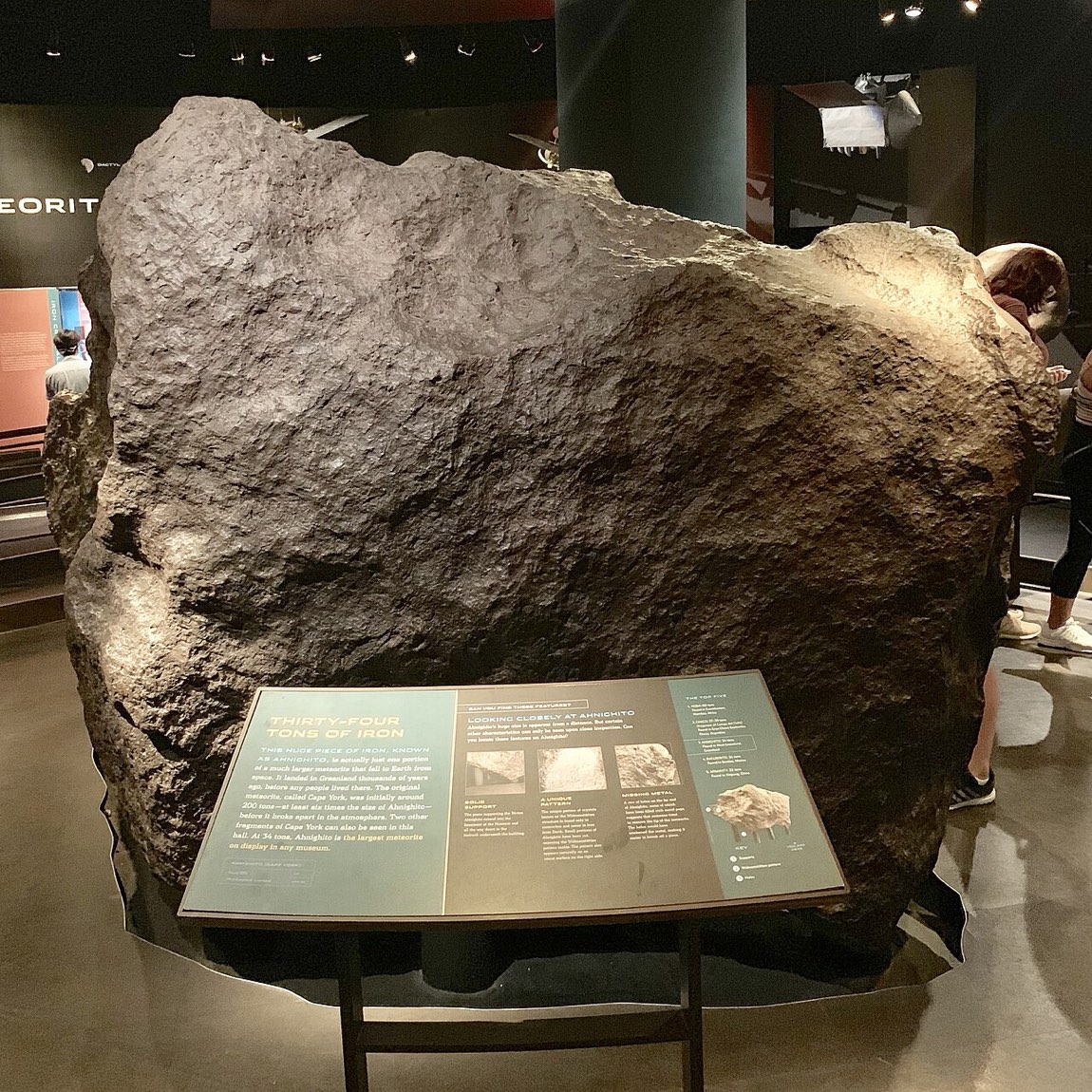
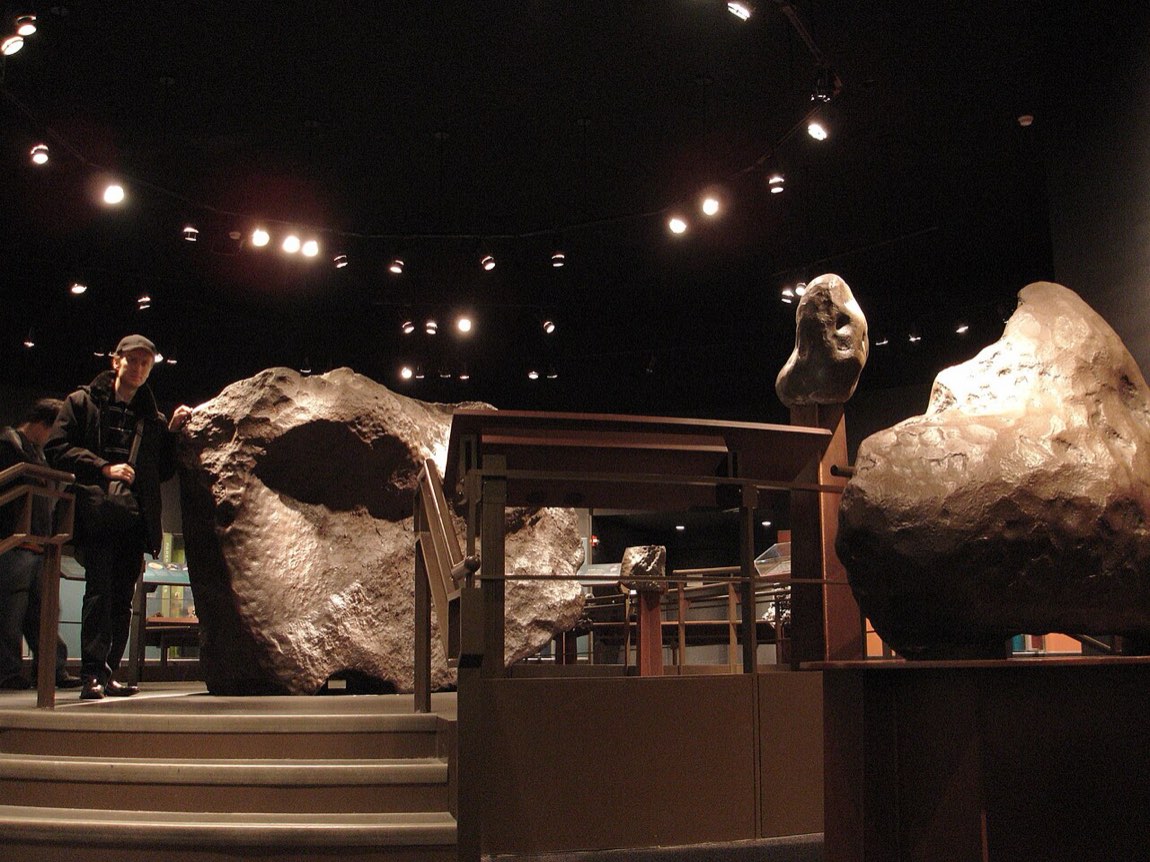
Ahnighito holds a specific and remarkable record: it is the heaviest meteorite ever to have been relocated from its landing site. Its dimensions are 3.4 by 2.1 by 1.7 metres (11.2 ft × 6.9 ft × 5.6 ft), and it weighs 31 tonnes (68,000 lb) — roughly the mass of five adult African elephants. Only the Hoba meteorite in Namibia, which has never been moved, is heavier among known iron meteorites. Ahnighito's sheer mass created a structural challenge for the American Museum of Natural History in New York, where it has been on display ever since: the supports of its display stand had to be engineered to extend all the way down to the bedrock beneath the museum building. All three of the Cape York fragments recovered by Peary — the Woman, the Dog, and Ahnighito — remain on display at the museum today.
06 Four More Fragments, Four More Stories Deeper
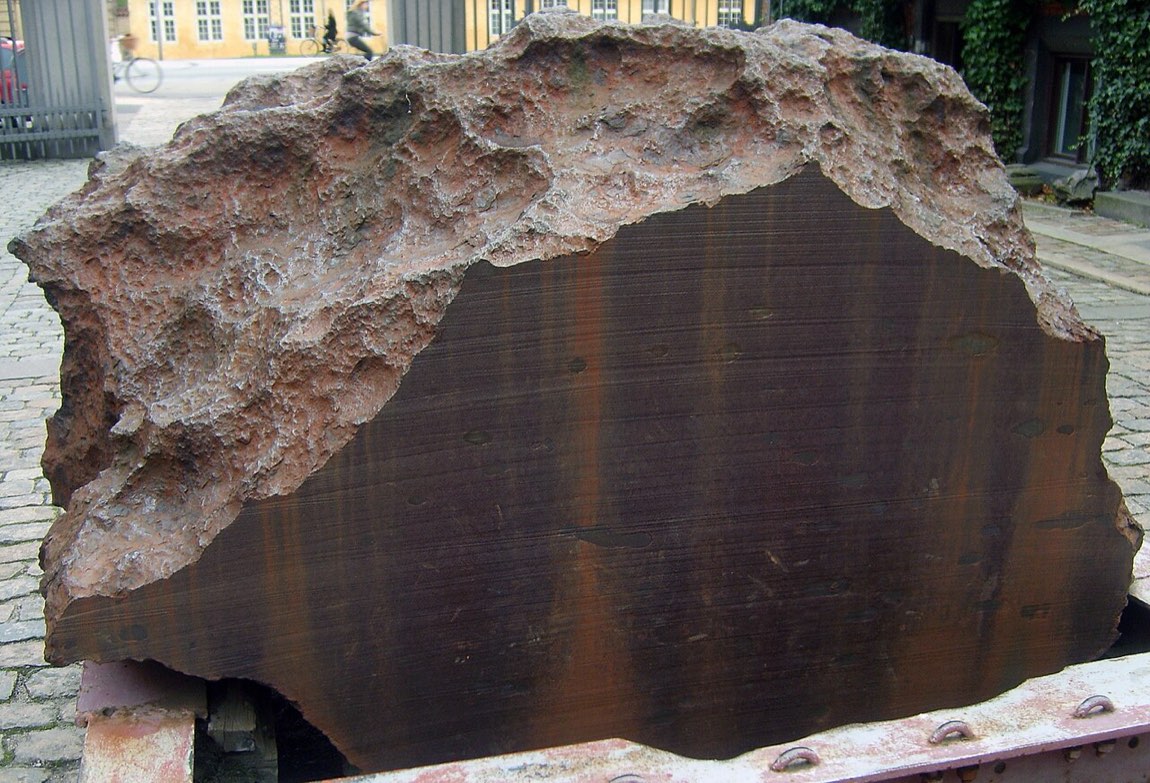
Peary's three pieces were only the beginning. In 1913 a fourth large fragment, Savik I, weighing 3.4 tonnes (7,500 lb), was found on the promontory Saveqarfik, 10 km (6 mi) east of the Woman-Dog location. Basaltic hammer stones found around it confirmed it had also been worked by earlier generations of Inuit. Wartime logistics delayed its removal; it sat until 1923–24, when it was brought down from a cliff to the shore and hauled 25 km (16 mi) across sea ice to Bushnan Island, where the ship Sokongen could collect it and sail to Copenhagen, where it arrived in 1925. In 1963, Vagn Buchwald discovered the fifth major piece, Agpalilik — also called 'the Man' — on the Agpalilik peninsula; it weighs about 20 tonnes (44,000 lb) and is now displayed at the Geological Museum of the University of Copenhagen. In 1984, hunter Jeremias Petersen found Tunorput on the east coast of Meteorite Island near the original Ahnighito site; lying just below the low-tide line, it is likely the first meteorite ever recovered from the ocean. Magnetometer surveys in 2012 and georadar surveys in 2014 found no evidence of further large buried fragments on Meteorite Island.
 ⤢
07 Iron, Nickel, and a Rare Nitride Mineral Deeper
Cape York is classified as a medium octahedrite belonging to chemical group IIIAB, one of the largest groupings of iron meteorites and thought to represent the differentiated core of a destroyed asteroid. The defining characteristic of meteoric iron is its elevated nickel content, which separates it from most terrestrial iron. Scattered through the metal matrix are abundant elongated troilite nodules — troilite being an iron sulfide mineral common in iron meteorites. Those nodules are themselves complex, containing inclusions of chromite, sulfides, phosphates, silica, and copper. Perhaps most notably, the rare nitride mineral carlsbergite (CrN) has been identified within the metal phase matrix. Graphite, which appears in many other iron meteorites, was not observed in Cape York samples. Additionally, the nitrogen isotopes in the meteorite are in disequilibrium, a detail that carries implications for understanding the conditions and history of the parent body from which Cape York originated. These compositional details place Cape York firmly in a well-studied meteorite group while still preserving a few chemical puzzles.
08 The Small Finds That Map a Hidden Strewn Field
Beyond the eight major named fragments, numerous smaller pieces and meteoritic iron artifacts have accumulated in the scientific record over more than a century. The Thule meteorite, found in 1955 by American glaciologists surveying the glacier flowing from Blue Ice Valley into the Moltke Glacier, is one of the more unusual examples. It measures 35 by 30 by 20 cm (13.8 by 11.8 by 7.9 in) in its greatest dimensions and weighs 48.6 kg (107 lb), with a distinctive narrow 'neck and head' extension about 10 by 3 by 10 cm (3.9 by 1.2 by 3.9 in) that apparently formed during atmospheric fragmentation and sculpting. In 1961, a small complete mass of just 7.8 kg (17 lb), designated Savik II, was found by Inuk hunter Augo Suerssaq at the coast 1 km (1,100 yd) east of the Savik I site. The article notes frankly that most small finds are not precisely enough located to be useful for reconstructing the full strewn field, though collectively they confirm how central this meteorite once was to Arctic material culture.
09 The Human Cost of the Peary Expedition
The story of Cape York's removal from Greenland carries a painful human dimension that the scientific record does not omit. When Peary returned to the United States with Ahnighito in 1897, he brought along six Inughuit — described as three men, one woman, a boy, and a girl — to be studied at the American Museum of Natural History. Among them was a child named Minik Wallace. Within a few months of arriving, four of the six died. Minik Wallace survived and later became the subject of significant attention as the broader story of Peary's treatment of the Inughuit came to light. Peary has received substantial historical criticism for these actions. The juxtaposition is stark: the same expedition that preserved one of the world's greatest meteorites for scientific study did so at severe human cost to the community that had lived alongside and depended on those iron stones for centuries.
 ⤢
10 A Western Search That Took Nearly 80 Years
The gap between first Western knowledge and actual discovery of the meteorite stretched nearly eight decades. In 1818, the British First Ross Expedition, led by Captain John Ross, encountered Inuit on the northern shore of Melville Bay who explained they had settled in the area specifically to exploit a nearby iron source. They gave its location a name — Sowallick, likely a reference to Savilik, meaning 'with knife' in Greenlandic — but bad weather and sea ice stopped Ross from investigating. He correctly concluded the described iron rocks were meteorites and bought several tools with meteoritic iron blades as evidence. Over the following decades, Britain, Sweden, and Denmark all mounted expeditions that failed to find the source. A promising candidate briefly emerged in 1870 when Nordenskiöld located a large iron mass at Ovifak on the south coast of Disko Island, but analysis showed it was of terrestrial origin. The Sowallick irons were eventually dismissed as meteorites entirely — until Peary's successful 1894 visit finally settled the question.