 Photograph · Hewholooks · CC BY-SA 3.0
Galaxy · Deep guide
NGC 891 (Silver Sliver Galaxy)
Also called: Caldwell 23 · C23 · Silver Sliver Galaxy · Outer Limits Galaxy · UGC 1831 · PGC 9031
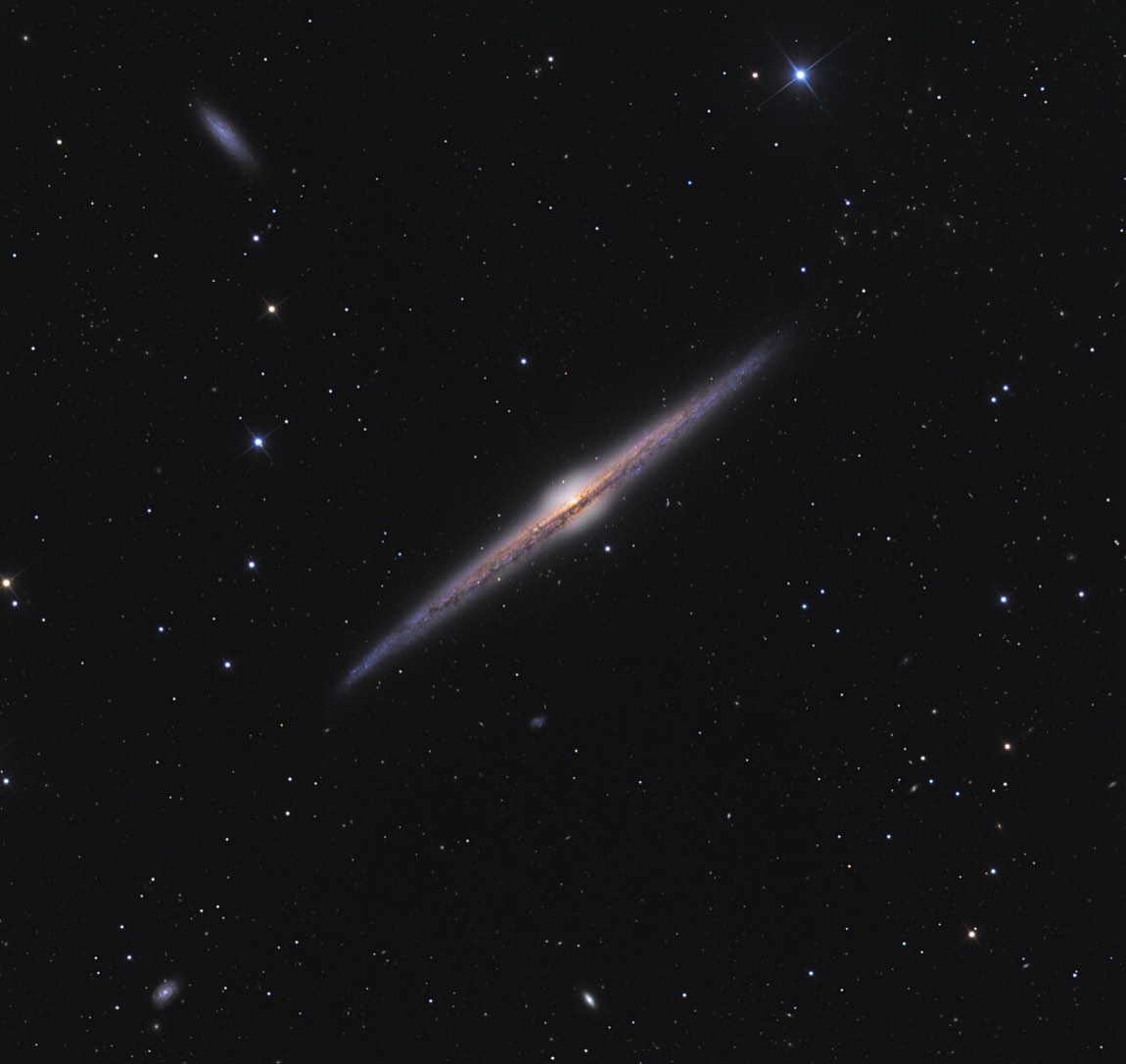
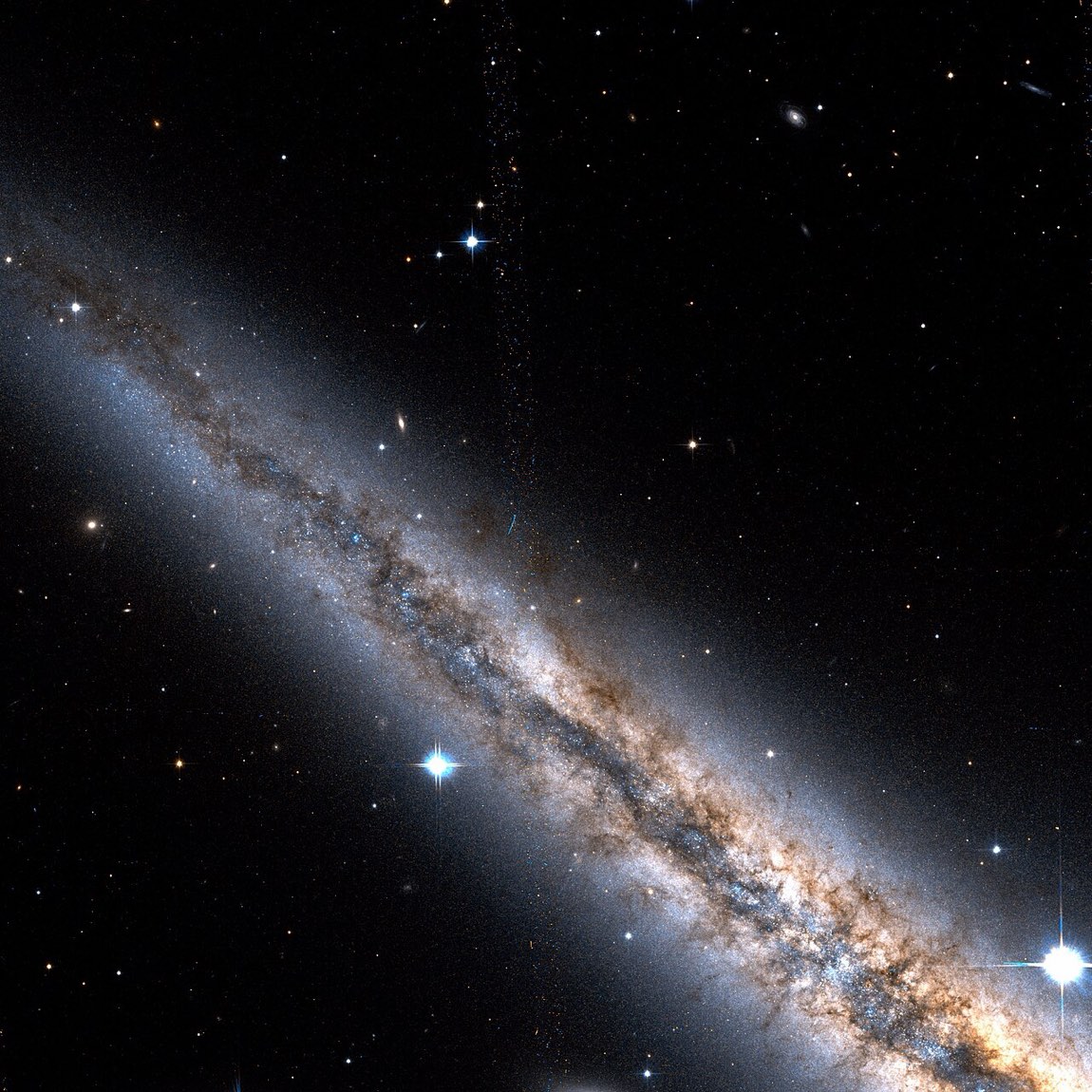
A spiral seen perfectly edge-on: a picture of how our own Milky Way might look from the side.
What is it?
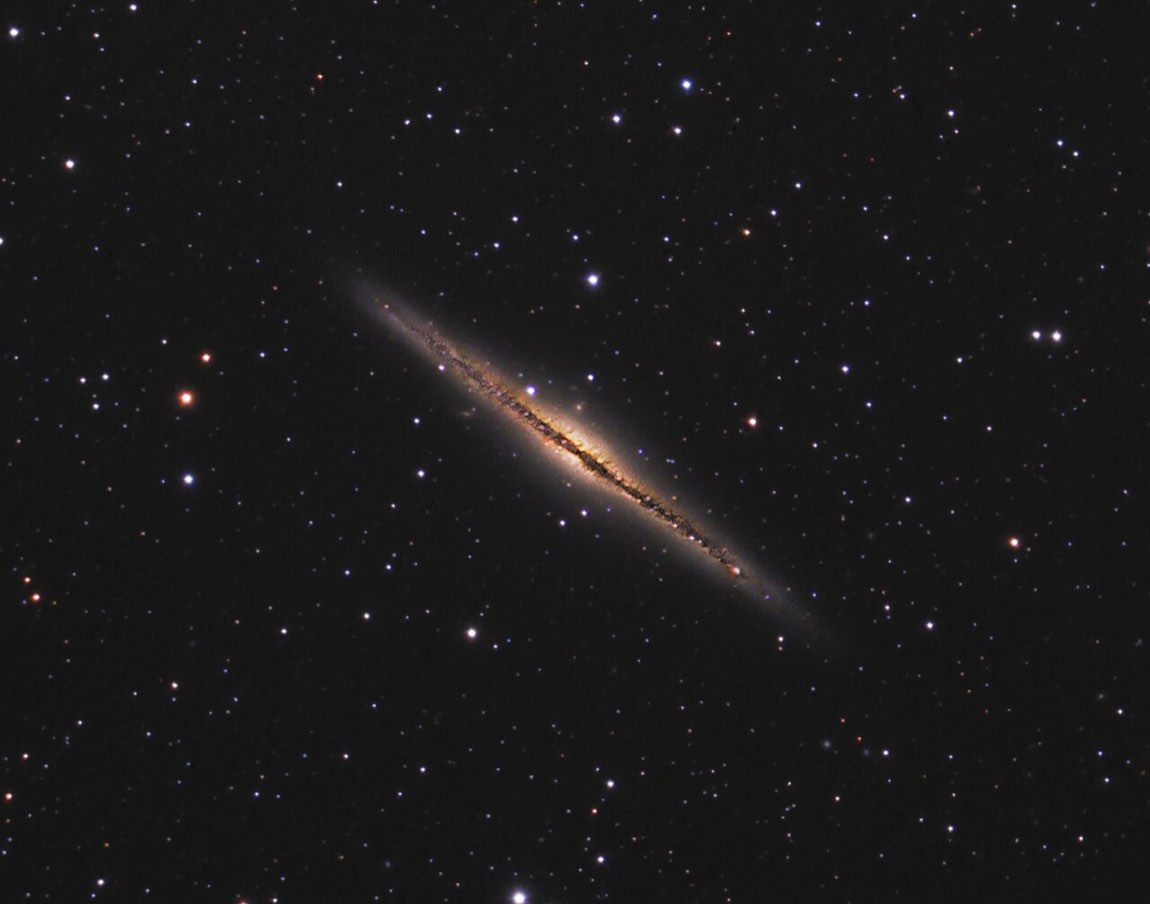
NGC 891 is an unbarred spiral galaxy in Andromeda that we see exactly edge-on, so it appears as a thin streak of light split by a dark lane of dust. Astronomers often compare it to the Milky Way, since the two are similar in brightness and size. It belongs to the NGC 1023 group of galaxies. William Herschel discovered it on 6 October 1784, and it was chosen as the first-light image for the Large Binocular Telescope in 2005.
The deep dive
Researched for the Atlas from Wikipedia — NGC 891 (3,252 characters read) · updated Nov 15, 2026
01 A Galaxy That Mirrors Our Own
NGC 891 has earned a special place in astronomy because it offers something rare: a credible mirror image of the Milky Way seen from the outside. Because it lies perfectly edge-on from our vantage point, we see its disk sliced thin like a coin, with a bright central bulge and a dramatic dark lane of dust running along its equator. Astronomers have noted that the view of our own galaxy from the Southern Hemisphere bears a striking resemblance to NGC 891 as seen through a telescope. Studies confirm that the two galaxies are genuinely comparable in both luminosity and physical size, making NGC 891 the closest real-world analogue we have for understanding what our galaxy looks like to a distant observer. Beyond aesthetics, this similarity has scientific weight: by studying NGC 891's structure in detail, researchers can test hypotheses about the Milky Way's own disk, bulge, and dust distribution without the fundamental problem of being trapped inside the system we are trying to understand.
02 The Hidden Bar at the Center Deeper
Although NGC 891 is classified as an unbarred spiral galaxy, the situation is more complicated than that label suggests. Studies of the dynamics of molecular hydrogen within the galaxy have revealed evidence pointing toward the likely presence of a central bar — the same elongated, rotating structure of stars found in roughly half of all spiral galaxies, including our own Milky Way. The classification as "unbarred" reflects what can be seen directly in optical images, where the edge-on orientation makes it virtually impossible to detect a bar visually: a bar running along the galaxy's length would be hidden in projection behind the dense disk and dust lane. The molecular hydrogen dynamics, however, betray its presence through characteristic velocity patterns. If confirmed absolutely, this would further strengthen the already close analogy between NGC 891 and the Milky Way, since our own galaxy is known to host a central bar, and it would underscore how edge-on orientations can systematically hide structural features from even careful observers.
03 Dust That Defies the Disk
One of the most striking and scientifically puzzling features revealed by high-resolution imaging is that NGC 891's dust does not stay neatly confined to its galactic disk where stars form and die. Instead, recent images show unusual filamentary patterns of dust extending outward into the halo of the galaxy — the vast, diffuse region above and below the flat disk. These filaments rise away from the galactic plane in structures that look almost like chimneys or plumes. The leading explanation is that supernova explosions, violent stellar deaths that release enormous amounts of energy, literally blast interstellar dust out of the disk and loft it into the halo. However, scientists have not ruled out a second mechanism: the cumulative light pressure from surrounding stars may also push dust grains outward. Both processes could operate simultaneously. This dust-in-the-halo phenomenon has implications for how galaxies exchange material between their star-forming disks and their surrounding spaces, and NGC 891's perfect edge-on geometry makes it one of the best laboratories in the sky for studying the effect.
04 Streams from a Swallowed Companion Deeper
The outskirts of NGC 891 are far more complex than its clean, edge-on disk suggests. Detailed surveys have revealed multiple low-surface-brightness substructures in the galaxy's outer regions — vast, coherent features described as giant streams that loop around the parent galaxy and extend to distances of approximately 50 kiloparsecs from the galactic center. To put that scale in perspective, 50 kiloparsecs is roughly 163,000 light-years, considerably larger than the visible disk itself. Surrounding both the bulge and the disk is a flat, thick, cocoon-like stellar structure with vertical distances of up to 15 kiloparsecs and radial distances of up to 40 kiloparsecs. Astronomers interpret all of these features as the remnant of a satellite galaxy that ventured too close to NGC 891 and was gravitationally disrupted — stretched, torn apart, and gradually absorbed. The process is ongoing, making NGC 891 a living example of galactic cannibalism, the same mechanism by which the Milky Way has itself grown over billions of years by consuming smaller companions.
05 The NGC 1023 Group: A Galactic Neighborhood
NGC 891 is not an isolated system. It belongs to a modest collection of galaxies known as the NGC 1023 Group, itself part of the broader Local Supercluster. The group includes a diverse set of members: NGC 925, NGC 949, NGC 959, NGC 1003, NGC 1023, and NGC 1058, as well as several galaxies catalogued under the UGC designation — UGC 1807, UGC 1865 (also known as DDO 19), UGC 2014 (DDO 22), UGC 2023 (DDO 25), UGC 2034 (DDO 24), and UGC 2259. Galaxy groups like this one are the most common environment in the universe for large spiral galaxies; they are gravitationally bound families that interact, exchange gas, and occasionally merge over cosmic timescales. The group context matters for understanding NGC 891 specifically, because gravitational interactions with companions may partly explain the disturbed outer structures — the streams and cocoon-like features — observed in its halo. The galaxy's membership in a group is therefore not merely a cataloguing detail but a physical factor shaping its ongoing evolution.
06 SN 1986J: A Stellar Death on Record
Only one supernova has been recorded in NGC 891. Designated SN 1986J, it was discovered on August 21, 1986, by astronomers J. van Gorkom, M. Rupen, G. Knapp, and J. Gunn. The event was classified as a Type IIn supernova and reached an apparent magnitude of 14, placing it at the faint end of visibility for dedicated observers but well within reach of the instruments available at the time. Type IIn supernovae are a distinctive subclass characterized by narrow hydrogen emission lines in their spectra, which indicate that the exploding star's blast wave is colliding with previously ejected material that surrounded the progenitor star before its death. This interaction makes Type IIn events among the most energetically complex supernova types to study. Because NGC 891 sits at approximately 30 million light-years, the light from SN 1986J actually left the galaxy around 30 million years before it was detected on Earth — meaning the explosion itself occurred long before humans existed. The event is the only confirmed stellar death observed in this galaxy so far.
07 William Herschel's October Discovery
NGC 891 was discovered by William Herschel on October 6, 1784, during the period when Herschel was systematically sweeping the sky and cataloguing nebulae and star clusters in unprecedented numbers. Herschel's observations were made visually, without photography or electronic detectors, relying entirely on his eye at the eyepiece of his large reflecting telescopes. At 30 million light-years, NGC 891 is a genuinely faint object, and Herschel's ability to detect it at all speaks to the quality of his instruments and observing conditions. The galaxy later received the alternate designation Caldwell 23 in the Caldwell Catalogue, a modern list of deep-sky objects compiled to complement the older Messier Catalogue. It also acquired two evocative popular names: the Silver Sliver Galaxy, referring to its thin, luminous appearance in telescopes, and the Outer Limits Galaxy, a name tied to its appearance in popular culture rather than any physical property. The object has an H II nucleus, meaning its central region contains ionized hydrogen gas, a marker of ongoing or recent star formation activity at the core.
08 How to Find and Observe NGC 891
For amateur astronomers, NGC 891 sits in the constellation Andromeda and is accessible from mid-northern latitudes during autumn evenings. The article notes that the object is visible in small to moderate telescopes as a faint elongated smear of light — the "sliver" appearance that inspired its popular name. The dust lane that runs along the galaxy's midplane, one of its most scientifically important features, only becomes visible in larger aperture instruments, where greater light-gathering ability reveals the contrast between the bright disk and the dark absorbing lane. Dark skies are essential: at a distance of roughly 30 million light-years, NGC 891 has a low surface brightness despite spanning a noticeable length on the sky, and any light pollution will wash it out quickly. Its edge-on orientation, while scientifically invaluable, makes it appear more like a needle than the classic spiral pattern many observers expect. Experienced observers often describe the view as one of the most rewarding in the autumn sky precisely because of its stark, minimalist appearance and the knowledge of the complex structure hidden within it.
09 First Light for Two Major Telescopes Deeper
NGC 891 holds an unusual distinction: it has served as the "first light" test image for not one but two significant professional telescopes. In 2005, it was selected as the first light image of the Large Binocular Telescope — a choice the article attributes explicitly to NGC 891's attractiveness and scientific interest, suggesting it was considered both photogenic and scientifically meaningful enough to represent the new instrument's capabilities to the world. Then in 2012, it was used again as the first light image of the Lowell Discovery Telescope, captured with the Large Monolithic Imager. First light images are ceremonially and practically important milestones in telescope commissioning: they represent the moment when a new instrument first opens its eye to the sky, and the target chosen is meant to demonstrate the instrument's resolution, sensitivity, and imaging quality. The repeated choice of NGC 891 for this role underscores how well its combination of a sharp dust lane, extended halo, and bright elongated disk stress-tests an imaging system. Earlier, in 1999, the Hubble Space Telescope had imaged the galaxy in infrared, adding another layer of observational history to this frequently revisited target.
10 NGC 891 in Music and Television
Few galaxies have accumulated as much cultural presence as NGC 891. Its most visible pop-culture connection is its appearance in the end credits of the Outer Limits television series, where it was shown alongside several other famous galaxies including the Andromeda Galaxy, the Sombrero Galaxy, the Pinwheel Galaxy, M81, NGC 5128, NGC 1300, and M67 — a gallery of galactic imagery that apparently left enough of an impression to give NGC 891 its alternative name, the Outer Limits Galaxy. In 1974, the same year as important space-era cultural production, two separate musical works referenced the galaxy by name. The soundtrack of John Carpenter's film Dark Star features a muzak-style instrumental piece titled "When Twilight Falls on NGC 891." In the same year, Edgar Froese released his first solo album, Aqua, which included a track called "NGC 891" on its second side. That second side carried an additional distinction: it was a rare commercially issued recording made using the artificial head system, an early binaural audio technique. It is striking that a relatively obscure edge-on galaxy roughly 30 million light-years away inspired creative works across film, music, and television within the same decade.
 ⤢