 Photograph · Ken Crawford · CC BY-SA 3.0
Galaxy · Deep guide
The Needle Galaxy (NGC 4565)
Also called: Caldwell 38 · C38 · NGC 4565 · Flying Saucer Galaxy · Berenice's Hair Clip · UGC 7772 · PGC 42038
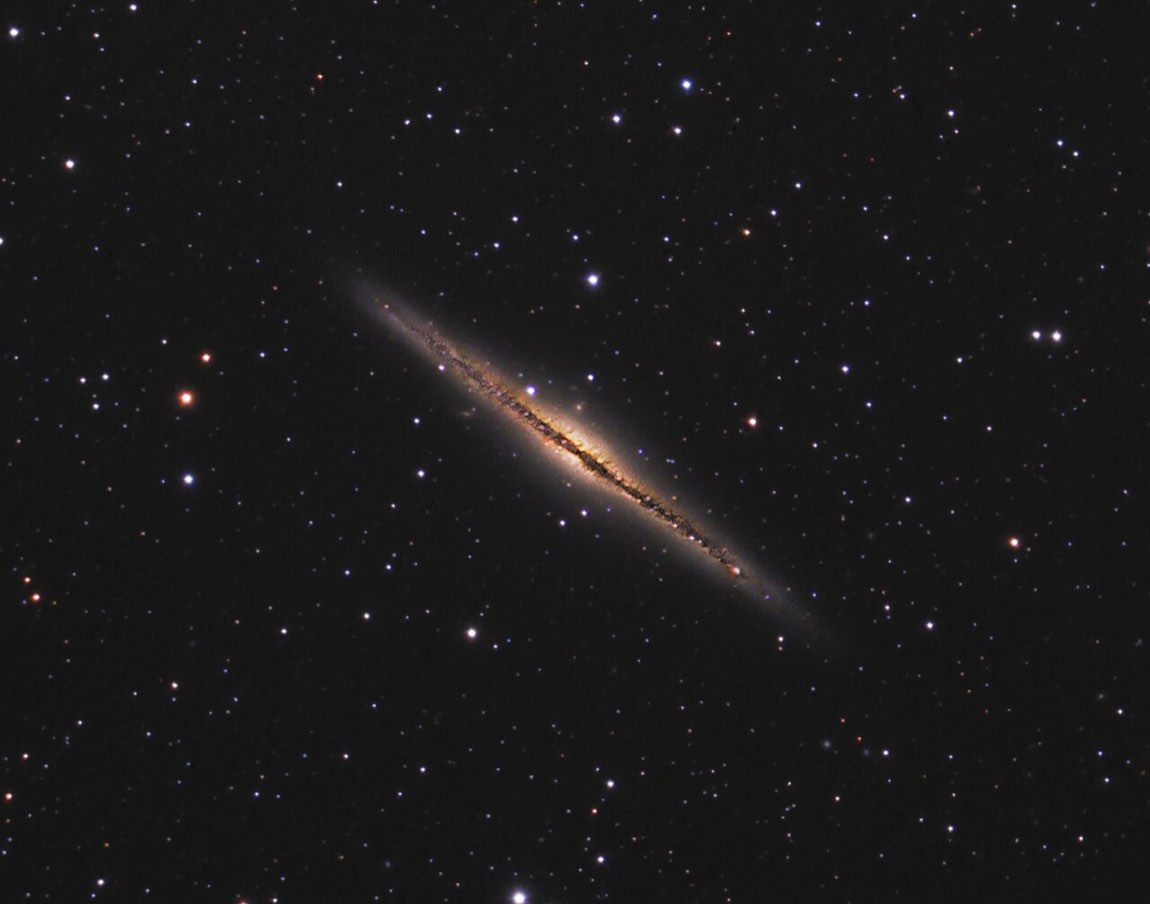
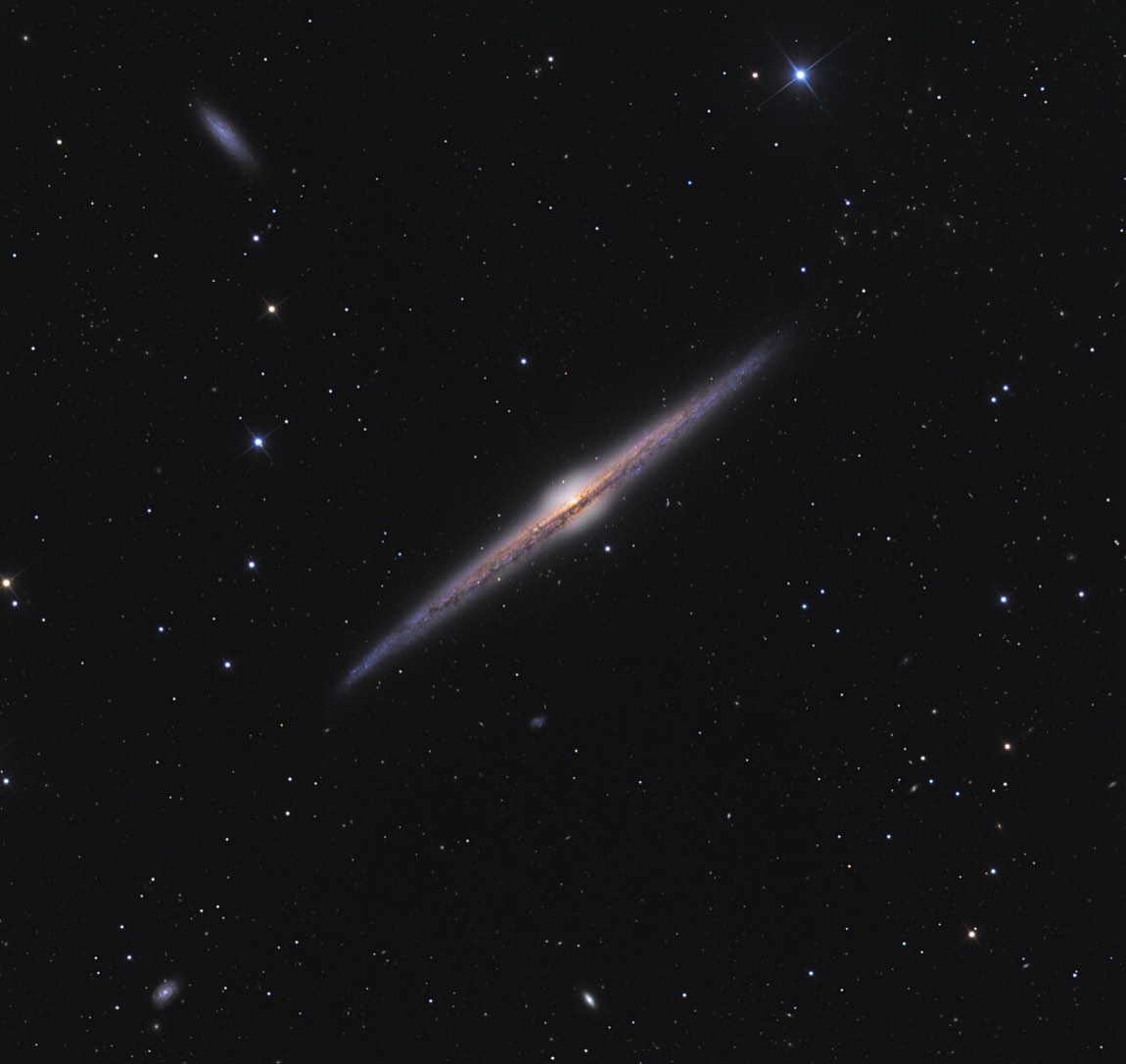
A giant spiral turned exactly edge-on, thin as a needle across the sky.
What is it?
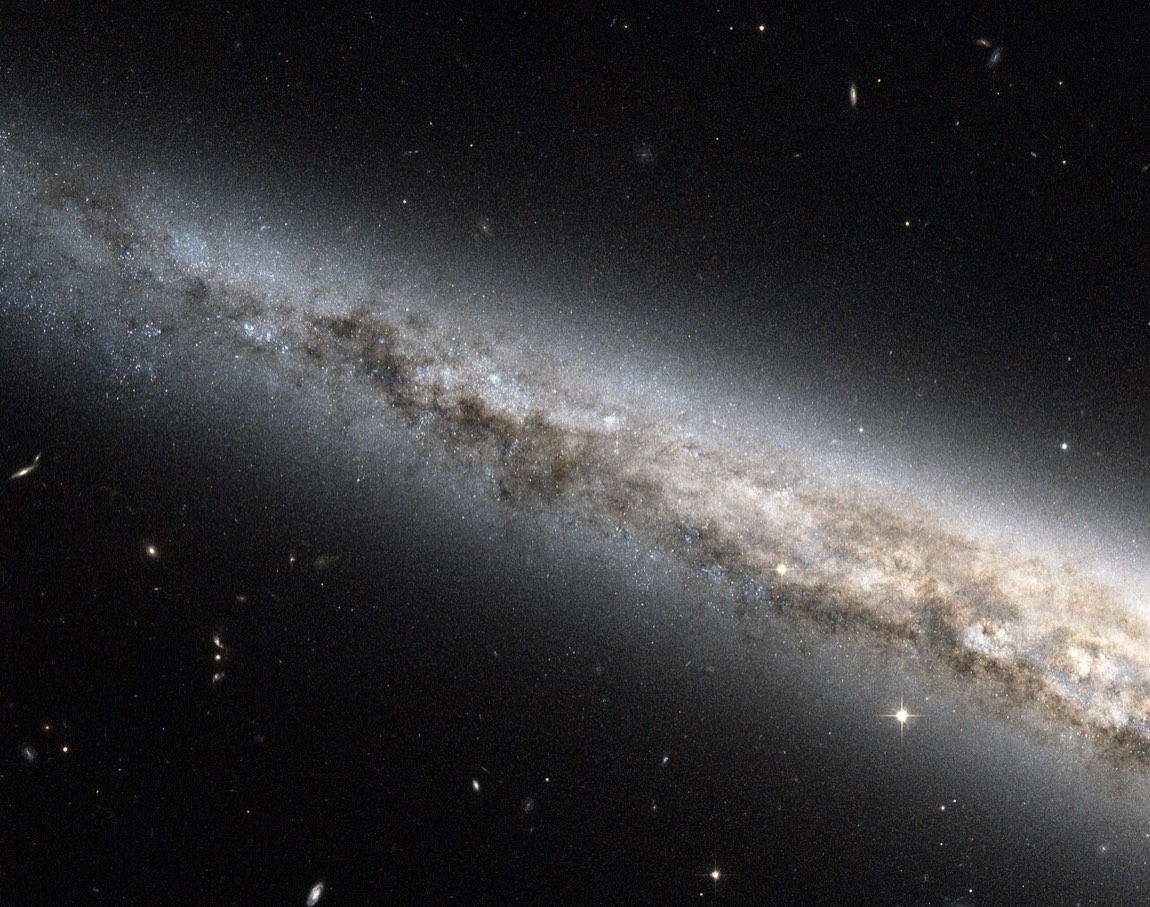
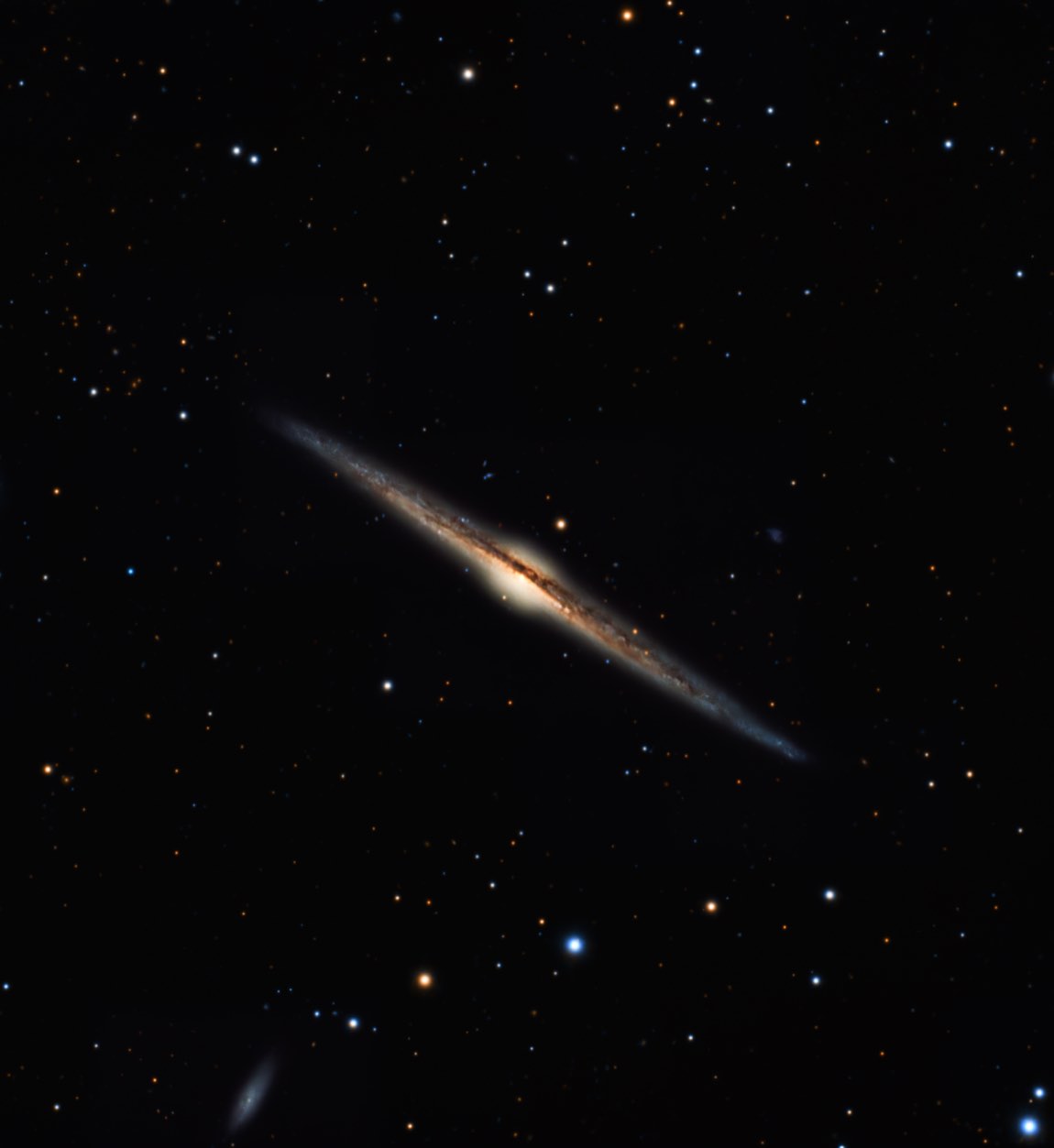
NGC 4565 is a giant spiral galaxy in Coma Berenices that we see edge-on, so it looks like a slender needle of light with a dark dust lane down its length. It is more luminous than the Andromeda Galaxy. Spitzer Space Telescope observations showed that it has a central bar and an inner ring, hidden from a side-on view. It lies roughly 30 to 50 million light-years away, close to the north galactic pole, and William Herschel discovered it on 6 April 1785.
The deep dive
Researched for the Atlas from Wikipedia — NGC 4565 (3,014 characters read) · updated Nov 15, 2026
01 A Galaxy More Luminous Than Andromeda
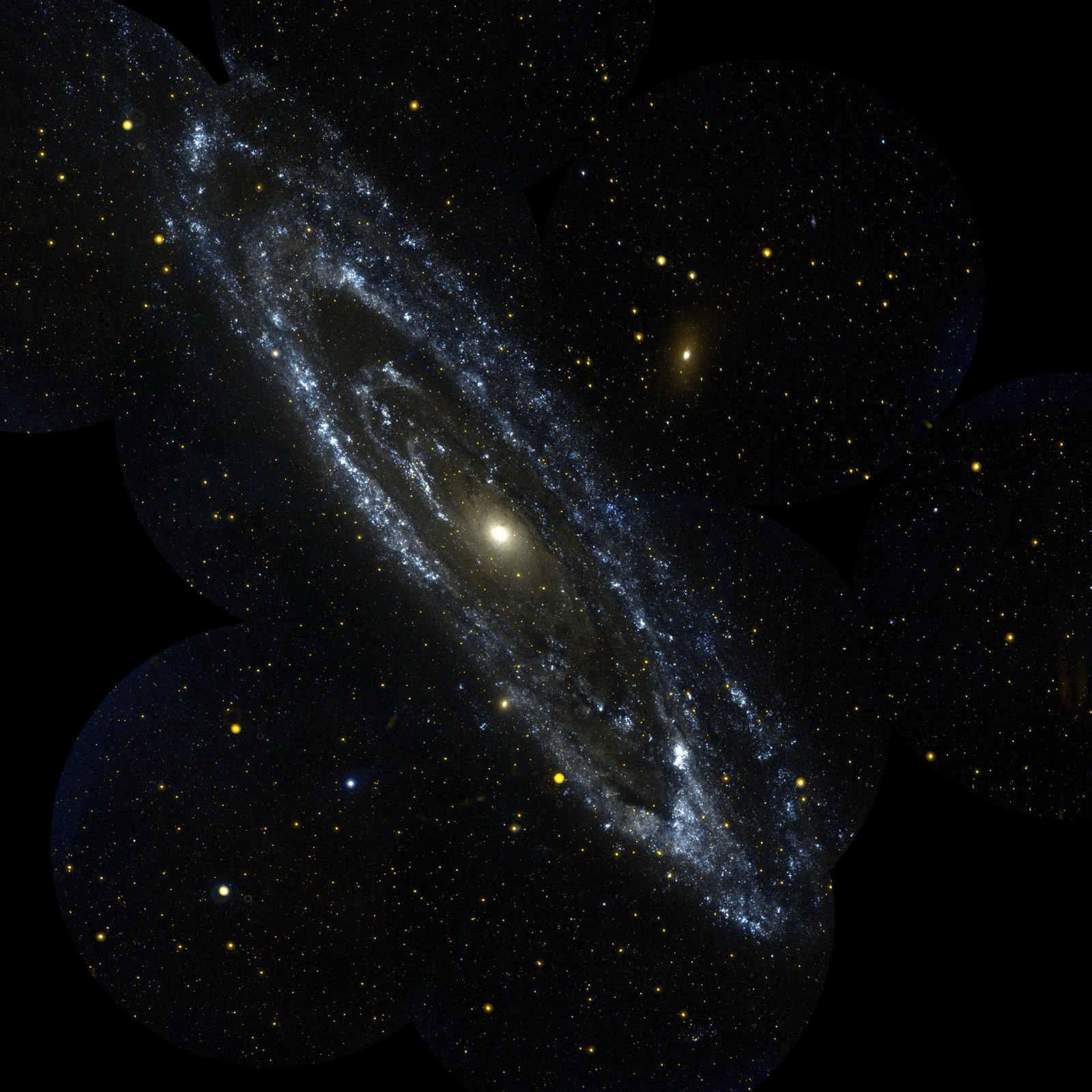
It is easy to assume that the Andromeda Galaxy, our nearest large galactic neighbor and a titan of the Local Group, sets the standard for spiral galaxy brightness. NGC 4565 quietly surpasses it. Despite being viewed edge-on and therefore having its full disk light compressed into a razor-thin line across the sky, the Needle Galaxy is intrinsically more luminous than Andromeda. That distinction matters because luminosity is a rough proxy for the total mass of stars a galaxy has assembled over its lifetime. Seeing such a powerhouse nearly perfectly side-on is both a gift and a complication for astronomers: the edge-on orientation makes it a spectacular showpiece for studying disk structure, dust lanes, and halos, but it also scrambles attempts to map the galaxy's spiral arm pattern directly. What we can say is that the Needle's brightness places it among the more impressive spiral galaxies within tens of millions of light-years, a fact that is easy to underestimate when looking at its slender, needle-like silhouette.
02 The Hidden Bar and Pseudobulge Within Deeper
For years astronomers debated the nature of the bright central bulge that pokes above and below the Needle Galaxy's dust lane like a glowing knot. Photometric data alone — measuring how brightness falls off with distance from the center — could not settle whether the bulge was a classical pressure-supported structure or something more exotic. Its exponential brightness profile was an early hint that something unusual was going on, suggesting a barred spiral rather than a pure elliptical bulge. Confirmation came from observations with the Spitzer Space Telescope, whose infrared eyes could peer through the dust that obscures the core at visible wavelengths. Spitzer not only confirmed the presence of a central bar but also revealed a pseudobulge nested inside it, along with an inner ring. A pseudobulge is a disk-like structure that grows slowly through internal secular processes — gas funneled inward by the bar — rather than through the violent mergers that build classical bulges. Finding all three features together (bar, pseudobulge, and inner ring) in a single edge-on galaxy makes NGC 4565 a compelling case study in how galaxies reshape themselves from the inside out over billions of years.
03 A Warped and Flaring Radio Halo Deeper
Beyond its visible disk, the Needle Galaxy hosts an unseen structure that only modern radio telescopes can reveal: a diffuse radio halo detected by astronomers at the University of Hamburg using the LOw-Frequency ARray, known as LOFAR. Radio halos are produced by cosmic ray electrons spiraling through a galaxy's magnetic field, emitting synchrotron radiation at frequencies far below what the human eye can detect. Within this halo, LOFAR observations uncovered a warp in the radio continuum that mirrors the galaxy's known neutral hydrogen warp seen in HI observations. More strikingly, the halo shows a slight flaring — it puffs out near the warped edges — and the vertical intensity profiles are asymmetric on opposing sides, consistent with the geometry of the warp itself. Astronomers interpret the flaring as a direct consequence of the warp's shape rather than an independent phenomenon. The cosmic ray electrons responsible for this emission carry a spectral age of roughly 130 million years, meaning they were accelerated into the warp region over that span of time. This sets a minimum age for the warp itself: it has been bending the galaxy's outer disk for at least 130 million years.
04 Clues to a More Turbulent Recent Past
The radio halo discovered by LOFAR does more than map the galaxy's magnetic landscape — it carries a message about NGC 4565's recent history. The spectral age of the cosmic ray electrons, approximately 130 million years, suggests the galaxy may be in the aftermath of a period of more intense star formation. Vigorous star formation pumps energy into a galaxy's halo through supernova explosions and stellar winds, accelerating cosmic ray electrons and inflating the radio halo. The likely trigger for that burst is gravitational interaction with one or both of the Needle's satellite galaxies. Supporting this interpretation is a bridge of neutral hydrogen gas, an HI bridge, detected stretching from NGC 4565 to its satellite IC 3571. Gas bridges between galaxies are among the clearest signs of a recent gravitational encounter, because tidal forces during a close pass can strip gas from one system and string it between the two galaxies. In cosmic terms, 130 million years is not very long at all — roughly the time since the late Jurassic period on Earth — suggesting that whatever gravitational drama unfolded between the Needle and its companions is still echoing through the galaxy today.
 ⤢
05 Satellite Galaxies and the Coma I Group
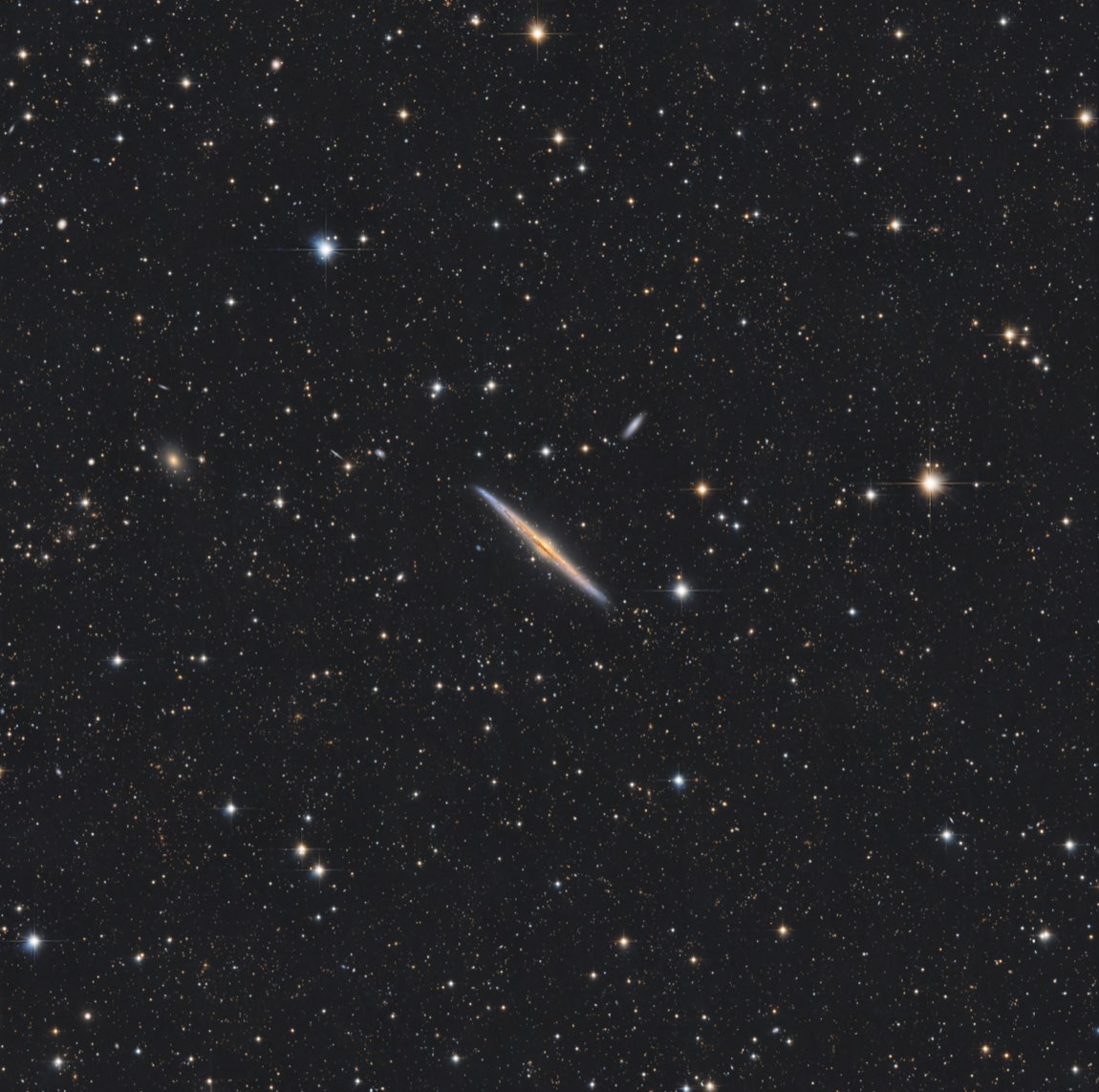
NGC 4565 is not alone in its corner of the universe. It hosts at least two confirmed satellite galaxies, NGC 4562 and IC 3571, and at least one of those satellites is actively interacting with the Needle now. The galaxy is also one of the brightest members of the Coma I Group, a loose association of galaxies in the direction of Coma Berenices. Within that larger context, NGC 4565 shares a subgrouping cataloged as Holm 426, which includes NGC 4562, IC 3543, and IC 3546. This grouping was first noted by Erik Holmberg in his 1937 work, A Study of Double and Multiple Galaxies Together with Inquiries into some General Metagalactic Problems — a remarkably comprehensive survey for its era. The gravitational environment that the Coma I Group provides, with multiple galaxies tugging on one another over billions of years, is likely what has sculpted the Needle's warped disk. Edge-on spirals like NGC 4565 are particularly useful for studying how group membership affects disk morphology, because the warping that results from tidal interactions is especially visible when you look at a disk from the side rather than face-on.
06 A Globular Cluster Population Richer Than the Milky Way's
Surrounding NGC 4565 is a swarm of roughly 240 globular clusters — ancient, densely packed balls of stars that orbit a galaxy's halo like loyal retinue. That count exceeds the Milky Way's own globular cluster population, which numbers around 150 to 160 known clusters. Globular clusters are among the oldest structures in any galaxy, with many dating back to within a billion years of the Big Bang, so their total number and spatial distribution carry clues about a galaxy's assembly history. A richer population can indicate a more active merger history, since galaxies often acquire globular clusters from smaller galaxies they consume. For NGC 4565, the edge-on orientation that makes the disk so photogenic also complicates globular cluster surveys, because clusters projected in front of or behind the dusty disk can be obscured or confused with foreground stars. Despite that challenge, the confirmed count of roughly 240 already places the Needle in distinguished company and hints that its past may have involved absorbing multiple smaller systems, contributing both to its impressive luminosity and to its rich retinue of ancient stellar fossils.
07 A Possibly Faint Active Nucleus Deeper
Deep in the core of NGC 4565, the Chandra X-ray Observatory may have detected the signature of an active galactic nucleus — a supermassive black hole quietly accreting material and leaking energy in the form of X-rays. The word 'possible' carries significant weight here: scientists describe the detection as a possible weak AGN, and the finding is described as highly debated within the research community. Weak AGN are notoriously difficult to distinguish from other X-ray sources in a galaxy's nucleus, including X-ray binaries and hot diffuse gas. The edge-on orientation of NGC 4565 adds another complicating layer, since the galaxy's own dust and gas column along the line of sight can absorb and scatter X-rays, dimming and distorting any nuclear signal. If confirmed, even a weak AGN would have implications for understanding how the central supermassive black hole interacts with the pseudobulge and bar structures discovered by Spitzer. For now, the question of whether the Needle's heart is truly flickering with low-level accretion activity remains genuinely open, an honest uncertainty that underscores how much careful follow-up work even well-studied nearby galaxies still require.
08 The Galaxy's Warped Disk in Detail Deeper
NGC 4565's disk is not perfectly flat. Deep optical surveys reveal that the disk is slightly warped and extended beyond its bright inner regions, and this subtle bending is not unique to visible light. GALEX ultraviolet images show the warp at the edge of the disk more clearly than other surveys, because ultraviolet light traces young, hot stars concentrated in the outer disk where the warp is most pronounced. The LOFAR radio observations add another dimension by detecting the warp in radio continuum emission, mirroring the shape of the neutral hydrogen warp seen in HI studies. Warped disks in spiral galaxies are common and are generally understood to arise from one of several mechanisms: gravitational torques from misaligned dark matter halos, tidal interactions with nearby galaxies, or accretion of intergalactic gas arriving along a tilted trajectory. In the case of NGC 4565, the interaction with satellite galaxies is the favored explanation, supported by the HI bridge to IC 3571 and the radio halo's asymmetric structure. The warp's minimum age of approximately 130 million years, as constrained by the spectral age of cosmic ray electrons in the halo, gives the interaction a rough timestamp rather than leaving it as a purely qualitative inference.
 ⤢
09 William Herschel's Discovery in 1785
NGC 4565 was discovered by William Herschel on 6 April 1785. Herschel, a German-British astronomer perhaps best known for discovering Uranus in 1781, was at that time engaged in one of history's most systematic sweeps of the northern sky, cataloging nebulae and star clusters with homemade reflecting telescopes of unprecedented size for their era. The Needle Galaxy, with an apparent visual magnitude of approximately 9.5, is bright enough to have been within reach of Herschel's instruments, though it would have appeared as a faint sliver of light rather than the richly detailed edge-on disk that modern telescopes and cameras reveal. Herschel's catalogs laid the groundwork for the New General Catalogue published by John Louis Emil Dreyer in 1888, which assigned the object its enduring designation NGC 4565. The galaxy later entered Charles Caldwell's twentieth-century list of showpiece deep-sky objects as Caldwell 38, a catalog designed specifically to highlight beautiful objects that Messier had not included in his own famous list. That Caldwell designation reflects what generations of amateur astronomers have confirmed: the Needle is one of the most visually striking edge-on galaxies accessible to telescopes of modest size.
10 Its Many Names and What They Reveal
Few galaxies have accumulated as many affectionate nicknames as NGC 4565. The name Needle Galaxy refers to its extraordinarily narrow profile as seen from Earth — the galaxy's disk is oriented almost exactly edge-on to our line of sight, so its full width of roughly 15.8 arcminutes in one direction is paired with a mere 2.1 arcminutes in the perpendicular direction, creating the slender sliver that inspired the name. The alternative nickname Flying Saucer Galaxy highlights the same geometry from a slightly different angle of imagination: the central bulge bulging above and below the thin disk recalls a classic saucer shape. Its constellation name, Coma Berenices, also gives rise to the more whimsical names Berenice's Hair Clip, a playful reference to the constellation's mythological association with the hair of the Egyptian queen Berenice II. The catalog designation Caldwell 38 places it among the objects that British amateur astronomer Patrick Moore compiled in 1995 as a southern supplement to the Messier catalog. Each nickname captures a different quality: the precise needle of its true profile, the saucer of its silhouette, the hair clip of constellation lore, and the catalog number that organizes it within the broader human project of naming and knowing the sky.
11 Its Position Near the North Galactic Pole
NGC 4565 is located close to the North Galactic Pole, the point on the sky that sits directly above the plane of the Milky Way. This positional coincidence is scientifically convenient and visually meaningful. Because our own galaxy's disk of gas, dust, and stars is concentrated near the galactic equator, regions near the poles offer a relatively unobstructed window into deep space — fewer foreground stars, less interstellar dust absorption, and cleaner sightlines to distant objects. Observing NGC 4565 from near the North Galactic Pole means astronomers are looking at an external edge-on galaxy through one of the clearest patches of the Milky Way's own canopy. The constellation Coma Berenices, where NGC 4565 resides, is a particularly rich hunting ground for external galaxies for exactly this reason: its high galactic latitude makes it a favorite target for galaxy surveys and deep imaging programs. NGC 4565's status as one of the brightest galaxies in the Coma I Group, combined with its favorable position near the galactic pole, means it has been photographed, spectrographed, and analyzed across nearly every wavelength of the electromagnetic spectrum, from GALEX ultraviolet to Chandra X-rays to LOFAR radio frequencies.
12 How and When to Observe the Needle
With an apparent visual magnitude of approximately 9.5 and an angular size of 15.8 arcminutes by 2.1 arcminutes, NGC 4565 falls within reach of amateur telescopes under dark skies, though it rewards patience and aperture. Its surface brightness is spread across that long, thin strip, which means a small telescope will show a faint sliver rather than a resolved structure. Larger amateur instruments, in the 8-inch aperture range and above under good conditions, begin to reveal the dark dust lane cutting along the galaxy's midplane and the brighter central bulge. The galaxy's location in Coma Berenices, close to the North Galactic Pole, means it is well placed for Northern Hemisphere observers during spring evenings, when Coma Berenices rides high in the sky. Its Caldwell 38 designation marks it as one of the showpiece objects on many amateur astronomers' observing lists, alongside the Virgo Cluster galaxies that occupy the same part of the sky. Because the galaxy is edge-on, it looks fundamentally different from face-on spirals like the Whirlpool Galaxy — there are no visible spiral arms, only the compressed glow of billions of stars reduced to a celestial needle suspended against the dark.
 ⤢