 Photograph · ESO · CC BY 4.0
Galaxy · Deep guide
NGC 55 (String of Pearls Galaxy)
Also called: Caldwell 72 · NGC 55 · String of Pearls Galaxy
An edge-on southern galaxy, like a smaller cousin of the Large Magellanic Cloud.
What is it?
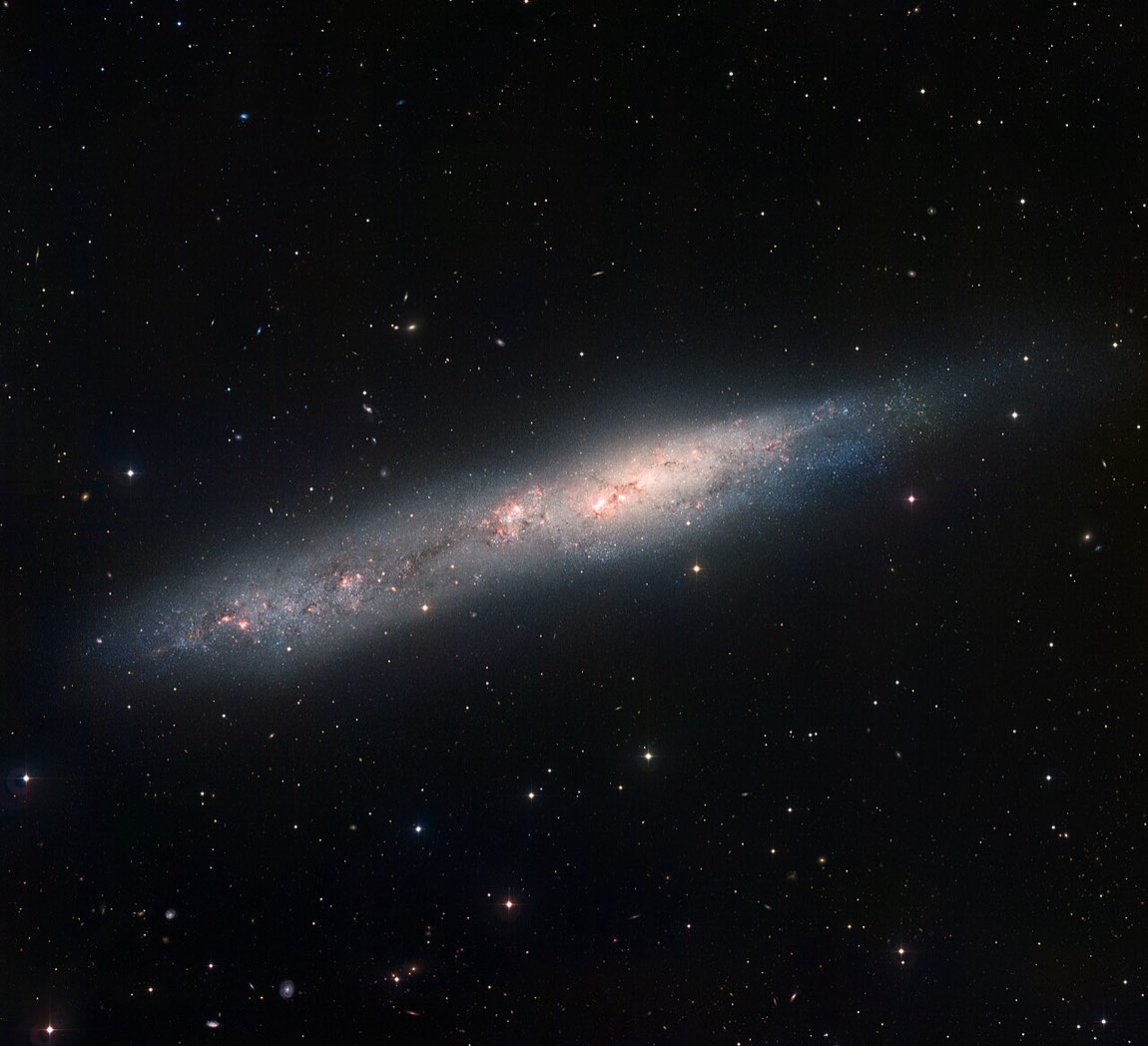
NGC 55 is a Magellanic-type barred spiral galaxy in Sculptor, seen almost edge-on. James Dunlop discovered it in 1826. Like its neighbour NGC 300, it is one of the closest galaxies outside the Local Group and probably lies between us and the Sculptor Group; the two may be a gravitationally bound pair. Its knotted, lopsided disc has been described as resembling a smaller version of the Large Magellanic Cloud.
The deep dive
Researched for the Atlas from Wikipedia — NGC 55 (1,649 characters read) · updated Nov 15, 2026
01 A Galaxy Caught Almost Edge-On
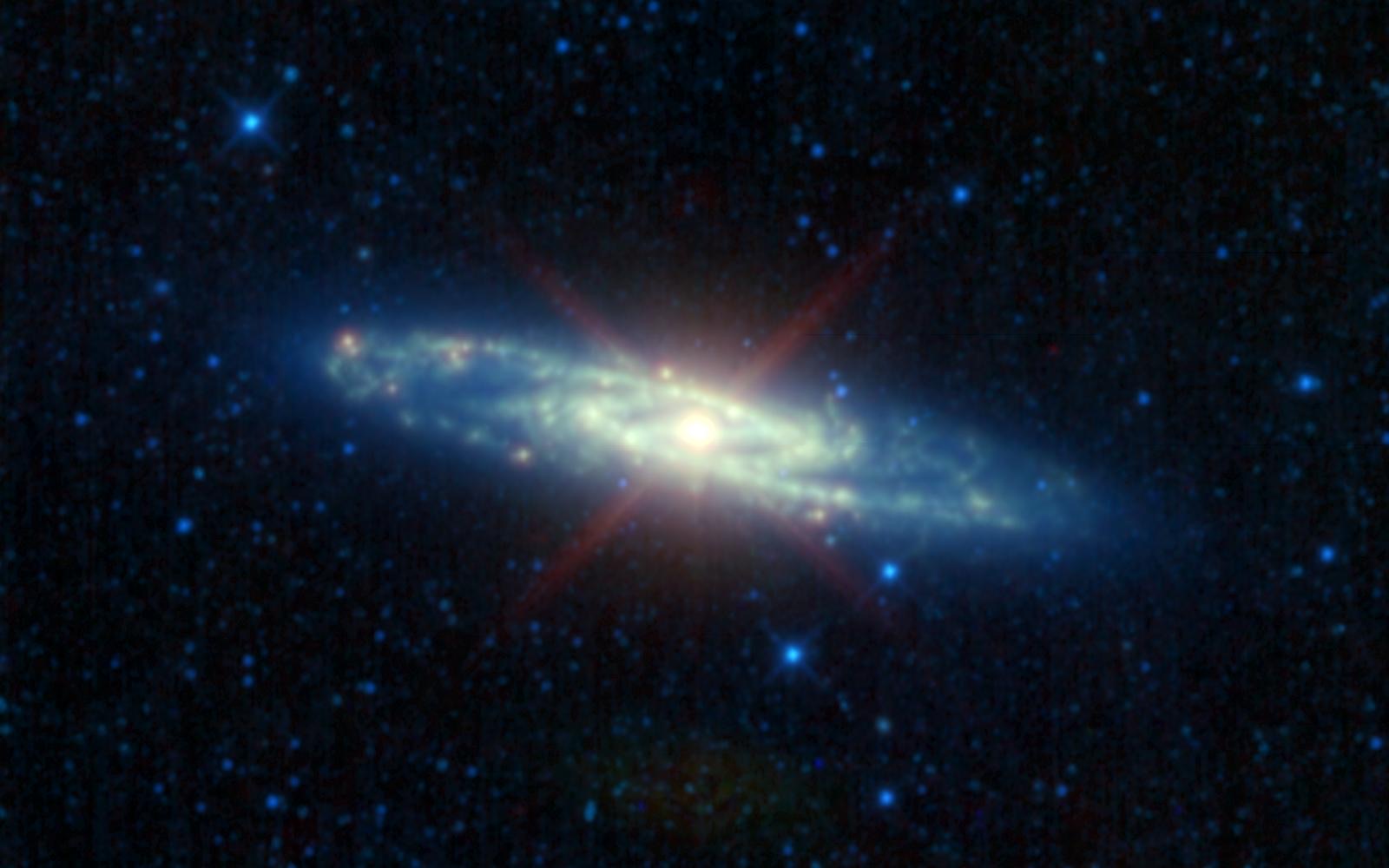
NGC 55 presents itself to observers at a nearly edge-on angle, which gives it one of its most striking qualities: its full elongated body stretches across the sky in a way that reveals internal structure difficult to see in face-on galaxies. The Webb Society Deep-Sky Observer's Handbook describes it as asymmetrical, with a diffuse, broad, and somewhat elongated bulge whose south edge appears sharp. Southeast of that bulge, the disk curves strongly and is lined with four or five faint knots — the "string of pearls" that inspired its popular name. The north edge of this curve is also described as sharp. This asymmetry is not merely an optical illusion of viewing angle; it reflects genuine structural irregularity within the galaxy itself. Burnham's Celestial Handbook ranked it as "one of the outstanding galaxies of the southern heavens," comparing it to a smaller version of the Large Magellanic Cloud. That comparison is apt: like the LMC, NGC 55 is a Magellanic type barred spiral, a classification reserved for irregular or loosely structured spirals that bear a family resemblance to the Milky Way's two irregular dwarf satellite galaxies.
02 What Kind of Galaxy Is NGC 55 Exactly?
NGC 55 is classified as a Magellanic type barred spiral galaxy, a category that places it in a middle ground between the grand design spirals familiar from textbook images and the chaotic irregular galaxies that lack any clear structure. Magellanic type spirals tend to be less massive and less symmetric than classical spirals, and NGC 55 fits that profile well. Its estimated mass is (2.0 ± 0.4) × 10¹⁰ solar masses — roughly one-fifth the mass commonly attributed to the Milky Way — making it a moderately sized system, not a dwarf but not a heavyweight either. The uncertainty of ± 0.4 × 10¹⁰ solar masses is a reminder that mass estimates for galaxies this far away carry real measurement challenges. The bar component, like bars in larger spiral galaxies, likely channels gas toward the galaxy's central regions, potentially feeding star formation. The asymmetrical appearance noted by observers adds to the picture of a galaxy whose structure has not settled into the elegant symmetry of a classic spiral, possibly reflecting its gravitational history and environment.
03 Where NGC 55 Sits in the Universe
At roughly 6.5 million light-years away, NGC 55 sits in a cosmically interesting no-man's-land. It resides in the direction of the constellation Sculptor, and for a long time it was listed as a member of the Sculptor Group, also cataloged as LGG 4. That group is one of the nearest galaxy aggregations beyond our own Local Group. However, more recent distance measurements have complicated this tidy membership: the data suggest that NGC 55 and its companion NGC 300 actually lie in the foreground, closer to us than the bulk of the Sculptor Group. This places them in a lonely stretch of space probably between the Local Group and the Sculptor Group proper — not fully belonging to either. This is not an unusual situation in observational astronomy; galaxy group assignments often get revised as distance-measuring techniques improve. The ambiguity matters scientifically because group membership affects estimates of a galaxy's environment, its merger history, and even projections of its future evolution.
04 NGC 55 and NGC 300: A Galaxy Pair
NGC 55 does not appear to wander this foreground region entirely alone. Its near-neighbor, the spiral galaxy NGC 300, shares a similar position in the sky and a comparable distance from us, and astronomers believe the two galaxies are likely gravitationally bound to each other — forming a genuine interacting pair. Pairs of galaxies are scientifically valuable because mutual gravitational influence can drive gas inflows, trigger bursts of star formation, and over billions of years lead to eventual merging. Whether NGC 55 and NGC 300 are on a path toward merger or will remain companions indefinitely is not stated definitively in current research. What is clear is that their pairing, combined with their position outside both the Local Group and the Sculptor Group proper, makes them something of an isolated binary system on the edge of our cosmic neighborhood. Studying such a pair in relative isolation — without the complicating gravitational influences of a large group — offers astronomers a cleaner laboratory for understanding how galaxy–galaxy interactions work.
05 James Dunlop's 1826 Discovery
NGC 55 was discovered on 7 July 1826 by the Scottish astronomer James Dunlop. Dunlop was working in the southern hemisphere, which gave him access to regions of sky invisible from Europe, and he cataloged numerous southern deep-sky objects that northern observers had never seen. NGC 55's position in the constellation Sculptor places it well south of the celestial equator, making it challenging or inaccessible from much of Europe and North America, so Dunlop's southern vantage point was essential to its discovery. The galaxy subsequently entered John Herschel's observational records as well — Herschel drew the eastern section of the galaxy — and eventually found its way into the New General Catalogue as NGC 55. Its popular nickname, the String of Pearls Galaxy, reflects the visual impression of the faint knots strung along its curved southeastern disk, a feature that likely struck early visual observers as much as it does modern ones.
06 Lewis Swift's Mistaken New Discovery
One of the more charming footnotes in NGC 55's history involves the American comet hunter Lewis Swift, famous for operating from New York. In September 1897, Swift observed the galaxy from Echo Mountain in California using a 16-inch refractor. He spotted the galaxy's faint eastern section and, apparently unaware that John Herschel had already drawn that same feature, logged it as a new discovery. The result was that this region of NGC 55 was entered into the Index Catalogue — the supplement to the New General Catalogue — as IC 1537, giving a single galaxy two separate catalog identities. This kind of duplicate cataloging was not rare in nineteenth-century astronomy, when communication between observers was slow and sky surveys were incomplete. Swift's error is understandable given that the eastern section of NGC 55 is described as faint, and distinguishing it as part of the same system rather than an independent object required careful comparison with prior observations. The IC 1537 designation persists in the literature as a historical artifact.
07 How Dust and Structure Shape Its Appearance Deeper
The visual description of NGC 55 contains several physically meaningful clues about its internal structure. The presence of dust near the bulge, noted by the Webb Society handbook, is consistent with what astronomers expect in a galaxy viewed nearly edge-on: dust lanes in the disk plane obscure background starlight and create the sharp-edged appearance along certain sides of the galaxy. The sharp south edge of the bulge and the sharp north edge of the southeastern curve, contrasted with the diffuse and broad character of the bulge itself, suggest that the dust is unevenly distributed — denser on one side than the other. This kind of asymmetry in dust distribution often reflects asymmetry in the underlying gas and young stellar population, since dust is produced by and associated with star-forming regions. The four or five faint knots strung along the curved southeastern section — the titular "string of pearls" — are likely regions of active or recent star formation, analogous to the bright HII regions seen in other nearby star-forming galaxies. Edge-on viewing angles make these knots stand out against the fainter diffuse background of older stars.
08 Observing NGC 55 from Earth
NGC 55 is a southern-sky object located in the constellation Sculptor, which means observers at mid-northern latitudes see it very low on the horizon or not at all. It is best observed from the southern hemisphere or from low northern latitudes where it can climb to a reasonable altitude above the horizon. Its apparent magnitude makes it accessible to small telescopes under good conditions, and its elongated, nearly edge-on shape makes it immediately recognizable once found. Burnham's description as "one of the outstanding galaxies of the southern heavens" suggests that experienced visual observers find it a rewarding target. The comparison to a smaller Large Magellanic Cloud is helpful for setting expectations: like the LMC, it has a low surface brightness spread over a relatively large angular area rather than a compact bright core. This means dark skies are more important than aperture for bringing out its full extent, and the string-of-pearls knotted structure along its disk requires attentive viewing or imaging to appreciate properly.
09 NGC 55's Place Among the Nearest Galaxies Deeper
At 6.5 million light-years, NGC 55 is not quite a member of the Local Group — which is generally considered to extend to roughly 3 million light-years — but it is close enough to be studied in considerable detail compared with more distant galaxies. Its status as one of the closest galaxies to the Local Group, sitting probably between the Milky Way and the Sculptor Group, makes it an important benchmark object. Nearby galaxies allow astronomers to resolve individual stars, measure Cepheid variable distances directly, study star-forming regions at fine physical scales, and test models of galaxy evolution in ways impossible at greater distances. The proximity of the NGC 55 / NGC 300 pair, in particular, offers the chance to compare two Magellanic-type systems at essentially the same distance, controlling for many observational variables. The ongoing question of whether these two galaxies formally belong to the Sculptor Group or are truly foreground objects is not merely a bookkeeping issue; it affects how they are incorporated into large-scale structure models of the nearby universe.
10 Open Questions and Ongoing Debates Deeper
Several genuine uncertainties surround NGC 55. The most consequential is its group membership: despite being traditionally assigned to the Sculptor Group (LGG 4), recent distance measurements suggest it and NGC 300 are foreground objects not fully part of that group. This ambiguity has not been fully resolved and continues to affect how astronomers characterize the galaxy's environment and evolutionary history. The nature of the gravitational binding between NGC 55 and NGC 300 is described as likely but not confirmed with certainty; establishing whether they are a true bound pair requires precise measurements of their relative velocities and distances. The physical origin of the asymmetry in NGC 55's structure — whether it results from past gravitational interactions, internal instabilities, or the influence of the bar — is also not explicitly resolved in available descriptions. The mass estimate of (2.0 ± 0.4) × 10¹⁰ solar masses carries a formal uncertainty that reflects the difficulty of measuring total galactic mass, including dark matter contributions, at this distance. Each of these open questions represents an active area where new observations or analysis could meaningfully shift understanding.