 Photograph · NASA/JPL-Caltech/UCLA
Galaxy · Deep guide
The Sculptor Galaxy
Also called: NGC 253
The nearest galaxy caught in a furious burst of star birth, known as the Silver Coin.
What is it?
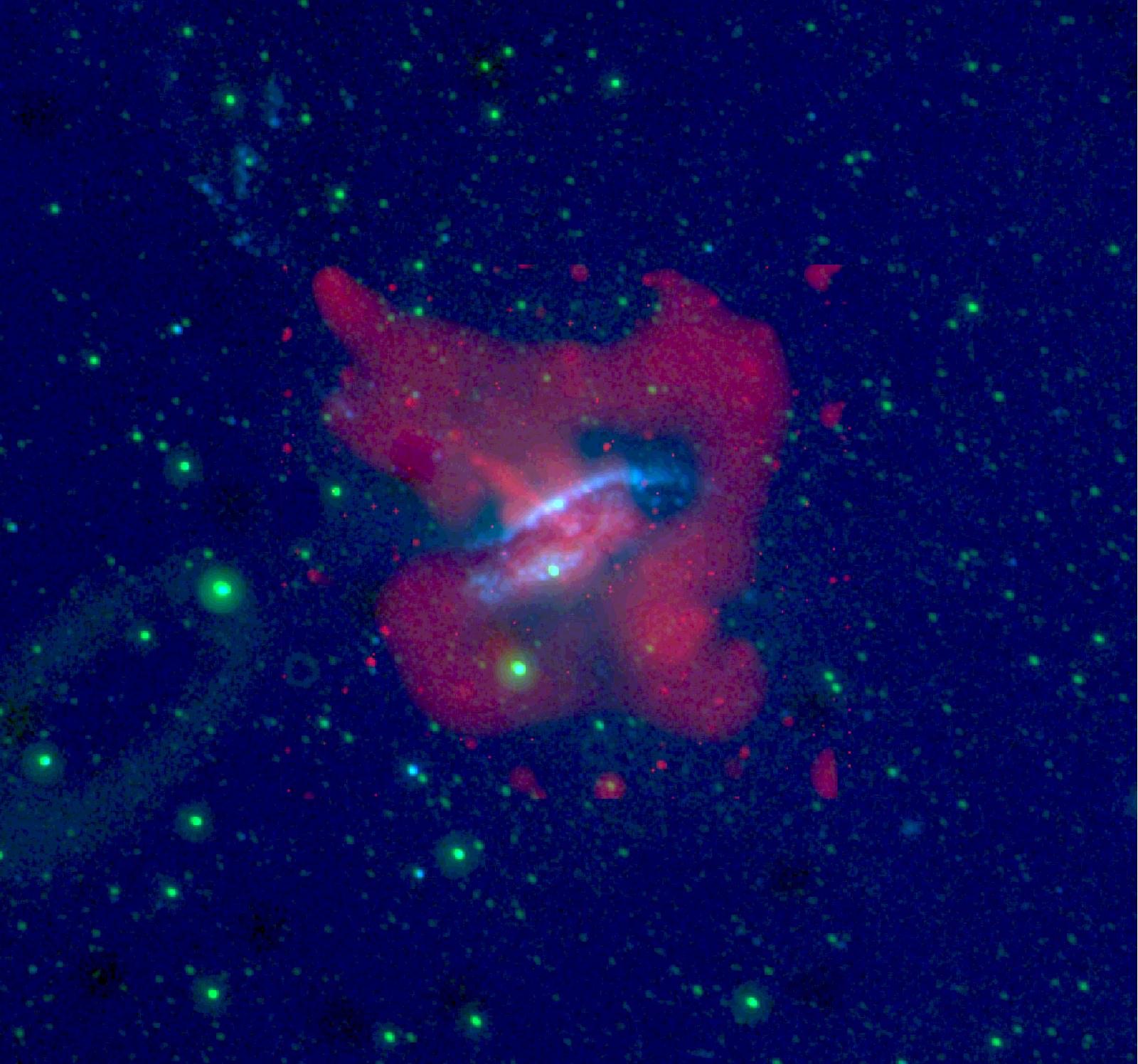
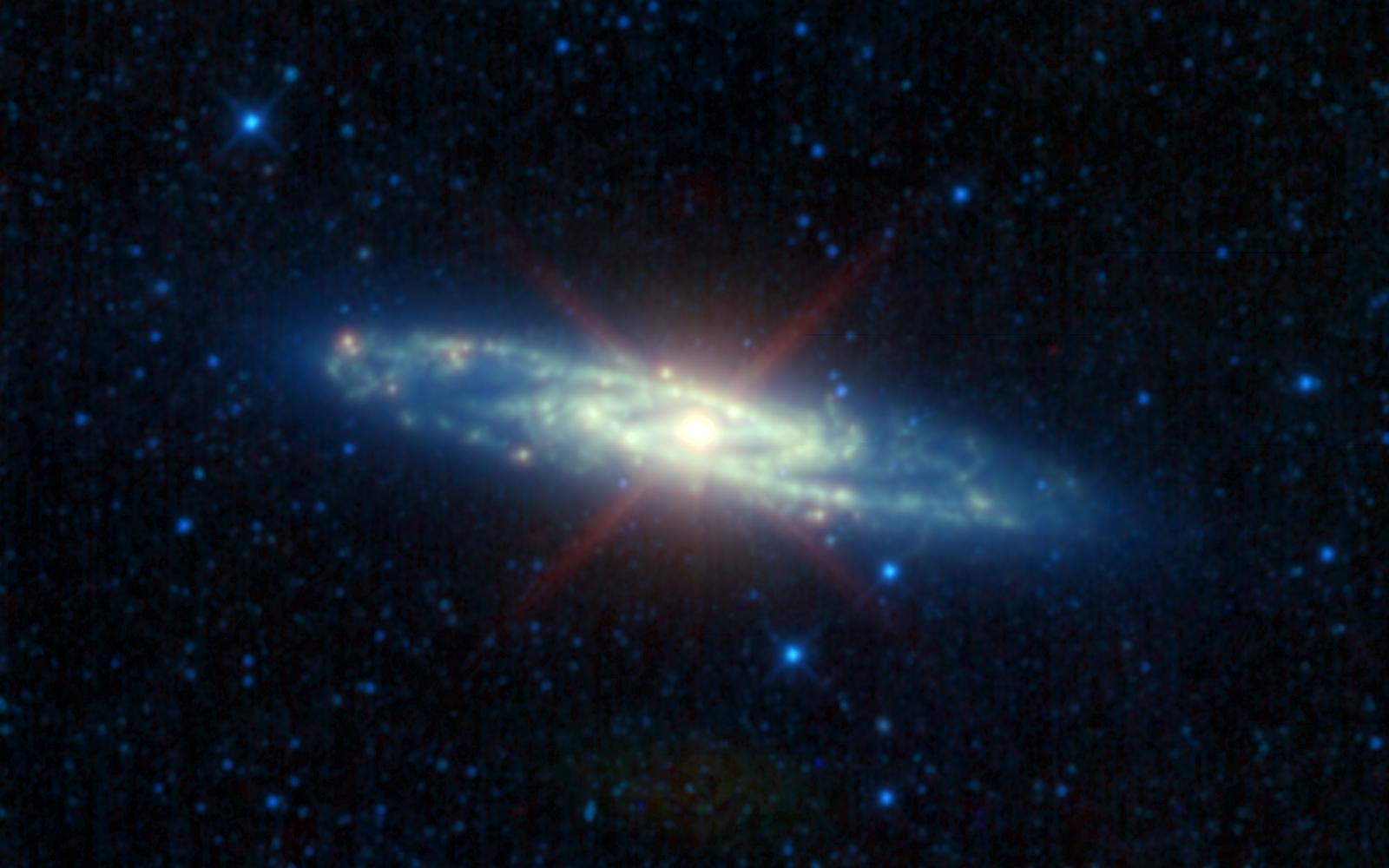
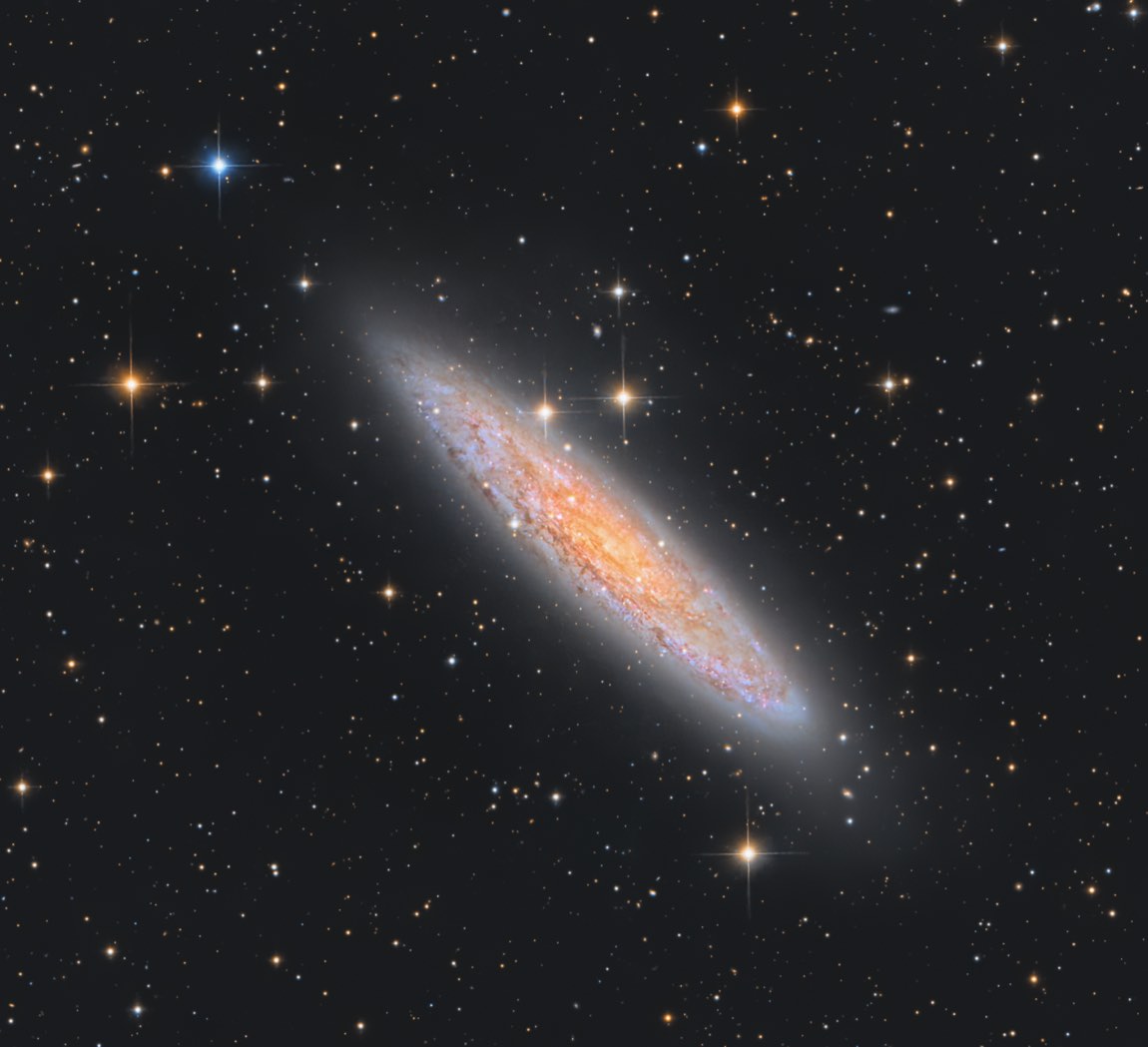
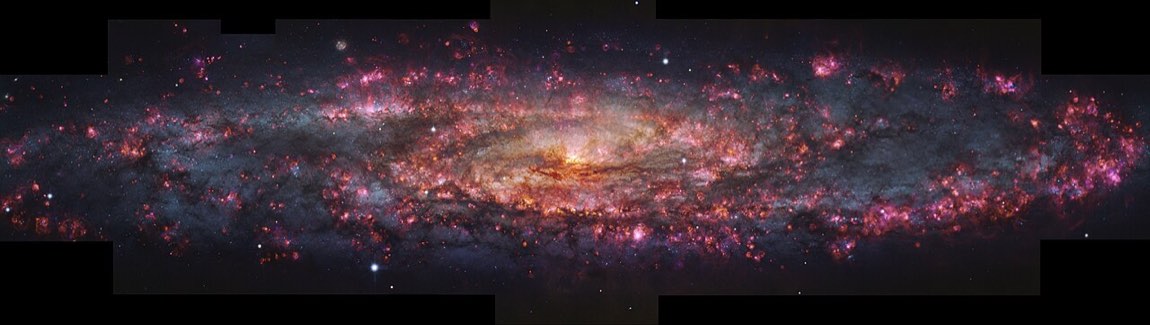
The Sculptor Galaxy (NGC 253), 11.4 million light-years away, is the closest major 'starburst' galaxy — its center is forging stars many times faster than the Milky Way, driving glowing fountains of gas out of its disk. Discovered by comet-hunter Caroline Herschel in 1783, it is bright enough for binoculars from southern skies, gleaming like a tilted silver coin.
The deep dive
Researched for the Atlas from Wikipedia — Sculptor Galaxy (8,465 characters read) · updated Sep 20, 2026
01 Caroline Herschel and the discovery
The Sculptor Galaxy was not found by a professional astronomer scanning the heavens with purpose-built equipment, but by Caroline Herschel in 1783 while she was methodically sweeping the sky for comets. That kind of systematic, unglamorous work — night after night, checking the same patches of sky — made her one of the most productive observers of her era. Years later, her nephew John Herschel turned his 18-inch metallic mirror reflector on the object from the Cape of Good Hope and was clearly impressed. He described it as "very bright and large (24′ in length); a superb object," noting that its light was "somewhat streaky" and that a handful of stars appeared near it but probably did not belong to the galaxy itself. That intuition was correct: the stars he saw are foreground objects lying between us and the galaxy, not members of it.
02 A radio source hiding in plain sight
Visible-light observations told only part of the Sculptor Galaxy's story. Working out of Sydney, astronomer Bernard Y. Mills discovered that NGC 253 is also a fairly strong radio source — a revelation that placed it in a small, energetic club of galaxies emitting powerfully across the electromagnetic spectrum. Radio emission at that level is a tell-tale sign of energetic processes: supernovae blasting shockwaves through interstellar gas, cosmic-ray electrons spiraling in magnetic fields, and the fierce stellar winds of massive young stars. For Allan Sandage, writing in the influential 1961 Hubble Atlas of Galaxies, the galaxy was already remarkable in a different way: he called it "the prototype example of a special subgroup of Sc systems" whose photographic appearance is dominated by intricate dust lanes and patches rather than cleanly defined spiral arms. Between Mills and Sandage, NGC 253 was cemented as one of the most scientifically significant nearby galaxies.
03 The anatomy of a starburst core Deeper
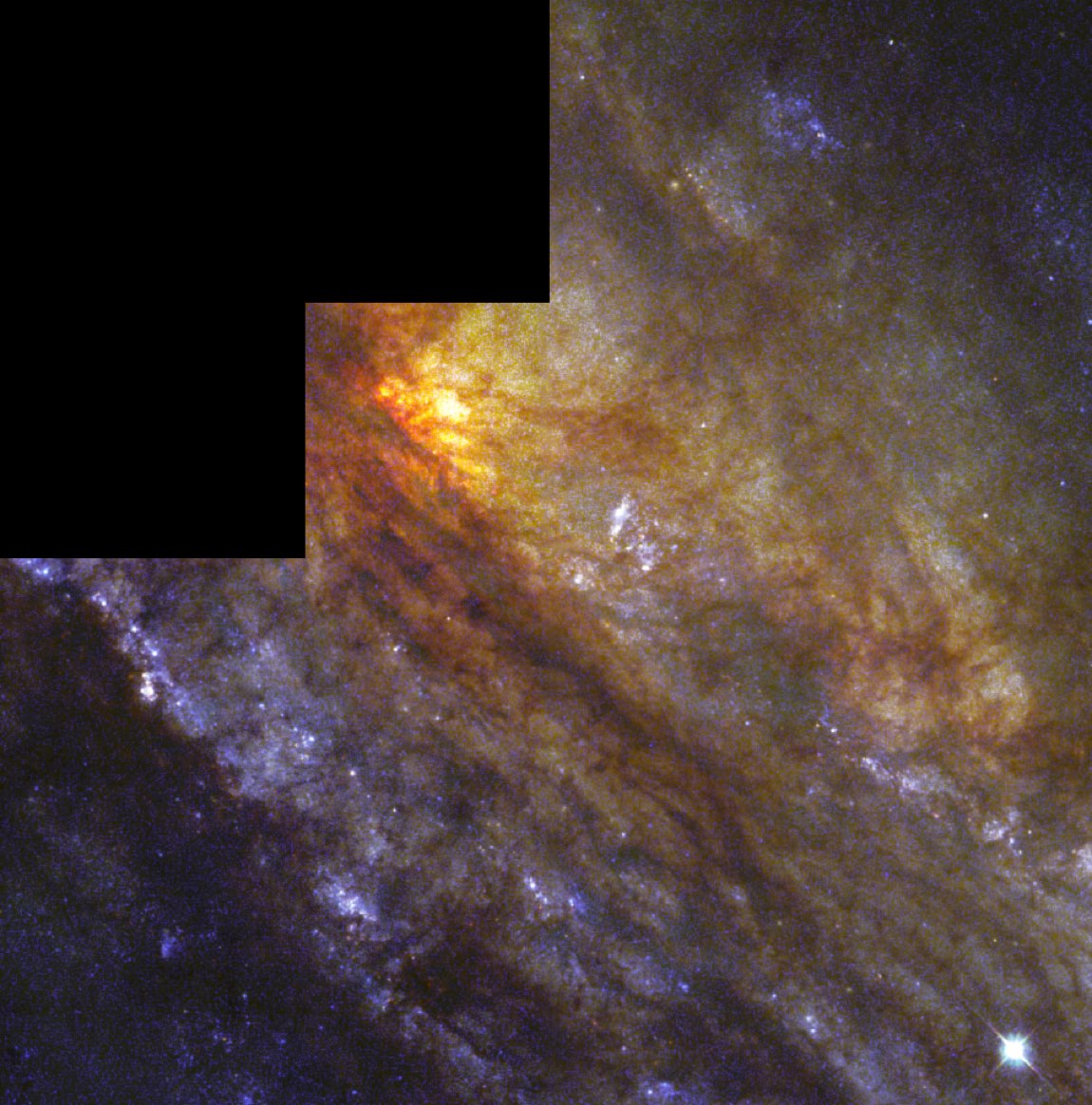
At the heart of NGC 253's starburst activity sit several super star clusters — dense, gravitationally bound swarms of stars far more massive than typical star-forming regions. Hubble Space Telescope observations revealed one cluster with a mass of 1.5×10⁶ solar masses and an absolute magnitude of at least −15, and two others massing around 5×10⁴ solar masses each with absolute magnitudes near −11. Later studies uncovered an even more massive cluster largely hidden behind NGC 253's own interstellar dust: it weighs in at 1.4×10⁷ solar masses — roughly 14 million times the mass of our Sun — and is estimated to be about 5.7×10⁶ years old, a cosmological infant. This heavily obscured cluster is rich in Wolf–Rayet stars, the brief, violent late stage of massive stellar evolution. Viewed from Earth, all these clusters appear arranged along what looks like a flat line, but in three dimensions they form an ellipse around the galaxy's nucleus.
 ⤢
⤢
04 How a dwarf galaxy lit the fuse
The Sculptor Galaxy's extraordinary rate of star formation did not ignite spontaneously. Evidence scattered across NGC 253 — young stars in the galaxy's halo, pockets of neutral hydrogen there, and unusually active star formation in the northeast of the disk where red supergiant stars cluster — all point toward a violent encounter in the relatively recent past. Astronomers believe that a gas-rich dwarf galaxy collided with NGC 253 approximately 200 million years ago. That collision disturbed the galaxy's disk and delivered a surge of fresh gas that kicked off the starburst still blazing today. Two hundred million years sounds ancient, but in galactic terms it is recent: the dinosaurs had only just appeared on Earth when this cosmic collision happened. The disrupted satellite galaxy NGC 253-dw2, identified using the Subaru Telescope, may be a related remnant — a faint dwarf that may not even survive its next close pass by its vastly larger host.
05 The superwind blowing star formation away Deeper
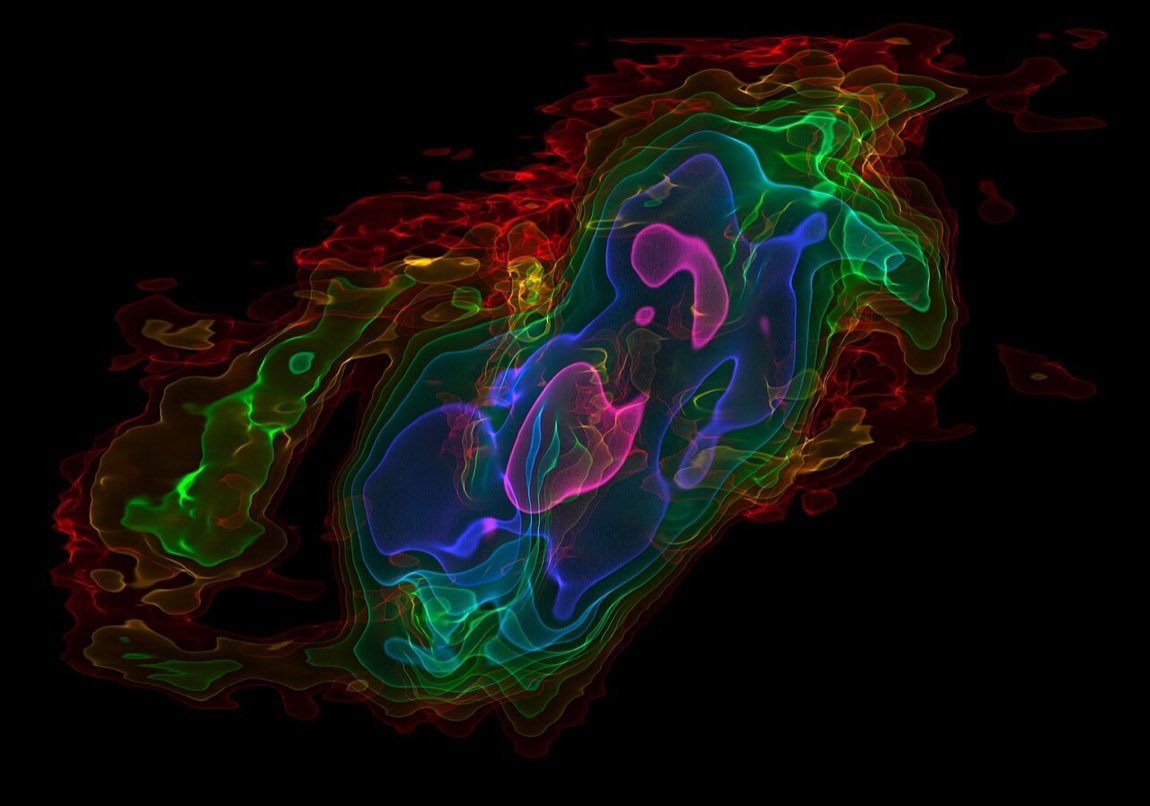
Intense star formation carries within it the seeds of its own suppression. As NGC 253 forges massive stars at a prodigious rate, those same stars generate powerful stellar winds during their lives and release enormous shockwaves when they die as supernovae. Together, these forces have driven a superwind — a large-scale outflow of gas and material — out of the galaxy's disk and into its halo. The effect mirrors what astronomers observe in other starburst galaxies such as Messier 82, NGC 4631, and NGC 4666. By evacuating gas from the central regions, the superwind is actively inhibiting further star formation in NGC 253. The galaxy is, in a sense, choking on its own productivity: the very burst of creation that defines it is simultaneously working to shut itself down. Whether this feedback loop will eventually end the starburst entirely remains an open question.
06 The supermassive black hole at the center
Like most large galaxies, the Sculptor Galaxy harbors a supermassive black hole at its core. Research estimates its mass at roughly 5 million times that of the Sun. For context, that makes it slightly more massive than Sagittarius A*, the supermassive black hole at the center of our own Milky Way, which weighs in at about 4 million solar masses. Given that NGC 253 is a starburst galaxy with a turbulent, dust-choked nucleus, pinning down the black hole's properties is observationally challenging — the very dust that makes the galaxy visually dramatic also obscures the galactic center at optical wavelengths. The relationship between the central black hole and the surrounding starburst activity is an area of active research: does the black hole influence the rate of star formation, does the starburst affect the black hole's feeding rate, or both? The article does not specify a settled answer.
 ⤢
⤢
07 Measuring the distance across 11 million light-years Deeper
Pinning down exactly how far away NGC 253 is has required multiple independent techniques, and the answers do not quite agree. Using the planetary nebula luminosity function method in 2005, researchers arrived at a distance of 10.89 +0.85/−1.24 million light-years (3.34 +0.26/−0.38 megaparsecs). A separate team applied the tip of the red giant branch method in 2004 and obtained 12.8 ± 1.2 million light-years (3.94 ± 0.37 megaparsecs). The two estimates overlap within their error bars but are not identical, reflecting genuine uncertainties in the calibration of each technique. A weighted average of the most reliable measurements gives a best current estimate of 11.4 ± 0.7 million light-years (3.5 ± 0.2 megaparsecs). To put that in perspective, 11.4 million light-years is roughly five times the distance to the Andromeda Galaxy, our nearest large galactic neighbor.
08 A nova finally confirmed in 2024
NGC 253 is close enough to Earth that individual stellar explosions smaller than supernovae — called classical novae — can be detected within it, which is unusual for galaxies beyond the Local Group. For decades, though, none had been confirmed. That changed on 12 July 2024, when the BlackGEM telescope array spotted a transient at magnitude 19.6 in the galaxy; the event was designated AT 2024pid and confirmed as the first classical nova ever detected in NGC 253. By contrast, only a single supernova has ever been observed there: SN 1940E, discovered by Fritz Zwicky on 22 November 1940 at magnitude 14.5, located approximately 54 arcseconds southwest of the galaxy's nucleus. Its type was never definitively classified. The scarcity of detected supernovae is somewhat surprising given NGC 253's vigorous star formation, and likely reflects the difficulty of seeing through the galaxy's thick dust at optical wavelengths.
09 A growing family of satellite galaxies
The Sculptor Galaxy presides over an expanding census of smaller companion galaxies. By 2020 astronomers knew of 12 satellite galaxies within its gravitational domain. Then in June 2021, Italian amateur astronomer Giuseppe Donatiello reported three more — Donatiello II, III, and IV — with Donatiello III lying approximately 340,000 parsecs from NGC 253, placing it among the outer members of the group. In August 2021, a separate professional team announced three further satellites, though one of theirs (Scl-MM-dw3) turned out to match the already-reported Donatiello II. Donatiello returned in May 2024 with five additional discoveries: Donatiello V through IX. The latest additions are notable because they weaken a previously attractive hypothesis that the satellites are arranged in a flat, coplanar disk — a configuration that has been debated for the Milky Way's own satellite system. Each new discovery refines the picture of how NGC 253 built its gravitational neighborhood.
 ⤢
⤢
10 The Sculptor Group and its cosmic neighborhood
NGC 253 does not sit in isolation; it anchors the Sculptor Group, described as one of the nearest groups of galaxies to the Milky Way. Within that group, it is the brightest member, and more broadly it ranks as one of the intrinsically brightest galaxies in our cosmic vicinity, surpassed only by the Andromeda Galaxy and the Sombrero Galaxy. The galaxy shares a gravitationally bound core with several companions: NGC 247, PGC 2881, PGC 2933, Sculptor-dE1, and UGCA 15. Most other galaxies associated with the Sculptor Group are only weakly gravitationally bound to this core, essentially drifting in its broader neighborhood without being firmly captured. Some galaxies that appear nearby in the sky — including NGC 59, NGC 625, DDO 226, and UGCA 442 — are classified as peripheral members and are not considered true satellites of NGC 253 despite sharing the same general region of sky.
11 How to see it with your own equipment
The Sculptor Galaxy rewards observers across a wide range of equipment. It is bright enough to be seen through binoculars and sits near the naked-eye star Beta Ceti, making it straightforward to locate. After the Andromeda Galaxy, it is considered one of the most easily observed spiral galaxies in the sky — a meaningful distinction given how many spirals appear as featureless smudges. A telescope with a 300 mm (about 12-inch) aperture resolves it into a galaxy with a long, oval bulge and a mottled disk; the bulge appears only slightly brighter than the disk but is noticeably extended compared to it. Step up to 400 mm (roughly 16 inches) or larger, and a dark dust lane northwest of the nucleus becomes visible, along with more than a dozen faint foreground stars superimposed on the bulge. Under exceptional conditions, some observers report glimpsing NGC 253 with the unaided eye — a remarkable feat for a galaxy lying 11.4 million light-years away.
 ⤢
⤢