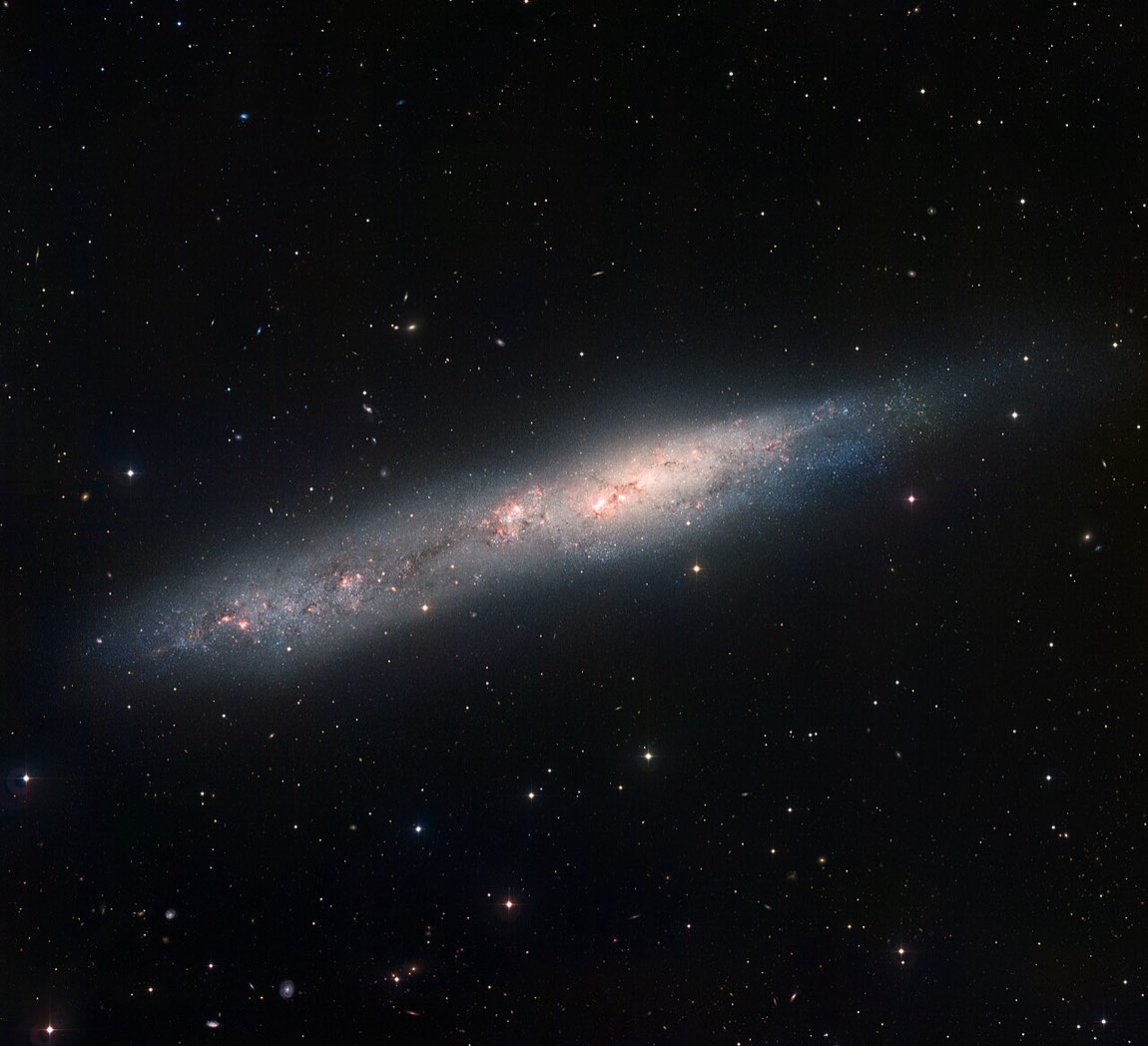
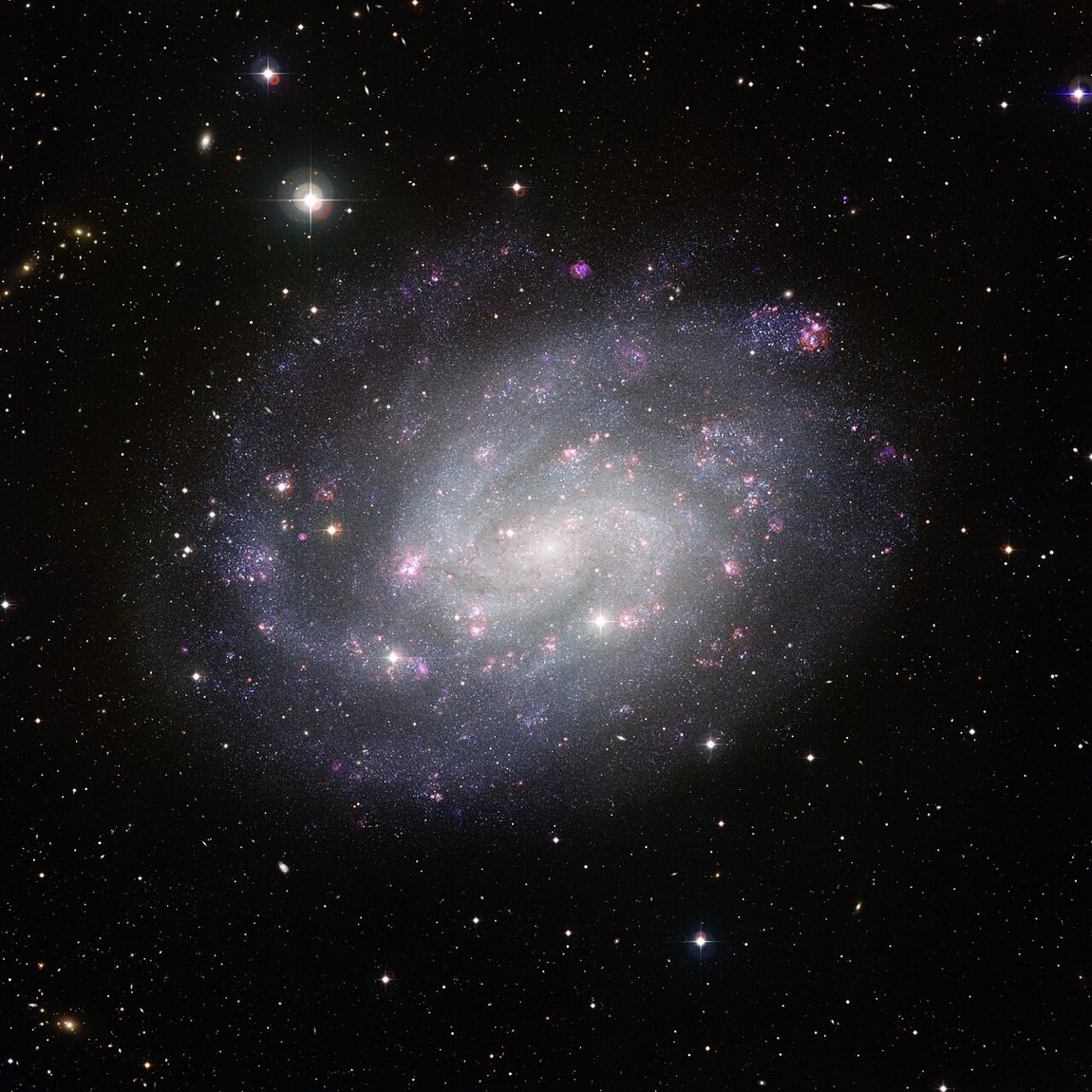
 Photograph · ESO · CC BY 4.0
Galaxy · Deep guide
NGC 300 (Sculptor Pinwheel Galaxy)
Also called: Caldwell 70 · NGC 300 · Sculptor Pinwheel Galaxy
A face-on southern spiral, a near twin of the Triangulum Galaxy.
What is it?
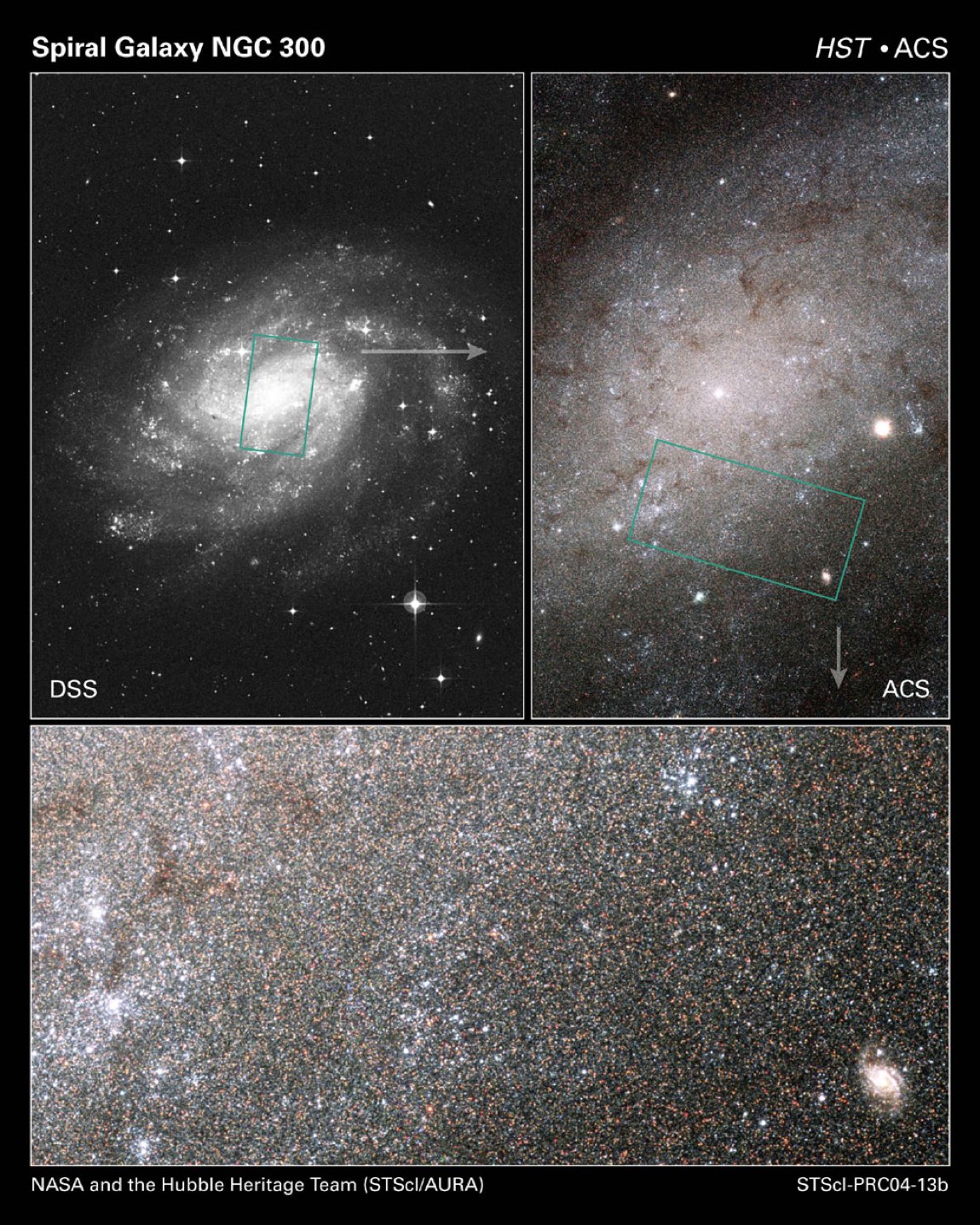
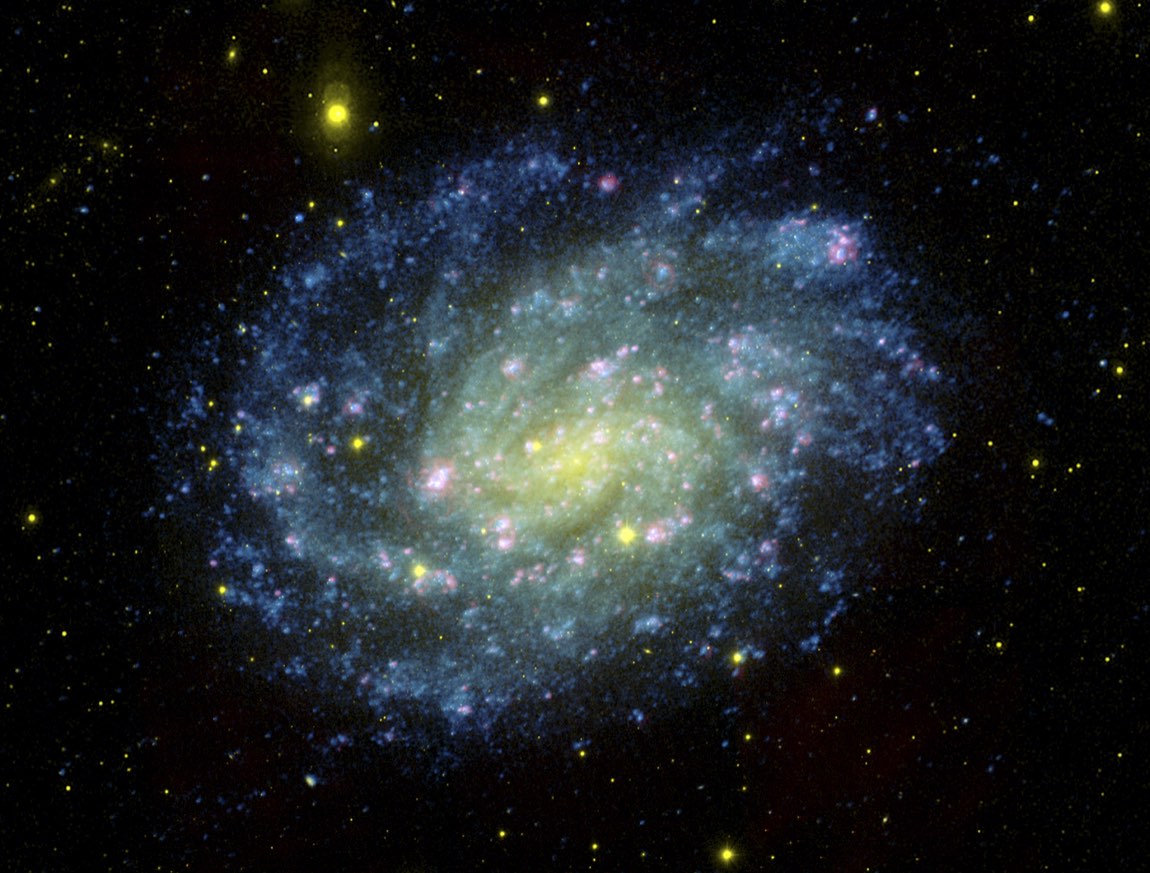
NGC 300 is a spiral galaxy in Sculptor, discovered by James Dunlop in 1826. It is one of the nearest galaxies beyond the Local Group and shares many traits with the Triangulum Galaxy. Long counted in the Sculptor Group, it now appears to sit in front of that group, probably bound in a pair with NGC 55. It is about 94,000 light-years across, a little smaller than the Milky Way, and is tilted about 42° to our view.
The deep dive
Researched for the Atlas from Wikipedia — NGC 300 (6,562 characters read) · updated Nov 15, 2026
01 A Galaxy Caught Between Two Groups
NGC 300 occupies an intriguing gravitational no-man's-land. It has long been listed as a member of the Sculptor Group, a nearby concentration of galaxies in the same constellation, but recent distance measurements have complicated that picture. The data now suggest that NGC 300 and its neighbour NGC 55 — a Magellanic-type barred spiral — actually lie in the foreground of the Sculptor Group rather than within it. The two galaxies are most likely gravitationally bound to each other, forming a pair that drifts between our Local Group and the Sculptor Group proper. This ambiguous address makes NGC 300 one of the more unusual galaxies in our cosmic neighbourhood: close enough to study in fine detail, yet not quite belonging to any firmly defined family. The dwarf galaxy Sculptor C sits about 6.65 million light-years from the Sun and is very likely a satellite of NGC 300, orbiting it much as the Magellanic Clouds orbit the Milky Way.
02 Pinning Down an Elusive Distance Deeper
Measuring how far away NGC 300 sits has been a decades-long refinement. In 1986, Allan Sandage placed it at 5.41 million light-years. By 1992, Freedman and colleagues pushed that figure out to 6.9 million light-years, and a 2006 revision by Karachentsev and collaborators settled on 7.0 ± 0.3 million light-years. Around the same time, astronomers applied the tip of the red giant branch method — which exploits the predictable brightness of aging giant stars at the moment their cores ignite helium — and obtained 5.9 ± 0.4 million light-years using edge detection and 6.1 ± 0.4 million light-years using maximum likelihood statistics. Independently, Wolfgang Gieren's team used near-infrared photometry of Cepheid variable stars in 2005 and arrived at 6.1 ± 0.2 million light-years. Combining the TRGB and Cepheid results gives a best current estimate of 6.07 ± 0.23 million light-years, or 1.86 ± 0.07 megaparsecs. The persistence of small but real disagreements among methods illustrates how challenging cosmic distance measurement remains even for a relatively nearby galaxy.
03 How NGC 300 Compares to Familiar Galaxies
NGC 300 is a spiral galaxy that shares many structural characteristics with the Triangulum Galaxy, the third-largest member of the Local Group. At roughly 94,000 light-years in diameter it is somewhat smaller than the Milky Way, which spans about 100,000 light-years, so the size difference is modest — think of a dinner plate versus a slightly smaller salad plate. Its estimated mass is (2.9 ± 0.2) × 10 to the power of 10 solar masses, meaning it weighs in at about 29 billion times the mass of our Sun. When we view it from Earth, NGC 300 is tilted at an angle of 42 degrees from face-on, giving it an attractively elongated oval appearance rather than a perfect circle or a razor-thin edge. It is also the brightest of the five main spirals visible in the direction of the Sculptor Group, making it a prominent landmark in that region of the sky.
04 The Amateur Who Found a Stellar Mystery
On 14 May 2008, amateur astronomer L. A. G. Berto Monard recorded a bright optical transient in a star-forming spiral arm of NGC 300. The event, now called NGC 300-OT, shone at a broad-band magnitude of 14.3 at discovery and reached a peak measured magnitude of 14.69 the very next day. Reviewing earlier images taken on 24 April 2008 — just after the galaxy reappeared from behind the Sun — showed the object already brightening at around magnitude 16.3, while an image from 8 February 2008 showed nothing unusual. The absolute magnitude at discovery was approximately −13, placing it in an awkward middle ground: far too faint for a typical core-collapse supernova, yet far brighter than a classical nova. It did not match the spectroscopic fingerprints of a luminous blue variable star either. This combination of properties made NGC 300-OT genuinely puzzling and attracted sustained professional follow-up despite its discovery by an amateur observer.
05 An Explosion Wrapped in Dust and Debate Deeper
Archival Spitzer Space Telescope data revealed a mid-infrared source at the location of NGC 300-OT before the outburst was ever noticed in visible light. That hidden progenitor was a star deeply shrouded in dust, radiating like a black body with a radius of roughly 300 astronomical units and a temperature of around 300 Kelvin, with a bolometric luminosity of approximately 10 to the power of 6 solar luminosities. After the visible transient peaked in May 2008, its brightness declined smoothly through September while the colour grew progressively redder; after September it continued fading in optical wavelengths but developed strong hydrogen-alpha emission. The optical spectrum is dominated by fairly narrow hydrogen Balmer and calcium II emission lines alongside calcium II H and K absorption features. Spitzer observations also revealed broad emission at 8 and 12 micrometres, features also seen in Galactic carbon-rich protoplanetary nebulae. Historical Hubble images suggested with 70 percent certainty that the progenitor formed in a burst of star formation 8 to 13 million years ago and carried a mass of 12 to 25 solar masses. On 19 April 2025, NGC 300-OT was formally classified as an Intermediate-Luminosity Red Transient, a category linking it to similarly ambiguous outbursts elsewhere.
06 A Stellar Merger Echoing V838 Monocerotis Deeper
One leading interpretation of NGC 300-OT draws a direct parallel with V838 Monocerotis, a remarkable Galactic nova in which two stars merged rather than exploded. Historical Hubble images constrain the progenitor's brightness to values consistent with a relatively low-mass main sequence star, and the transient's photometric and spectroscopic behaviour aligns with what models predict for a stellar merger event. Analysis of archival data pegs the progenitor at roughly 10 solar masses — on the lower end of massive-star territory. The properties of NGC 300-OT are described as nearly identical to those of SN 2008S in the galaxy NGC 6946, suggesting both events belong to the same physical class. This family of Intermediate-Luminosity Red Transients occupies a genuinely new region of astrophysical parameter space: too energetic for ordinary novae, too dim and too red for standard supernovae, and spectrally distinct from luminous blue variable eruptions. Settling their true nature remains an active area of research.
 ⤢
07 Other Outbursts in a Busy Galaxy
NGC 300 has proven to be a productive hunting ground for transient events beyond the celebrated 2008 optical transient. Amateur astronomer Monard also discovered SN 2010da on 23 May 2010 at magnitude 16, located about 15.9 arcseconds west and 16.8 arcseconds north of the galaxy's centre. Follow-up spectroscopy suggested it was another optical transient rather than a true supernova, possibly an outburst from a luminous blue variable star, and it faded 0.5 to 0.7 magnitudes in just nine days — faster than the 2008 event. The Distance Less Than 40 Mpc Survey found two more: AT 2019qyl on 26 September 2019 at magnitude 17.1, initially classified as a Type IIn or luminous blue variable but later revised to a classical nova; and SN 2020acli on 12 December 2020 at magnitude 18.4, typed as a peculiar Type IIn supernova. Two further events, AT 2024oth and AT 2024txt, were detected in mid-2024 by the BlackGEM and Pan-STARRS telescope networks respectively, both still of unknown type at the time of reporting.
08 A Black Hole Paired With a Dying Star Deeper
Buried in NGC 300 is an X-ray source designated NGC 300 X-1, which astronomers believe is a rare and newly recognised type of binary system pairing a stellar-mass black hole with a Wolf-Rayet star. Wolf-Rayet stars are massive, evolved objects that have shed their outer hydrogen envelopes and blow fierce winds of heavier elements into space. The two objects in NGC 300 X-1 circle each other with an orbital period of just 32.8 hours — completing one full orbit in little more than a day — at a separation of about 18.2 solar radii, which is roughly 12.7 million kilometres. The black hole carries a mass of 17 ± 4 solar masses, while the Wolf-Rayet companion weighs in at 26 with an asymmetric uncertainty of plus 7 or minus 5 solar masses. This system closely resembles IC 10 X-1, a confirmed Wolf-Rayet plus black hole binary in another nearby galaxy, suggesting that such pairings may represent a distinct evolutionary stage that precedes the formation of gravitational-wave-producing black hole mergers.
09 A Rare Oxygen Wolf-Rayet Star
NGC 300 hosts an oxygen-sequence Wolf-Rayet star designated STWR 13, classified as spectral type WO4. WO-type stars are among the rarest and most extreme stellar objects known: they represent the very final evolutionary stage of the most massive stars, with surface temperatures so high and stellar winds so powerful that even the carbon and oxygen produced in their cores are blown away and visible in their spectra. The WO4 designation places STWR 13 among the hottest and most oxygen-rich of this already rare subtype. It is located within one of the bright H II regions — glowing clouds of ionised hydrogen — in NGC 300, a setting that reflects the broader context of active, ongoing star formation in that part of the galaxy. The presence of such an extreme stellar object in a galaxy we can study at high resolution makes NGC 300 a valuable laboratory for understanding the final lives of the universe's heaviest stars.
10 James Dunlop and the August Discovery
NGC 300 was discovered on 5 August 1826 by James Dunlop, a Scottish astronomer working in the Southern Hemisphere. Dunlop is a less celebrated figure than contemporaries such as William Herschel, yet he systematically catalogued southern sky objects from Australia at a time when very few European astronomers had access to southern skies at all. The discovery of NGC 300 came during this pioneering survey work. The galaxy later entered John Dreyer's New General Catalogue and was additionally assigned the designation Caldwell 70 in Patrick Caldwell-Moore's catalogue of visually rewarding non-Messier objects. The name "Sculptor Pinwheel Galaxy" distinguishes it from other pinwheel galaxies such as Messier 101 in Ursa Major. Its brightness as the most prominent spiral in the direction of the Sculptor Group would have made it a natural early target for southern-hemisphere observers sweeping the sky with modest instruments.
11 Observing NGC 300 from Earth
NGC 300 sits in the constellation Sculptor, a relatively faint southern constellation that offers little competition from bright stars, making the galaxy easier to pick out with a telescope. Its apparent magnitude means it is accessible to amateur observers with moderate instruments under dark skies, and its inclination of 42 degrees gives it a pleasing elliptical shape rather than the featureless disc of a nearly edge-on galaxy. As the brightest of the five main spirals in the direction of the Sculptor Group, it serves as a natural anchor point for exploring that region of the sky. For observers in the Northern Hemisphere, Sculptor's low declination limits viewing opportunities, but from southern latitudes NGC 300 rides reasonably high and can be followed for extended periods. The galaxy's relatively large angular extent on the sky — a consequence of its proximity at around 6 million light-years — means that dark skies and wide-field eyepieces or imaging setups reveal its extended disc structure most effectively.
12 The Faint Satellite Sculptor C
Orbiting NGC 300 at a distance of about 6.65 million light-years from the Sun is a small companion called Sculptor C, classified as a dwarf galaxy. Its absolute magnitude of approximately −9.1 places it squarely in the category of ultra-faint dwarf galaxies — a population that has only been characterised in detail in recent years as detector technology and survey depth have improved enough to pick them out against the sky. For comparison, the most luminous globular clusters in the Milky Way reach similar absolute magnitudes, illustrating just how faint these satellite systems are. The relationship between Sculptor C and NGC 300 mirrors the relationship between the Magellanic Clouds and the Milky Way on a smaller scale. Identifying and studying such ultra-faint companions is scientifically important because they are thought to be the most dark-matter-dominated objects known, and their numbers and properties test predictions of cosmological structure-formation models.
 ⤢