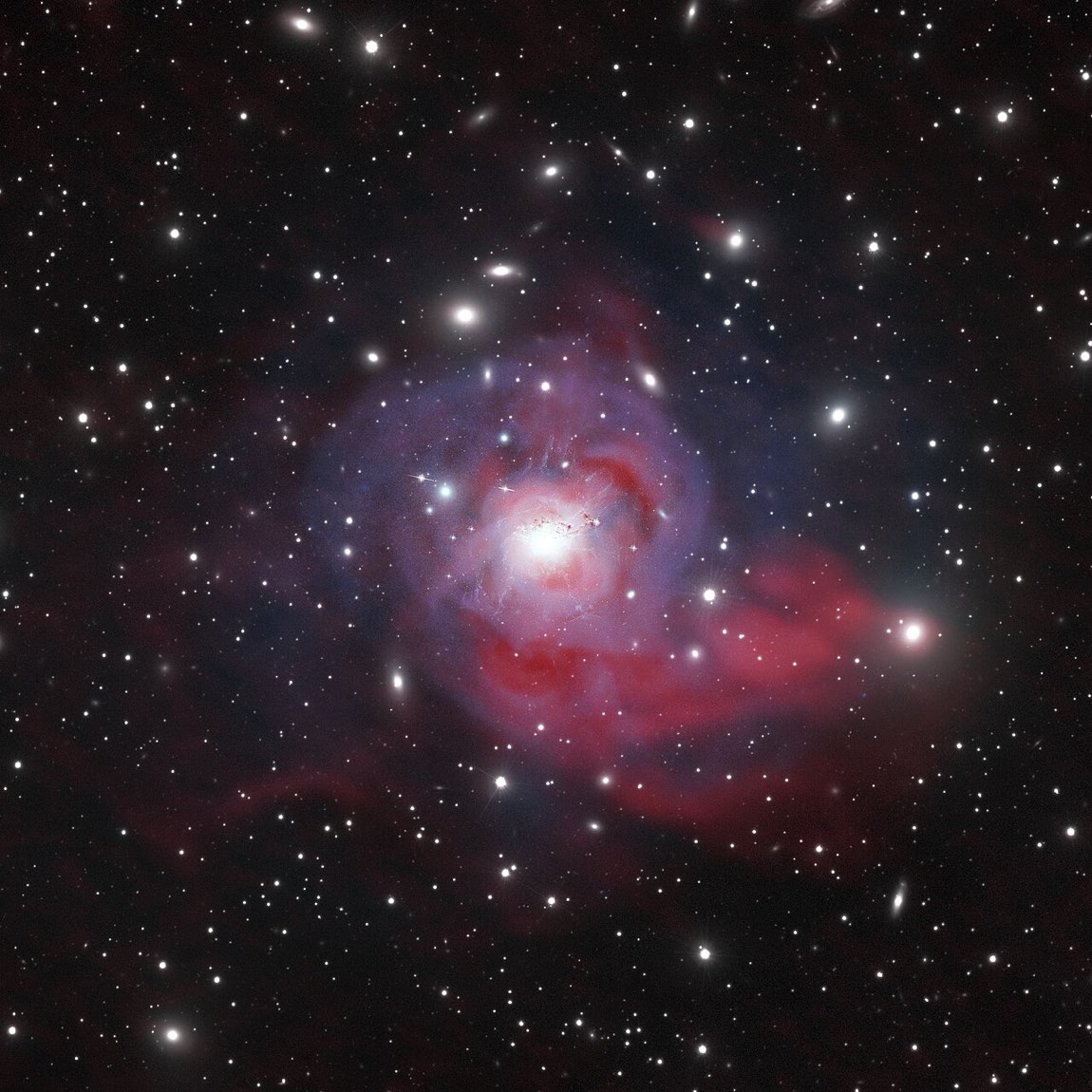
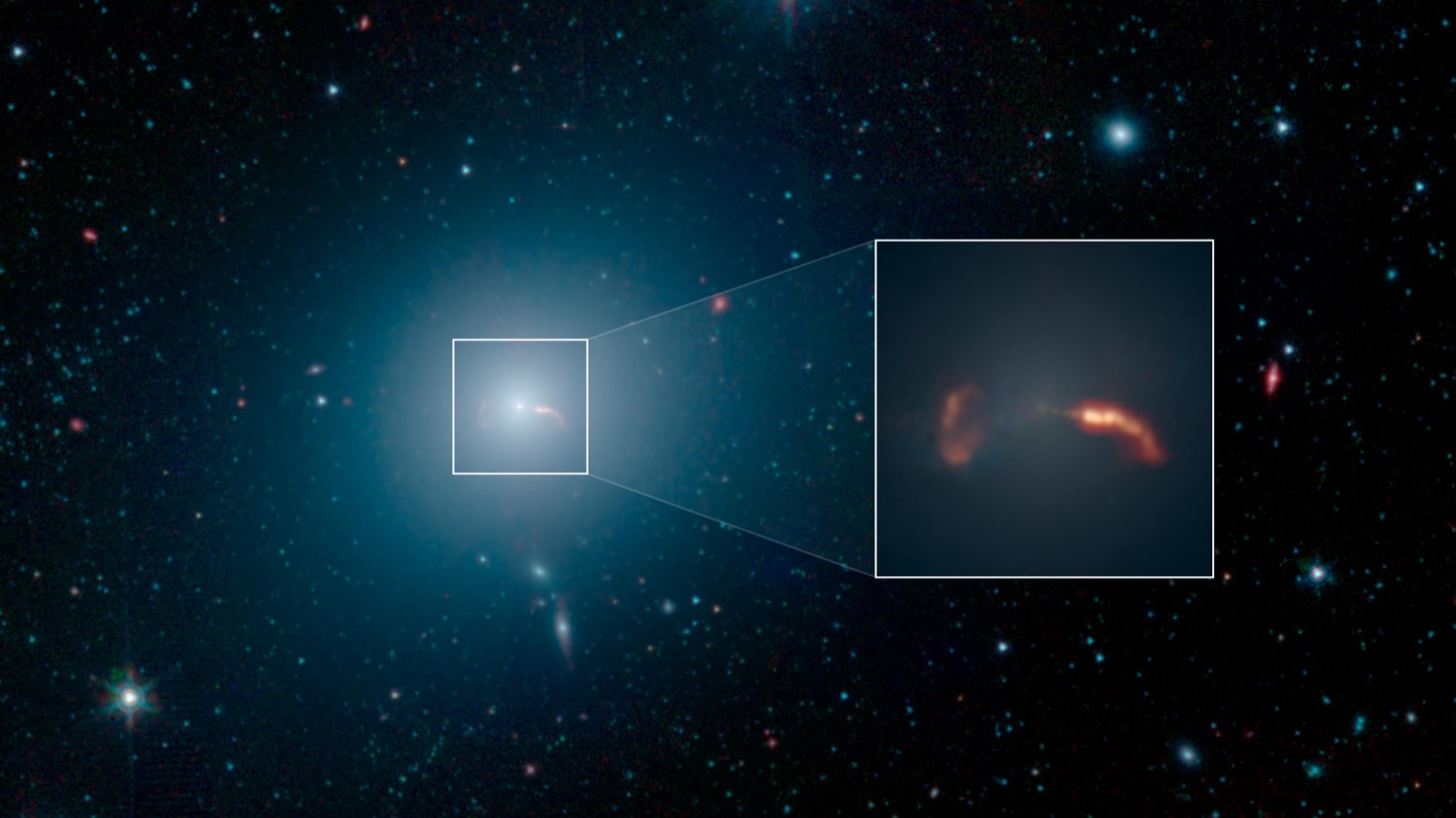
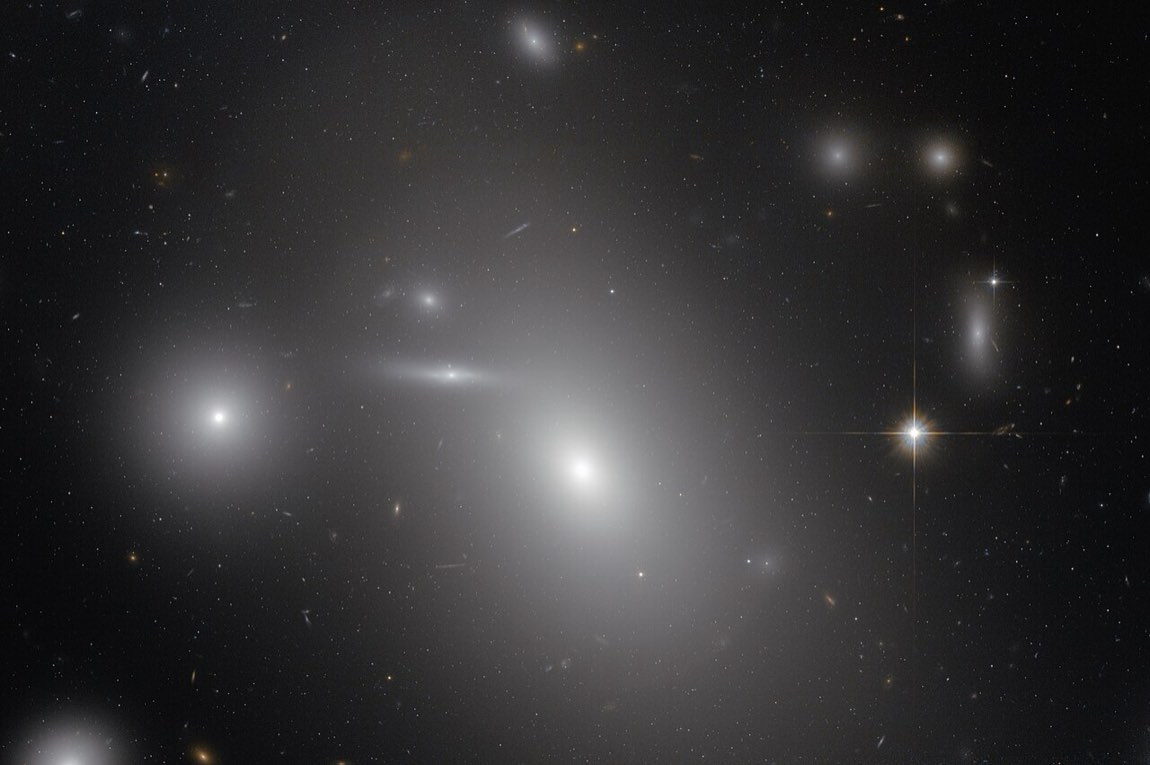
 Photograph · NASA Hubble · CC BY 2.0
Galaxy · Deep guide
NGC 4889
Also called: Caldwell 35 · C35 · Coma B · NGC 4884 · UGC 8110 · PGC 44715
A supergiant elliptical galaxy hiding one of the most massive black holes ever measured.
What is it?
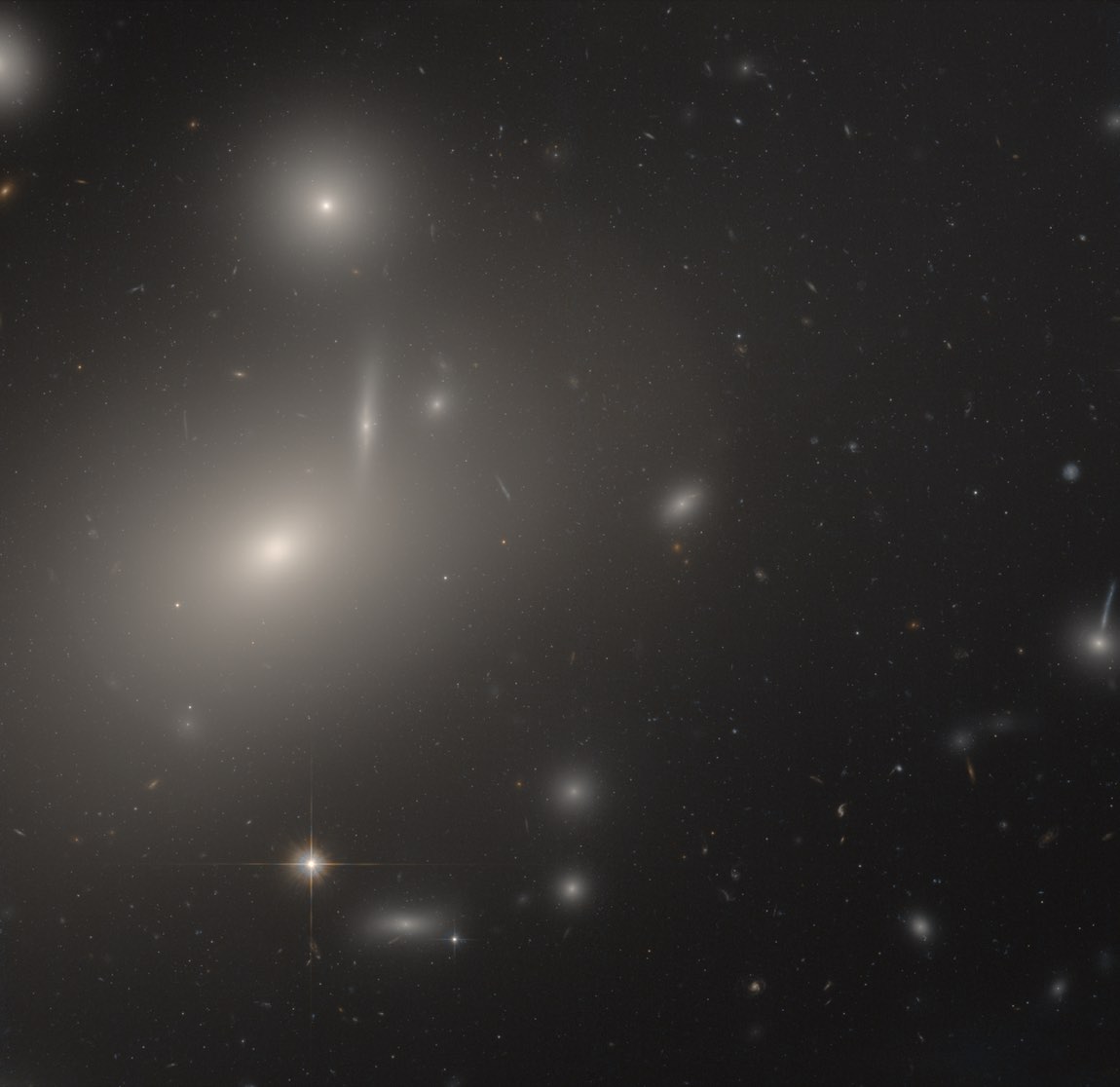
NGC 4889 is a supergiant elliptical galaxy and the brightest galaxy in the northern part of the Coma Cluster, about 308 million light-years away. At its core is a supermassive black hole with a best-fit mass of about 21 billion Suns, one of the heaviest on record; its event horizon could span 2 to 12 times the width of Pluto's orbit. The galaxy's faint outer halo of stars stretches about a million light-years across, and a large population of globular clusters orbits it. William Herschel discovered it in 1785.
The deep dive
Researched for the Atlas from Wikipedia — NGC 4889 (8,171 characters read) · updated Nov 15, 2026
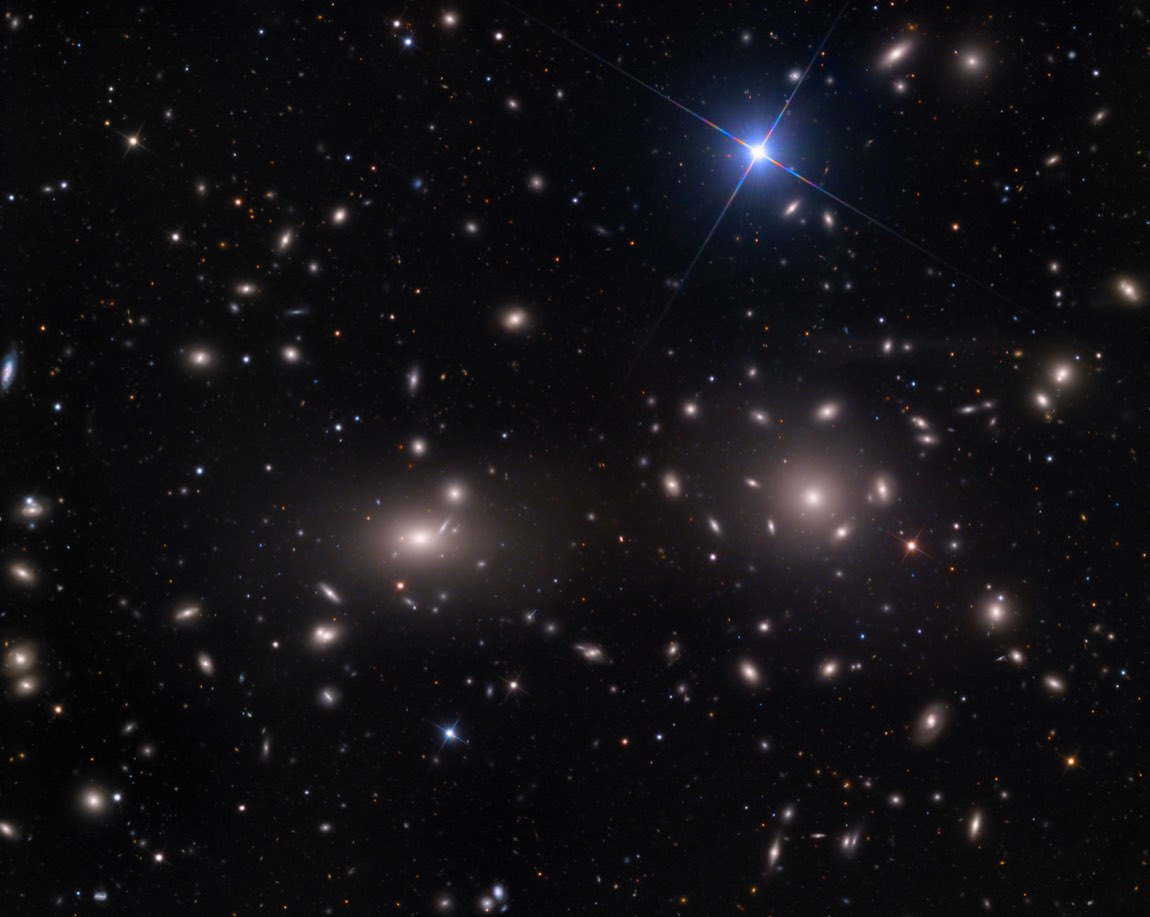
01 A Catalog Entry Born from a Mistake
The story of how NGC 4889 got its name is a small comedy of errors. Frederick William Herschel I, aided by his sister Caroline Lucretia Herschel, first observed the galaxy in 1785 and recorded it as a bright nebulous patch. His son, John Frederick William Herschel, later published the General Catalogue of Nebulae and Clusters of Stars in 1864, folding in his father's discoveries alongside his own. When astronomer John Louis Emil Dreyer assembled the landmark New General Catalogue in 1888 — a list of 7,840 objects — he accidentally catalogued the same galaxy twice, assigning it both the designations NGC 4884 and NGC 4889. The duplication went uncorrected for decades. It was only through later revision projects — The NGC/IC Project, the Revised New General Catalogue, and NGC 2000.0 — that the error was identified. Scholars agreed to keep the later designation, NGC 4889, which remains the accepted name today. In December 1995, Patrick Caldwell Moore added the galaxy to his alternative Caldwell catalogue of 109 objects missed by Messier, giving it the additional label Caldwell 35.
02 How to Actually Find It in the Sky
NGC 4889 sits in the high-declination region of the constellation Coma Berenices, just south of Canes Venatici. A practical sky-hopping trick is to draw a mental line from Beta Comae Berenices to Gamma Comae Berenices and follow it — the galaxy lies along that path. Its apparent magnitude is 11.4, which puts it within reach of a telescope with a 12-inch aperture, though light pollution is a real enemy here: the glare from Beta Comae Berenices can wash it out significantly. Under genuinely dark, moonless skies, even a small telescope will reveal it as a faint smudge, but seeing the galaxy's vast diffuse halo requires a larger instrument. The halo spans 17.8 arcminutes on the sky — roughly half the angular diameter of the full Moon — so patience, aperture, and dark skies are all rewarded. Charles Messier, who catalogued many nearby objects, somehow overlooked NGC 4889 entirely despite its intrinsic brightness, an omission that later inspired Caldwell Moore's rival list.
03 Shape, Classification, and What They Mean
NGC 4889 carries two overlapping classification labels that together paint a detailed picture of its structure. The first is E4, assigned within the updated Hubble morphological sequence that French astronomer Gérard de Vaucouleurs revised in 1959. The E4 designation means the galaxy presents a noticeably flattened, elliptical disk of stars — not perfectly round, but not dramatically elongated either. The second label is cD, a category invented in 1958 by American astronomer William Wilson Morgan. A cD galaxy is a giant form of D galaxy: it has an elliptical nucleus at its core, but that nucleus is engulfed by an immense, diffuse, dustless extended halo far larger than typical ellipticals possess. Together these labels describe a galaxy that is simultaneously compact and dense at its heart and extraordinarily sprawling at its edges. The stellar distribution is flattened and unequal, with a central bulge, while the diffuse stellar halo stretches out to one million light-years in diameter — a structure so vast it blurs the boundary between galaxy and surrounding space.
04 Size and Mass: The Numbers Are Staggering
The effective radius of NGC 4889 spans 2.9 arcminutes of sky, which translates to a diameter of 239,000 light-years — about 1.5 times the isophotal size of the Andromeda Galaxy, our own cosmic neighbor. Beyond that luminous disk lies the cD halo, stretching to a diameter of 1.3 million light-years. The galaxy is probably the largest and most massive galaxy within 100 megaparsecs (326 million light-years) of the Milky Way. Mass estimates vary depending on how the geometry is treated. Using the Milky Way as a reference unit, NGC 4889 may be close to 8 trillion solar masses when measured as a flat object, but because it is a three-dimensional spheroid rather than a flat spiral disk, the true figure could reach 15 trillion solar masses. That upper estimate is roughly 1,500 times the mass often attributed to the Milky Way. Even so, as is typical for elliptical galaxies, only a small fraction of that total mass is locked up in stars that actually radiate energy — the rest resides in dark matter and other non-luminous components.
 ⤢
05 The Monster Black Hole at Its Heart Deeper
On December 5, 2011, astronomers published measurements of the velocity dispersion — essentially how fast stars are moving in random directions — in the central regions of NGC 4889 and NGC 3842 in the Leo Cluster. The result for NGC 4889 was extraordinary: its central supermassive black hole has a best-fit mass of 2.1×10¹⁰ solar masses, or 21 billion solar masses, though the data allow a range from 6 billion to 37 billion solar masses. That best-fit figure makes it 5,200 times more massive than the black hole at the center of the Milky Way. The event horizon of this object spans roughly 20 to 124 billion kilometers in diameter — equivalent to 2 to 12 times the diameter of Pluto's orbit around the Sun. Despite this staggering mass, the black hole is currently quiescent, thought to have already consumed all readily available surrounding matter. The ionized medium still detectable around it hints that NGC 4889 was once a luminous quasar, blazing brilliantly before its fuel supply ran out and silence fell at its core.
06 A Stellar Population Shaped by Mergers Deeper
Giant elliptical galaxies like NGC 4889 are widely believed to have assembled through repeated mergers of smaller galaxies over cosmic time. This violent history has left a distinctive stellar fingerprint. Because most of the gas that could form new stars was consumed or dispersed long ago during those collisions, little dust remains to build fresh nebulae and nurseries. As a result, the stellar population is dominated by old, Population II stars — ancient objects relatively poor in elements heavier than hydrogen and helium. Unlike a spiral galaxy such as the Milky Way, where stars move in organized, rotating orbits within a disk, the stars of NGC 4889 follow random orbital paths in three dimensions. It is this randomness — not rotation — that gives the galaxy its egg-like shape and maintains it against gravitational collapse. The contrast with the orderly structure of a spiral is a direct consequence of NGC 4889's turbulent merger-driven past, which stirred and scrambled any primordial ordered motion that may once have existed.
07 What Fills the Space Between the Stars Deeper
The vast interior of NGC 4889 is not empty. Between its stars lies a dense interstellar medium packed with heavy elements shed by previous generations of stars as they aged and died. Carbon and nitrogen are continuously contributed by intermediate-mass stars as they pass through the asymptotic giant branch phase late in their lives, puffing off outer layers into surrounding space. The heavier elements — from oxygen all the way to iron — are primarily forged and expelled by supernova explosions within the galaxy. This interstellar medium is kept warm by a constant source of heating: gas and dust falling inward toward the central supermassive black hole release energy through friction, continuously energizing the material around them. The same black hole-driven heating also warms the intracluster medium on much larger scales. Meanwhile, gamma-ray bursts from the galaxy extend outward several million light-years from the cluster, broadcasting evidence of energetic events into the broader cosmic environment surrounding NGC 4889.
08 An Extraordinary Collection of Globular Clusters
Orbiting NGC 4889 is a population of 15,800 globular clusters — ancient, gravitationally bound spheres each containing hundreds of thousands to millions of stars. That number substantially exceeds the 12,000 globular clusters orbiting Messier 87, the famous giant elliptical at the center of the Virgo Cluster and a frequent comparison object. It is, however, roughly half the number associated with NGC 4874, NGC 4889's companion at the center of the Coma Cluster, which hosts approximately 30,000 globular clusters. The sheer count of globular clusters around a galaxy is considered a rough tracer of its total mass and merger history: more mergers bring in more clusters from infalling satellite galaxies. In that sense, NGC 4889's globular cluster population is itself a fossil record of the multiple galactic collisions that built the galaxy. These clusters orbit at large distances in the galaxy's halo, tracing the outer gravitational reach of one of the most massive galaxies in the nearby universe.
 ⤢
09 The Galaxy's Role in a Vast Cosmic Web
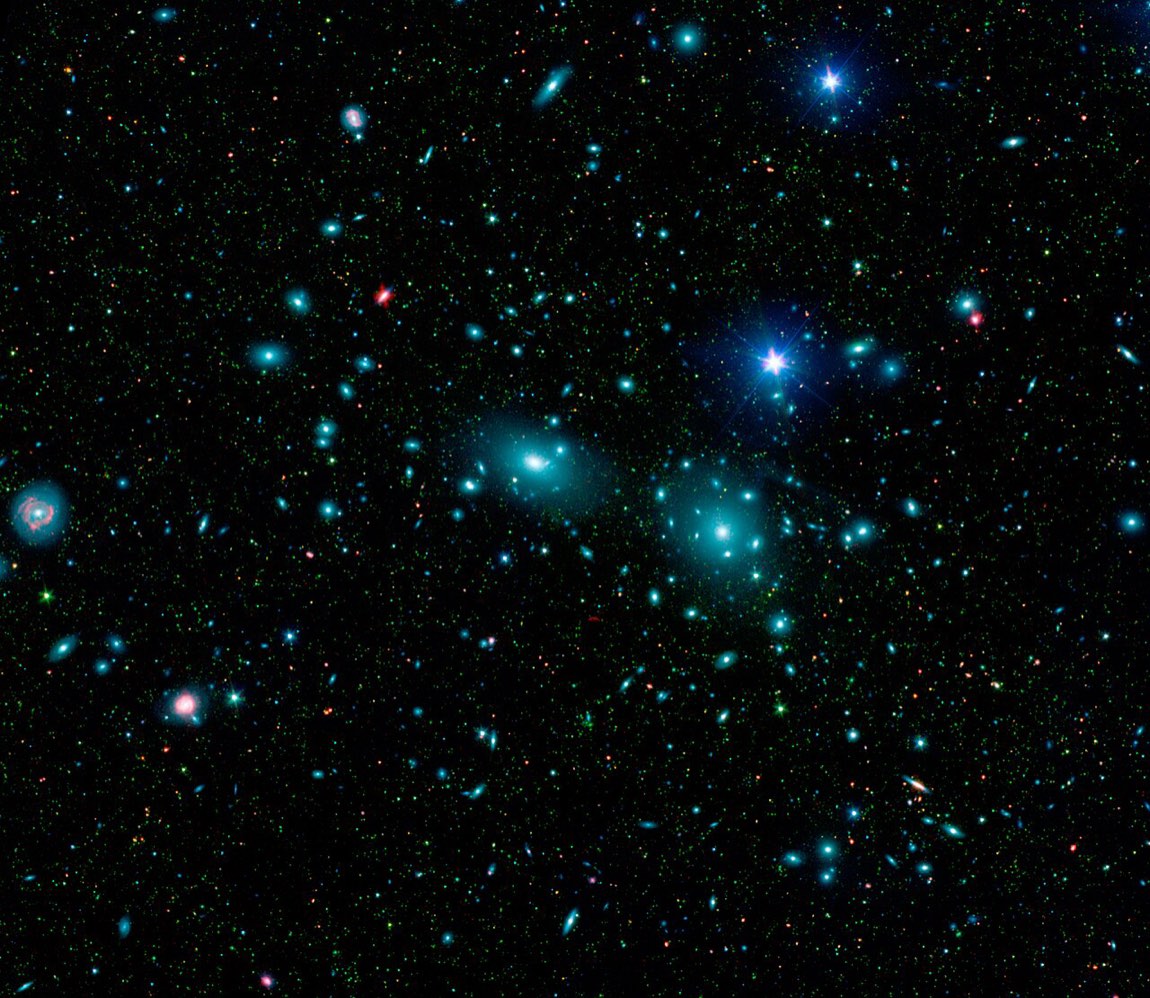
NGC 4889 does not sit in isolation. It occupies the center of component A of the Coma Cluster — a giant structure of approximately 2,000 galaxies whose total mass is estimated at around 4×10¹⁵ solar masses, or four quadrillion times the mass of the Sun. NGC 4889 shares this central position with NGC 4874, though NGC 4889 is sometimes identified as the definitive cluster center and carries the designation A1656-BCG, marking it as the brightest cluster galaxy. The Coma Cluster itself sits precisely at the center of the Coma Supercluster, one of the nearest superclusters to the Laniakea Supercluster that contains the Milky Way. Zooming out further, the Coma Supercluster is embedded within the CfA Homunculus — the core of the CfA2 Great Wall, the nearest major galaxy filament to Earth and one of the largest known structures in the universe. NGC 4889 is therefore not merely a large galaxy; it is a gravitational anchor for structures that cascade upward in scale across hundreds of millions of light-years.
10 Radiation: X-ray, Ultraviolet, and Radio Deeper
NGC 4889 is a strong emitter across multiple regions of the electromagnetic spectrum beyond ordinary visible light. It is a notable source of soft X-ray radiation, ultraviolet light, and radio-frequency emission. Each of these wavelength regimes carries different physical information. Soft X-rays are typically associated with hot plasma — superheated gas in and around the galaxy that has been energized by processes including the central black hole's interaction with infalling material. Ultraviolet emission traces younger or hotter stellar populations and energetic processes that visible light alone would miss. Radio emission can indicate synchrotron radiation produced by relativistic electrons spiraling through magnetic fields, often connected to past or present activity from the central black hole. Together these emissions make NGC 4889 a galaxy that must be studied across a broad swath of the spectrum to be properly understood. The galaxy's status as a strong multi-wavelength source has made it an important target for observatories operating well outside the range of optical telescopes.
11 A Prototype for Studying Distant Giants
Because NGC 4889 is — as the article describes it — probably the largest and most massive galaxy easily visible from Earth within 100 megaparsecs, it has become something of a standard reference object in professional astronomy. Researchers studying the dynamical evolution of supergiant elliptical galaxies in the more distant universe use NGC 4889 as a prototype, measuring its properties in detail and then applying those lessons when interpreting more remote and harder-to-resolve objects. Its proximity relative to galaxies of similar scale means that features which would be smeared into invisibility at greater distances can be observed with far greater precision here. At the same time it has attracted serious amateur attention: despite requiring a 12-inch telescope for confident identification, it is listed in the Caldwell catalogue specifically because it rewards patient observers. This dual role — scientific benchmark and amateur observing target — reflects how the galaxy bridges the worlds of research and public engagement in astronomy.
 ⤢