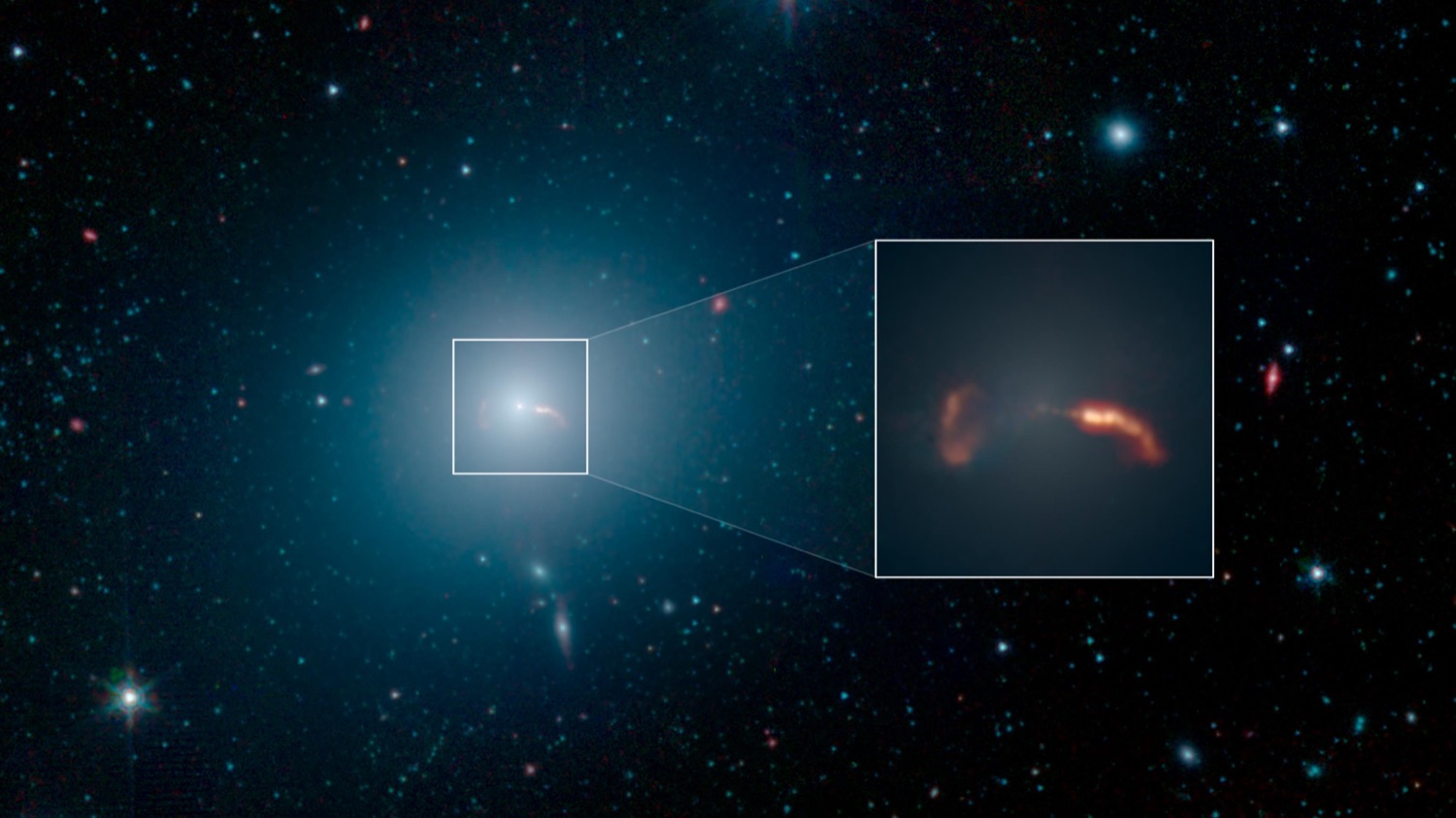
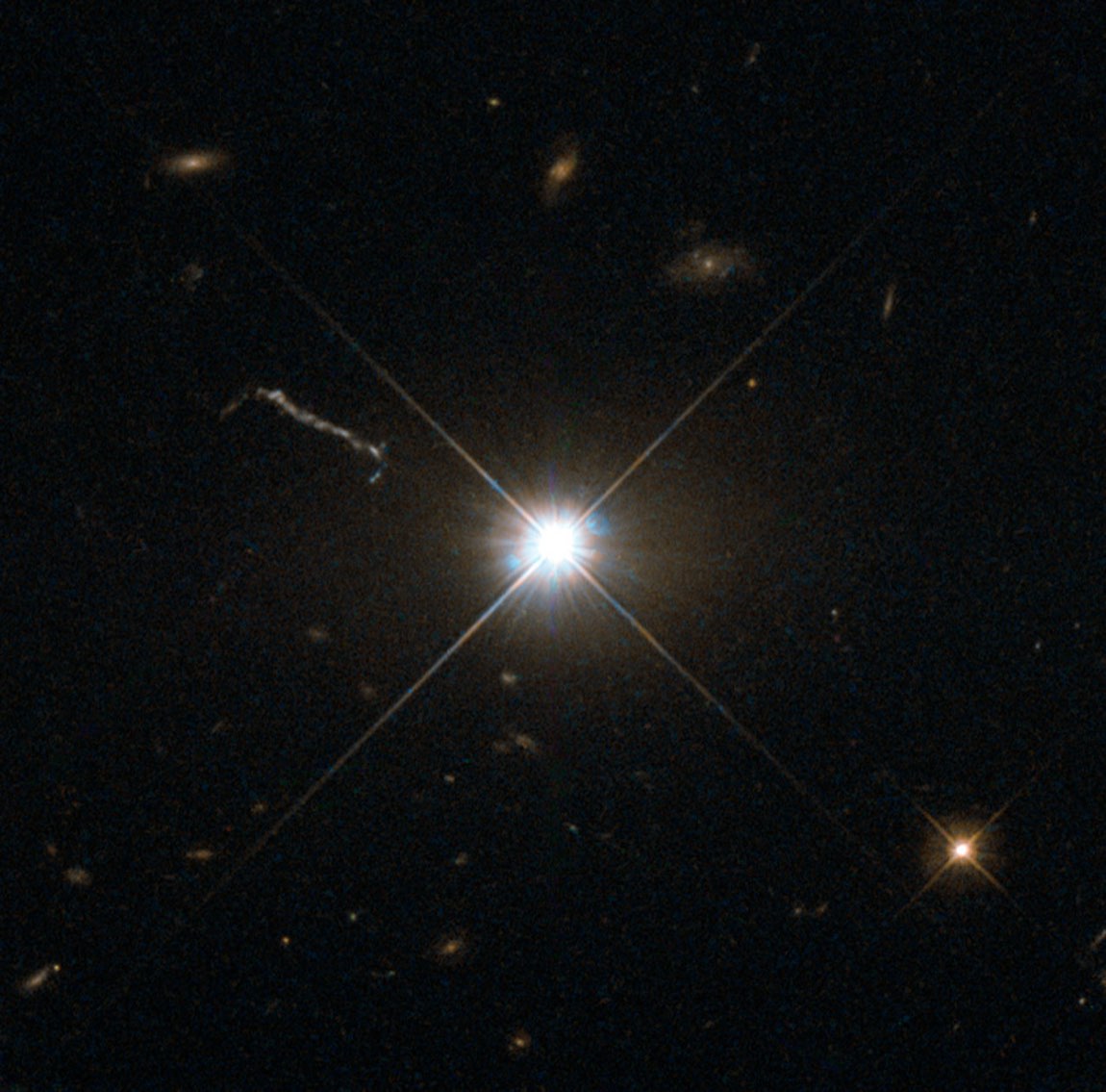
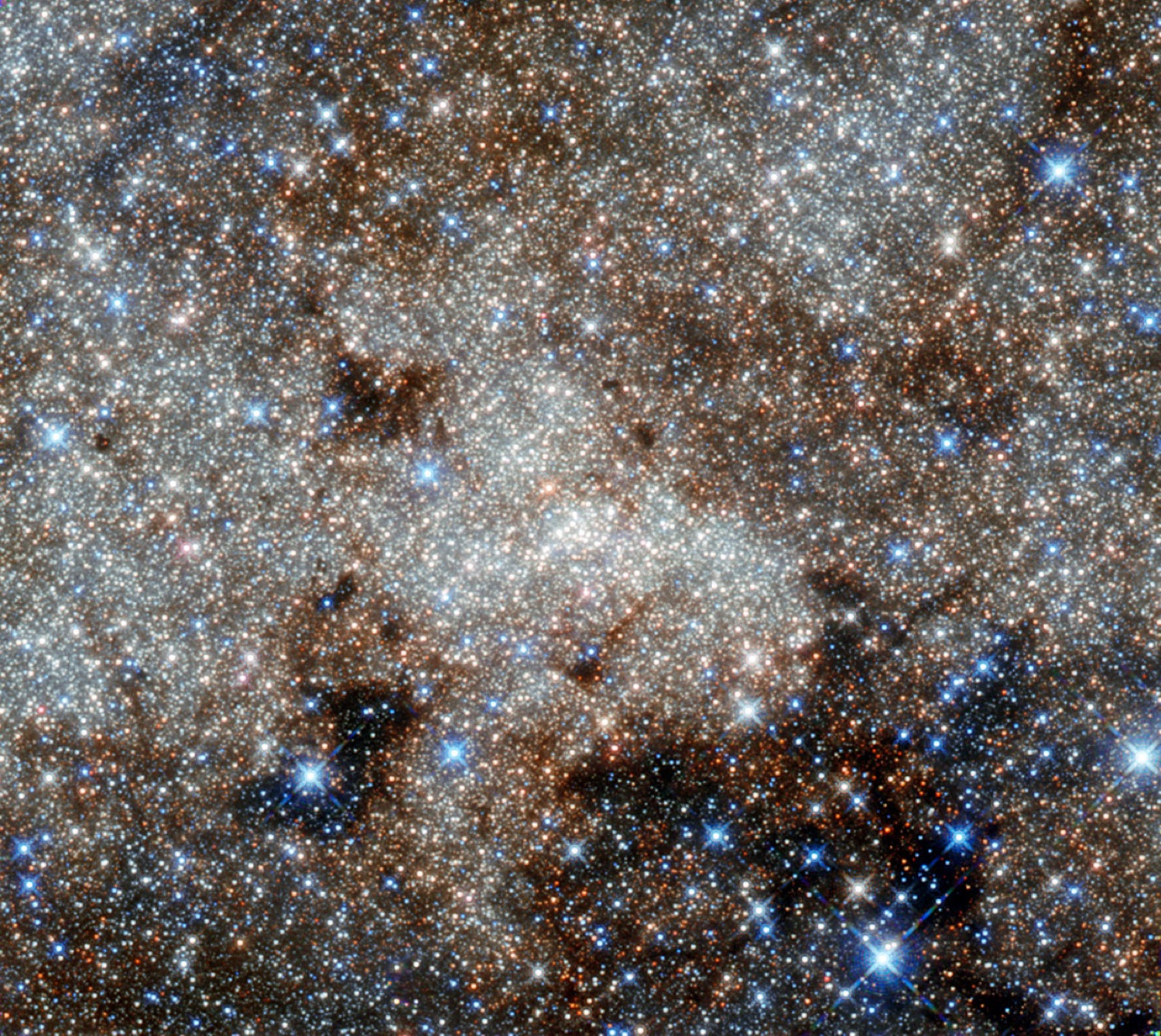
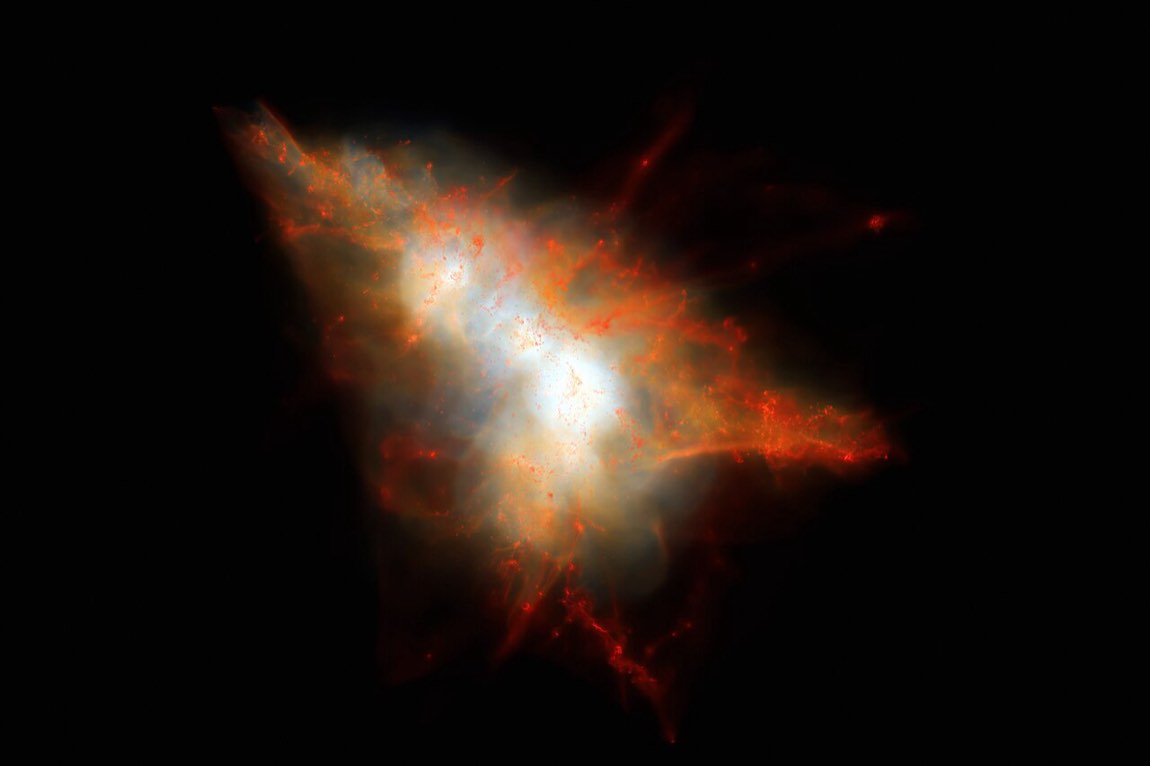
 Photograph · Sloan Digital Sky Survey DR9, via Aladin Lite · CC BY 4.0
Black Hole · Deep guide
TON 618
A quasar powered by one of the heaviest black holes ever weighed.
What is it?
TON 618 is a quasar 10.4 billion light-years away whose light left when the universe was a fraction of its current age. The engine behind its blaze is an ultramassive black hole estimated at tens of billions of solar masses — among the heaviest ever measured — with an event horizon that would swallow our entire Solar System thousands of times over. Mass estimates at this distance rely on gas-motion modeling and carry real uncertainty.
The deep dive
Researched for the Atlas from Wikipedia — TON 618 (6,863 characters read) · updated Sep 20, 2026
01 Discovered as a Faint Blue Star
Long before anyone understood what TON 618 truly was, it showed up in a 1957 survey as nothing more than a "decidedly violet" or faint blue speck on photographic plates taken with a modest 0.7 m Schmidt telescope at the Tonantzintla Observatory in Mexico. The astronomers conducting the survey, Braulio Iriarte and Enrique Chavira, were hunting for faint blue stars — mainly white dwarfs — that lie away from the plane of the Milky Way. They catalogued this peculiar dot as entry number 618 in the Tonantzintla Catalogue, giving the object the name it still carries today. There was no reason to suspect anything extraordinary; quasars as a class were not even recognized until 1963. The object sat quietly in that catalogue for thirteen years until a 1970 radio survey conducted at Bologna, Italy detected radio emissions from it. That detection was the key — radio emission was the fingerprint of a quasar. Marie-Helene Ulrich then obtained optical spectra at the McDonald Observatory, found emission lines characteristic of a quasar, and from their high redshift deduced that TON 618 was one of the most luminous quasars then known. A violet smudge had become one of the most extreme objects in the universe.
02 A Redshift That Reaches Back in Time
TON 618 carries an observed redshift of 2.219, a number that encodes both its distance and its age. The light arriving at our telescopes today left TON 618 approximately 10.8 billion years ago, meaning we see the quasar as it existed when the universe was only a fraction of its current age. The projected comoving distance — the true spatial separation accounting for cosmic expansion — is approximately 18.2 billion light-years. That gap between light-travel time and comoving distance exists because the universe expanded while the light was travelling. The high redshift also has a practical scientific benefit: it shifts the ultraviolet Lyman-alpha emission line out of the ultraviolet and into wavelength ranges that telescopes on the ground can detect, which is precisely why TON 618 became one of the most important objects for studying the Lyman-alpha forest — the web of absorption features imprinted by hydrogen gas clouds that the light passes through on its way to Earth. In this sense, the very remoteness of TON 618 transforms it from an obstacle into a tool, letting astronomers probe conditions in the early universe that closer, less redshifted objects simply cannot illuminate.
03 Two Mass Estimates and Why They Differ Deeper
The mass of TON 618's central black hole is not a settled number, and the difference between the two leading estimates is large enough to matter. The older, more frequently cited figure of 66 billion solar masses came from measuring the full width at half maximum of the Hβ spectral line in a sample of at least 29 quasars studied by Shemmer and coauthors. TON 618 had the broadest emission lines of the entire sample, with hints of infalling material moving at 10,500 km/s — a direct sign of ferocious gravity. In 2019, Xue Ge and collaborators returned to the same underlying data but used the C IV emission line rather than Hβ as their spectral yardstick. Their measurement yielded a gas velocity of only 2,761 ± 423 km/s, substantially lower, and correspondingly produced a mass estimate of 40.7 billion solar masses. Both methods use the width of an emission line as a proxy for the speed of gas orbiting the black hole, and that speed is linked mathematically to the black hole's gravity — but different emission lines trace gas at different distances and in different physical conditions, which is why they can disagree. The debate illustrates a broader challenge in black hole astronomy: even for the most extreme objects, mass measurements carry real uncertainties rooted in which spectral features you choose to trust.
04 The Schwarzschild Radius in Everyday Terms
One of the most viscerally striking ways to appreciate TON 618's black hole is through its Schwarzschild radius — the radius of the event horizon, the point of no return. Under the older 66-billion-solar-mass estimate, this radius stretches to 1,300 astronomical units, equivalent to 194 billion kilometres or 0.0206 light-years, and spans 283,000 solar radii. To put that in solar-system terms, that event horizon is more than 60 times the distance from the Sun to Pluto. The more recent 40.7-billion-solar-mass estimate shrinks the event horizon somewhat but keeps it extraordinary: 800 astronomical units across, or about 40 times the Sun-to-Pluto distance, corresponding to 120 billion kilometres or 0.0127 light-years. In either case, the entire orbit of every known planet in our solar system would fit inside this black hole with vast room to spare. The Schwarzschild radius grows in direct proportion to mass, so the uncertainty in the mass estimate translates directly into an uncertainty in the event horizon's size — a reminder that even the most basic geometric property of this object remains a matter of active scientific refinement.
05 Heavier Than All the Stars in the Milky Way
Perhaps the single most staggering comparison the article offers is this: the older mass estimate of 66 billion solar masses for TON 618's black hole exceeds the combined mass of all the stars in the entire Milky Way galaxy, which is estimated at 64 billion solar masses. The black hole is not merely a component of a large system — it outweighs every star our galaxy contains. It is also 15,300 times more massive than Sagittarius A*, the Milky Way's own central black hole, which weighs in at roughly 4 million solar masses by comparison. Objects in this extreme mass range — far beyond ordinary supermassive black holes — have led researchers to propose a new classification entirely: ultramassive black holes. TON 618 may qualify for that proposed category, though the classification remains a subject of ongoing discussion in the astronomical community. The surrounding host galaxy, despite presumably containing hundreds of billions of stars of its own, is completely invisible from Earth because the brilliance of the central quasar — shining with an absolute magnitude of −30.7 — utterly overwhelms it.
06 How Bright Is 140 Trillion Suns?
TON 618 radiates with a luminosity of 4×10⁴⁰ watts, which the article translates into a more intuitive figure: 140 trillion times the luminosity of our Sun. To give that a concrete handle, our entire Milky Way galaxy, with its hundreds of billions of stars, produces roughly 30 billion solar luminosities — meaning TON 618 alone outshines the whole Milky Way by a factor of thousands. This makes it one of the brightest objects in the known universe. That extraordinary output comes not from stars but from the accretion disc surrounding the central black hole, where gas and matter fall inward and are compressed and heated to extreme temperatures, releasing energy with an efficiency that nuclear fusion in stars cannot match. The quasar's absolute magnitude of −30.7 codifies this brightness on the astronomical magnitude scale; for reference, the full Moon has an absolute magnitude far dimmer, and even the brightest individual stars rarely exceed absolute magnitudes of around −8 or −9. TON 618 sits in a class essentially by itself when measured by raw radiative output.
07 Broad Emission Lines and What They Reveal Deeper
Like all quasars, TON 618 shows emission lines in its spectrum produced by cooler gas located well beyond the accretion disc, in a region astronomers call the broad-line region. The word "broad" refers not to the physical extent of this region but to the width of its spectral lines — a width caused by the Doppler effect as gas clouds move at high velocities around the central black hole. In the case of TON 618, these emission lines are unusually wider than those of most other quasars. The full width at half maximum measured for TON 618 was the largest among the sample of at least 29 quasars that Shemmer and coauthors analysed, with the Hβ line indicating infall speeds hinting at 10,500 km/s. That is roughly 3.5 percent of the speed of light. The C IV line used by Xue Ge et al. in 2019 gave a lower figure of 2,761 ± 423 km/s. In both cases, the line widths serve as a tool: because the size of the broad-line region can be estimated from how brightly the quasar radiation illuminates it, and because the velocity of gas within it is measurable from spectral widths, astronomers can apply a form of the virial theorem to calculate the black hole mass. The emission lines are therefore simultaneously a window onto the physics of the gas and a scale for weighing the black hole itself.
08 The Enormous Lyman-Alpha Nebula
Surrounding TON 618 and its hidden host galaxy is an enormous cloud of gas known as a Lyman-alpha blob, or LAB. Observations by the Atacama Large Millimeter Array (ALMA) in 2021 identified this cloud as the source of the strong Lyman-alpha ultraviolet emission that had been associated with TON 618 since at least the 1980s. The nebula spans a diameter of at least 100 kiloparsecs, which translates to roughly 330,000 light-years — triple the diameter of the Milky Way. It is structured in two distinct components: an inner molecular outflow and an extensive cold molecular gas reservoir in the circumgalactic medium. Each of these two components carries a mass of 50 billion solar masses, and both are aligned with the radio jet produced by the central quasar, suggesting the jet plays a role in shaping the nebula. The extreme radiation from TON 618 excites hydrogen atoms in the surrounding gas so intensely that the cloud glows brightly in the Lyman-alpha ultraviolet line — the same mechanism seen in other LABs powered by their inner galaxies. Lyman-alpha blobs are themselves among the largest nebulae known to exist, with some identified in the 2000s reaching at least hundreds of thousands of light-years across.
09 Why Lyman-Alpha Is So Hard to Study Deeper
The Lyman-alpha line is emitted by neutral hydrogen at an ultraviolet wavelength, which presents an immediate observational problem: Earth's atmosphere strongly absorbs ultraviolet light, blocking it before it can reach ground-based telescopes. This means that Lyman-alpha emitters at low redshifts are extraordinarily difficult to study from the ground. The workaround is redshift itself — if an object is moving away from us fast enough, the Lyman-alpha emission is stretched to longer wavelengths, eventually shifting into the visible or near-infrared range that ground-based instruments can detect. TON 618's redshift of 2.219 does exactly this, pushing its Lyman-alpha emission into an observable range and making it accessible to observatories like ALMA. This is why high-redshift objects like TON 618 have been disproportionately important in building the study of the Lyman-alpha forest — the ensemble of absorption lines imprinted in quasar spectra by intervening clouds of neutral hydrogen. Each dip in the spectrum represents a different cloud at a different distance, allowing astronomers to map the distribution of gas across cosmic time. TON 618's luminous Lyman-alpha output and its convenient redshift have made it one of the most scientifically valuable objects available for this kind of mapping.
10 What TON 618 Tells Us About Galaxy Growth
TON 618 is scientifically valuable not only as an extreme object in its own right but as a window into processes that shaped modern galaxies. Both quasars and Lyman-alpha blobs are understood to be precursors of the large galaxies we see in the universe today. The 2021 ALMA observations of the Lyman-alpha nebula surrounding TON 618 gave researchers a direct view of the molecular gas reservoir and outflow structure around a massive, actively accreting black hole at a time when the universe was far younger. The alignment of both the inner molecular outflow and the outer cold molecular gas reservoir with the quasar's radio jet indicates that the jet may be actively redistributing gas, potentially influencing which parts of the surrounding medium can collapse to form stars and which are blown outward. This feedback process — where the central black hole's energy output regulates the growth of its own host galaxy — is one of the central unsolved problems in galaxy formation theory. By studying an object as extreme as TON 618, astronomers probe this feedback in a regime where the effects are amplified, offering insight into the ionization and early development of massive galaxies.
11 A Lifespan Almost Beyond Imagining
Black holes do not last forever. Quantum mechanics predicts that they slowly evaporate by emitting Hawking radiation, shedding energy — and therefore mass — at a rate so vanishingly slow that for massive black holes the process takes an almost incomprehensible length of time. For TON 618, evolution models based on the revised mass of 40.7 billion solar masses predict that the black hole will survive for roughly 1.3×10⁹⁹ years before it finally dissipates entirely via Hawking radiation. To give that number context: the article notes this places the end of TON 618 near what cosmologists call the Black Hole Era of the universe, at a point when the cosmos will be nearly 10⁸⁹ times its current age. Our universe is currently about 13.8 billion years old; the number 10⁸⁹ is so far beyond any everyday comparison that no analogy can do it justice. The current age of the universe, multiplied by itself many times over, still falls incomprehensibly short. In a very real sense, TON 618's black hole is among the most durable objects the universe will ever produce — an entity that will outlast every star, every galaxy, and almost every other structure that exists today.
12 Where It Sits in the Sky
For observers interested in locating TON 618 on the sky, the quasar sits near the border between two constellations: Canes Venatici, the Hunting Dogs, and Coma Berenices, Berenice's Hair. Both constellations lie in a region of sky that sits well away from the dense star fields and dust clouds of the Milky Way's plane, which is exactly the kind of area Iriarte and Chavira were surveying in 1957 when they first recorded it. This high-galactic-latitude position is observationally convenient for extragalactic astronomy because intervening dust and stars from our own galaxy do not obscure the view as severely as they would closer to the Milky Way's disc. Of course, at its distance of approximately 18.2 billion light-years and with its energy concentrated into a point-like core, TON 618 appears as a faint point source rather than an extended object, and observing it meaningfully requires professional-grade spectroscopic equipment. Its classification as radio-loud also means that radio telescopes on Earth can detect it — the very feature that allowed the 1970 Bologna survey to identify it as something far more remarkable than the faint blue star it had been catalogued as thirteen years earlier.
 ⤢
⤢