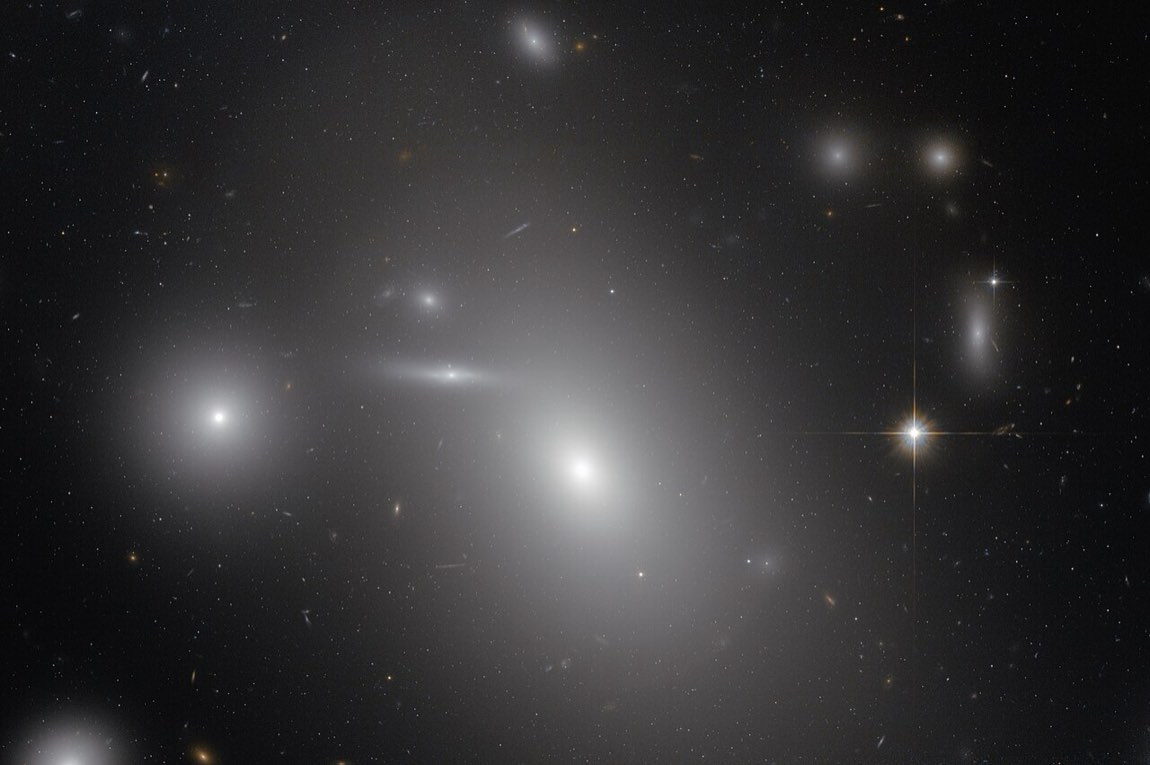
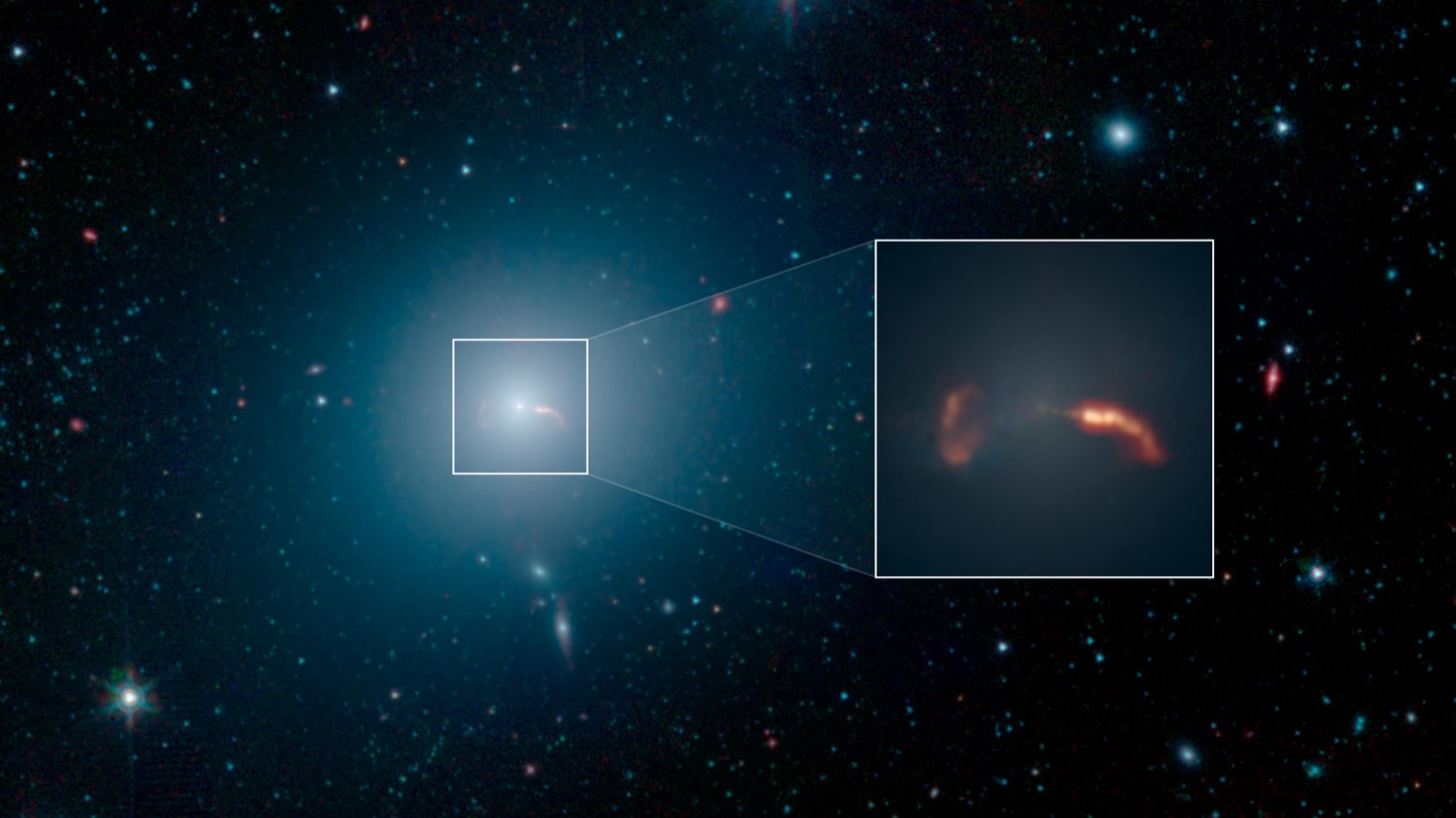
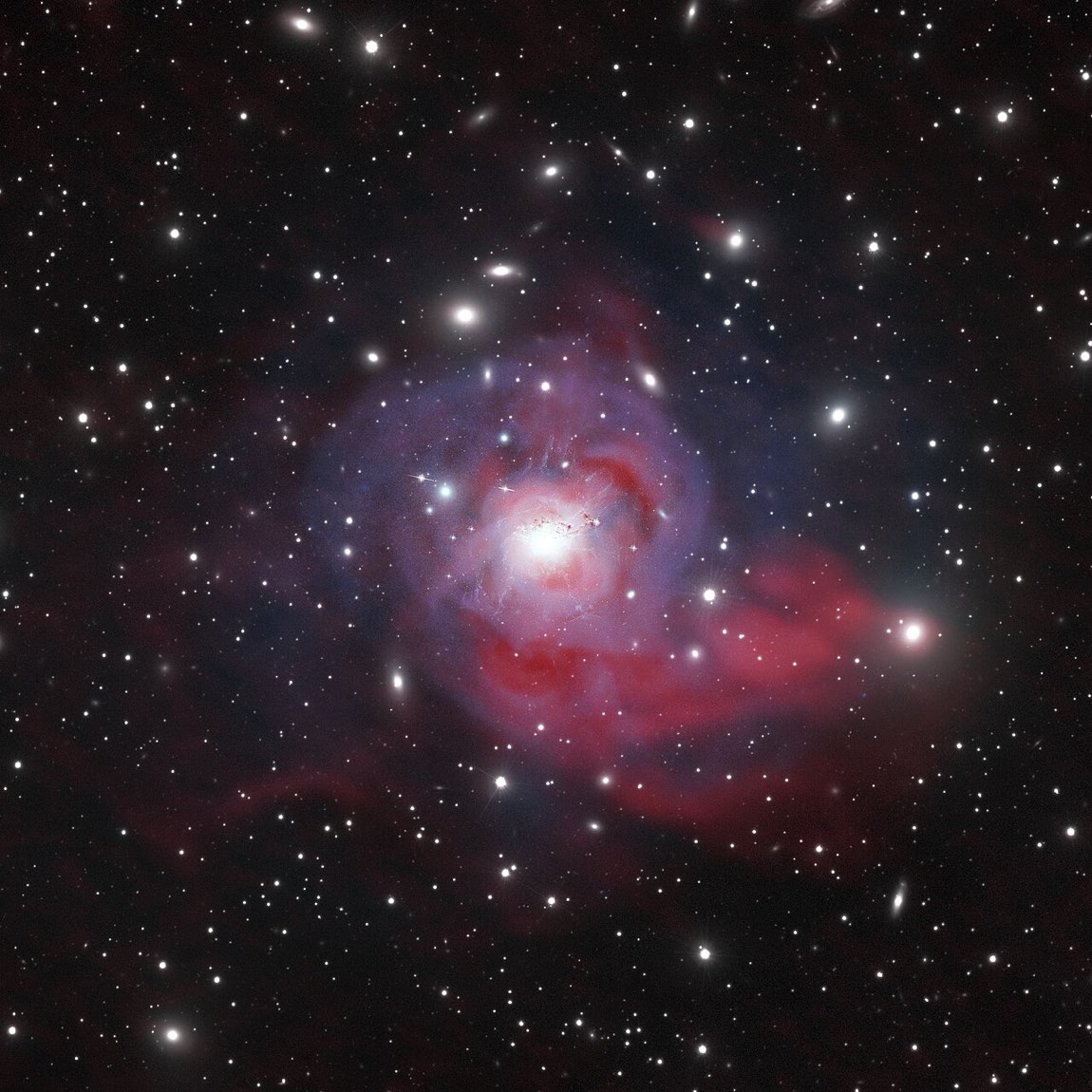
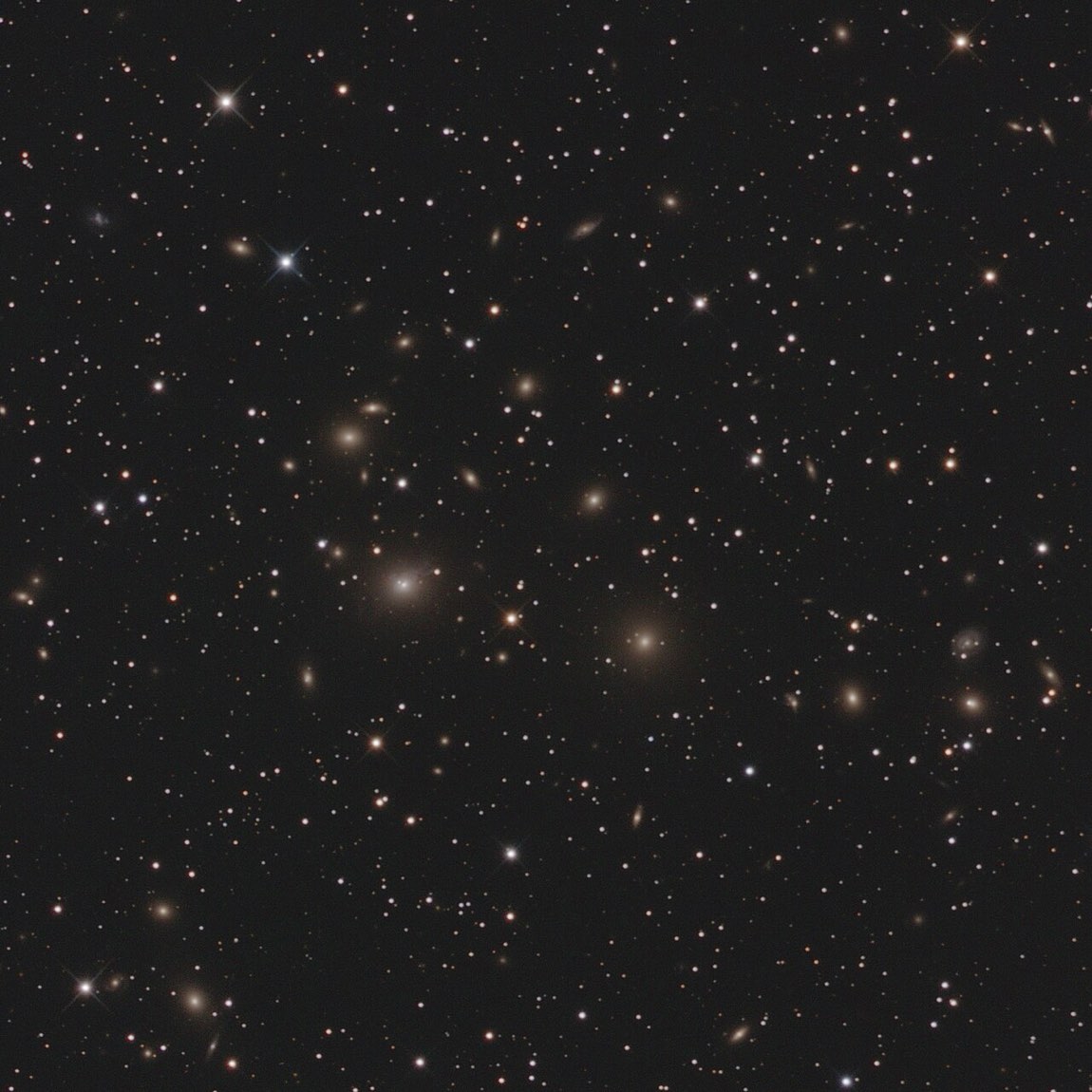
 Photograph · Marie-Lou Gendron-Marsolais (Université de Montréal) , Julie Hlavacek-Larrondo ( · CC BY 4.0
Galaxy · Deep guide
NGC 1275 (Perseus A)
Also called: Caldwell 24 · C24 · Perseus A · 3C 84 · PGC 12429 · UGC 2669
The giant galaxy at the heart of the Perseus Cluster, blasting jets into the gas around it.
What is it?
NGC 1275 is the dominant galaxy at the centre of the Perseus Cluster of galaxies, about 225 million light-years away. It is an active Seyfert galaxy: a supermassive black hole at its core powers jets of particles that heat the surrounding cluster gas so strongly it shines in X-rays. In front of it lies a second, smaller galaxy moving toward it at about 3,000 km/s and being stripped of gas as it falls into the cluster. NGC 1275 is also a bright radio source, known as Perseus A or 3C 84. William Herschel discovered it on 17 October 1786.
The deep dive
Researched for the Atlas from Wikipedia — NGC 1275 (2,973 characters read) · updated Nov 15, 2026
01 Two Galaxies Hiding as One
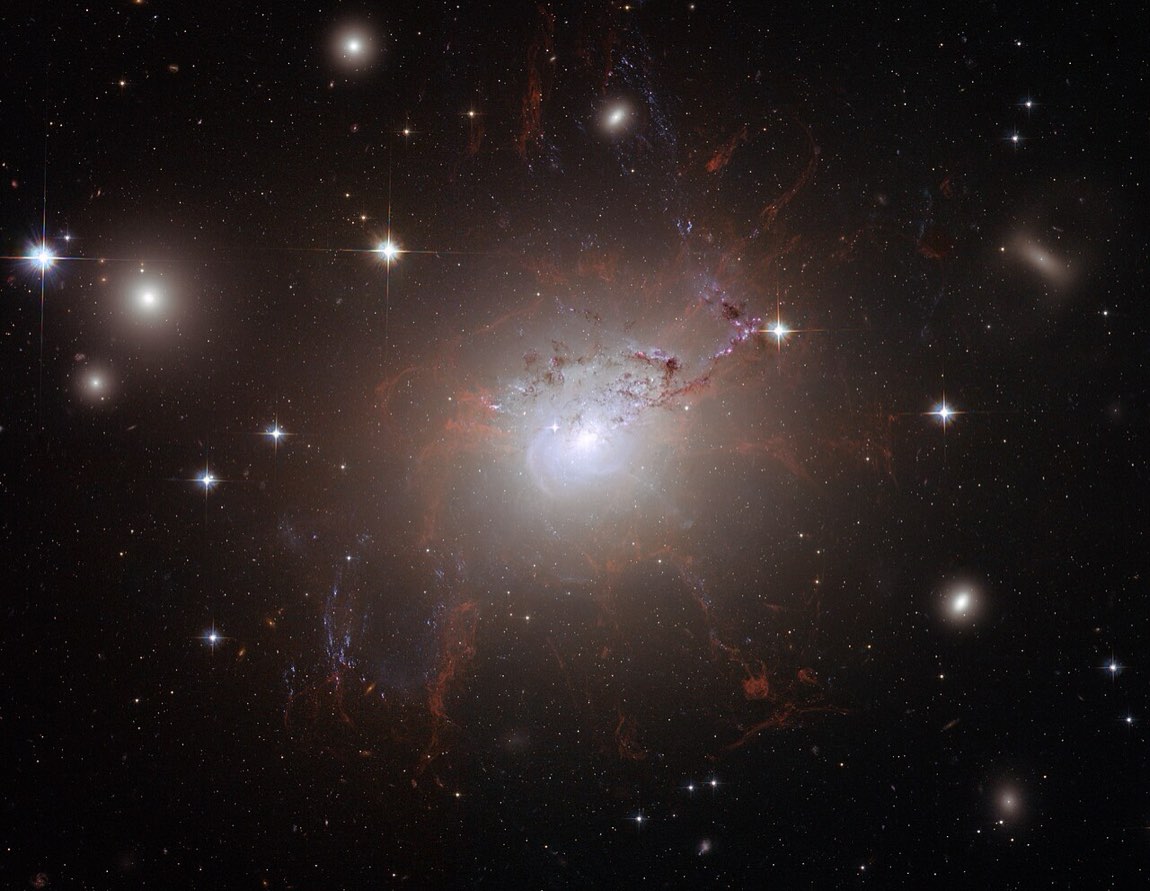
What looks like a single galaxy in a casual photograph is actually two distinct systems caught in a slow-motion cosmic encounter. The dominant one is a type cD galaxy — a giant, diffuse beast that sits at the gravitational heart of the Perseus Cluster. In front of it lies the so-called high velocity system, or HVS, a separate galaxy plowing toward the cluster at 3,000 kilometers per second — roughly ten times faster than typical galaxy motions within clusters. Despite that alarming speed, the HVS has not yet physically touched the cD galaxy; it still sits at least 200,000 light-years in front of it. But the cluster itself is already tearing the HVS apart. Tidal forces are distorting its structure, while the dense, hot gas that fills the space between cluster galaxies — the intracluster medium — rams into the HVS and strips away its gas like wind peeling paint off a surface. That stripped gas is not just lost: some of it is collapsing into new stars, so the violent process is paradoxically driving a burst of star formation in the doomed galaxy.
02 Ghostly Threads Longer Than Imagination
Among the most striking features of NGC 1275 is a vast network of glowing filaments that stream outward from the galaxy's center into the surrounding cluster. These are not wisps — a typical thread contains roughly one million times the mass of the Sun. Yet each thread is only about 200 light-years wide while stretching up to 20,000 light-years in length, making them extraordinarily thin and straight for structures on a galactic scale. For comparison, 20,000 light-years is roughly one-fifth of the diameter of the Milky Way. The filaments glow by emitting specific spectral lines, betraying the presence of relatively cool gas embedded within the multimillion-degree, X-ray-emitting gas that permeates the Perseus Cluster. The leading explanation for why they exist at all is that rising bubbles of relativistic plasma, launched by the galaxy's active nucleus, drag the cooler gas outward like smoke following a rising thermal, pulling threads of material far beyond where they would otherwise reach.
03 Why Haven't the Filaments Fallen Apart? Deeper
The filaments of NGC 1275 present a genuine puzzle for astrophysicists. The surrounding intracluster gas is at temperatures of millions of degrees, while the filaments are vastly cooler. By normal physical reasoning, the temperature difference should cause the threads to rapidly absorb heat from their surroundings and either warm up and disperse, or cool further and collapse under gravity to form stars. Neither fate appears to have befallen them — they persist as thin, coherent structures over timescales that are difficult to explain. One hypothesis invokes weak magnetic fields threading through the filaments, estimated at roughly one ten-thousandth the strength of Earth's own magnetic field. Even at that modest strength, the field could exert enough pressure on the charged ions within the threads to prevent them from diffusing outward into the hot surrounding gas. The magnetic field would essentially act as an insulating sheath, holding the cool material together against the thermal assault from outside. This explanation is plausible but not yet confirmed, and the longevity and straightness of the filaments remains an active area of debate.
 ⤢
04 A Supermassive Engine at the Center
At the heart of NGC 1275 sits a supermassive black hole whose presence is betrayed by the galaxy's classification as a type 1.5 Seyfert — a class of active galactic nucleus that shines with the energy of accreting matter falling inward. The black hole is surrounded by a rotating disk of molecular gas, and astronomers have been able to study that disk in remarkable detail. Using adaptive optics on the Gemini North telescope — a technique that corrects for the blurring effects of Earth's atmosphere in real time — researchers measured the rotation of the disk at high resolution. From those measurements, they derived a central mass of approximately 800 million solar masses. That figure encompasses both the black hole itself and the inner core of the surrounding gas disk, so the black hole alone is likely somewhat less than 800 million solar masses, but it still ranks among the most massive known. To feed this engine, NGC 1275 draws on a reservoir of 13 billion solar masses of molecular hydrogen that appears to be raining inward from the Perseus Cluster's intracluster medium in a process called a cooling flow.
05 Cooling Flows and the Galaxy's Fuel Supply Deeper
The Perseus Cluster is one of the most luminous X-ray sources in the sky, and much of that luminosity comes from the hot, dense gas that fills the cluster. Where that gas is densest — near NGC 1275 at the cluster's center — it radiates energy so efficiently that it slowly cools and sinks inward, a phenomenon called a cooling flow. NGC 1275 sits squarely at the bottom of this gravitational and thermodynamic drain. The result is that an estimated 13 billion solar masses of molecular hydrogen has accumulated around the galaxy, apparently infalling from the intracluster medium. This material serves a dual purpose: some of it feeds the central active galactic nucleus, maintaining the black hole's activity and the production of the relativistic plasma jets that inflate the bubbles driving the filaments outward. The rest fuels significant star formation, turning the region around NGC 1275 into an unusually productive stellar nursery by the standards of a cluster-center galaxy. The interplay between the nucleus heating the gas and the cooling flow replenishing it creates a feedback loop that shapes the entire central region of the Perseus Cluster, not just the galaxy itself.
06 Three Supernovae and What They Tell Us
NGC 1275 has hosted at least three observed supernovae across six decades, each caught by different observers using different methods. The first, SN 1968A, was discovered by Hungarian astronomer Miklós Lovas on 25 January 1968, though its type was never firmly established; it reached an apparent magnitude of 15.5. Nearly four decades later, on 31 December 2005, SN 2005mz was found by Jack Newton, Mike Peoples, and Tim Puckett — a Type Ia supernova, the thermonuclear explosion of a white dwarf star, reaching magnitude 18.2. Most recently, SN 2024xav was discovered on 2 October 2024 by the GOTO survey at magnitude 18.63, classified as a Type II-P supernova, the core-collapse death of a massive star that produces a characteristic plateau in its light curve. The diversity of types reflects the range of stellar populations within the galaxy. At 225 million light-years, none of these supernovae were visible to the naked eye, but each provided a snapshot of stellar evolution unfolding inside an active, complex galactic environment that is simultaneously forming new stars and housing an energetic central nucleus.
 ⤢
07 The Radio Source Known as 3C 84
NGC 1275 carries three catalog names that reflect the history of how it was discovered and studied across different wavelengths. The designation 3C 84 places it in the Third Cambridge Catalogue of Radio Sources, one of the foundational surveys that mapped the radio sky in the mid-twentieth century and led astronomers to identify many active galactic nuclei. The name Perseus A follows a convention of naming the brightest radio source in a constellation with its parent constellation's name and the letter A, in analogy with naming conventions for other bright celestial radio emitters. The active galactic nucleus responsible for this radio emission is also the source of the relativistic plasma jets and rising bubbles that shape the filament network. The original optical discovery, however, predates radio astronomy entirely: William Herschel first recorded the galaxy on 17 October 1786, centuries before anyone knew it harbored one of the most energetic nuclei in the nearby universe. That layered discovery history — optical, radio, then X-ray and infrared — mirrors the broader story of how astronomy has revealed the true complexity of galaxies like this one.
08 NGC 1275 as the Perseus Cluster's Anchor Deeper
NGC 1275 is not simply a member of the Perseus Cluster — it is the dominant central galaxy around which the entire cluster is organized. Its classification as a cD galaxy signals this status: cD galaxies are the largest and most massive type of elliptical galaxy, found only at the gravitational centers of rich clusters, where they have grown by cannibalizing smaller galaxies over billions of years. The Perseus Cluster itself is described in the article as a large cluster, and NGC 1275's position at its heart means the galaxy experiences the highest density of hot intracluster gas, the strongest infall of cooling material, and the most intense gravitational interactions of any cluster member. The HVS currently falling toward the cluster is an example of an ongoing accretion event — a galaxy being added to the cluster's mass budget, with its gas already being stripped and redistributed. The cooling flow feeding 13 billion solar masses of hydrogen into the central region is likewise a cluster-scale phenomenon channeled into the galaxy. In this sense, NGC 1275 functions less like an isolated object and more like the metabolic center of an enormous cosmic structure, processing infalling matter and returning energy to the cluster through its jets and relativistic plasma bubbles.
09 Seeing It Through a Telescope
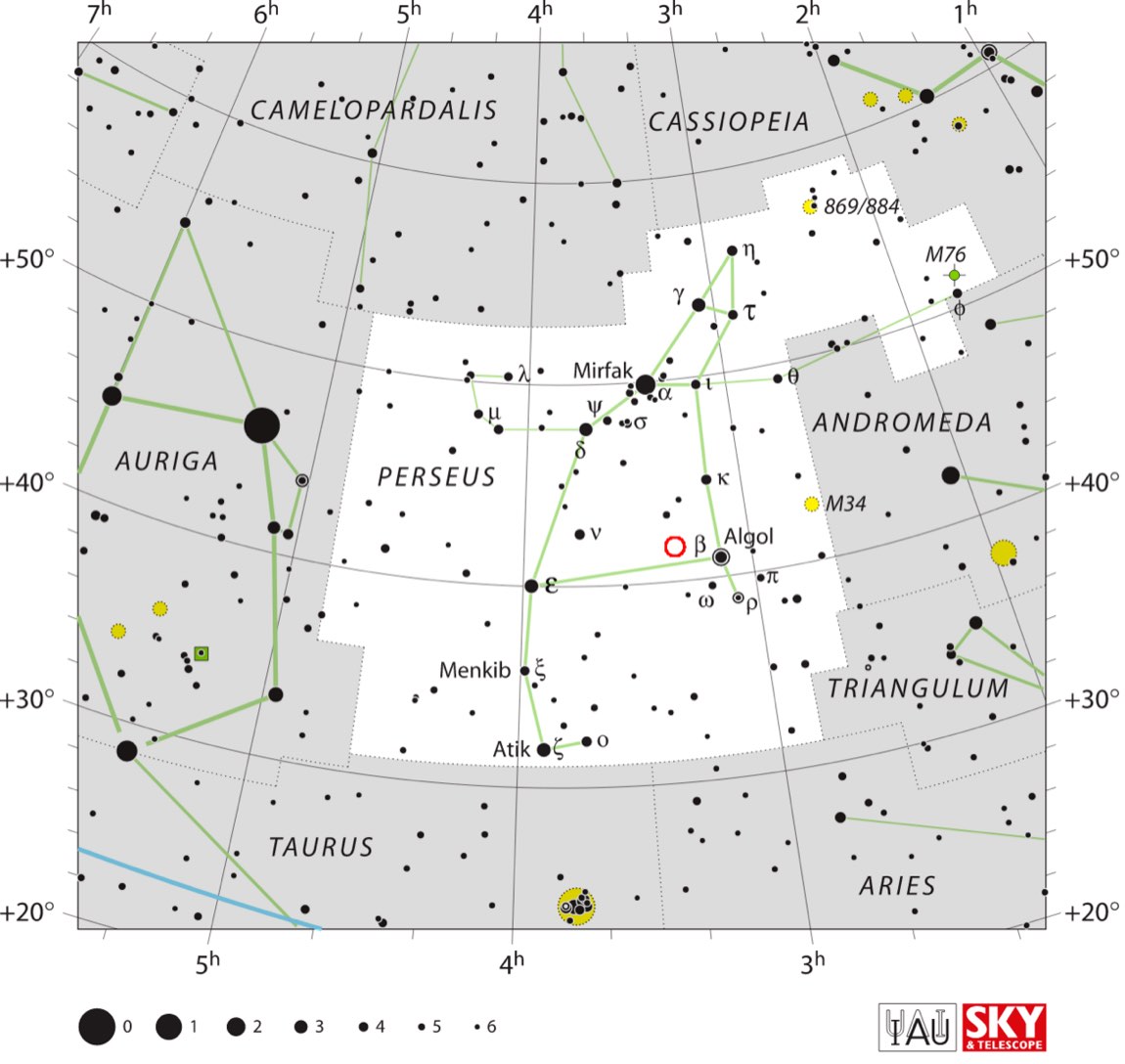
NGC 1275 lies in the constellation Perseus at an apparent magnitude that places it within reach of moderately large amateur telescopes under good conditions, though its appearance through an eyepiece gives little hint of the extraordinary physics occurring within it. It sits approximately 225 million light-years from Earth — a distance so vast that the light arriving tonight left the galaxy before the first dinosaurs appeared on Earth. The galaxy is part of the Perseus Cluster, a concentration of galaxies dense enough that a skilled observer can detect multiple cluster members in the same wide field of view. The filaments, the AGN jets, the high velocity system, and the X-ray glow of the intracluster medium are all invisible to optical telescopes without specialized equipment; they are revealed only through radio telescopes, X-ray space observatories, and instruments with adaptive optics systems like those used at Gemini North. For observers interested in tracking the site over time, the three historical supernovae in NGC 1275 serve as a reminder that explosive events can and do occur in this galaxy, and future supernovae remain a genuine possibility worth monitoring.
 ⤢
10 Open Questions That Keep Astronomers Busy Deeper
NGC 1275 sits at the intersection of several unresolved problems in astrophysics. The survival of the cool filaments against the thermal pressure of the surrounding multimillion-degree gas is not yet satisfactorily explained; the magnetic field hypothesis is plausible but requires more direct observational confirmation. The exact mass of the central black hole remains somewhat uncertain because the measurement of approximately 800 million solar masses blends the black hole's own mass with that of the surrounding gas disk's inner core, and separating the two contributions cleanly requires even higher resolution data. The nature and long-term fate of the high velocity system is also an open question: astronomers believe it is merging with the Perseus Cluster, but the timeline and the eventual outcome for the galaxy's stars and remaining gas are not fully mapped. More broadly, the feedback loop between the AGN, the relativistic jets, the rising plasma bubbles, and the cooling flow represents one of the central unsolved problems in galaxy cluster physics — understanding precisely how energy from the black hole regulates star formation and gas cooling across scales of hundreds of thousands of light-years remains a leading challenge for the field.