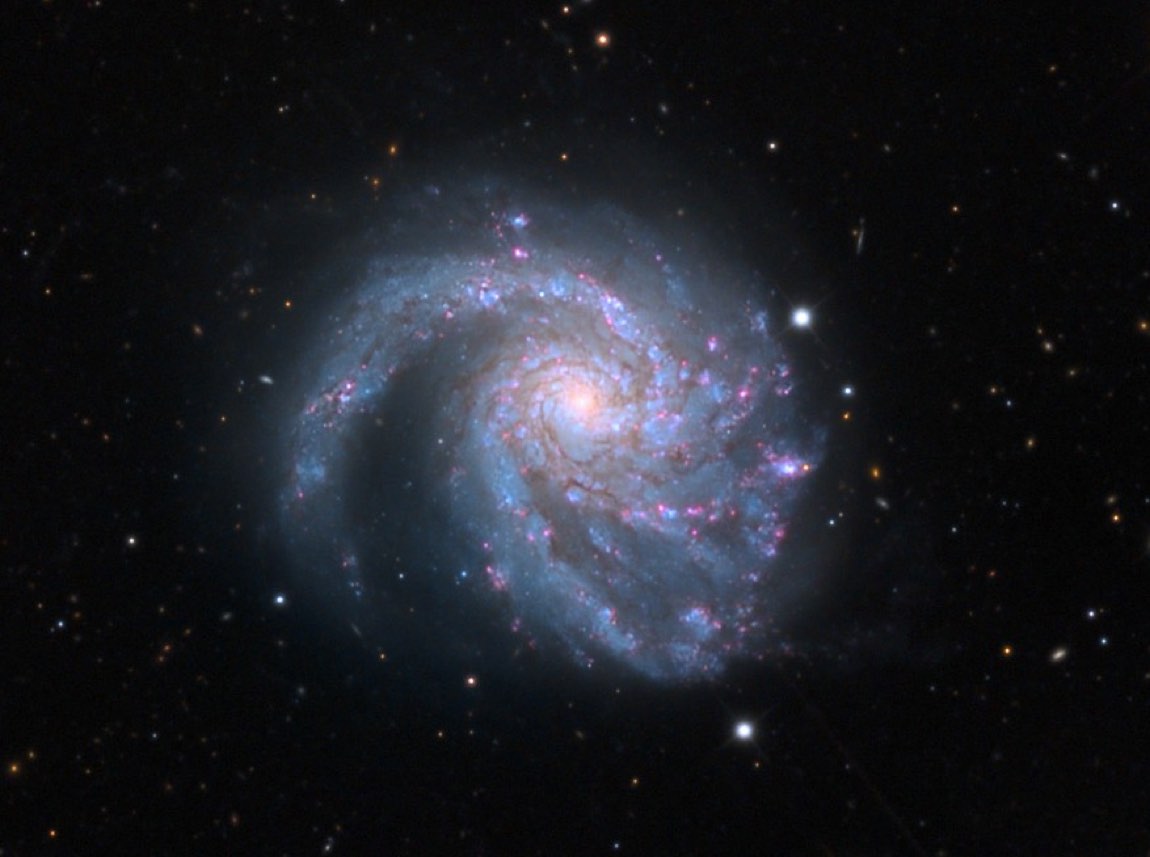
 Photograph · Credit Line and Copyright Adam Block/Mount Lemmon SkyCenter/University of Arizon · CC BY-SA 3.0
Galaxy · Deep guide
Messier 99 (Coma Pinwheel)
Also called: M99 · NGC 4254 · Coma Pinwheel Galaxy · St. Catherine's Wheel · Virgo Cluster Pinwheel
A lopsided pinwheel with one arm pulled long, one of the first spirals ever recognised.
What is it?
Messier 99, the Coma Pinwheel, is a spiral galaxy in Coma Berenices discovered by Pierre Méchain on 17 March 1781. In 1846 Lord Rosse saw its spiral pattern, making it one of the first galaxies known to be a spiral. It is lopsided: one arm looks normal, while another is stretched out and loosely wound. A bridge of hydrogen gas links it to VIRGOHI21, a gas cloud that might be a dark galaxy, though it may instead be debris from an encounter with another galaxy about 280 million years ago.
The deep dive
Researched for the Atlas from Wikipedia — Messier 99 (2,485 characters read) · updated Nov 15, 2026
01 Discovered in a Single Remarkable Week
Pierre Méchain spotted M99 on 17 March 1781, during one of the most productive stretches in observational astronomy history. He promptly reported the finding to Charles Messier, who was assembling his famous catalogue of fuzzy, comet-like objects that could fool observers into false alarms. The catalogue was essentially a nuisance-prevention list, yet it ended up immortalising some of the sky's most spectacular deep-sky objects. M99 earned its slot as number 99 in that list, tucked into the northern constellation Coma Berenices. What Méchain and Messier could not know was that they were cataloguing a galaxy — a vast island of hundreds of billions of stars — roughly 49,000,000 light-years away. The concept of external galaxies lay more than a century in the future. To eighteenth-century eyes, M99 was simply an unresolved luminous smear, indistinguishable in character from a distant comet frozen in place.
02 The Moment Spiral Structure Was Revealed
For decades after its discovery, M99 remained little more than a glowing patch. That changed in the spring of 1846, when William Parsons, the third Earl of Rosse, turned his enormous 72-inch reflecting telescope — nicknamed the Leviathan of Parsonstown — toward the constellation Coma Berenices. Lord Rosse became the first person to identify a spiral pattern in M99, making it one of only a handful of objects in which spiral structure was recognised during that pioneering era. At the time, there was no consensus on what these spiral nebulae actually were: some astronomers thought they might be solar systems in formation, others suspected they were distant star cities. Regardless, the spiral shape Rosse traced in M99 was real and reproducible, and it planted a seed of curiosity that would eventually flower into our modern understanding of galaxy morphology. M99 thus holds a small but genuine place in the history of cosmic discovery.
03 Anatomy of a Grand Design Spiral Deeper
M99 carries the morphological classification SA(s)c, a shorthand that encodes several structural facts at once. The 'SA' indicates a pure spiral with no central bar — unlike barred spirals such as our own Milky Way. The '(s)' means the arms wind outward from the nucleus in an s-shape rather than connecting to an outer ring, and the 'c' places it at the loose end of the spiral-arm winding scale, meaning its arms are open and spread wide rather than tightly coiled. The galaxy is tilted 42° to our line of sight, so we see it at an intermediate angle — neither face-on nor edge-on — with its major axis oriented at a position angle of 68°. That tilt is actually fortunate for astronomers: it allows features on both the near and far sides of the disk to be studied without the extreme foreshortening that an edge-on view would impose. Despite the 'grand design' label implying symmetry, M99 is notably asymmetric, with one arm appearing normal and a second arm that is extended and wound far more loosely.
04 A Ghost Galaxy and a Bridge of Gas
One of the strangest features associated with M99 is a filament of neutral hydrogen gas stretching from the galaxy toward an object called VIRGOHI21. This HI region is unusual because it appears to have the mass of a galaxy but emits no detectable starlight, making it a candidate 'dark galaxy' — a hypothetical structure composed mostly of dark matter and gas, with little or no stellar population. The gravitational pull of VIRGOHI21 may have distorted M99's shape and drawn out the hydrogen bridge that now connects them, the result of a close encounter between two galaxy-sized objects that have since drifted far apart. However, the picture is not settled. An alternative explanation proposes that VIRGOHI21 is not a dark galaxy at all, but rather tidal debris shed during a close interaction between M99 and the lenticular galaxy NGC 4262 roughly 280 million years ago. Distinguishing between these two scenarios is an active area of research, because confirming even one genuine dark galaxy would have significant implications for theories of galaxy formation.
05 Plunging into the Virgo Cluster
M99 is not a settled, isolated spiral living out a quiet existence. Astronomers believe it is most likely falling into the Virgo Cluster for the very first time, currently bound to the cluster's outskirts at a projected separation of about 3.7°, or roughly one megaparsec, from the cluster's gravitational heart near the giant elliptical galaxy Messier 87. That infall has consequences. As M99 plunges through the hot, tenuous gas that fills the space between cluster galaxies — the intracluster medium — a process called ram-pressure stripping is actively sweeping interstellar gas out of M99's disk, much as wind strips leaves from a tree. This gas is the raw fuel for future star formation, so its removal will gradually throttle the galaxy's ability to make new stars. M99 is therefore caught at a transitional moment: still vigorously forming stars today, but on a long-term trajectory toward the gas-poor, star-formation-quiet fate common among galaxies deep inside dense clusters.
06 Star Formation Running at Triple Speed Deeper
Although M99 is not formally classified as a starburst galaxy — a category reserved for objects with truly extreme, often short-lived bursts of star birth — its rate of star formation is still three times higher than that of other galaxies sharing its Hubble type. That elevated activity is thought to have been triggered by the gravitational disturbance of its encounter with either VIRGOHI21 or NGC 4262. Interactions between galaxies are well-established drivers of star formation: the compression of gas clouds by tidal forces and shock waves can trigger the collapse of molecular clouds into new stars far more efficiently than quiescent internal processes alone. For M99, this means that whatever encounter stirred up its gas also accelerated its stellar birthrate to a pace unusual for a spiral of its kind. The extended, loosely wound arm that characterises M99's asymmetric appearance is expected to gradually relax and tighten back to something resembling its normal arm once the gravitational disturbance from the encounter has fully subsided.
07 Four Supernovae Lighting Up One Galaxy
With a star formation rate running well above average, it is perhaps unsurprising that M99 has hosted an unusually eventful record of stellar explosions. Four supernovae have been observed within it over roughly five decades. SN 1967H, a Type II supernova reaching magnitude 14.0, was discovered by the prolific Fritz Zwicky on 1 July 1967. SN 1972Q, whose type remains unknown, was spotted at magnitude 15.8 by Leonida Rosino on 14 December 1972. SN 1986I, another Type II event at magnitude 14, was found by Carlton Pennypacker and collaborators on 17 May 1986. Most recently, SN 2014L — a Type Ic supernova, the kind that arises when a massive star has shed both its hydrogen and helium envelopes — was discovered at magnitude 17.2 by the THU-NAOC Transient Survey on 26 January 2014. Each type tells astronomers something different about the progenitor star: Type II supernovae retain their hydrogen envelopes, while Type Ic events do not, hinting at binary interactions or powerful stellar winds before the explosion.
08 A Rare Stellar Merger Caught in the Act Deeper
Beyond its four supernovae, M99 has also hosted a far rarer and more recently understood class of stellar explosion. On 16 April 2010, the Palomar Transient Factory detected a transient designated PTF 10fqs, classified as a luminous red nova and reaching magnitude 20.1. Luminous red novae are not supernovae at all; they represent a completely different physical process — the merger of two stars into a single, more massive object. As the two stars spiral together and finally collide, they eject a shell of cool, red-glowing gas and release a burst of luminosity intermediate between ordinary novae and supernovae. The 'red' in the name refers to the distinctly cool, reddish spectrum produced by this ejected material. PTF 10fqs in M99 belongs to a small but growing catalogue of such events identified in external galaxies, and its detection at magnitude 20.1 — far fainter than any of the galaxy's supernovae — required the automated, wide-field survey capabilities that modern transient-detection programmes like the Palomar Transient Factory were specifically designed to provide.
09 Its Two Names and What They Picture
M99 carries two evocative common names, each inspired by its visual appearance. The more widely used is the Coma Pinwheel Galaxy, a straightforward reference both to its host constellation, Coma Berenices, and to the spinning pinwheel shape its loosely wound spiral arms suggest when viewed in a telescope. The second name, St. Catherine's Wheel, invokes the spiked, rotating wheel associated with the martyrdom of Saint Catherine of Alexandria — a symbol that became a popular medieval motif precisely because of its radiating, turning appearance. Both names gesture at the same underlying geometry: open spiral arms fanning outward from a central nucleus in a pattern that feels, intuitively, like rotation made visible. The galaxy is distinct from the better-known Pinwheel Galaxy, which is Messier 101 in Ursa Major, so the qualifier 'Coma' in M99's nickname serves an important disambiguating function for observers planning a night at the eyepiece.
10 How to Find and Observe M99
M99 sits in Coma Berenices, a faint but rewarding constellation best seen from the northern hemisphere during spring evenings. With an apparent magnitude bright enough to appear in modest amateur telescopes under good skies, it is a worthwhile target for anyone equipped with more than a small refractor. Because the galaxy is inclined 42° to our line of sight — not face-on, but not edge-on either — observers with larger apertures can begin to trace the asymmetry between its two arms, particularly the extended arm that is wound more loosely than its counterpart. The galaxy's position roughly one megaparsec from the Virgo Cluster center means it appears in a region of sky rich with other galaxies, so sweeping the field of view around M99 often rewards the patient observer with additional faint smudges belonging to the broader Virgo supercluster environment. Dark skies and nights of steady atmospheric seeing are the key variables: the difference between a featureless oval glow and a galaxy with hinted spiral structure often comes down to the quality of the night rather than the size of the instrument.
11 Open Questions Surrounding M99 Deeper
Several genuinely unresolved questions surround M99. Chief among them is the true nature of VIRGOHI21: is it a dark galaxy — a gravitationally bound structure composed mostly of dark matter but failing to form stars — or is it merely a cloud of tidal debris expelled during a past interaction with the lenticular galaxy NGC 4262some 280 million years ago? The answer matters well beyond M99 itself, since confirmed dark galaxies would validate predictions of certain cosmological models and alter our census of the universe's matter. A second open question concerns M99's orbital history within the Virgo Cluster: the evidence suggests this is the galaxy's first infall into the cluster, but tracing the three-dimensional trajectory of an object 49,000,000 light-years away from incomplete velocity and position data is inherently uncertain. Finally, the long-term fate of M99's elevated star formation rate — whether ram-pressure stripping will quench it on timescales of hundreds of millions of years or whether fresh gas accretion will sustain it — remains a subject of modelling and debate among researchers studying galaxy evolution in dense environments.