 Photograph · ESO · CC BY 4.0
Galaxy · Deep guide
Messier 100
Also called: M100 · NGC 4321 · Mirror Galaxy · UGC 7450 · PGC 40153
A grand spiral in the Virgo Cluster, one of the first spiral 'nebulae' ever identified.
What is it?
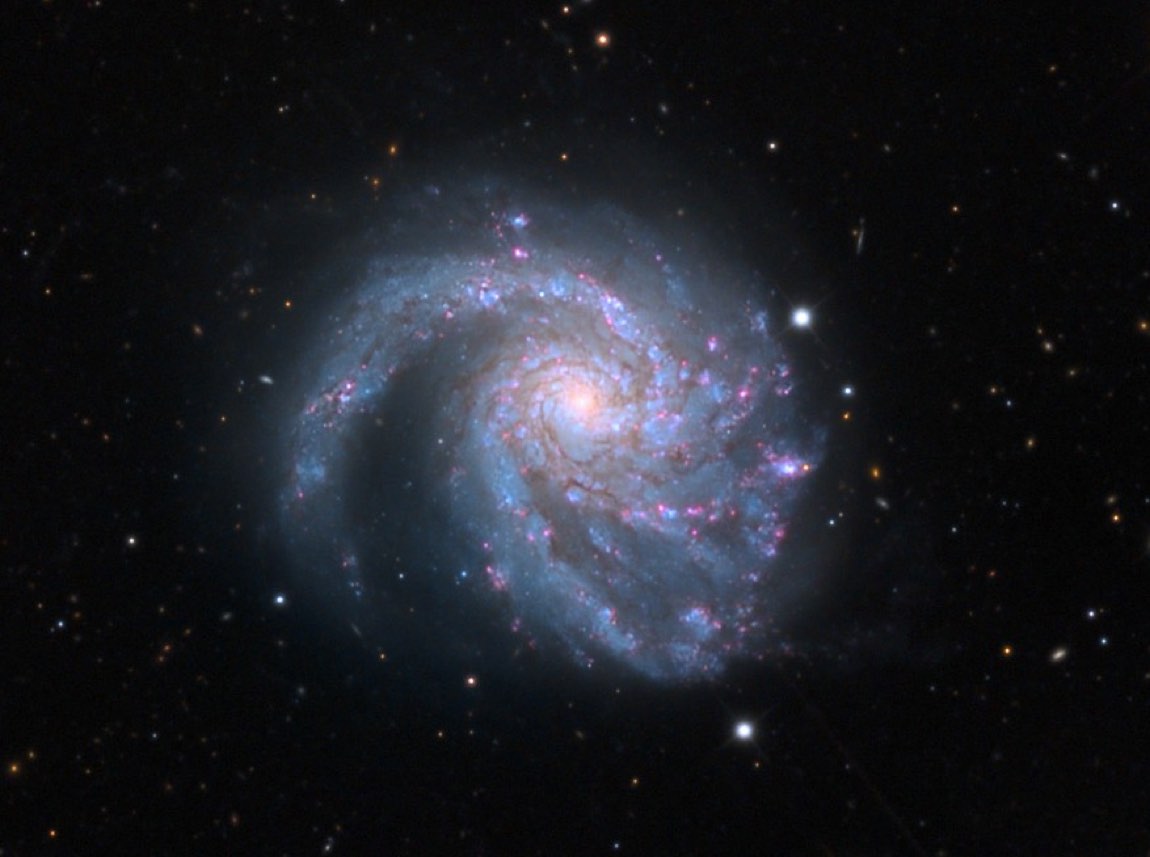
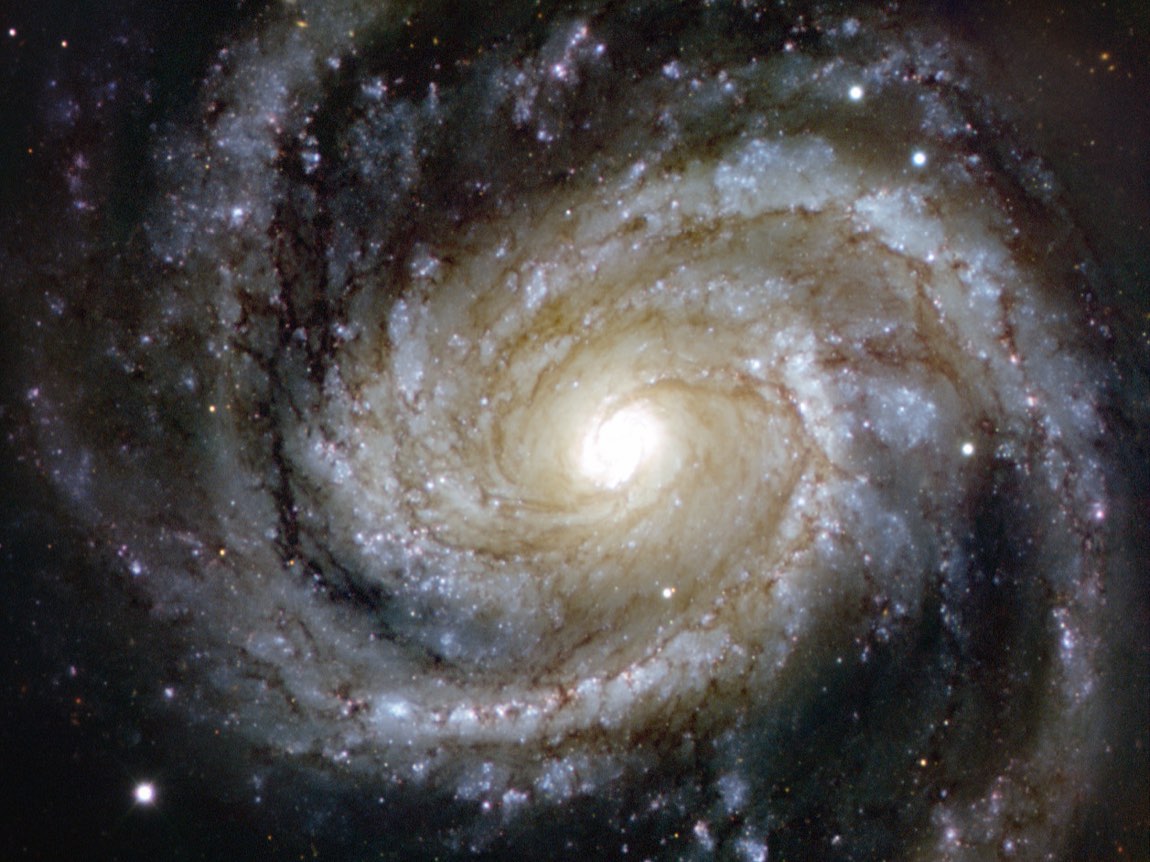
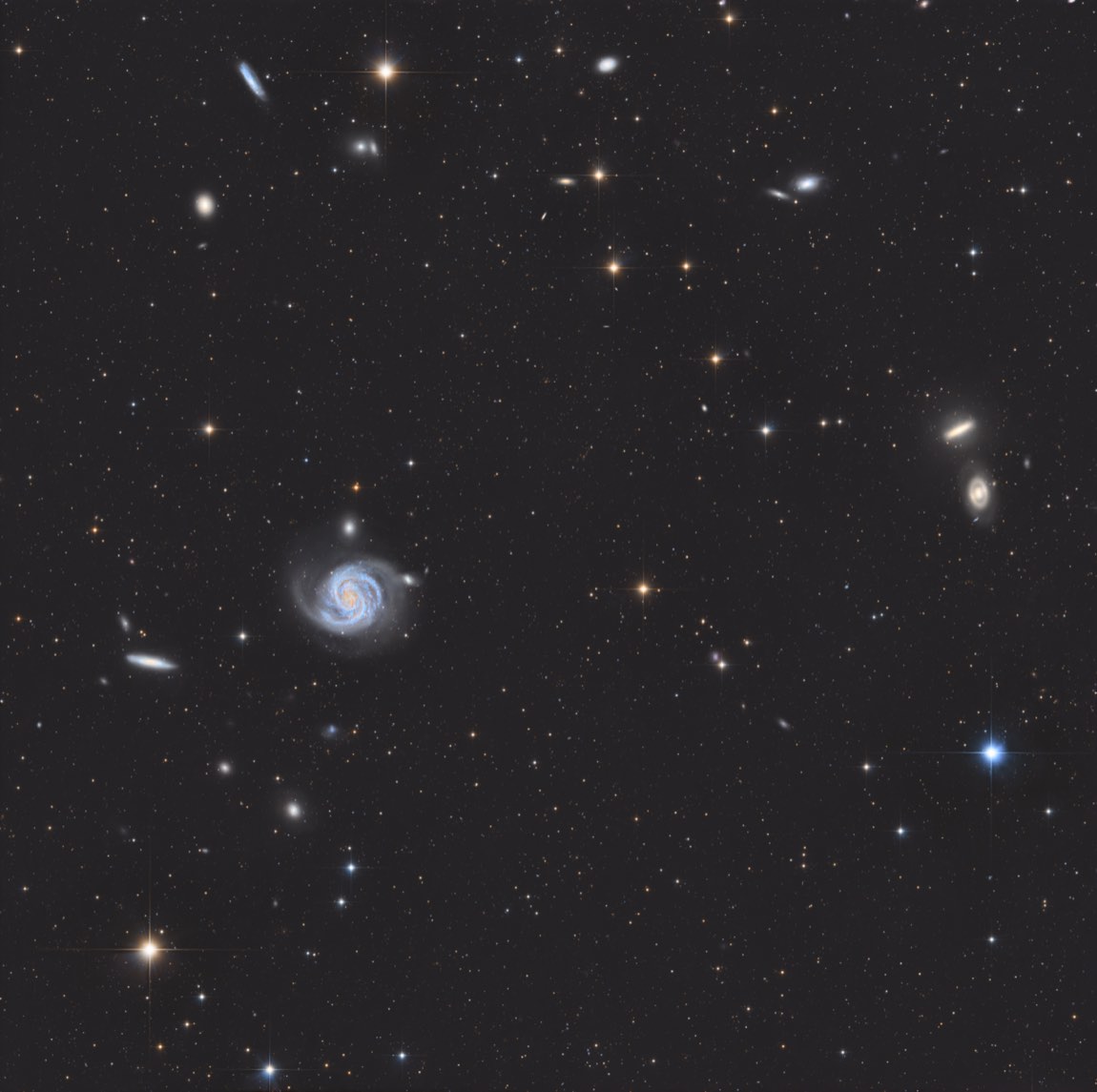
Messier 100 is a grand-design spiral galaxy in Coma Berenices and one of the brightest and largest galaxies in the Virgo Cluster. It lies about 55 million light-years away. Pierre Méchain discovered it in 1781, and Lord Rosse listed it in 1850 among the first fourteen known spiral nebulae. Its well-defined arms wind around a bright centre, and it may hold about 400 billion stars. Two small satellite galaxies, NGC 4323 and NGC 4328, orbit it; one is joined to it by a faint bridge of light.
The deep dive
Researched for the Atlas from Wikipedia — Messier 100 (2,878 characters read) · updated Nov 15, 2026
01 A Galaxy Caught in the Act of Making Stars
Messier 100 is not just a pretty spiral — it is a starburst galaxy, meaning it is manufacturing new stars at a rate far above average. The most intense action is confined to its very center, where two tightly wound spiral arms wrap around a small nuclear bar roughly one thousand parsecs across. That central ring has been producing stars in separate, distinct bursts for at least 500 million years — a span of time more than a hundred times longer than complex animal life has existed on Earth. This sustained, episodic starburst makes M100 one of the most scientifically productive targets in the Virgo Cluster for astronomers studying how galaxies build themselves over cosmic time. Each burst likely triggers the next as expanding shells of hot gas from dying massive stars compress nearby clouds of raw material, setting off fresh rounds of star birth in a self-perpetuating cycle.
02 Seven Supernovae and What They Revealed
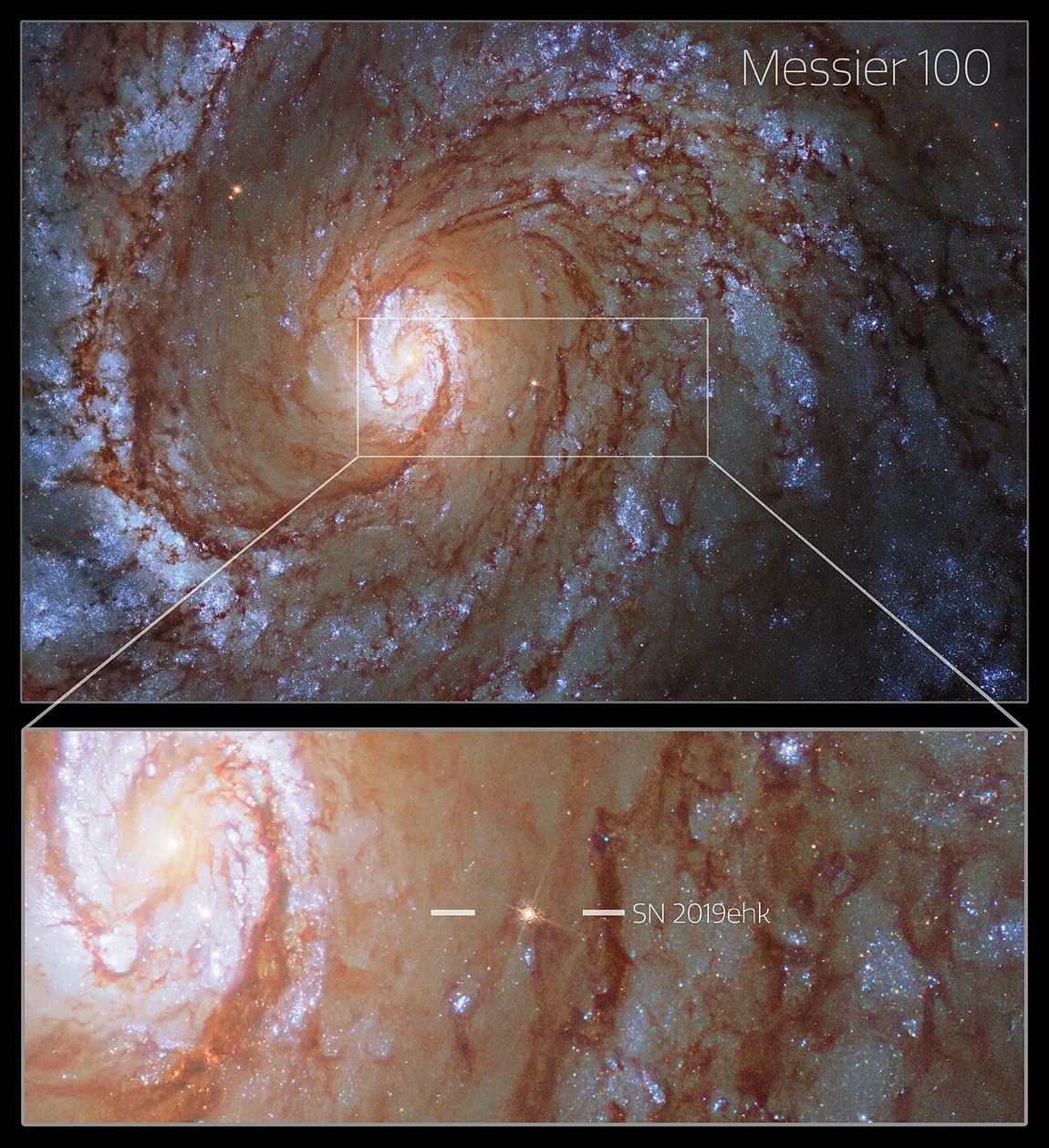
Seven supernovae have been identified in M100, an extraordinary count for a single galaxy and a direct testament to its vigorous star formation. The tally spans more than a century of observation, opening with SN 1901B, a Type I event at magnitude 15.6 discovered by Heber Curtis on 17 March 1901. Curtis found a second supernova, SN 1914A, on 2 March 1914, though its type remains unknown. Milton Humason added SN 1959E at a fainter magnitude 17.5 around early to mid 1960. Amateur astronomer Gus Johnson then scored a landmark discovery on 15 April 1979 with SN 1979C — the first confirmed Type II supernova in M100 — though the star faded quickly and was later studied across wavelengths from X-ray to radio. More recently, SN 2006X (Type Ia, magnitude 15.3) was found by Shoji Suzuki and Marco Migliardi on 7 February 2006 and faded to magnitude 17 within just two weeks, while Jaroslaw Grzegorzek caught SN 2019ehk (Type Ib) on 29 April 2019, peaking near magnitude 15.8. The automated system ALeRCE rounded out the list by detecting SN 2020oi (Type Ic) on 7 January 2020.
03 An Amateur's Greatest Moment: SN 1979C
Among M100's seven supernovae, SN 1979C stands out not only for its science but for how it was found. Amateur astronomer Gus Johnson spotted the explosion on 15 April 1979, a reminder that sky-watchers outside professional institutions can still make discoveries of genuine importance. The event was classified as a Type II supernova — the collapse of a massive star that has exhausted its nuclear fuel — and it was the first supernova of that type identified within M100. The star itself faded quickly after discovery, but the story did not end there. Subsequent observations spanning from X-ray to radio wavelengths detected the lingering remnant, allowing astronomers to study the aftermath of the explosion long after the initial brilliant flare had dimmed. That multi-wavelength follow-up transformed a brief visual event into an ongoing laboratory for understanding how stellar debris expands and interacts with the surrounding interstellar medium.
04 Satellite Galaxies and a Bridge of Light Deeper
M100 does not travel alone through the Virgo Cluster. Two smaller galaxies, NGC 4323 and NGC 4328, are recognized as its satellite galaxies, orbiting the grand spiral much as the Magellanic Clouds orbit the Milky Way. What makes the arrangement especially striking is the relationship between M100 and NGC 4323: the two are connected by a bridge of luminous matter, a physical stream of stars and gas strung between them through gravitational interaction. Such bridges are among the clearest visual signatures of tidal forces at work between galaxies, and they hint at a history of close encounters that has redistributed material from one system to the other. The bridge is a rare, direct piece of evidence that even galaxies well away from the most crowded cluster cores are actively shaping one another, trading mass and potentially triggering new rounds of star formation in both the host and its companions.
05 Its Place in the Virgo Cluster
At roughly 55 million light-years from the Milky Way, M100 sits within the Virgo Cluster, the nearest large galaxy cluster to our own Local Group. Within that sprawling congregation of hundreds of galaxies, M100 earns special status as one of the brightest and largest members, spanning about 166,000 light-years in diameter — noticeably bigger than our own Milky Way, which is generally estimated at around 100,000 light-years across. Its scale and luminosity make it a natural reference point for astronomers calibrating distances and studying how the largest spiral galaxies in dense environments differ from those in more isolated settings. Being embedded in the Virgo Cluster also means M100 experiences a more complex gravitational environment than a field galaxy would, which may help explain why both its starburst activity and its satellite interactions are so pronounced.
06 One of the First Spirals Ever Identified
The recognition of M100 as a spiral structure was itself a milestone in the history of astronomy. Lord William Parsons of Rosse — using his massive 72-inch reflecting telescope known as the Leviathan of Parsonstown — listed M100 as one of fourteen spiral nebulae in 1850. At that time, astronomers had no way to know whether these hazy spirals were clouds of gas within the Milky Way or entire island universes of their own. The debate over their true nature would not be settled definitively for another seven decades. M100's inclusion in Parsons's list placed it among the founding objects of a category that would eventually reshape humanity's understanding of the cosmos. What Méchain first noticed as a faint smudge in 1781, Parsons later revealed to have the unmistakable curved arms of a grand design spiral.
 ⤢
07 From Faint Smudge to Pearly Nebula: Early Observers' Words Deeper
The progression of early descriptions of M100 is itself a small history of improving optics and careful eyes. When Pierre Méchain discovered it in 1781, the object was apparently notable enough to alert Messier, who catalogued it 29 days later after observing it as a nebula without any discernible star — he explicitly flagged its faintness as making it hard to recognize. William Herschel, with superior equipment, managed to pick out a bright cluster of stars embedded in the glow where his predecessors had seen only haze. His son John Herschel pushed further in 1833 and described a round, brighter galaxy, though even he acknowledged the object was barely visible through clouds — an honest note of observing conditions that many modern accounts omit. William Henry Smyth added texture to the picture by characterizing M100 as a pearly white nebula and noting diffuse spots within it, language that evokes both the aesthetic beauty and the genuine scientific puzzle these early astronomers were wrestling with.
08 How the Type Ia Supernova SN 2006X Shone and Vanished Deeper
Of all the supernovae recorded in M100, SN 2006X offers one of the sharpest snapshots of a Type Ia event's rapid evolution. Discovered on 7 February 2006 by Shoji Suzuki and Marco Migliardi, it reached a peak brightness of magnitude 15.3 — bright enough to be detected with modest equipment — before fading to magnitude 17 in roughly two weeks. That swift drop from peak to near-invisibility illustrates how quickly a thermonuclear explosion can run its course relative to the leisurely timescales of most astronomical change. Type Ia supernovae are especially important to cosmologists because their peak luminosities are remarkably consistent, allowing them to serve as standard candles for measuring cosmic distances. Finding one within a well-studied nearby galaxy like M100 gave astronomers a valuable nearby reference point, and observations of SN 2006X contributed to ongoing efforts to understand the environments in which these explosions occur and how interstellar dust along the line of sight affects their apparent brightness.
09 The Automated Sky That Found SN 2020oi
The discovery of SN 2020oi on 7 January 2020 marks a generational shift in how supernovae are found. Unlike the earlier events in M100's history — spotted by individual observers scanning photographic plates or eyepiece views — SN 2020oi was detected by ALeRCE, the Automatic Learning for the Rapid Classification of Events system. This platform applies machine learning algorithms to data streams from wide-field sky surveys, identifying and classifying transient events in near real time without waiting for a human to notice a brightening dot. The supernova was classified as Type Ic, a variety thought to arise from massive stars that have shed both their hydrogen and helium envelopes before exploding. That ALeRCE could flag a magnitude 17.28 event in a galaxy 55 million light-years away within days of its appearance illustrates how thoroughly automated astronomy has transformed the search for rare, short-lived cosmic events that might otherwise go unnoticed for weeks.
10 Observing M100: What You Actually See
Messier 100 sits in the constellation Coma Berenices and carries an apparent magnitude that places it among the more accessible Virgo Cluster galaxies for amateur observers, though Messier himself warned it was notably faint and hard to recognize. Through a small telescope under good skies, it appears as a round, softly glowing patch — much as John Herschel described a round, brighter galaxy, while still noting how clouds could render it barely visible. Larger apertures begin to hint at the spiral structure, and the two main arms of this grand design spiral become detectable in photographs even with modest equipment. Its companion NGC 4323, connected by the luminous bridge, lies nearby but requires careful attention to distinguish from background objects. Because it is one of the brightest and largest galaxies in the Virgo Cluster, M100 is a natural anchor point for galaxy-hopping sessions through that region of sky in spring, when Coma Berenices rides high in the northern hemisphere.
11 Open Questions About Its Starburst Cycles Deeper
Despite over two centuries of observation, M100 leaves some of its most important questions unanswered. The star formation in its central ring has been proceeding for at least 500 million years in separate bursts, but the article does not specify precisely how many distinct bursts have been identified, what triggers each new episode, or when the next one might begin. It is not established from the article what role the satellite galaxies or the luminous bridge to NGC 4323 play in fueling or regulating this activity. The classification of M100 as an intermediate spiral adds another layer of uncertainty: its morphology places it between pure barred and unbarred configurations, and what drives a galaxy into that intermediate state remains an active area of inquiry. The sheer number of supernovae — seven confirmed events — raises further questions about whether the supernova rate is elevated compared to other spirals of similar size and whether that elevation is a direct consequence of the starburst activity in the nucleus.
 ⤢