 Photograph · NASA/JPL-Caltech/ESA/STScI/CXC
Galaxy · Deep guide
The Pinwheel Galaxy
Also called: M101
Bigger than the Milky Way and lit by stellar nurseries, this giant spiral is seen face-on.
What is it?
The Pinwheel (M101), 21 million light-years away in Ursa Major, is a grand face-on spiral nearly twice the Milky Way's diameter, its arms studded with enormous pink star-forming regions. Slightly lopsided from encounters with its companions, it was also home to one of the closest recent supernovae — SN 2011fe — a cosmic distance-calibration gift.
The deep dive
Researched for the Atlas from Wikipedia — Pinwheel Galaxy (5,051 characters read) · updated Sep 20, 2026
01 How the Pinwheel Got Its Lopsided Shape
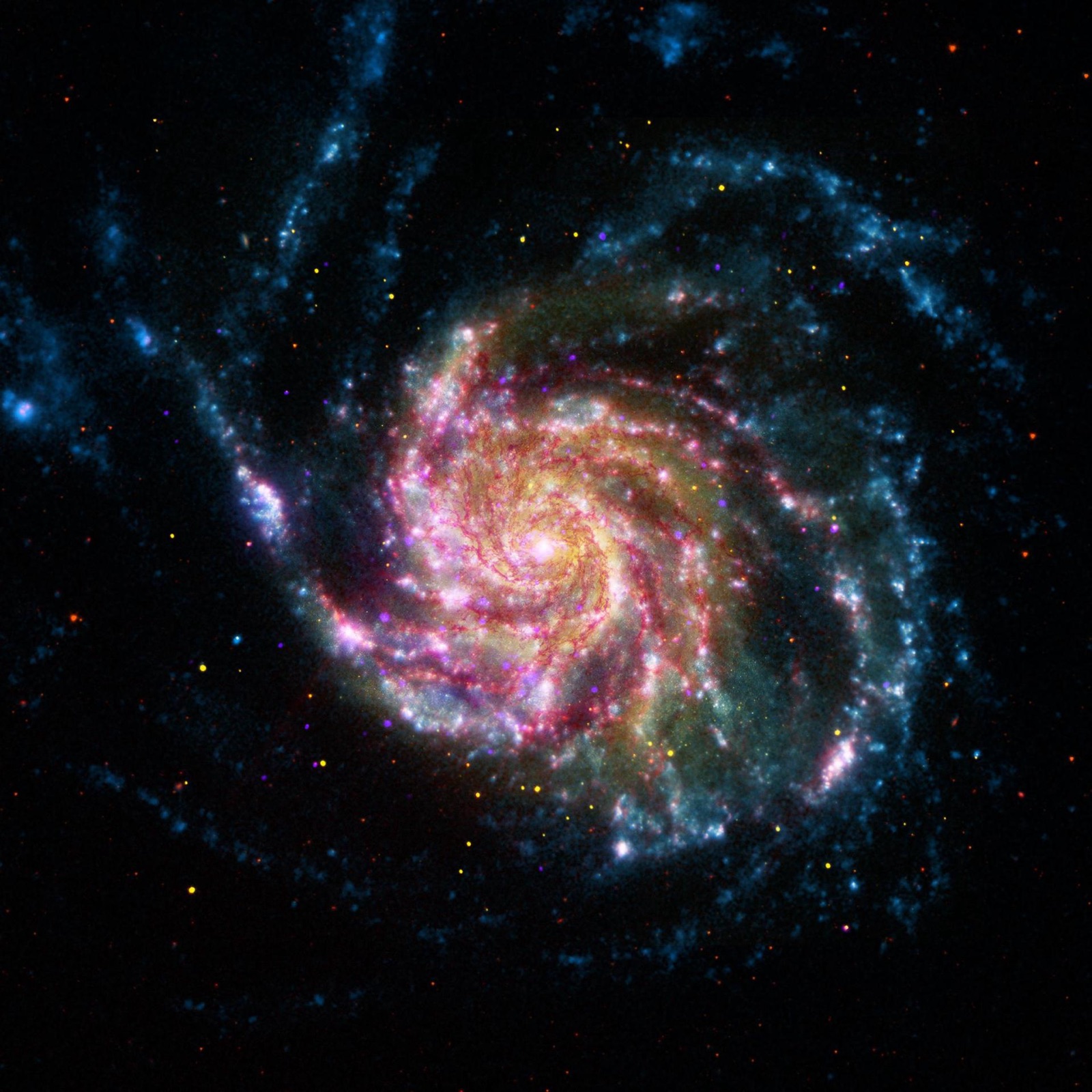
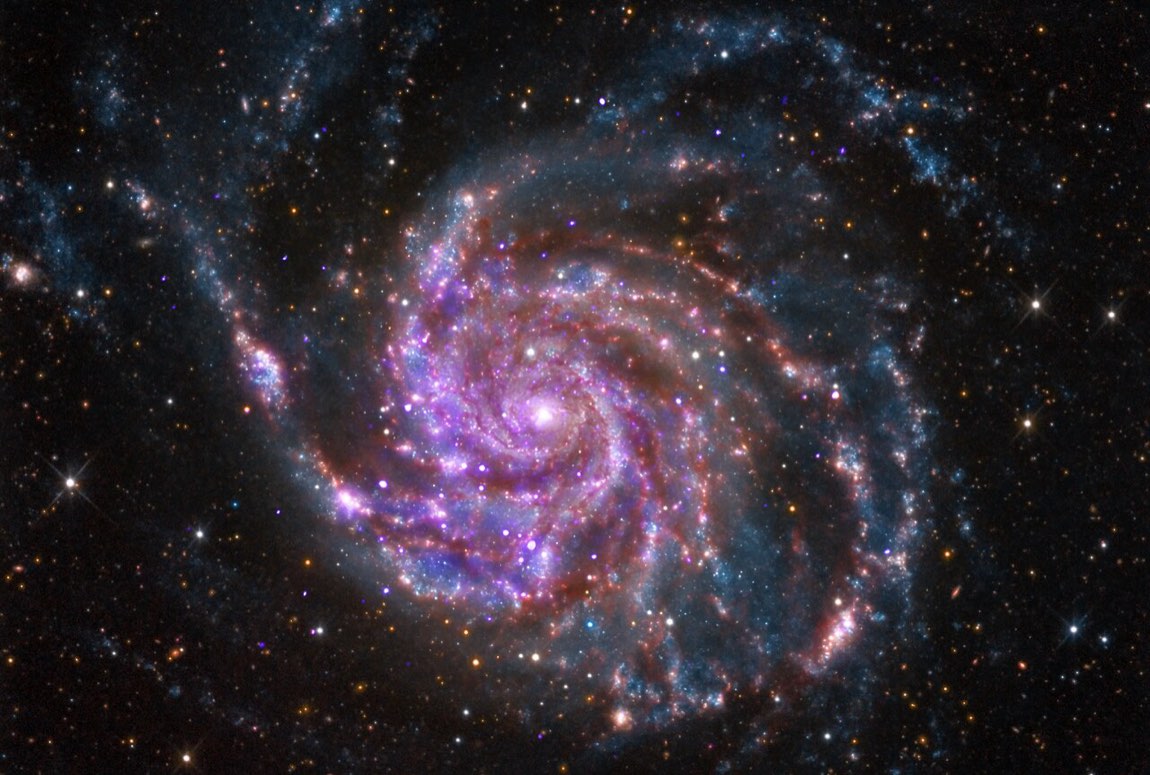
M101 looks like a textbook perfect spiral, but look closely and something is off — the galaxy is noticeably asymmetrical. The culprit is gravity. M101 has six prominent companion galaxies, including NGC 5474, NGC 5477, NGC 5585, NGC 5204, UGC 8837, and UGC 9405, and their collective gravitational tugging has pulled the disk out of perfect symmetry over billions of years. These tidal forces do more than warp the shape; they actively compress interstellar hydrogen gas throughout the spiral arms, squeezing it until star formation ignites. The result shows up vividly in ultraviolet images, which trace the glow of young, hot stars born from that compressed gas. Astronomers believe these same gravitational interactions are responsible for driving M101's grand design spiral pattern — the sweeping, well-defined arms that give the galaxy its pinwheel nickname. One companion, NGC 5474, appears to have been particularly disturbed by M101's gravitational influence. Together, M101 and most or all of its companions form what is called the M101 Group, a small gravitationally bound family of galaxies roughly analogous to our own Local Group.
02 A Trillion Stars Across 252,000 Light-Years
M101 is genuinely enormous by galactic standards. Its disk stretches 252,000 light-years across — nearly three times the diameter of the Milky Way, which spans about 87,400 light-years. Within that vast disk lives roughly a trillion stars, an almost incomprehensible number; if you counted one star per second it would take over 31,000 years just to reach a billion. The disk itself carries a mass on the order of 100 billion solar masses, while a small central bulge adds around 3 billion solar masses more. In this way M101 is often compared structurally to the Andromeda Galaxy, another large intermediate spiral that astronomers use as a reference point for understanding big disk galaxies. Despite its enormous stellar population, M101's central bulge is relatively modest, which is part of what gives the galaxy its open, face-on pinwheel appearance rather than the puffier, more elliptical core seen in some other spirals. Because we see M101 almost perfectly face-on, we get an unobstructed view of the full disk, making it one of the best-studied large spiral galaxies in the sky.
03 Star Factories: The H II Regions of M101 Deeper
One of M101's most scientifically important features is its extraordinarily rich population of H II regions — glowing clouds of ionized hydrogen that mark where new stars are being born. In a comprehensive 1990 study, astronomers cataloged 1,264 individual H II regions within the galaxy, an exceptionally high count. These regions form when enormous, dense molecular hydrogen clouds collapse under gravity, and the hot young stars that ignite within them flood the surrounding gas with ultraviolet radiation, stripping electrons from hydrogen atoms and causing the characteristic red glow. In M101, the ionizing stars are so numerous and energetic that some H II regions can generate hot superbubbles — vast cavities of superheated, low-density gas carved out by stellar winds and supernova explosions. Three of M101's H II regions are so large and luminous that they earned their own entries in the New General Catalogue: NGC 5461, NGC 5462, and NGC 5471. The galaxy's ongoing tidal interactions with its companion galaxies are directly responsible for sustaining this elevated rate of star formation, as gravitational compression continuously replenishes the supply of dense gas available to form new stellar nurseries.
 ⤢
⤢
04 The X-Ray Mystery of M101 ULX-1 Deeper
Tucked inside M101 is one of astronomy's more puzzling objects: an ultra-luminous X-ray source designated M101 ULX-1. First identified in 2001 using the Chandra X-ray Observatory from a source cataloged as P98, it emits more X-ray energy than any single star is expected to produce, yet less than an entire galaxy — placing it in a strange middle ground that has long challenged theorists. In 2005, combined observations from the Hubble Space Telescope and the XMM-Newton space observatory revealed an optical counterpart to the X-ray emission, strongly indicating that M101 ULX-1 is an X-ray binary system — two objects in close orbit, one pulling material from the other. What makes it especially strange is what further study revealed about the black hole at its center: it has a mass of just 20 to 30 solar masses, which is relatively modest. Yet it appears to be consuming material, including captured stellar wind from its companion star, at a rate higher than standard theoretical models predict should be possible. This deviation from expected behavior continues to make M101 ULX-1 an active subject of research into the physics of accretion and compact objects.
05 Six Supernovae and a Red Nova
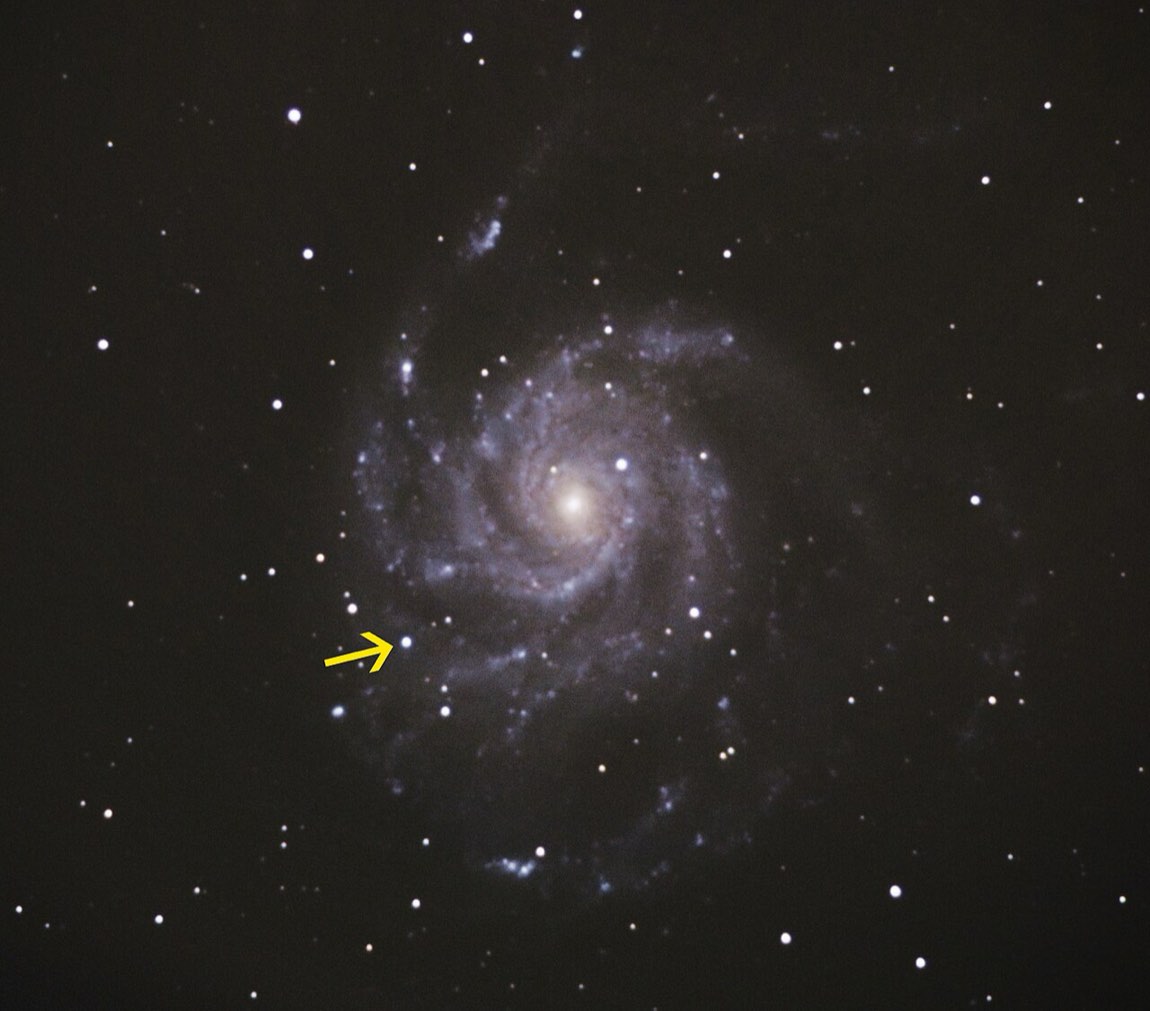
M101 has been unusually generous to supernova hunters. Six stellar explosions have been recorded there across more than a century of observation. The first, SN 1909A, was spotted by Max Wolf on 21 February 1909 and reached a remarkable magnitude of 10 — bright enough to be a notable event. SN 1970G, a Type II supernova discovered by Miklós Lovas on 30 July 1970, reached magnitude 11.5. The most famous is SN 2011fe, discovered by the Palomar Transient Factory on 24 August 2011 and initially called PTF 11kly. A Type Ia explosion, it peaked at visual magnitude 9.9 and became the brightest supernova of 2011. Most recently, SN 2023ixf was found by Kōichi Itagaki on 19 May 2023 and immediately classified as Type II. Beyond supernovae, M101 hosted a rarer event: M101 OT2015-1, also known as AT 2015dl, a luminous red nova discovered on 10 February 2015 by Dumitru Ciprian Vîntdevară. Luminous red novae are thought to result from stellar mergers rather than conventional explosions, making this a distinctly different class of transient from the supernovae that share M101's long record of stellar drama.
06 Globular Clusters: A Census Like Our Own
Despite being nearly three times wider than the Milky Way, M101 appears to host roughly the same number of globular clusters as our own galaxy. Astronomers estimate M101 contains about 150 globular clusters — the same figure typically cited for the Milky Way's own population. Globular clusters are ancient, tightly packed spheres of hundreds of thousands of stars, gravitationally bound and orbiting a galaxy's halo. They are among the oldest structures in the universe and carry important clues about a galaxy's early formation history. The fact that a galaxy as large as M101, with its trillion stars and 252,000-light-year diameter, hosts no more globular clusters than the much smaller Milky Way is an intriguing data point for astronomers studying how these clusters form and survive. It suggests the relationship between a galaxy's total stellar mass and its globular cluster population is not straightforwardly proportional — a puzzle that remains an active area of research in extragalactic astronomy.
 ⤢
⤢
07 From Méchain to Messier: The Discovery Story
M101 was discovered by the French astronomer Pierre Méchain in 1781. Méchain described what he saw as a 'nebula without star, very obscure and pretty large, 6' to 7' in diameter, between the left hand of Bootes and the tail of the great Bear,' adding that it was 'difficult to distinguish when one illuminates the [grating] wires' — a reference to the challenge of seeing faint extended objects against the glow of his instrument's crosshairs. Méchain communicated his finding to Charles Messier that same year, and Messier verified the object's position, adding it as one of the final entries in his famous catalogue of nebulae and star clusters. The object would later be cataloged also as NGC 5457. Decades later, in 1784, William Herschel noted that M101 showed what he called 'resolvable' nebulosity through his reflectors of 7-, 10-, and 20-foot focal lengths, hinting that it was composed of stars. It was Lord Rosse, observing with his enormous 72-inch-diameter Newtonian reflector in the second half of the 19th century, who first extensively documented the galaxy's spiral structure, producing several sketches that marked a major step in understanding the true nature of spiral nebulae.
08 The Record-Breaking Hubble Portrait of 2006
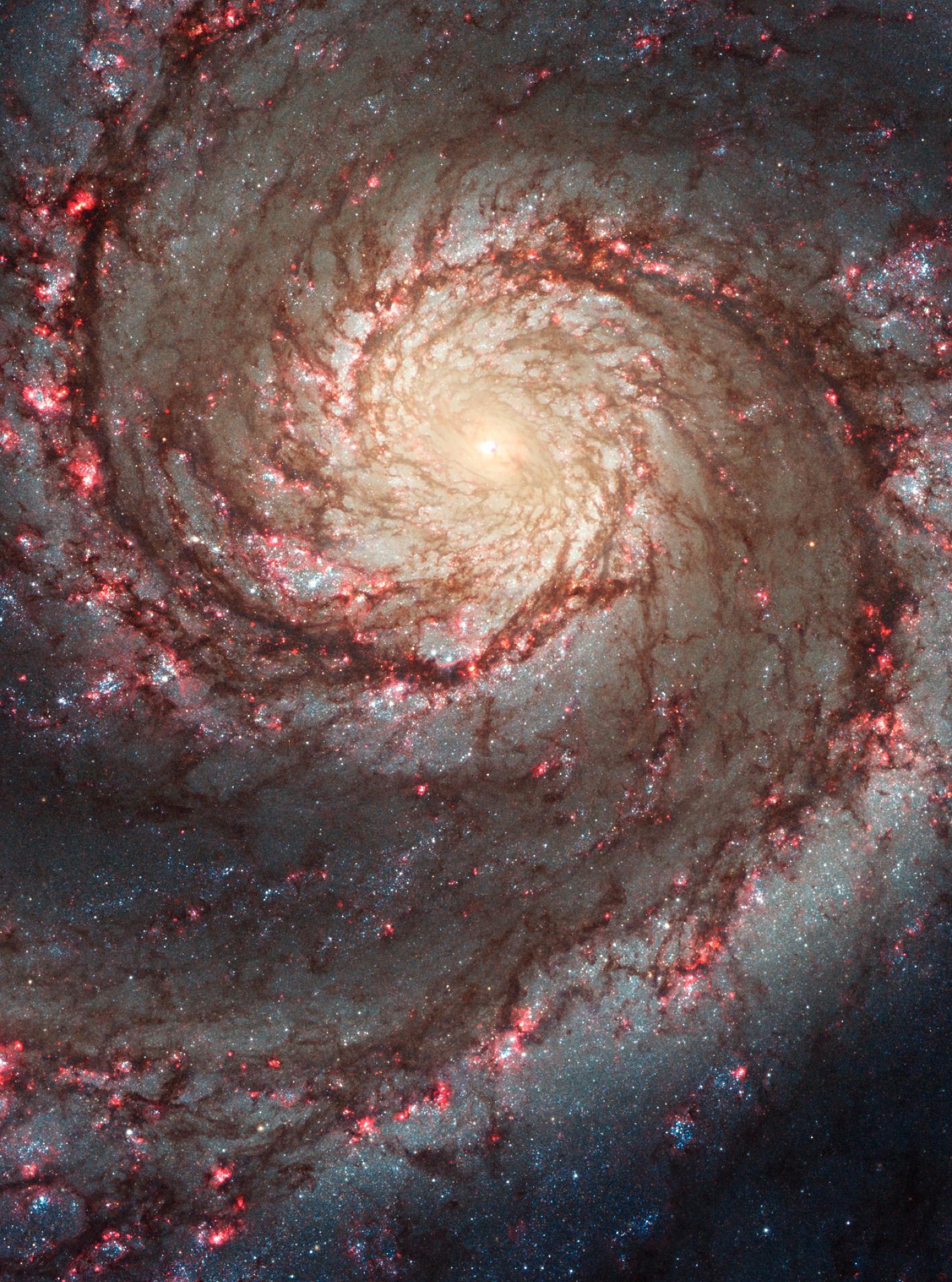
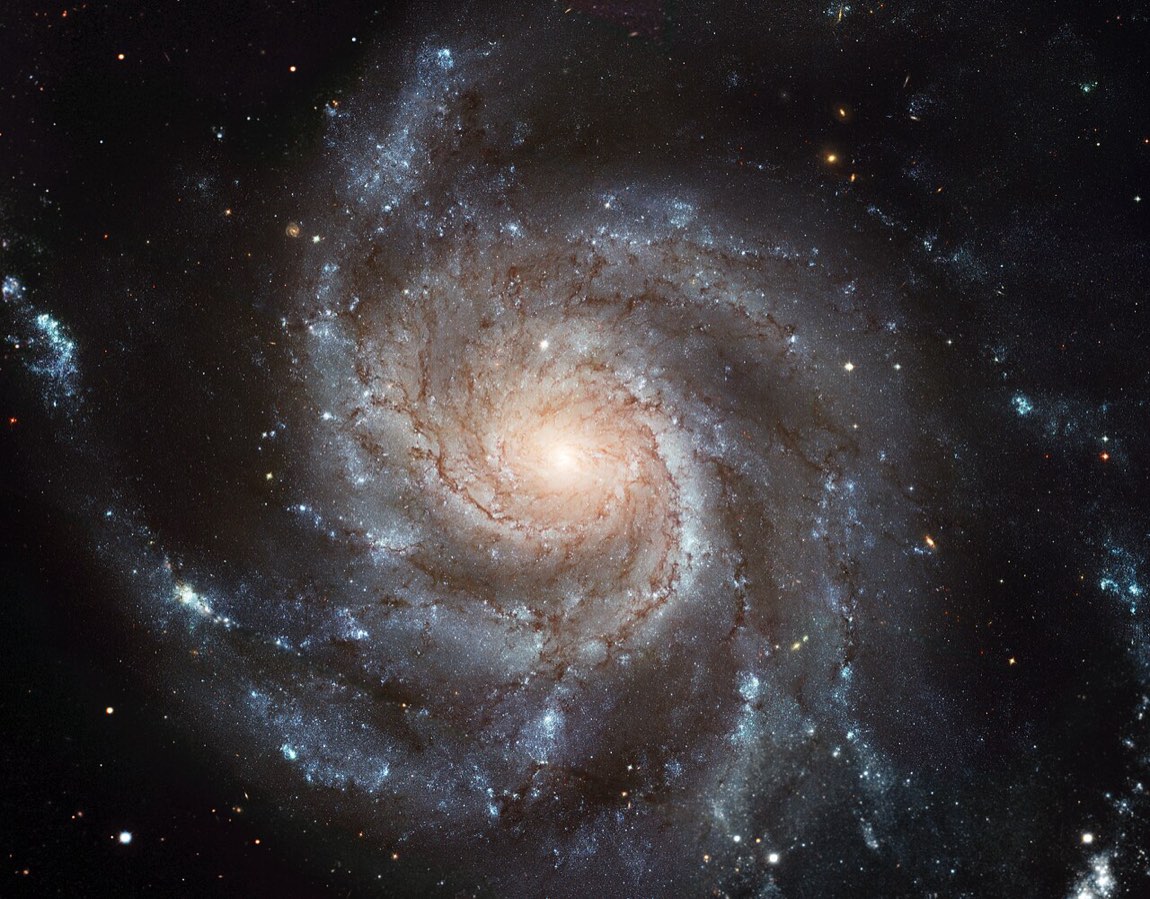
On 28 February 2006, NASA and the European Space Agency jointly released what was at that time the largest and most detailed image of any galaxy ever produced by the Hubble Space Telescope. The subject was M101. The image was not the result of a single exposure but was painstakingly assembled from 51 individual Hubble exposures, supplemented with additional ground-based photographs to fill in surrounding detail. The composite captured M101 in extraordinary resolution, allowing astronomers and the public alike to pick out individual star-forming regions, dust lanes, and luminous H II complexes across the galaxy's full face-on disk. The release was timed to coincide with broader public engagement efforts, and the image became one of Hubble's most widely reproduced. For researchers, such detailed mosaics are scientifically valuable because they allow systematic studies of star formation across an entire galaxy at once, something impossible from ground-based telescopes. M101's face-on orientation made it an ideal target for this kind of total-disk imaging, and the 2006 portrait remains a landmark in observational extragalactic astronomy.
09 How to Find and Observe M101 Yourself
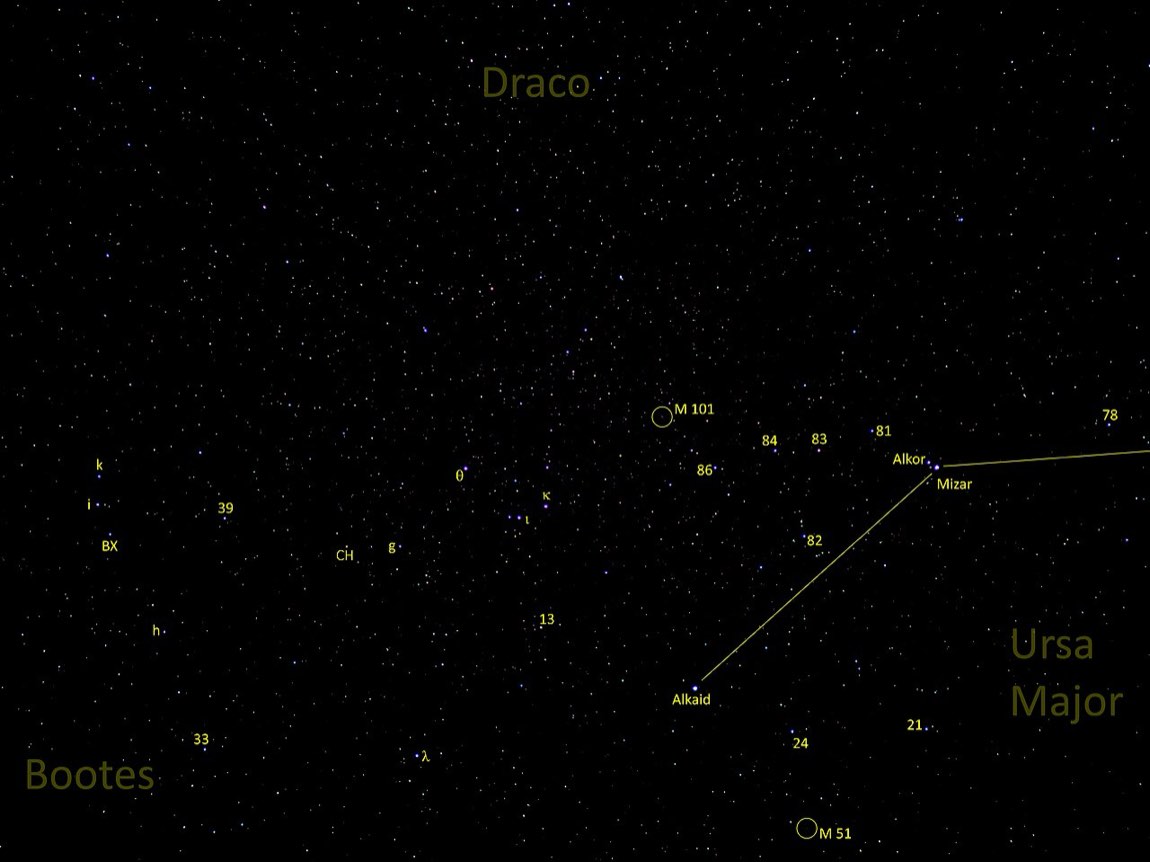
M101 sits in the constellation Ursa Major, positioned between the left hand of Boötes and the tail of the Great Bear as Méchain originally described. At 21 million light-years away, it is distant enough that seeing any detail requires patience and good conditions, but it is close enough to be detectable with binoculars or a small telescope. The challenge is that M101 is a large, low-surface-brightness object — its light is spread across an area of sky roughly 6 to 7 arcminutes across, making it appear dim even though its total brightness is reasonable. To actually see the spiral structure without the help of a camera, observers need a fairly large telescope, genuinely dark skies away from city light pollution, and a low-power eyepiece that keeps the image as bright as possible. Under the right conditions the sweeping arms begin to emerge, and with its face-on orientation the full pinwheel shape becomes apparent — a rare case where visual observation can match, at least in impression, the dramatic photographs that made the galaxy famous.
 ⤢
⤢
10 What Kind of Spiral Galaxy Is M101? Deeper
M101 is classified as an intermediate spiral galaxy, meaning it sits between two end members of the spiral family. A barred spiral has a distinct elongated bar of stars running through its center, while an unbarred spiral lacks this feature entirely. M101 shows characteristics of both, placing it in the intermediate category. It is also described as a grand design spiral, a term referring to spirals with two prominent, well-defined arms that sweep elegantly outward — as opposed to flocculent spirals, which have patchy, fragmented arm structure. Astronomers believe the grand design pattern in M101 is sustained at least partly by the gravitational influence of its companion galaxies, whose tidal perturbations help organize the spiral density waves that propagate through the disk. The galaxy is oriented face-on relative to Earth, which is fortunate for observers and researchers alike, as it allows an unobstructed view of the disk's full structure. This combination of large size, intermediate spiral classification, face-on orientation, and rich H II region population has made M101 one of the most intensively studied spiral galaxies outside the Local Group.
More real images of The Pinwheel Galaxy
Genuine spacecraft and telescope imagery, every frame credited and licensed. Tap any photo to enlarge.