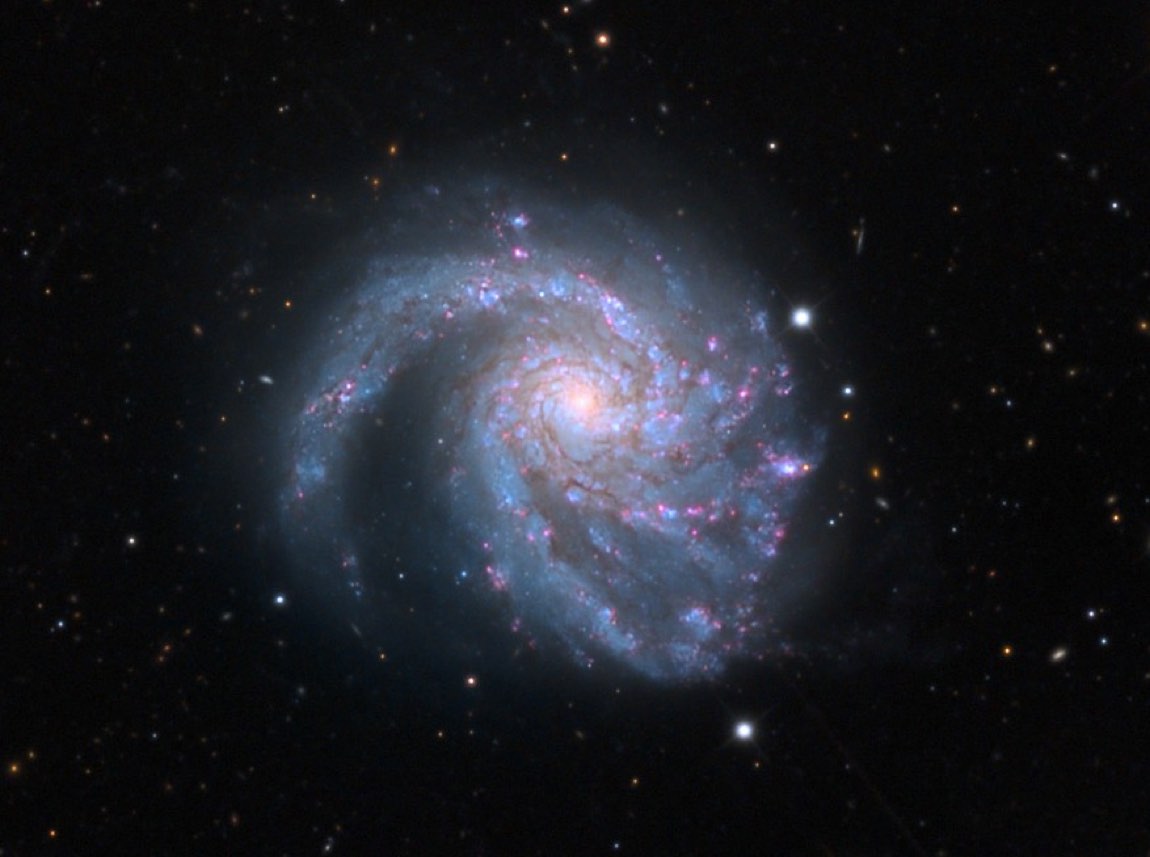
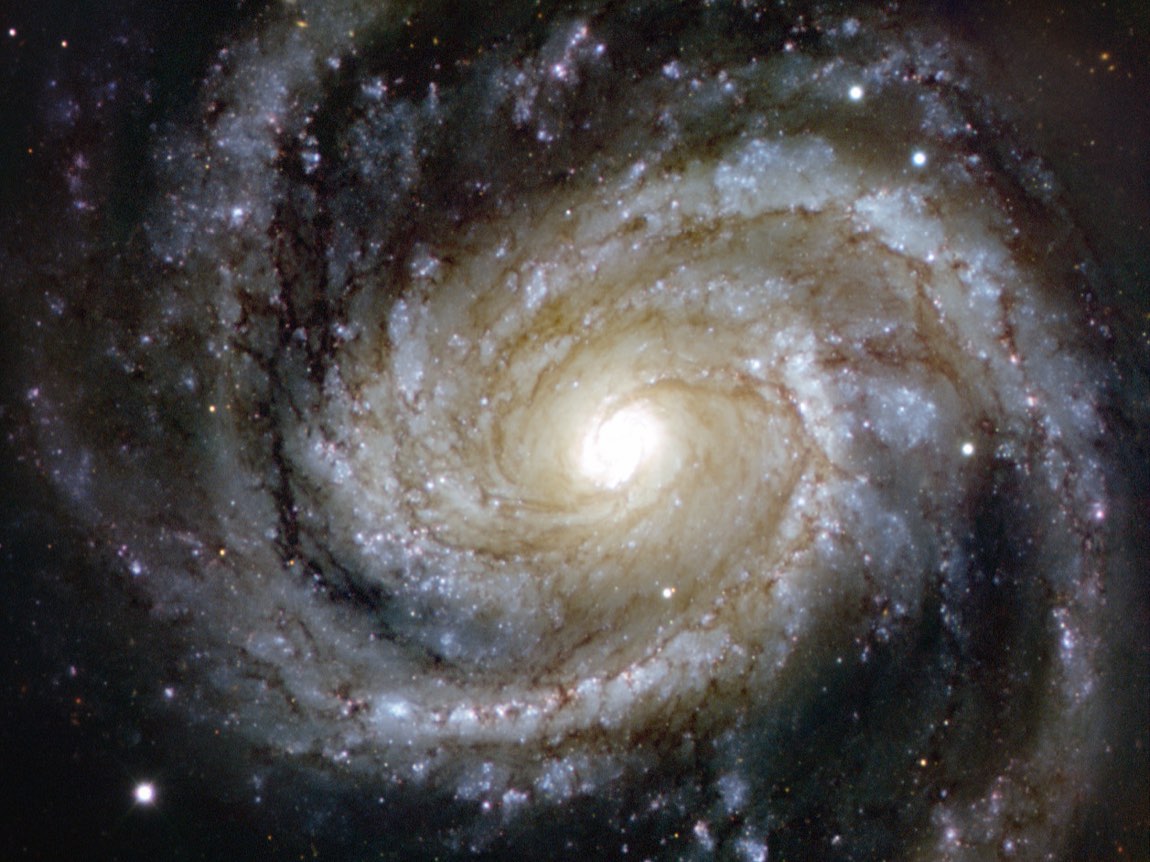
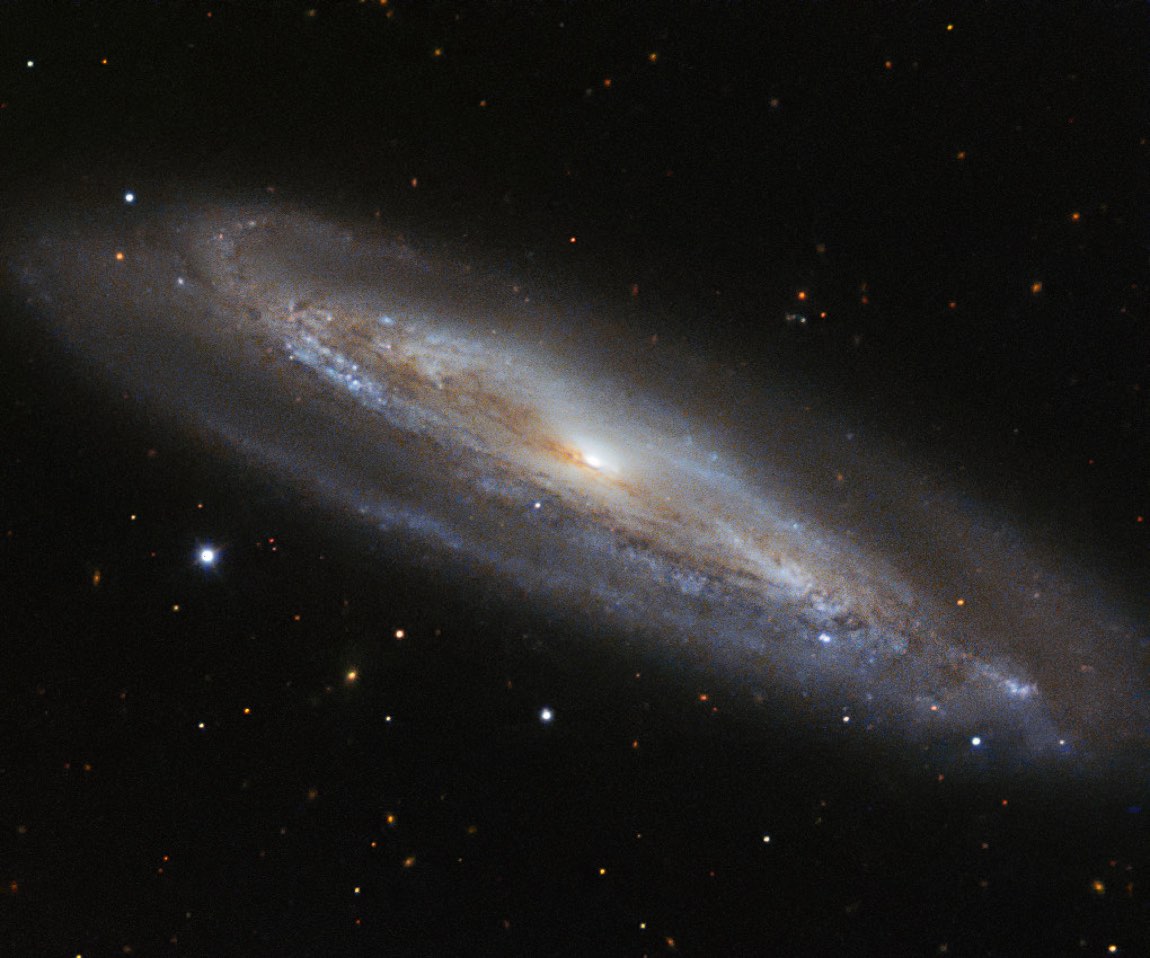
 Photograph · ESO Acknowledgements: Flickr user jbarring · CC BY 4.0
Galaxy · Deep guide
Messier 98
Also called: M98 · NGC 4192 · UGC 7231 · PGC 39028
A steeply tilted spiral in Coma Berenices that is moving toward us, not away.
What is it?
Messier 98 is a spiral galaxy in Coma Berenices, about 6° east of the star Denebola. Pierre Méchain found it in 1781 along with M99 and M100. We see it steeply tilted, about 74° from face-on. Although it lies about 44 million light-years away in the Virgo Cluster, it is approaching us at roughly 140 km/s, so its light is blueshifted. Its stars add up to about 76 billion solar masses, and it also holds about 4.3 billion solar masses of hydrogen gas.
The deep dive
Researched for the Atlas from Wikipedia — Messier 98 (1,515 characters read) · updated Nov 15, 2026
01 A galaxy moving the wrong way
Almost every distant galaxy is racing away from us as the universe expands, so astronomers expect their light to be stretched toward the red end of the spectrum — a redshift. Messier 98 is one of the rare exceptions. Its light arrives compressed toward the blue end, a blueshift, which means the galaxy is actually approaching Earth at roughly 140 km/s — fast enough to cross the Moon's orbit in under three seconds. This doesn't mean the universe is contracting in this direction. Rather, M98 has its own independent velocity through space, a so-called peculiar motion, that currently overrides the general expansion of the cosmos in our neighborhood. This makes M98 one of only a small handful of Messier objects with a confirmed blueshift, and it has long fascinated astronomers as a vivid reminder that cosmic expansion is a large-scale average, not an iron rule that applies to every individual galaxy at every moment.
02 What kind of spiral is it, exactly? Deeper
Galaxy classification can feel like alphabet soup, but M98's code — SAB(s)ab — tells a precise story. The 'SAB' means it sits between a purely ordinary spiral and a full barred spiral, showing mixed barred and non-barred features rather than committing cleanly to either type. The '(s)' indicates there is no ring structure encircling the core. The 'ab' at the end describes how tightly the spiral arms are wound: intermediate to tight, meaning the arms curve in closely rather than sprawling wide. Taken together, the classification paints a picture of a galaxy that is structurally ambiguous — not quite one thing or another — which makes it genuinely useful for researchers trying to understand how bars form and dissolve over cosmic time. Many galaxies cycle between barred and non-barred phases, and M98 may be caught mid-transition, offering a natural laboratory for studying that process.
03 Tilted nearly on edge toward us
Messier 98 is inclined to our line of sight at an angle of 74°, which means we see it tipped nearly — but not quite — edge-on. A perfectly face-on galaxy would show us its full spiral pattern spread out like a pinwheel; a perfectly edge-on galaxy would appear as a thin sliver. At 74°, M98 falls closer to the sliver end, showing us its disk stretched diagonally across the sky with the spiral arms compressed into overlapping lanes. This steep inclination is both a gift and a complication for astronomers. It makes it easier to measure the galaxy's rotation by tracking how one side moves toward us and the other moves away using the Doppler effect. That is exactly how the maximum rotation velocity of 236 km/s was determined — a speed at which stars and gas in the outer disk are completing their orbits, giving scientists a handle on how much mass is holding everything together.
04 Weighing the stars, gas, and dust Deeper
Breaking a galaxy into its component materials reveals a great deal about its past and future. The combined stellar mass of M98 is estimated at 76 billion solar masses — written out, that is 7.6 × 10¹⁰ times the mass of our Sun, or roughly 15 times the stellar mass of the Milky Way's disk. Beyond those stars, the galaxy holds approximately 4.3 billion solar masses of neutral hydrogen gas, the raw fuel from which new stars can eventually form. Dust accounts for a comparatively modest 85 million solar masses, yet dust plays an outsized role: it absorbs ultraviolet and visible starlight and re-emits it as infrared radiation, shaping what we can observe and how rapidly the interstellar medium cools to allow star formation. The ratio of gas to stellar mass suggests M98 still has meaningful reserves for future star-making, though its position within the dense Virgo Cluster means that gas can be stripped away over time by gravitational and ram-pressure interactions with neighboring galaxies.
05 An active nucleus that defies easy labels Deeper
The core of M98 is not quiet. It is classified as a 'transition' type active nucleus, a designation that places it in one of the more contested categories in extragalactic astronomy. Specifically, the nucleus shows characteristics of a LINER — a Low Ionization Nuclear Emission-line Region — blended with features of an H II region, which is a cloud of ionized hydrogen typically associated with intense star formation. The coexistence of these two signatures is precisely what earns the label 'transition': astronomers debate whether such nuclei are powered primarily by a low-luminosity supermassive black hole, by a dense cluster of hot young stars, or by some combination of both processes. M98 therefore sits at a genuinely interesting intersection, where the physics of accretion onto a black hole and the physics of stellar nurseries become difficult to disentangle, and where improved observations with high spatial resolution could eventually settle the question.
06 Home in the Virgo Cluster
Messier 98 is not an isolated galaxy drifting alone through the cosmos. It is a member of the Virgo Cluster, one of the largest and nearest galaxy clusters in our cosmic neighborhood, itself embedded within the broader Local Supercluster. Membership in such a dense environment has profound consequences. The Virgo Cluster contains hundreds of galaxies packed into a region whose gravitational influence reaches across tens of millions of light-years. Galaxies within it interact constantly — through direct collisions, through tidal stretching, and through a process called ram-pressure stripping where the hot intracluster gas sweeps away a galaxy's own gas supply as it moves through the cluster. M98's peculiar blueshift velocity is itself a sign of its energetic motion within this gravitational environment; the cluster's collective gravity has accelerated it toward us in a way that temporarily overcomes the universal expansion.
07 A possible ancient encounter with M99
About 750 million years ago, Messier 98 may have experienced a close interaction with its neighbor Messier 99, another large spiral galaxy in the same region of sky. Such a gravitational encounter would not necessarily mean the two galaxies collided directly, but even a near-passage can leave dramatic marks — triggering bursts of star formation, warping spiral arms, or redistributing gas across tens of thousands of light-years. Today, M98 and M99 are separated by 1,300,000 light-years, or 400,000 parsecs, so whatever happened between them is long in the past. The word 'may' matters here: the interaction is a hypothesis supported by their proximity and orbital histories, not a certainty. Reconstructing galactic encounters from their current positions and velocities is a bit like watching two cars pass on a highway and trying to determine whether they once grazed each other in a parking lot centuries ago.
08 Discovery on a productive night in 1781
Pierre Méchain, a French astronomer and colleague of Charles Messier, discovered M98 in 1781 alongside two other galaxies, M99 and M100, in what must have been an exceptionally productive observing session. Méchain passed his findings to Messier, who added M98 to his famous Catalogue des Nébuleuses and des amas d'Étoiles just 29 days after the initial discovery. Messier's catalogue was originally designed as a practical tool — a list of fuzzy objects that might be mistaken for comets, which were the prestige discovery of the era. Neither Méchain nor Messier understood that they were cataloguing entire galaxies containing billions of stars; to them, M98 was simply a nebula, a smudge among the stars of Coma Berenices. It would be nearly a century and a half before the true extragalactic nature of such objects became accepted scientific consensus.
09 Finding M98 in the night sky
Messier 98 lives in the constellation Coma Berenices, positioned about 6° to the east of Denebola, the bright star at the tip of Leo's tail also known as Beta Leonis. That 6° separation is roughly equivalent to holding three fingers together at arm's length against the sky, making Denebola a convenient jumping-off point for star-hopping to M98. At an apparent magnitude that places it among the more accessible Messier galaxies, it is within reach of a modest amateur telescope under reasonably dark skies, though its high inclination of 74° means it appears elongated rather than displaying an open spiral face. Observers should not expect to see spiral arms directly; instead, M98 presents as a bright, elongated glow with a noticeably brighter core. Its location in Coma Berenices also places it in a region rich with other Virgo Cluster members, making it an ideal anchor for a guided tour of the cluster.
10 What SAB galaxies reveal about bar evolution Deeper
The SAB classification — indicating a galaxy that is neither fully barred nor fully unbarred — raises one of modern galactic astronomy's quietly fascinating open questions: are bars permanent structures, or do they grow, weaken, and dissolve over billions of years? Simulations suggest that bars can form from instabilities in a galaxy's disk, funnel gas inward toward the nucleus, and then gradually disperse as they redistribute angular momentum through the stellar population. If that picture is correct, SAB galaxies like M98 could represent multiple different things: a bar in the process of forming, a bar in the process of dissolving, or simply a galaxy whose mass distribution happens to produce a weak, sustained bar. Without knowing M98's full dynamical history, it is impossible to say which scenario applies. This ambiguity is not a failure of science — it is an honest reflection of how difficult it is to observe billions of years of galactic evolution from a single snapshot in time.