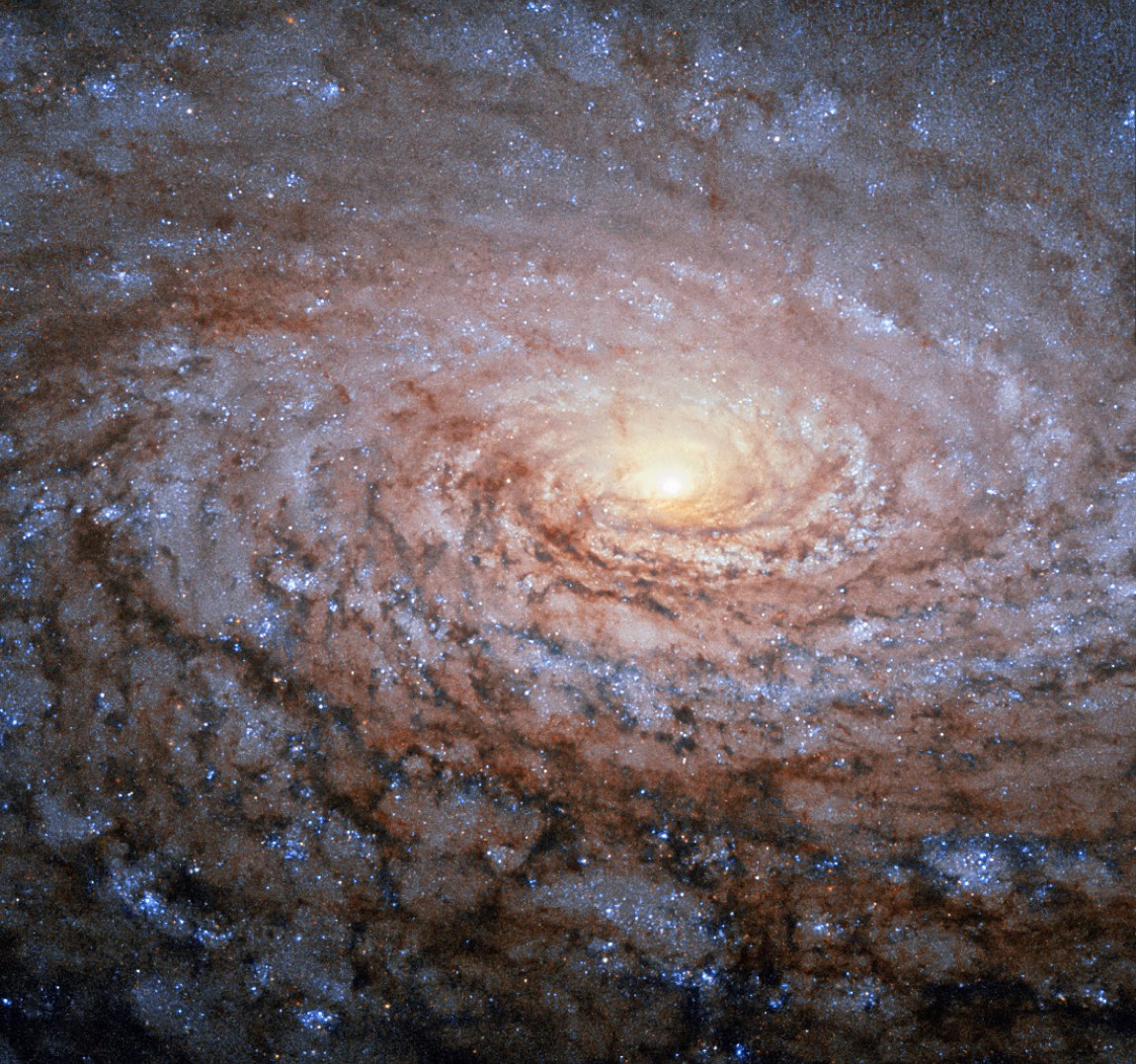
 Photograph · NASA/ESA - The Hubble Legacy Archive (HLA): Space Telescope Science Institute (S · Public domain
Galaxy · Deep guide
Messier 63 (Sunflower Galaxy)
Also called: M63 · NGC 5055 · Sunflower Galaxy · PGC 46153 · UGC 8334
A fluffy, petal-patterned spiral in Canes Venatici, one of the first galaxies seen to have spiral structure.
What is it?
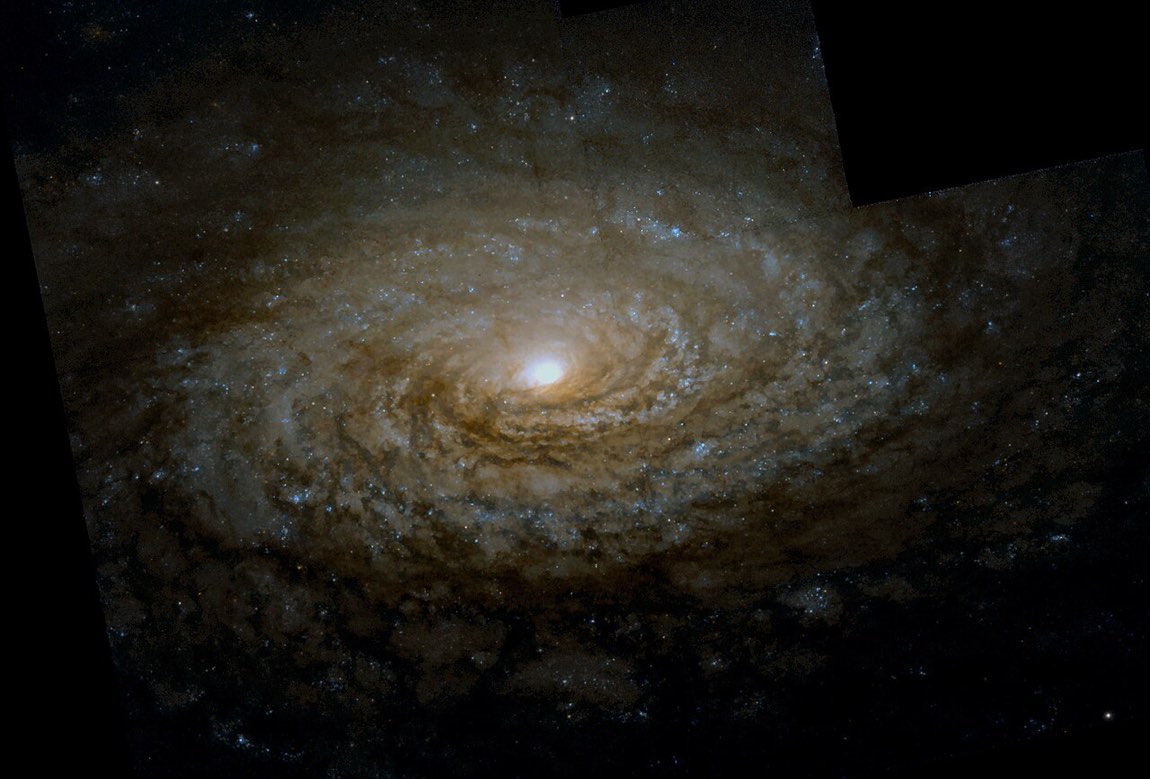
Messier 63, the Sunflower Galaxy, is a spiral galaxy in Canes Venatici. Pierre Méchain found it and Messier confirmed it on 14 June 1779. In the 1800s Lord Rosse saw spiral structure in it, making it one of the first galaxies where this was noticed. In visible light its arms are broken into many short, patchy segments, a style called flocculent, but infrared images reveal two smooth, symmetric arms underneath. It may hold about 400 billion stars.
The deep dive
Researched for the Atlas from Wikipedia — Messier 63 (3,055 characters read) · updated Nov 15, 2026
01 How the Sunflower Got Its Name
The galaxy's popular nickname, the Sunflower Galaxy, comes from its visual appearance through a telescope: loosely wound, petal-like spiral arms spreading outward from a bright central hub, much like the head of a sunflower. Its formal catalog identity is more bureaucratic — it carries three separate designations: Messier 63, NGC 5055, and the discoverer-linked history that sits behind both of them. Pierre Méchain first spotted the galaxy and reported it to his colleague Charles Messier, who verified the observation on 14 June 1779 and entered it as the 63rd object in his famous catalog. That catalog was originally a practical tool — a list of fuzzy objects that might be mistaken for comets — so M63 was essentially cataloged as a nuisance before anyone understood what it truly was. It sits in the northern constellation Canes Venatici, the Hunting Dogs, a region of sky that turns out to be exceptionally rich in spiral galaxies.
02 Lord Rosse and the First Spiral Clue
In the mid-19th century, the Anglo-Irish astronomer Lord Rosse turned one of the largest telescopes then built toward M63 and detected something revolutionary: spiral structure within the galaxy's haze. This made M63 one of the first galaxies in which spiral structure was ever identified by a human observer. The significance of that moment is easy to underestimate today. At the time, there was no consensus on what these nebulae even were — whether they were nearby gas clouds or vast island universes of stars at unimaginable distances. Rosse's painstaking observations of spiral form in M63 and a handful of other objects planted an early seed in the debate that would not be resolved until Edwin Hubble's work more than half a century later. M63 thus appears not just in the history of observational astronomy but in the deeper intellectual history of humanity's expanding picture of the cosmos.
03 Flocculent by Day, Grand Design by Night Deeper
M63 has a morphological classification of SAbc — a spiral galaxy with no central bar feature (the SA designation) and moderately to loosely wound arms (the bc suffix). But its appearance depends dramatically on what kind of light you use to look at it. In visible light, the galaxy lacks large-scale continuous spiral structure, which earns it the label 'flocculent galaxy' — meaning its arms appear patchy and broken, more like scattered clumps than clean sweeping curves. Switch to near-infrared observation and the picture transforms entirely: a symmetric, two-arm grand-design spiral snaps into view. Each of those infrared arms wraps 150 degrees around the galaxy and extends out to 13,000 light-years (4,000 parsecs) from the nucleus. The difference arises because visible light traces young, hot, short-lived stars and dust, while near-infrared reveals the older stellar population that traces the underlying gravitational structure — the galaxy's true skeleton, hidden beneath a messier skin.
 ⤢
04 A Warped Gas Disk Stretching Far Beyond the Stars Deeper
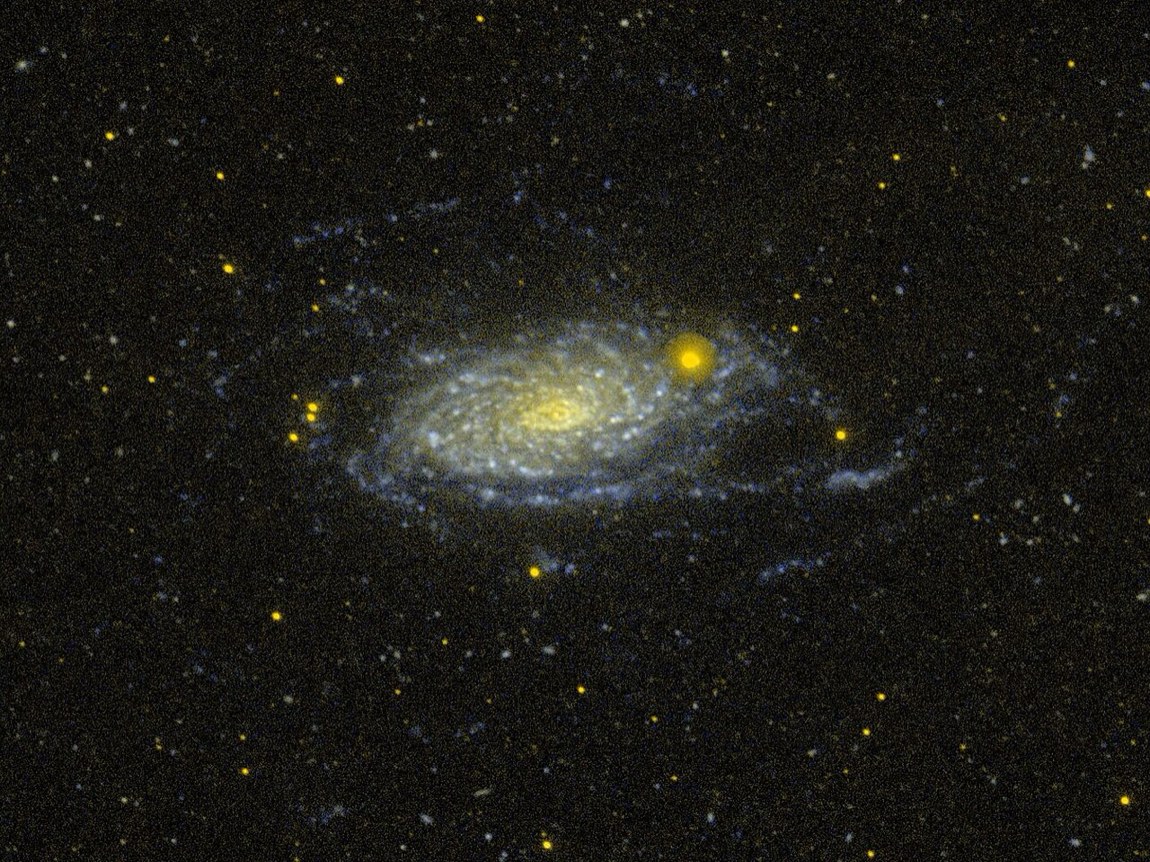
Radio observations tuned to the 21-centimeter hydrogen line reveal a gaseous disk around M63 that extends outward to a radius of 130,000 light-years (40 kiloparsecs) — well beyond the bright optical disk that dominates photographs. For comparison, our entire Milky Way's visible disk spans roughly 100,000 light-years, so M63's hydrogen envelope is larger in radius than a whole Milky Way-sized disk is in diameter. What makes this gas disk especially interesting is its shape: it is symmetrical but pronouncedly warped, with the warping beginning at a radius of 33,000 light-years (10 kiloparsecs) from the center. The geometry of this warp is not random. The position angle of the warp points toward UGC 8313, a smaller companion galaxy, suggesting that gravitational interaction with that neighbor may be responsible — though the exact mechanism remains unclear. The overall form of the gas disk also hints at a dark matter halo that is offset with respect to the galaxy's inner region, a subtle but potentially important clue about how dark matter is distributed around M63.
05 The Uncertain Black Hole at the Core Deeper
At the heart of M63 lies something unusual: a weakly active nucleus classified as a LINER, which stands for low-ionization nuclear emission-line region. This type of nucleus emits light characteristic of low-energy ionized gas rather than the blazing accretion typical of a quasar. The activity shows up as an unresolved point source at the galactic center, surrounded by a diffuse emission region that extends along a position angle of 110 degrees relative to the north celestial pole. Both soft X-rays and hydrogen emission in the H-alpha wavelength can be detected coming from nearly the same direction. Whether a supermassive black hole drives this activity is genuinely uncertain — the article is explicit that its existence at the nucleus is not confirmed. If one does exist, mass estimates place it at approximately (8.5 ± 1.9) × 10⁸ solar masses, meaning somewhere between about 660 million and over a billion times the mass of our Sun. That uncertainty range alone spans hundreds of millions of solar masses, illustrating how difficult such measurements are even for relatively nearby galaxies.
06 How Far Away Is M63, Really?
Measuring the distance to a galaxy is harder than it sounds, and M63 is a good illustration of why astronomers use several independent methods and rarely get the same answer twice. A luminosity-distance measurement places M63 at about 29,300,000 light-years (8.99 megaparsecs). The tip of the red-giant branch technique — which uses the known brightness of the brightest red giant stars as a distance standard — gives 28,930,000 ± 950,000 light-years (8.87 ± 0.29 megaparsecs), reasonably consistent with the first figure. But estimates using the Tully–Fisher relation, which links a galaxy's rotation speed to its luminosity, spread across a wide range: anywhere from 16,000,000 to 34,000,000 light-years (5.0 to 10.3 megaparsecs). Meanwhile, the radial velocity relative to the Local Group yields an estimate of only 15,200,000 light-years (4.65 megaparsecs). These disagreements are not errors so much as the inherent challenge of cosmic distance-measuring, where each method carries its own assumptions and systematic uncertainties.
 ⤢
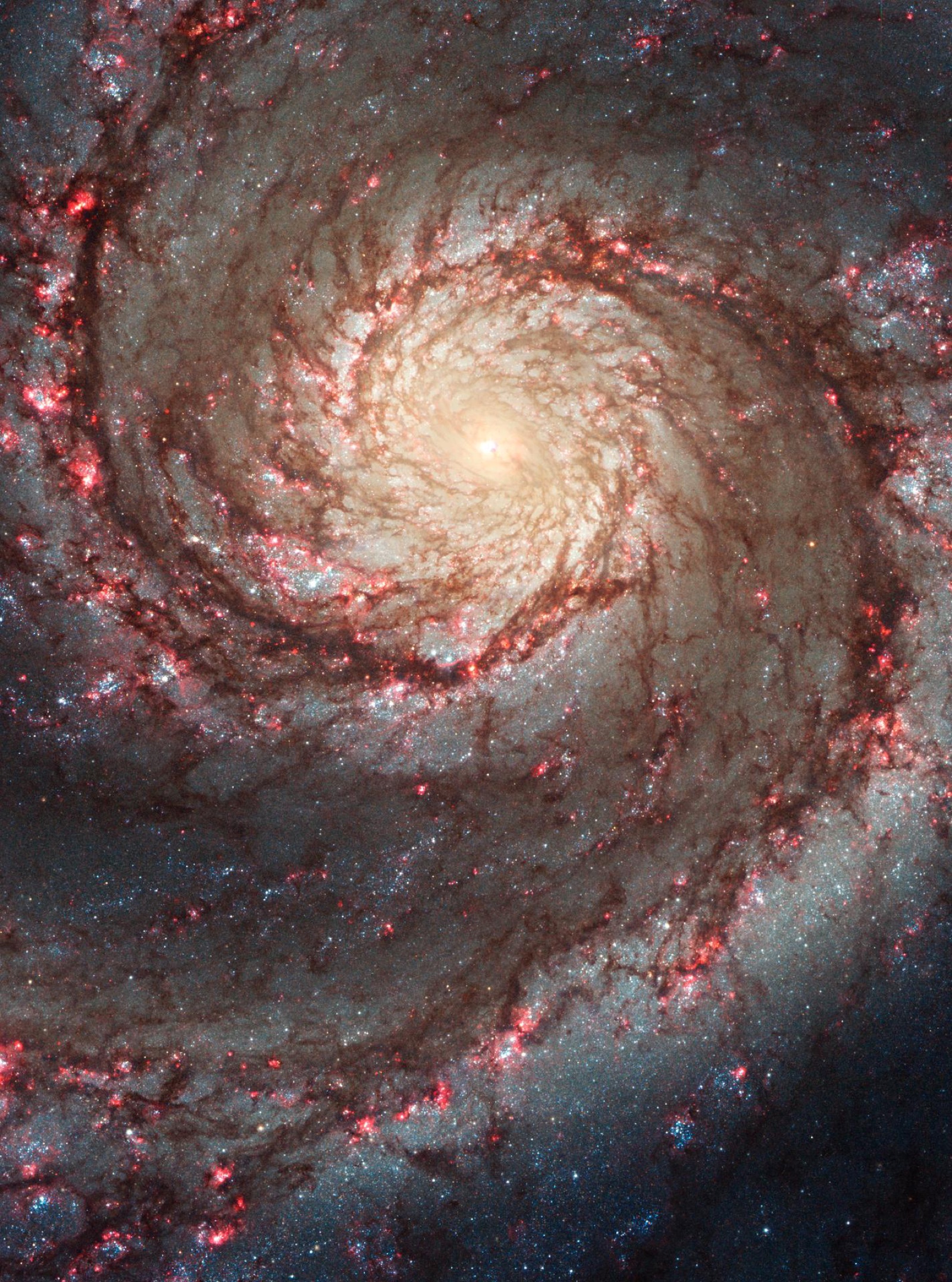
07 Cosmic Neighbors: M63 and the M51 Group
M63 is not an isolated galaxy. It belongs to the M51 Group, a gravitationally associated collection of galaxies that takes its name from its most famous member, M51 — the Whirlpool Galaxy, one of the most photographed spiral galaxies in the sky. Being part of a group means these galaxies influence one another through gravity, and the warped hydrogen gas disk of M63 may be a direct consequence of such interactions. The smaller galaxy UGC 8313 also lies nearby, and the direction of M63's gas warp points directly toward it, suggesting an ongoing gravitational conversation between the two. Galaxy groups like this are the typical environment for spirals in the universe — isolated field galaxies are comparatively rare. Studying M63 within its group context helps astronomers understand how interactions shape galaxy structure over billions of years, gradually distorting disks, triggering star formation, and redistributing gas far beyond a galaxy's visible boundaries.
08 SN 1971I: An Anomalous Explosion
On 24 May 1971, an observer named Glenn Jolly discovered a new point of light blazing within M63. Five days later, on 29 May, Roger Clark independently found the same object. This was SN 1971I, a supernova that reached its peak brightness around 26 May — meaning the initial discovery had come just two days before maximum light. At peak, it shone at magnitude 11.8, bright enough to be seen with a modest amateur telescope. Spectroscopic analysis classified it as a Type Ia supernova, the category caused by a white dwarf star detonating after accumulating too much mass from a companion. Type Ia supernovae are valued as cosmological distance standards precisely because they are thought to explode with consistent peak luminosity. What made SN 1971I stand out, however, was that while its spectrum was broadly consistent with Type I behavior, its spectroscopic behavior appeared anomalous — an oddity that the article notes without further resolution, leaving it as a small historical curiosity within M63's story.
09 Observing M63 from Your Backyard
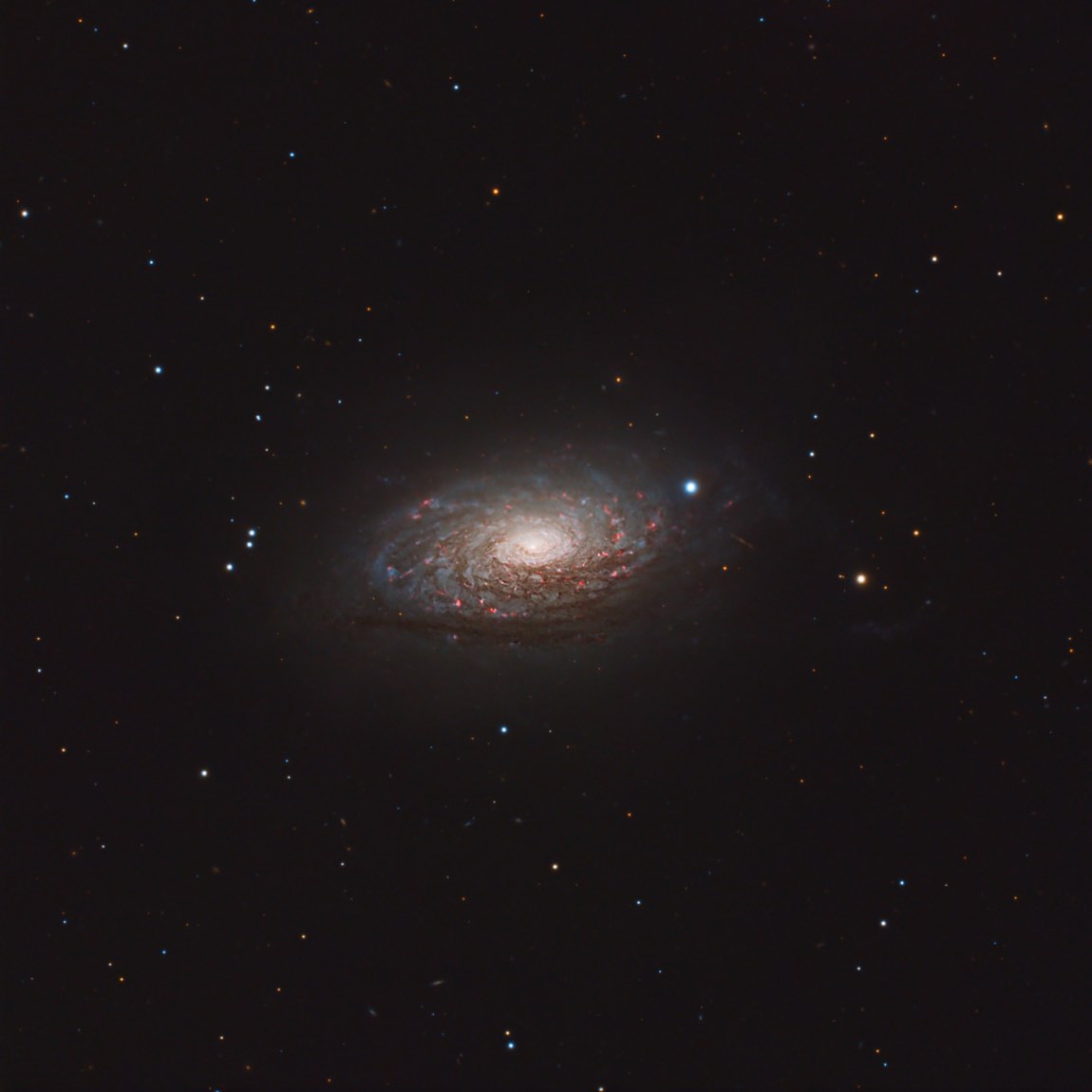
M63 sits in Canes Venatici, one of the more rewarding constellations for galaxy hunters in the northern spring sky. With an apparent magnitude that places it among the accessible Messier objects, it is reachable with binoculars under dark skies and shows as an elongated smudge with a brighter core. A moderate amateur telescope will begin to reveal the asymmetric glow of its disk, though the patchy, flocculent arm structure that makes it scientifically interesting is subtle visually. Long-exposure astrophotography is where M63 begins to show its personality: the loose, broken spiral arms become visible along with the warmer color of its nucleus. Because near-infrared imaging reveals the symmetric two-arm structure invisible at optical wavelengths, even relatively modest cooled CCD cameras equipped with infrared-pass filters can give amateur observers a glimpse of the same structural transformation that professional astronomers use to understand this galaxy's true architecture.
 ⤢