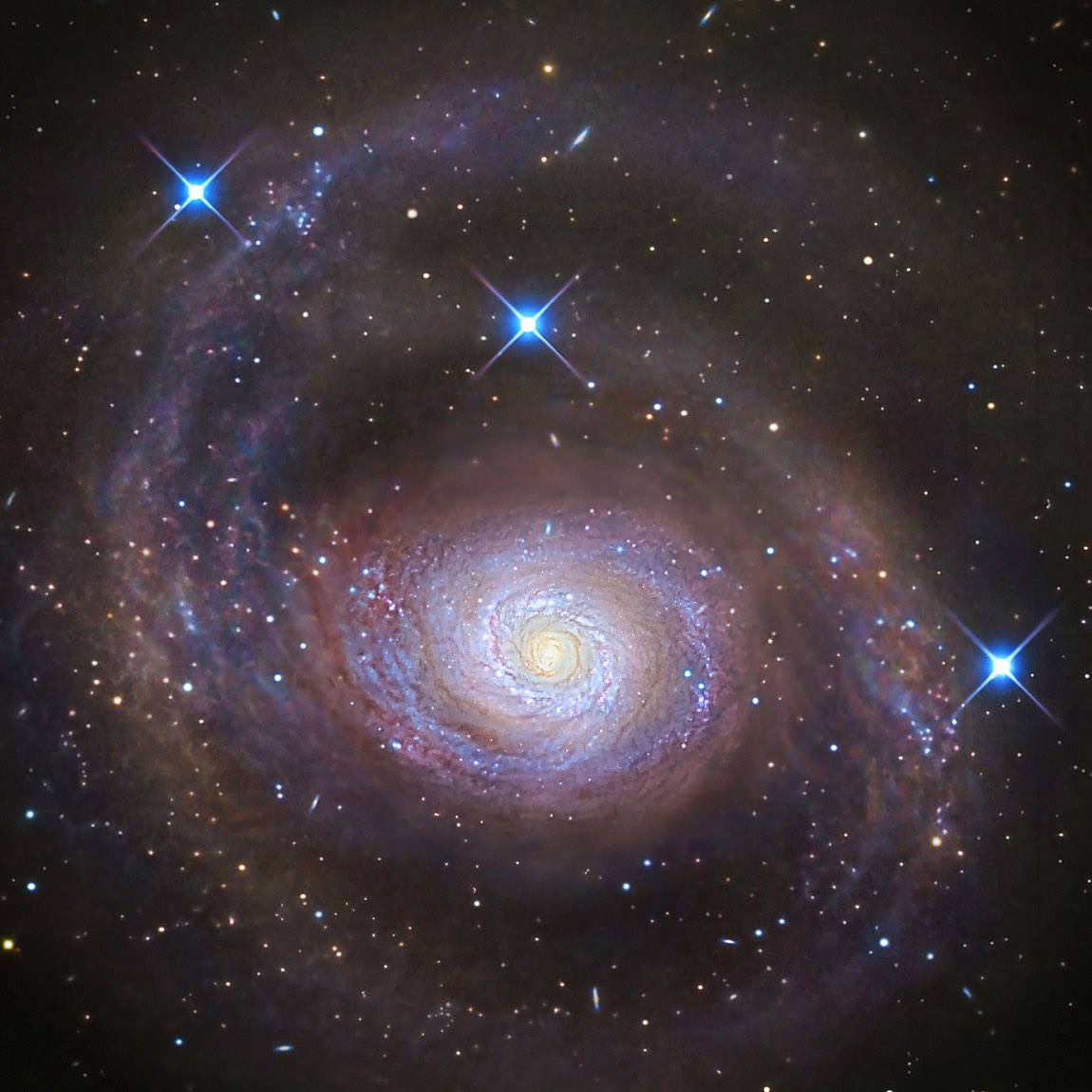
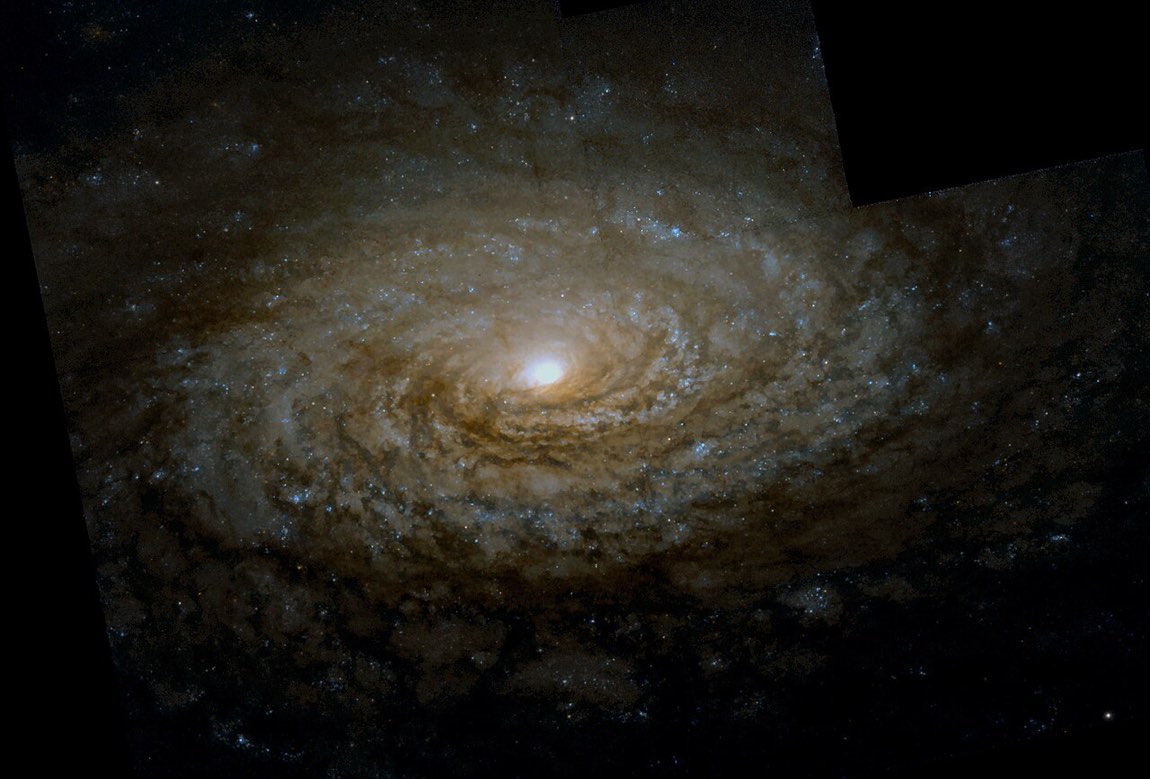
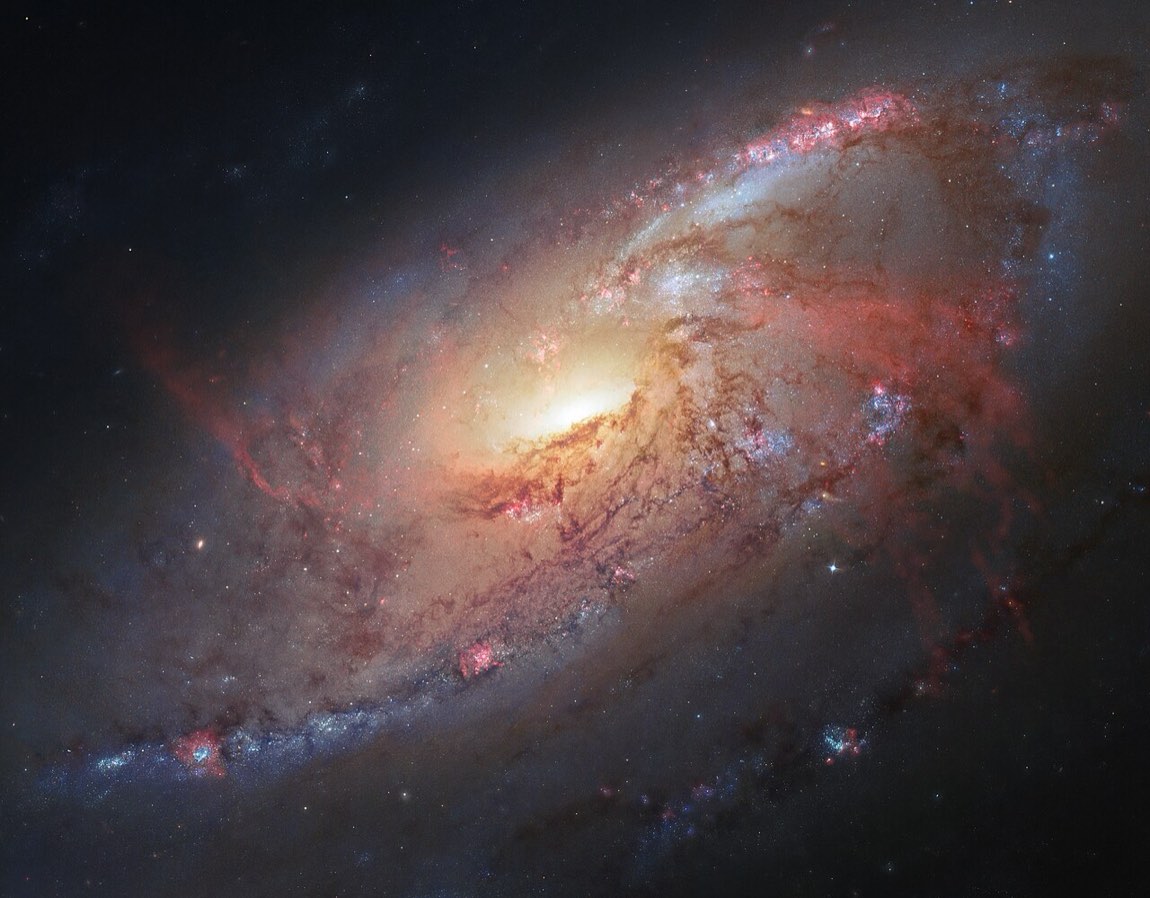
 Photograph · NASA, ESA, the Hubble Heritage Team (STScI/AURA), and R. Gendler (for the Hubble · Public domain
Galaxy · Deep guide
Messier 106
Also called: M106 · NGC 4258 · UGC 7353 · PGC 39600
A spiral with ghostly extra arms and a natural microwave laser that helped measure the universe.
What is it?
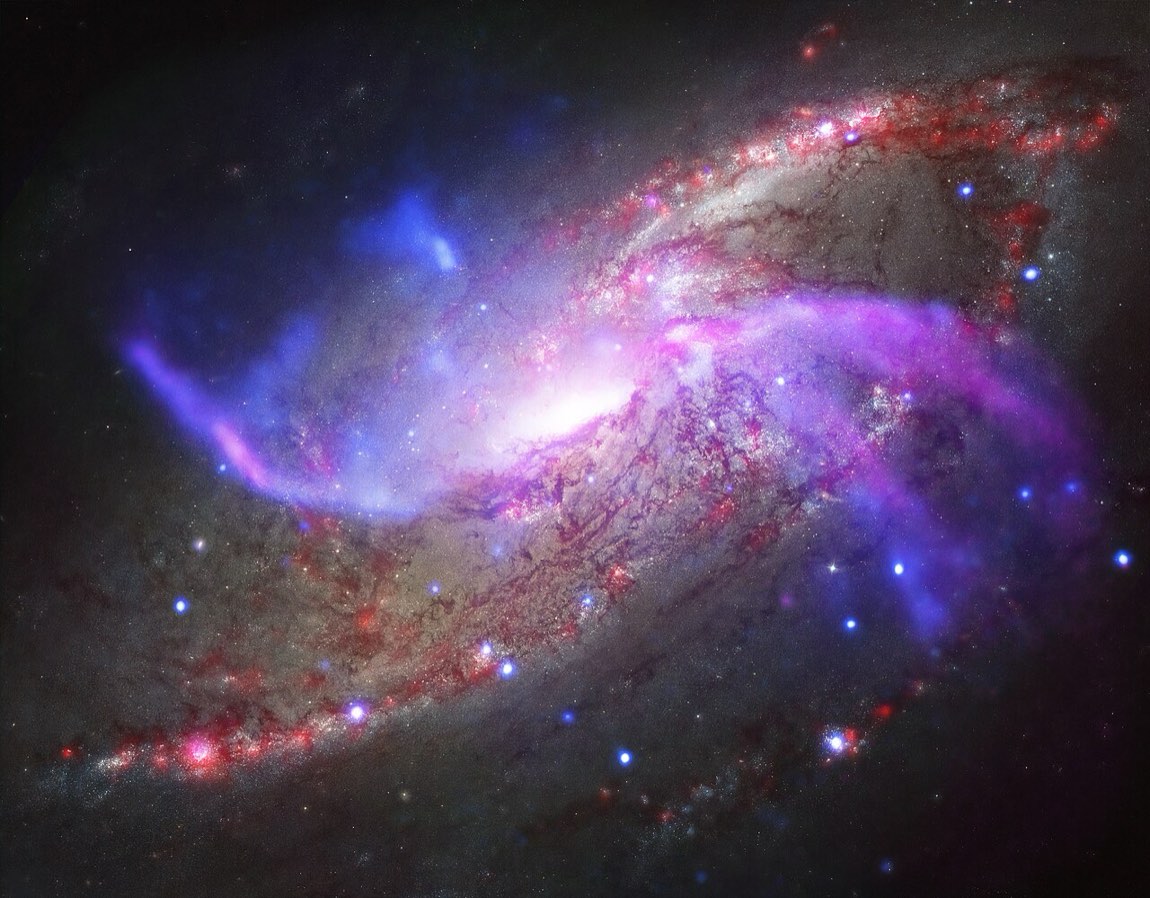
Messier 106 is a spiral galaxy in Canes Venatici, discovered by Pierre Méchain in 1781 and about 22 to 25 million light-years away. Its active centre holds a supermassive black hole, revealed by radio measurements of gas whirling around it. That gas produces a water megamaser, a natural microwave laser. Tracking the maser made M106 the first galaxy whose distance was measured directly, an important anchor for measuring distances across the universe. X-ray telescopes also show two extra anomalous arms besides its visible spiral arms.
The deep dive
Researched for the Atlas from Wikipedia — Messier 106 (2,413 characters read) · updated Nov 15, 2026
01 A Galaxy With Extra Arms Nobody Expected
Most spiral galaxies wear their structure proudly in two sweeping arms of stars and gas. Messier 106 has those, but it also carries two additional "anomalous arms" that only reveal themselves when you look through an X-ray telescope. These extra arms are not built from the same stellar material as the visible ones — they trace hot, energetic gas that the galaxy's violent core has blasted outward into the surrounding disk. That combination of optical and X-ray structure makes M106 a genuinely unusual object: a galaxy that looks normal in a backyard telescope but turns out to be far more complicated once you open up other windows of the electromagnetic spectrum. The existence of these anomalous arms is a direct fingerprint of the active nucleus at M106's heart, evidence that what happens in the innermost regions of a galaxy can reshape structures on a scale of tens of thousands of light-years.
02 The Megamaser: A Cosmic Microwave Amplifier Deeper
Deep inside M106 sits a water vapor megamaser — essentially the galactic-scale equivalent of a laser, but operating in the microwave part of the spectrum rather than visible light. The specific signal astronomers detect is the 22-GHz emission line of ortho-H2O, which flags the presence of exceptionally dense and warm molecular gas. Ordinary masers occur in modest star-forming regions within our own Milky Way, but a megamaser is orders of magnitude more powerful, powered by the intense radiation pumping energy into water molecules near an active galactic nucleus. What makes M106's megamaser especially important is its location: the water molecules are arranged in a slightly warped, thin, almost edge-on Keplerian disk on a subparsec scale — smaller than the distance between our Sun and its nearest stellar neighbors — orbiting directly around the central black hole. Because water masers are precise enough to track the rotation of nuclear accretion disks, they serve as extraordinarily fine-grained probes of conditions right at the edge of the black hole's gravitational grip.
03 Weighing a Black Hole With Radio Waves Deeper
The supermassive black hole at the center of M106 has been measured with unusual precision: its mass is (3.9 ± 0.1) × 10⁷ solar masses — roughly 39 million times the mass of our Sun, with an uncertainty of only about one million solar masses. That tight error bar is a direct result of the megamaser disk. By observing how the disk of molecular gas rotates around the black hole at radio wavelengths, astronomers could apply Keplerian orbital mechanics — the same physics that describes planets orbiting a star — to calculate the mass of the central object directly. The surrounding disk itself encircles a central region with a total mass of 4 × 10⁷ solar masses. This kind of dynamical mass measurement, anchored in straightforward physics rather than indirect proxies, is one of the most rigorous methods available for black hole mass estimation, and M106 provided one of the clearest early demonstrations that it could be done from tens of millions of light-years away.
04 A Galaxy That Anchors the Distance Ladder
Measuring distances across the universe is one of astronomy's oldest and thorniest problems. The cosmic distance ladder works by chaining together different methods, each calibrated against the one below it — and errors at the bottom rungs propagate all the way up. M106 delivered a crucial fix to that chain. Its water megamaser allowed astronomers to make the first direct geometric measurement of the distance to a galaxy, providing an independent anchor that did not rely on assumed properties of stars. That distance — roughly 22 to 25 million light-years — could then be cross-checked against other techniques. On top of that, M106 contains Cepheid variable stars with a range of metallicities (chemical compositions) that spans both the Milky Way's own Cepheids and those found in more distant galaxies. This uniquely mixed population allowed astronomers to recalibrate how metallicity affects Cepheid brightness, correcting a systematic bias that had skewed distance estimates to galaxies across the universe.
05 Pierre Méchain and the Discovery of M106
Messier 106 was discovered by the French astronomer Pierre Méchain in 1781, making it a contemporary of many entries in Charles Messier's famous catalog of nebulae and star clusters. Méchain was a skilled observer and a close collaborator of Messier, regularly contributing new finds to the catalog. Despite that early discovery date, M106 carries the catalog number 106, which suggests it was recorded after the original published catalog was largely complete — it appears in an extended list rather than the core Messier objects. The galaxy is also cataloged as NGC 4258, the designation it receives in the New General Catalogue compiled later in the nineteenth century. Today it sits in the constellation Canes Venatici, the Hunting Dogs, a region of sky that hosts a remarkable concentration of bright galaxies well placed for northern hemisphere observers.
06 How M106 Compares to Andromeda
When astronomers describe M106's overall scale, they reach for the most famous galaxy most people know: the Andromeda Galaxy. M106 is described as similar in size and luminosity to Andromeda, making it one of the largest and brightest galaxies in its cosmic neighborhood. That is a meaningful comparison — Andromeda is roughly 2.5 million light-years from Earth and spans more than twice the apparent diameter of the full Moon in the sky, yet it is considered a large but not extraordinary spiral galaxy. M106, sitting some 22 to 25 million light-years away, matches that scale. The difference is that Andromeda has a relatively quiet nucleus, while M106 hosts an active Type 2 Seyfert core — so the two galaxies show what a broadly similar spiral structure can look like when one has a far more energetically active center feeding its supermassive black hole.
07 What Makes a Seyfert Type 2 Nucleus Deeper
M106's active nucleus is classified as a Type 2 Seyfert, one of the two main categories of Seyfert galaxies — a class of active galactic nuclei first systematically studied by Carl Seyfert in the 1940s. In a Type 2 Seyfert, the broad-line region of the nucleus — where gas moves at thousands of kilometers per second close to the black hole — is obscured from our direct line of sight, typically by a torus or disk of dust and gas surrounding the core. What we see instead are narrower emission lines from gas farther out. In M106's case, the obscuring material is consistent with the nearly edge-on molecular disk that the megamaser observations have mapped in detail. This geometry is actually fortunate for science: the edge-on orientation of the disk is precisely what makes the maser signals geometrically interpretable and what allowed the direct distance measurement and black hole mass calculation to be performed with such clarity.
08 Two Supernovae Caught in One Galaxy
M106 has hosted two observed supernovae, both of Type II — the category produced when a massive star exhausts its nuclear fuel and its core collapses catastrophically. The first, designated SN 1981K, reached an apparent magnitude of 17 and was reported by E. Hummel; it was subsequently verified by Paul Wild through examination of archival photographs dated 3 November 1981, meaning the explosion had already been captured on old images before anyone noticed it in real time. The second, SN 2014bc, was considerably brighter at magnitude 14.8 and was discovered on 19 May 2014 by the PS1 Science Consortium's 3Pi survey — a systematic all-sky imaging program designed to catch exactly these kinds of transient events. Two supernovae in one relatively nearby galaxy within about 33 years of each other gives astronomers useful data points for estimating the core-collapse supernova rate in a galaxy of M106's type and star formation activity.
09 NGC 4217: A Possible Companion Galaxy
M106 may not travel alone through space. NGC 4217 is identified as a possible companion galaxy of Messier 106, suggesting the two galaxies are gravitationally associated rather than simply appearing near each other by chance along the line of sight. Companion galaxies are common around large spirals — the Milky Way itself has the Magellanic Clouds, and Andromeda is flanked by M32 and M110. Whether NGC 4217 is a true gravitational partner of M106 or a chance projection remains an open question the article flags without resolving definitively. If the association is real, the two galaxies would constitute a small group, and their mutual gravitational influence could subtly affect the star formation histories and structural evolution of both systems over billions of years.
10 Observing M106 From Your Own Backyard
With an apparent magnitude bright enough to make it one of the most prominent nearby galaxies, M106 is accessible to amateur astronomers with modest equipment. It sits in Canes Venatici, a constellation that climbs high in the northern sky during spring evenings, making it well-placed for observers in the northern hemisphere for a generous portion of the year. Through a small telescope the galaxy appears as an elongated glow, hinting at its inclined disk orientation. Larger instruments and longer exposures begin to reveal the spiral arm structure visible in optical light. The two anomalous arms, however, require X-ray space telescopes entirely beyond amateur reach — as does any direct evidence of the megamaser or the black hole. Nevertheless, M106 rewards patient observers precisely because knowing what lies hidden beneath that soft oval smudge — a 39-million-solar-mass black hole, a molecular maser disk, blasted anomalous arms — transforms the view entirely.
11 Open Questions That M106 Still Poses Deeper
Even as M106 has answered major questions in extragalactic astronomy, it leaves others open. The nature and origin of the two anomalous X-ray arms is not exhaustively explained in the observational record — their connection to the active nucleus is inferred, but the precise mechanism by which core energy output carves those structures into the disk remains an area of active interpretation. The status of NGC 4217 as a true gravitational companion rather than a projection is also unresolved. And while the megamaser distance measurement provided a valuable independent anchor for the cosmic distance ladder, the range given for M106's distance — 22 to 25 million light-years — still carries a spread of about 3 million light-years, reflecting genuine measurement uncertainty. Each improvement in that distance estimate matters, because M106's role as a Cepheid metallicity calibrator means that errors in its distance propagate into distance measurements for galaxies far beyond it.
 ⤢