 Photograph · R Jay Gabany (Blackbird Obs.) · CC BY-SA 3.0
Galaxy · Deep guide
Messier 94
Also called: M94 · NGC 4736 · Cat's Eye Galaxy · Crocodile Eye Galaxy · Croc's Eye Galaxy
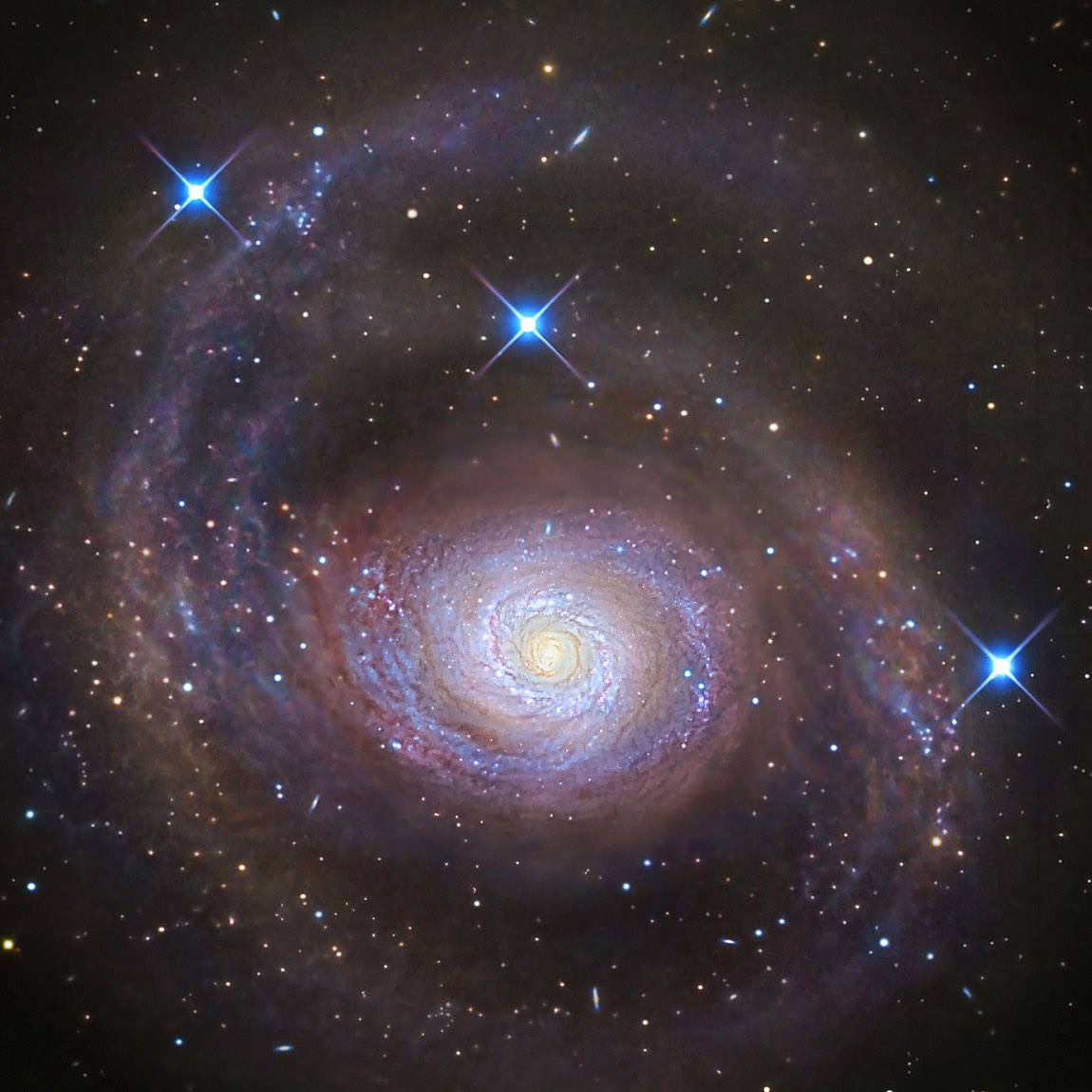
A spiral galaxy with two glowing rings, the inner one blazing with new stars.
What is it?
Messier 94 is a spiral galaxy in Canes Venatici, discovered by Pierre Méchain in 1781 and catalogued by Messier two days later. Its most striking features are two rings: a bright inner ring about 5,400 light-years across, where star formation is intense, and a faint outer ring about 45,000 light-years across. The rings likely form at resonance points in the galaxy's rotating disk. Its weakly active centre holds a supermassive black hole measured with the James Webb Space Telescope at about 16 million solar masses.
The deep dive
Researched for the Atlas from Wikipedia — Messier 94 (5,013 characters read) · updated Nov 15, 2026
01 Pierre Méchain's 1781 Discovery
Messier 94 was first spotted by Pierre Méchain in 1781, and Charles Messier catalogued it just two days later — a remarkably quick turnaround that speaks to how bright and well-defined the galaxy appears through even a modest telescope. Messier's catalogue was originally designed to help comet hunters avoid confusing fuzzy, non-moving objects with actual comets, so M94 earned its place simply by looking deceptively comet-like at low magnification. Despite this early attention, the galaxy's true complexity — its double ring system, its pseudobulge, and the contested nature of its outer disk — remained hidden for more than two centuries. The classification question alone took decades to settle partially: some references still describe M94 as a barred spiral galaxy, but the structure usually identified as a bar is now understood to be more oval-shaped, making the classification genuinely ambiguous rather than a simple oversight by earlier observers.
02 A Galaxy With Two Distinct Rings
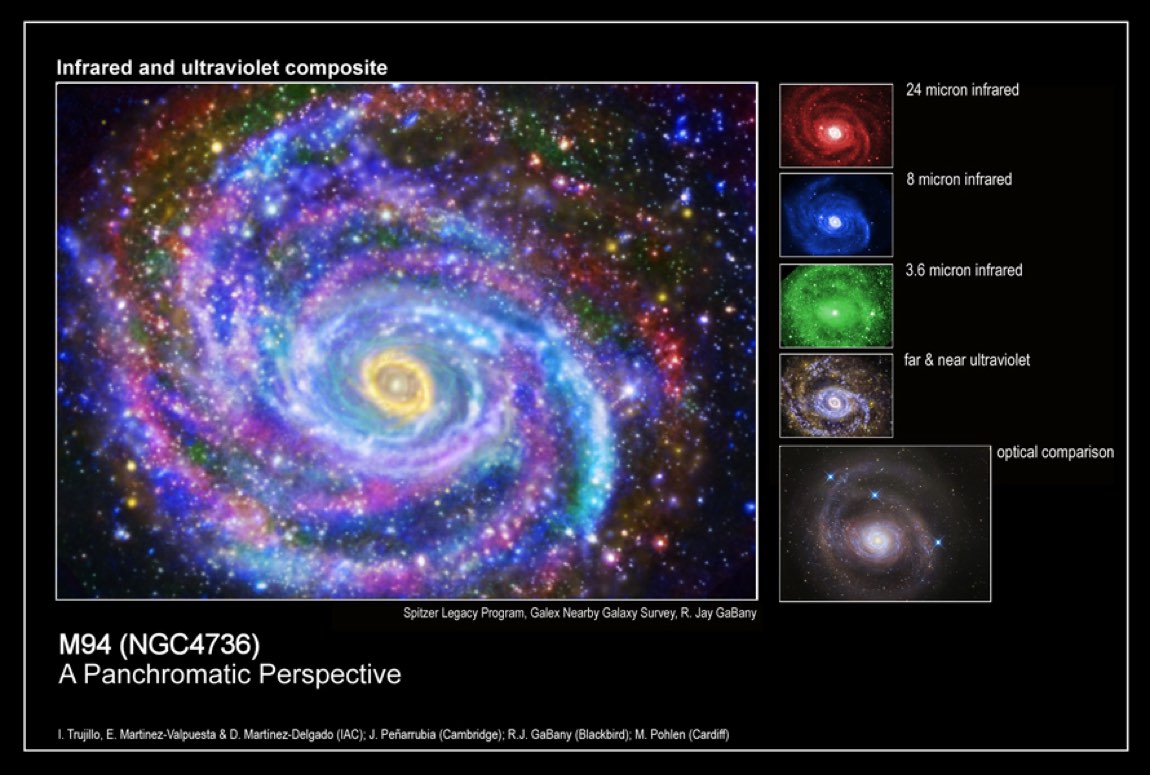
One of the most striking structural features of M94 is that it possesses not one but two ring structures, sitting at very different scales. The inner ring spans 70 arcseconds on the sky, which translates to a physical diameter of about 5,400 light-years. It is a hotbed of ongoing star formation — so vigorous that astronomers call it a starburst ring — powered by gas that the inner oval-shaped bar-like region drives dynamically inward. The outer ring is vastly larger, stretching 600 arcseconds across, or roughly 45,000 light-years in physical diameter. That outer ring is nearly as wide as the entire Milky Way. Both rings are thought to form at resonance points within the galactic disk, locations where the orbital frequencies of stars and gas align in ways that concentrate material and trigger large-scale structure. The existence of these resonance-driven rings gives M94 a bullseye appearance that makes it one of the more visually distinctive galaxies in the northern sky.
03 The Starburst Ring Up Close Deeper
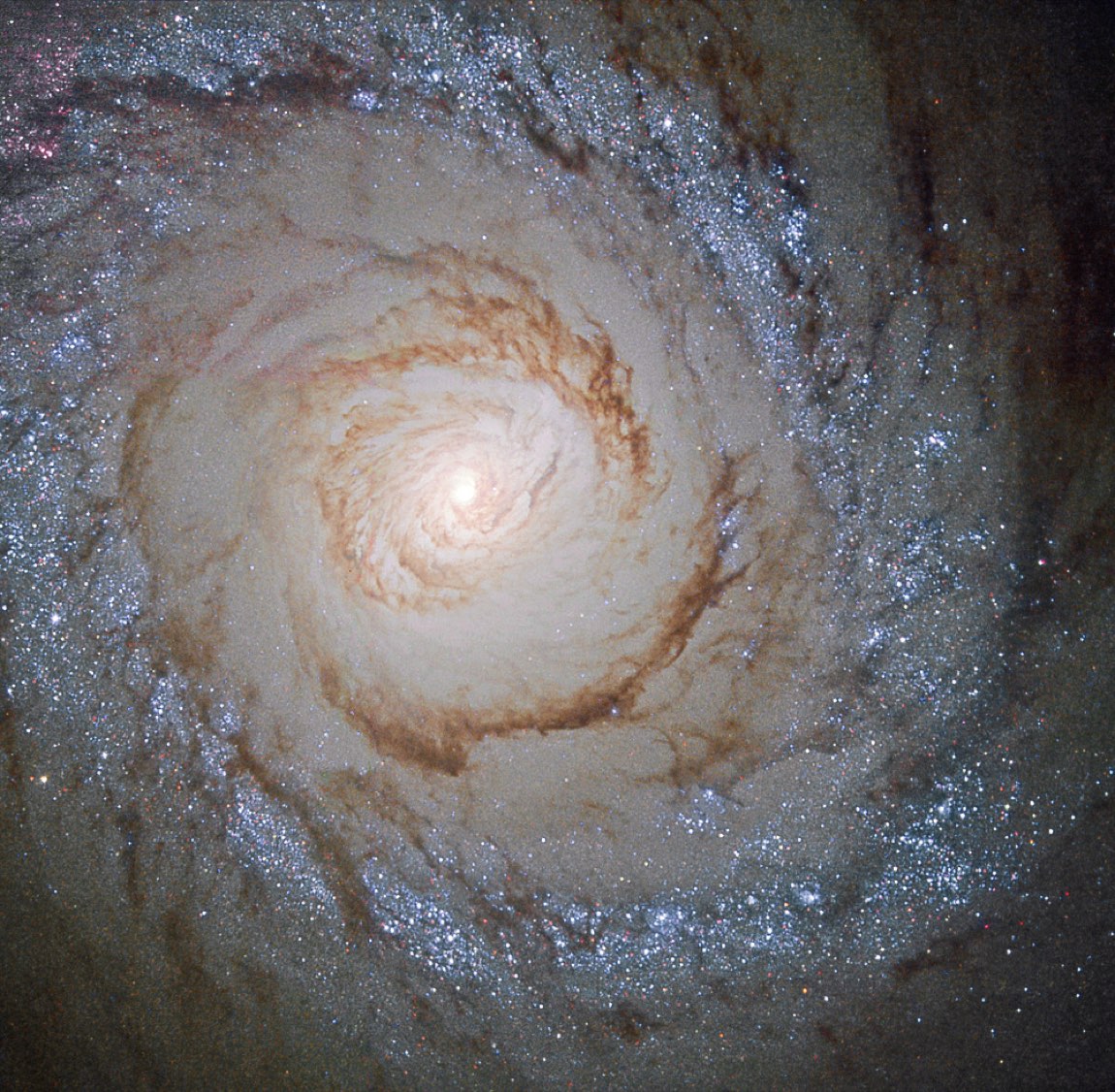
The inner ring of M94 is not merely a pretty feature — it is one of the most actively star-forming regions in any nearby galaxy. Gas is funneled into this ring by the dynamics of the inner oval distortion, which acts like a slow-motion pump, pushing interstellar material toward the resonance radius where the ring sits. Once concentrated there, the gas collapses into new stars at an elevated rate that qualifies the region as a starburst environment. This kind of internally driven star formation is distinct from the violent starbursts triggered by galaxy mergers, because M94 appears to be generating it largely through its own internal gravitational machinery. The starburst ring's diameter of about 5,400 light-years means it encircles a region comparable in size to the distance between the Sun and the center of the Milky Way, so the star-forming activity is spread across an enormous area rather than being confined to a compact nuclear burst.
04 The Outer Disk Is Not What It Seemed Deeper
For much of its observational history, the outer ring of M94 was described in the literature as a closed stellar ring — a neat, self-contained loop of stars at the galaxy's periphery. A 2009 study by an international team of astrophysicists overturned that picture entirely. When examined in mid-infrared and ultraviolet wavelengths, the outer structure resolves not into a closed ring but into a complex arrangement of spiral arms. This distinction matters enormously because a closed ring and a system of spiral arms form through completely different physical processes. The study also found that this outer disk is far from passive: it contains approximately 23% of the galaxy's total stellar mass and contributes about 10% of its newly formed stars. Even more surprising, the star formation rate per unit of stellar mass in the outer disk is roughly two times greater than in the inner disk, meaning the periphery is actually more efficient at converting gas into stars than the bright central regions.
 ⤢
05 How the Outer Disk Came to Be Deeper
Explaining the origin of M94's outer disk has proven genuinely difficult, and the 2009 study that re-examined it considered several competing scenarios without finding a clean answer. One possibility is that M94 swallowed a smaller satellite galaxy whose stars and gas were dispersed into the outer regions during the accretion event. Another candidate explanation involves a gravitational interaction with a nearby star system that could have stirred up and redistributed material. However, the researchers found specific problems with each of these external scenarios when they tested them against the observational data. The conclusion they reached was that the outer disk most likely grew from within: the inner oval distortion — that same bar-like structure driving gas into the starburst ring — may have gradually pushed material outward over cosmic time, seeding the peripheral disk without any need for a dramatic external collision. This internal origin story remains the leading hypothesis, though it has not been definitively confirmed.
06 Pseudobulges and What They Reveal
In 2004, astronomers John Kormendy and Robert Kennicutt argued that M94 contains a prototypical pseudobulge — a term that describes a central structure that mimics the appearance of a classical galactic bulge but forms through completely different physics. A classical bulge is a large, roughly spherical swarm of old stars built up through mergers and gravitational collapse in the early universe. A pseudobulge, by contrast, is a bright central structure characterized by ongoing or recent star formation that simply looks bulge-like when the galaxy is seen face-on. In M94 specifically, the pseudobulge takes the form of a ring surrounding a central oval-shaped region. The significance of identifying M94 as a prototypical case is that it gives astronomers a nearby, well-resolved laboratory for studying how pseudobulges grow and evolve, which in turn sheds light on the secular — meaning slow and internally driven — evolution of disk galaxies.
07 A Supermassive Black Hole Measured by JWST
At the center of M94 sits a supermassive black hole with a mass of 1.60 × 10⁷ solar masses — about 16 million times the mass of the Sun. For comparison, the Milky Way's central black hole, Sagittarius A*, has a mass of roughly 4 million solar masses, so M94's central engine is several times more massive. This measurement was made using stellar kinematics derived from James Webb Space Telescope data, meaning astronomers tracked the motions of stars near the galactic center and inferred the gravitational mass required to produce those motions. The result is described as consistent with established scaling relations between black hole mass and the properties of the surrounding galaxy, specifically the MBH–σ relation (connecting black hole mass to the velocity dispersion of bulge stars) and the MBH–M★,gal relation (connecting black hole mass to total stellar mass). M94 also hosts a LINER nucleus — a low ionization nuclear emission region — meaning its core emits light from weakly ionized gas rather than the blazing output of a full quasar.
08 The Dark Matter Mystery at M94
Among the many puzzles M94 presents, none has proven more controversial than its apparent shortage of dark matter. A 2008 study analyzed the rotation curves of stars across the galaxy — measuring how fast stars orbit at different distances from the center — alongside the density of hydrogen gas, and concluded that ordinary luminous matter appeared to account for essentially all of M94's mass. This is a striking anomaly because virtually every current model of galaxy formation assumes that galaxies are embedded in massive halos of dark matter that dominate the total mass budget. A galaxy without dark matter raises two uncomfortable questions that the study acknowledged: how could such a galaxy have formed in the first place, and how could it have lost its dark matter halo if it once had one? Even alternative gravity theories like MOND, which are sometimes invoked to explain galactic rotation curves without dark matter, struggle to account for M94's behavior. Crucially, the result has not been confirmed or accepted by other research groups, and has not been tested against standard galaxy formation model predictions.
 ⤢
09 Measuring the Distance to M94 Deeper
Pinning down the distance to M94 required two independent techniques, and their results do not agree perfectly — a reminder that cosmic distance measurement remains genuinely hard. The first method uses surface brightness fluctuations, which exploit the fact that a galaxy's bulge looks grainier the closer it is because individual clumps of stars can be resolved. This technique places M94 at 17.0 ± 1.4 million light-years. The second method takes advantage of M94 being close enough for the Hubble Space Telescope to resolve and measure the brightness of individual luminous stars within the galaxy, then compare those values to similar stars at known distances in the Milky Way. That approach yields 15 ± 2 million light-years. Averaged together, the two estimates give a best distance of 16.0 ± 1.3 million light-years. The error bars on both measurements overlap, so they are consistent within their uncertainties, but the spread illustrates why astronomers rarely trust a single distance technique and prefer to triangulate using multiple independent methods.
10 M94 and Its Galaxy Group
M94 is one of the brightest members of a galaxy group that bears its name — the M94 Group — which contains somewhere between 16 and 24 galaxies depending on which objects are counted as genuine members. That uncertainty in membership size is itself telling: determining whether a nearby galaxy is gravitationally bound to a group or simply passing through the same region of space is not always straightforward. In fact, the article notes that although a large number of galaxies may be associated with M94 by proximity, only a few actually appear to form a gravitationally bound system. Most of the others seem to be simply moving with the general expansion of the universe rather than orbiting M94 in any meaningful sense. The M94 Group itself is one of many galaxy groups lying within the Virgo Supercluster, the vast cosmic structure — also called the Local Supercluster — that contains the Local Group of galaxies, including our own Milky Way.
11 How to Find and Observe M94
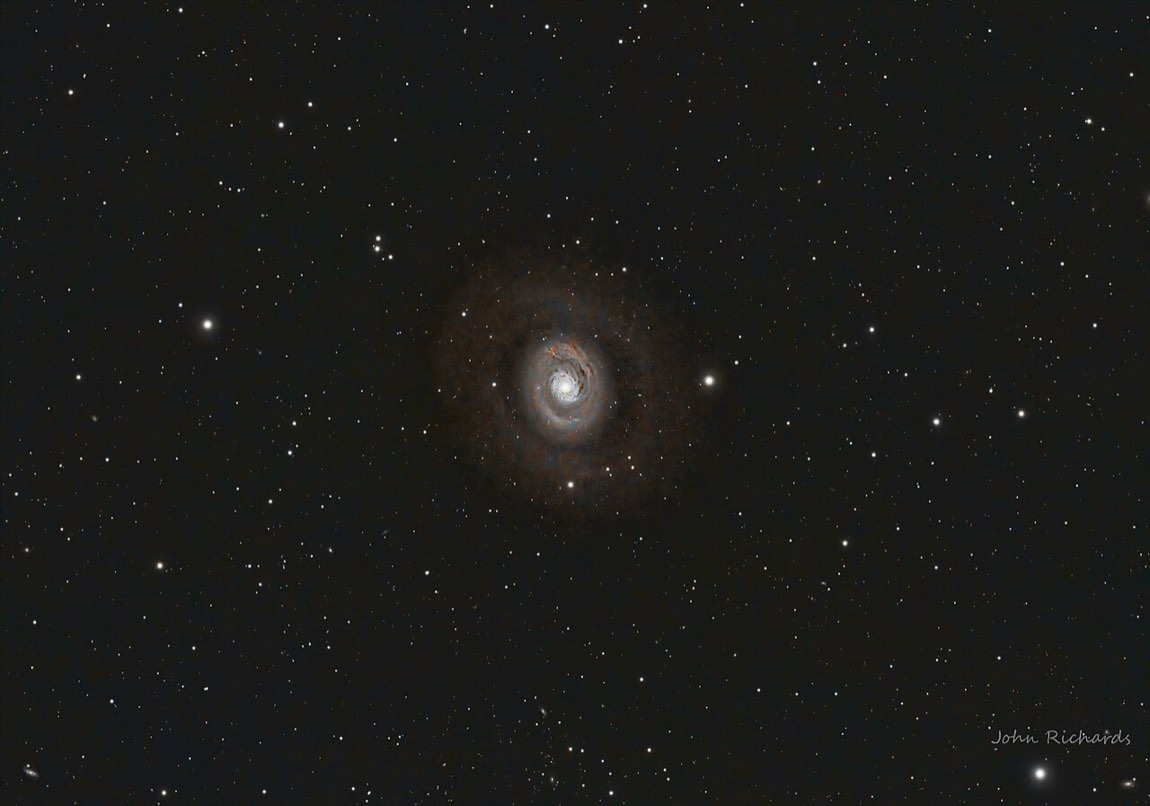
M94 sits in Canes Venatici, a mid-northern constellation that rides high in the spring sky for observers in the Northern Hemisphere. With an apparent magnitude bright enough to have caught Méchain's eye with 18th-century instruments, it is well within reach of small modern telescopes and even good binoculars under dark skies. Through a small telescope, the galaxy appears as a bright, condensed core surrounded by a fainter glow — the same comet-like appearance that earned it a place in Messier's catalogue. Larger apertures begin to reveal the high surface brightness of the central region and hints of structure in the surrounding disk. The dual ring architecture and the starburst inner ring are not visible to the eye at the eyepiece; they emerge only in long-exposure imaging, particularly at ultraviolet and infrared wavelengths where the 2009 study revealed the outer disk's true spiral-arm nature. For visual observers, M94 rewards visits as one of the most compact, high-surface-brightness galaxies in the Messier catalogue.
12 LINER Nuclei and Weak Ionization Deeper
M94 is classified as hosting a low ionization nuclear emission region, or LINER, nucleus — a category of galactic core that occupies a middle ground between the quiet nuclei of ordinary galaxies and the blazing cores of Seyfert galaxies or quasars. LINER nuclei as a class are defined by their optical spectra: the light they emit reveals the presence of ionized gas, meaning electrons have been stripped from atoms, but only weakly so. In practice, this means the atoms in the nucleus have lost relatively few electrons compared to the highly ionized gas seen around more powerful active galactic nuclei. What drives this weak ionization in LINERs is still debated — candidates include low-luminosity accretion onto the central black hole, shock waves from stellar winds or supernovae, or photoionization by hot evolved stars. In M94's case, the LINER classification sits alongside its pseudobulge and starburst ring, making it a galaxy where multiple forms of nuclear and circumnuclear activity coexist at moderate intensity rather than any single process dominating.
 ⤢