 Photograph · GSFC / NASA Image Library
Galaxy · Deep guide
The Whirlpool Galaxy
Also called: M51
The first spiral humanity ever saw, caught mid-embrace with a smaller galaxy.
What is it?
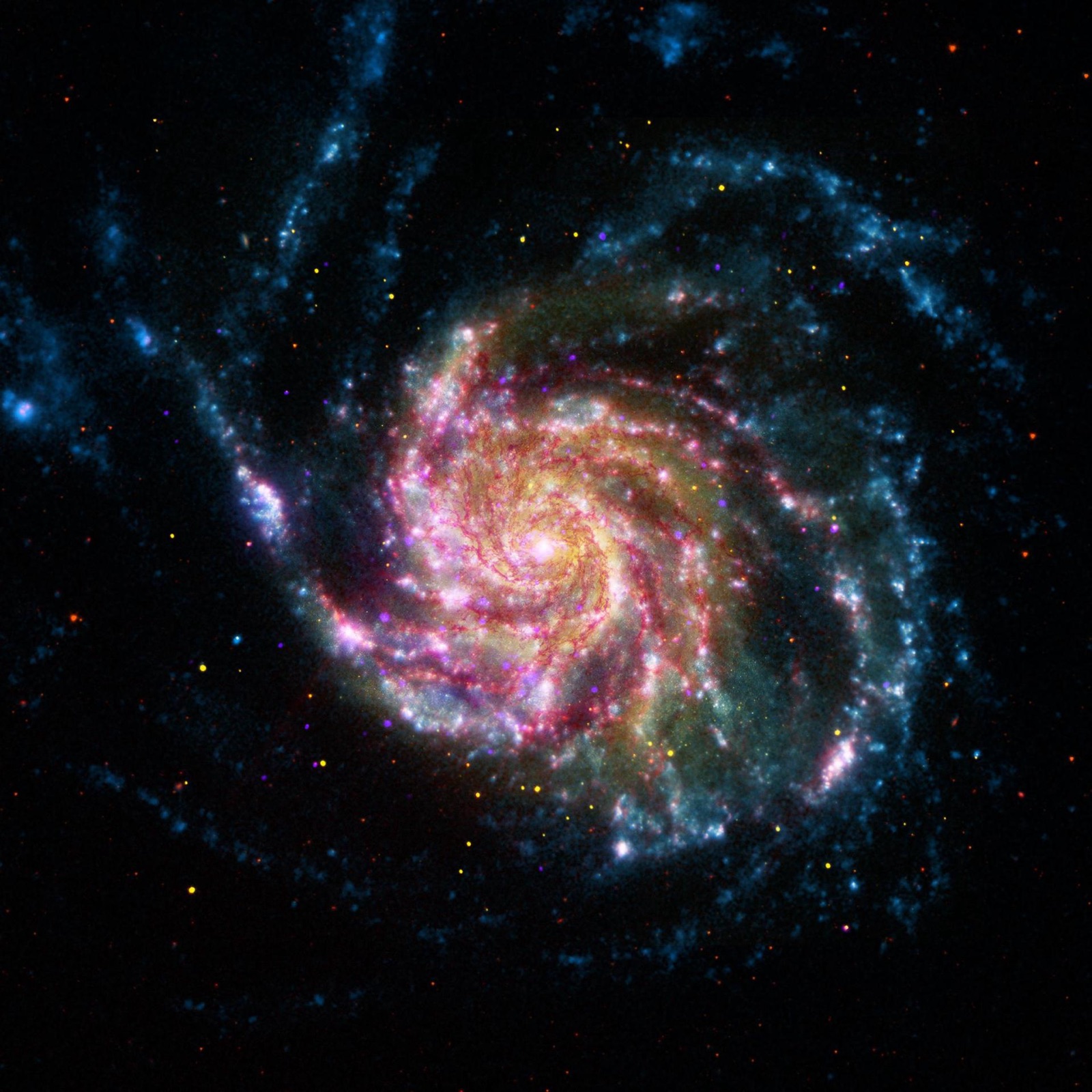
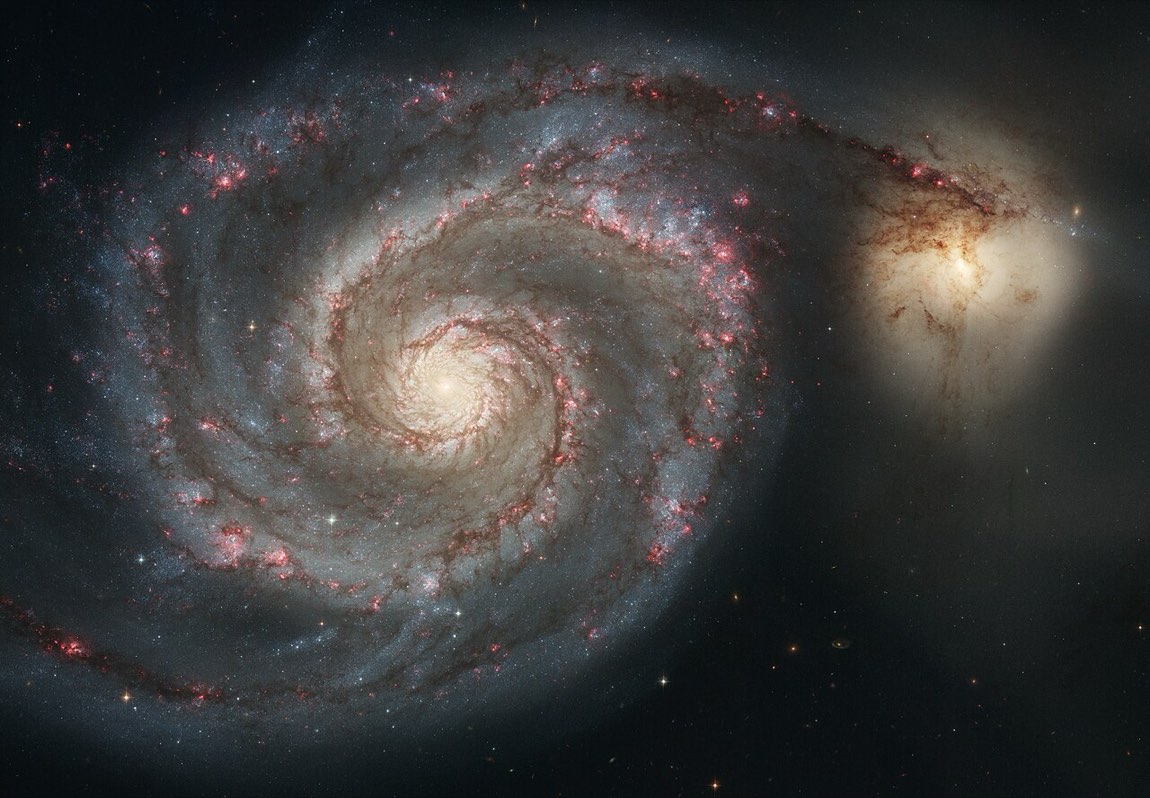
The Whirlpool (M51), about 28 million light-years away, is the galaxy that revealed spiral structure: Lord Rosse sketched its swirl through his giant telescope in 1845, decades before anyone knew what galaxies were. Its perfect face-on spiral is being sharpened by an ongoing encounter with the small yellow galaxy NGC 5195, which hangs off one arm like a bell on a ribbon.
The deep dive
Researched for the Atlas from Wikipedia — Whirlpool Galaxy (10,491 characters read) · updated Sep 20, 2026
01 The First Spiral Ever Recognized
When Charles Messier catalogued this smudge of light on October 13, 1773, he had no idea what he was looking at — he simply wanted to warn comet hunters away from it. The real breakthrough came decades later, when William Parsons, the 3rd Earl of Rosse, turned his enormous 72-inch (1.8-metre) reflecting telescope at Birr Castle in Ireland toward the object. What he saw changed astronomy forever: a clear spiral structure, the first ever recognized in any nebula. At the time, nobody knew these spiral nebulae were entire galaxies in their own right. That understanding had to wait until Edwin Hubble identified Cepheid variable stars inside some of them, proving they were so distant they could only be independent stellar systems on a colossal scale. The Whirlpool Galaxy thus holds a unique place in scientific history — the object that first revealed the spiral form that we now know shapes so much of the visible universe.
02 How Radio Waves Solved a Mystery
For a long time, astronomers debated whether the Whirlpool and its nearby companion NGC 5195 were truly interacting or merely a chance alignment along the line of sight. The arrival of radio astronomy settled the question decisively. Radio waves, unlike visible light, can penetrate dust and trace the distribution of gas across vast distances. When radio images of M51 were made, they unequivocally showed that the two galaxies are physically connected, with gas mapping out a genuine bridge between them. This was not an accident of perspective — the Whirlpool and NGC 5195 are genuinely locked in a gravitational embrace. Radio observations thus transformed what had been a beautiful visual curiosity into one of the most important and closely studied cases of galaxy interaction in the sky, giving theorists real data against which to test their models of how galaxies collide and reshape one another.
03 A Surprisingly Young and Lightweight Galaxy Deeper
Despite its grand appearance, the Whirlpool Galaxy turns out to be a relatively modest system by cosmic standards. Its diameter is 23.58 kiloparsecs — equivalent to about 76,900 light-years — making it roughly 88% the size of the Milky Way. Its mass, however, is estimated at only 160 billion solar masses, which works out to around 10.3% of the Milky Way's mass. In other words, the Whirlpool looks almost as wide but is far less massive than our own galaxy, implying a much lower average density. Perhaps most striking is its estimated age: only about 400 million years old. To put that in perspective, the dinosaurs on Earth appeared roughly 230 million years ago, so the Whirlpool has existed for less than twice the span of dinosaur history — extraordinarily young for a galaxy. Its distance from Earth is pinned somewhere between 23 and 31 million light-years, a range that reflects the genuine difficulty of measuring extragalactic distances with precision.
 ⤢
⤢
04 The Black Hole at the Heart of the Spiral
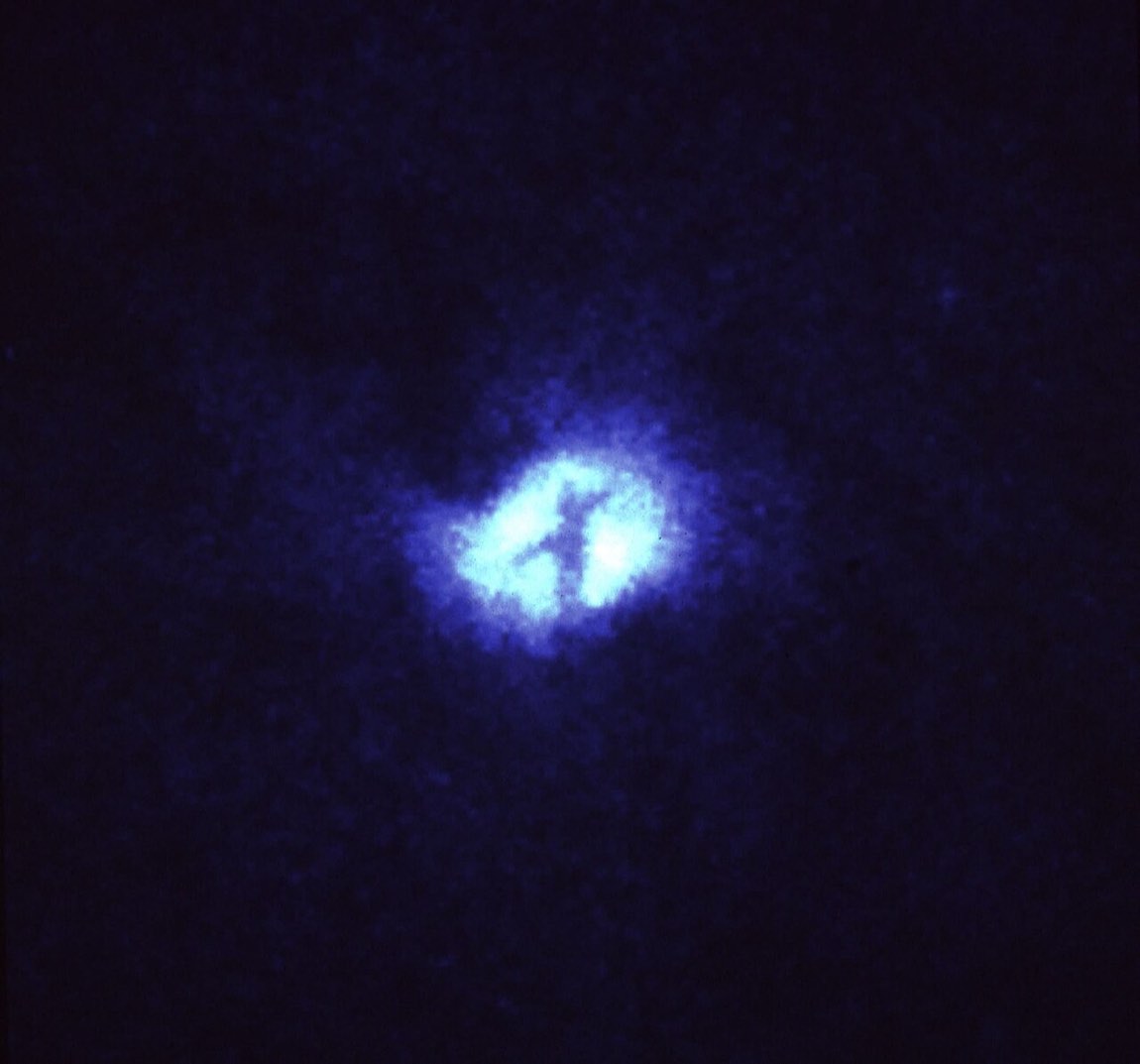
At the very center of the Whirlpool Galaxy sits an active galactic nucleus classified as a Seyfert 2 type, which means its energetic core is partially hidden from direct view. A black hole lies at the heart of this nucleus, and astronomers have revised their picture of what surrounds it over time. Earlier models proposed that the black hole was encircled by a complete ring of dust, but the current understanding is more nuanced: the dust only partially occludes the black hole rather than forming a neat torus around it. Extending outward from this nucleus are a pair of ionization cones — regions where energetic radiation from the active nucleus has ionized surrounding gas, carving out cone-shaped structures in the interstellar medium. In 1984, using a high-speed detector system developed jointly by French research institutions and mounted on the Canada-France-Hawaii Telescope atop Mauna Kea, Hua and colleagues managed to detect the double component of the galaxy's very nucleus for the first time.
05 How an Ancient Collision Built Those Spiral Arms Deeper
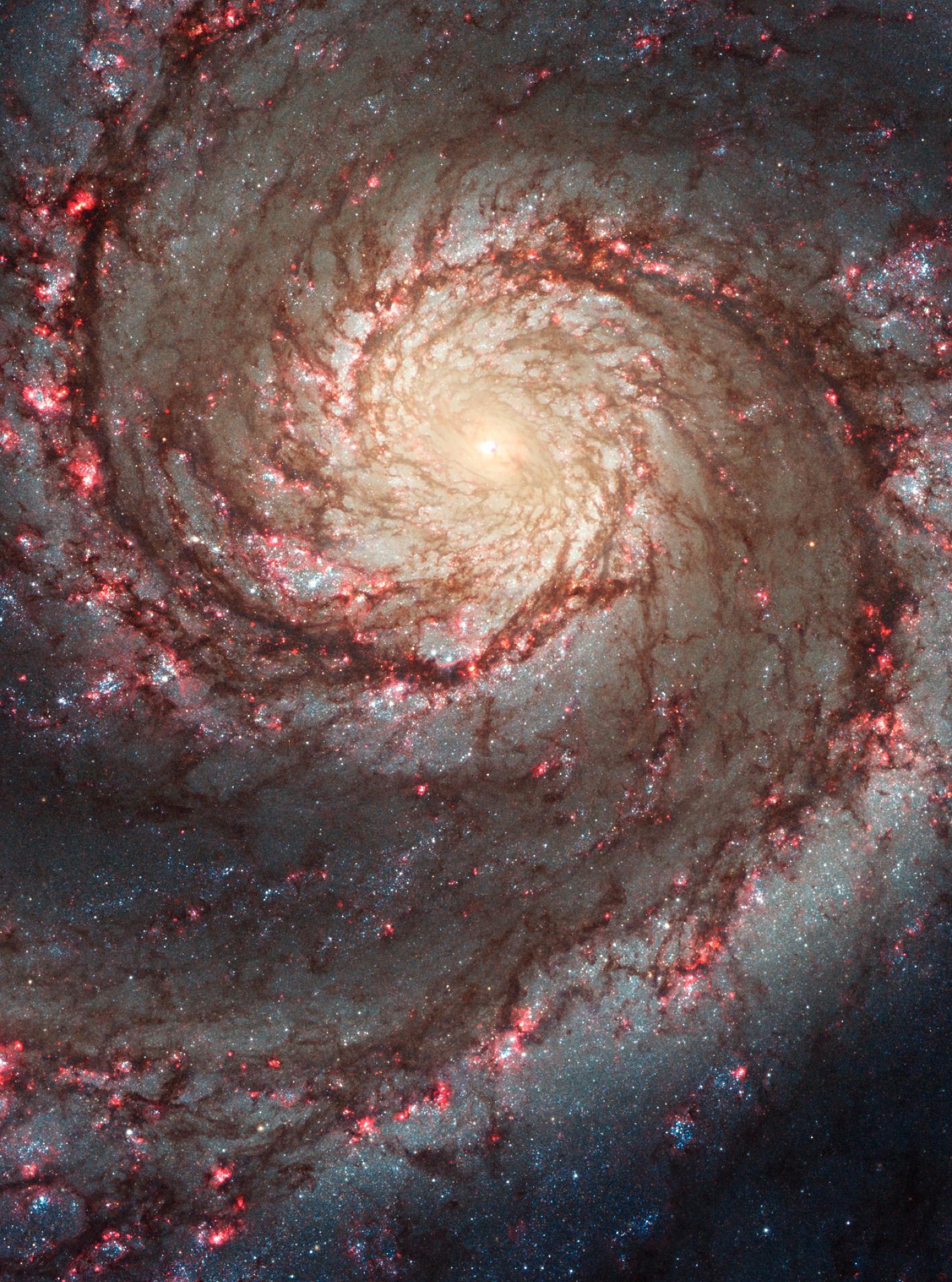
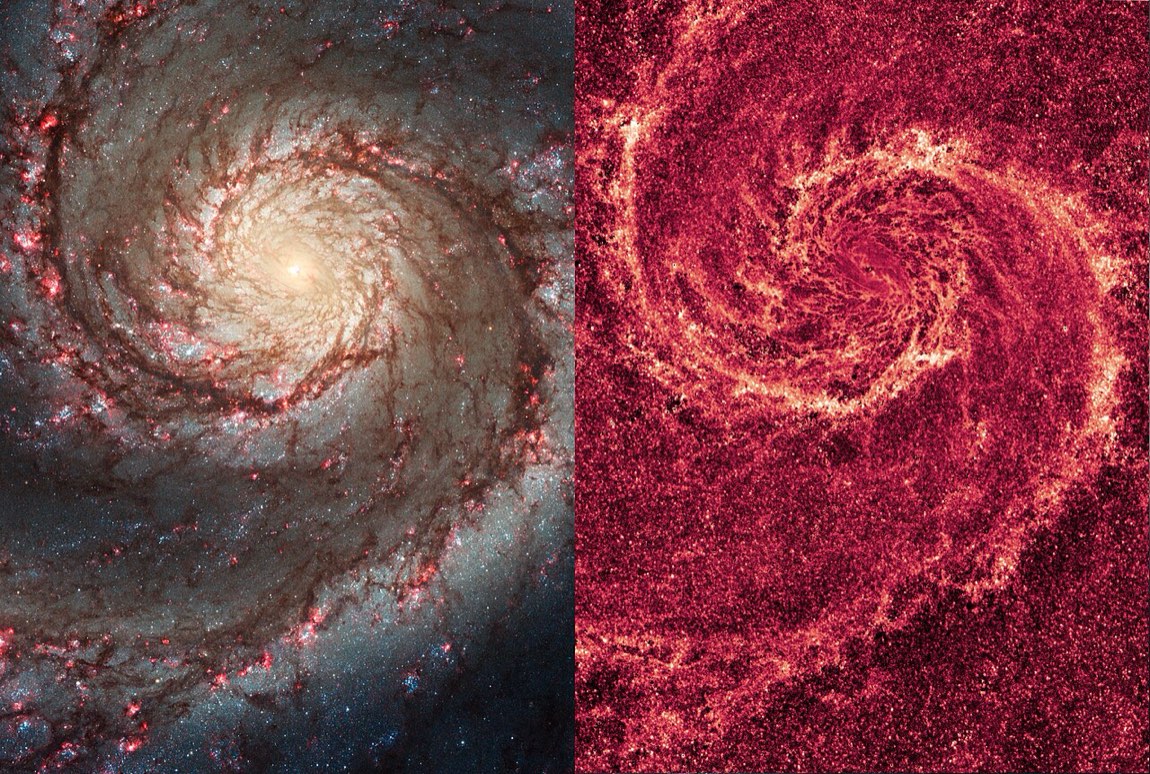
The Whirlpool's two prominent spiral arms, which wind clockwise and are among the most photogenic in the known universe, are not simply the natural shape of a rotating disk. Astronomers believe the spectacular spiral structure was directly triggered by the gravitational interaction with companion galaxy NGC 5195. The leading model proposes that NGC 5195 passed entirely through the main disk of M51 roughly 500 to 600 million years ago, approaching from behind and moving toward the observer. It then made a second disk crossing as recently as 50 to 100 million years ago and now sits slightly behind M51 as we see it today. This repeated stirring of the disk is thought to have amplified and organized the spiral pattern we observe. Notably, one of the two spiral arms deviates significantly from a constant pitch angle, a subtle asymmetry that the ongoing interaction may help explain. The whole scenario makes the Whirlpool a living laboratory for understanding how gravitational encounters sculpt galactic structure.
06 Tidal Plumes Stretching Across the Void Deeper
Galaxy interactions do not just rearrange stars — they fling enormous streams of material into intergalactic space. The most dramatic example around the Whirlpool is the so-called Northwest plume, which stretches 43 kiloparsecs (about 140,000 light-years) from the galaxy's center — nearly twice the diameter of the galaxy itself. This plume is remarkably uniform in color and is thought to have originated from the Whirlpool, carried by diffuse gas. Nearby sit two additional Western plumes with a slightly bluer tint, hinting at a different stellar population or star-formation history. As recently as 2015, a study identified two further tidal features: a Northeast plume and a South plume. Interestingly, computer simulations that model only a single passage of NGC 5195 through the Whirlpool's disk cannot reproduce the Northeast plume at all. Only multiple-passage simulations, such as those constructed by Salo and Laurikainen, generate structures that match the observations — providing indirect but compelling evidence that the two galaxies have interacted more than once.
 ⤢
⤢
07 A Burst of Star Birth That Cannot Last
The gravitational stirring caused by NGC 5195 has had a dramatic side effect: it has supercharged star formation across the Whirlpool. The central region is currently undergoing a period of enhanced star birth, and the spiral arms are equally active, with new stars igniting all along them. Despite this elevated activity, the efficiency of star formation — defined as the fraction of star-forming gas that actually becomes new stars — sits at only about 1%, which is comparable to the global rate in the Milky Way and other galaxies. The real difference is in the sheer amount of gas being processed. Astronomers estimate, however, that this heightened rate of star formation can sustain itself for no more than another 100 million years or so before the available fuel is exhausted. In geological terms, that sounds like a long time, but for a galaxy it is a brief, brilliant episode — a cosmic fireworks display triggered by the ongoing collision.
08 Three Supernovae and a Stellar Impostor
The Whirlpool's vigorous star formation produces massive stars that die spectacularly, and astronomers have witnessed four dramatic events in modern times. In 1994, supernova SN 1994I was spotted and classified as Type Ic, meaning its progenitor had been extremely massive and had already shed most of its outer layers before exploding; it peaked at apparent magnitude 12.91. In June 2005, amateur astronomer Wolfgang Kloehr discovered SN 2005cs, a Type II supernova that peaked at apparent magnitude 14. Then on May 31, 2011, SN 2011dh appeared, peaking at magnitude 12.1 and displaying an unusually blue spectrum with P Cygni profiles in its hydrogen-Balmer lines — signatures of rapidly expanding material. Its progenitor was probably a yellow supergiant rather than the red or blue supergiants more typically associated with Type II supernovae. Finally, on January 22, 2019, an event designated AT 2019abn was discovered. Initially classed as a supernova impostor, it was later identified as a luminous red nova, peaking at magnitude 17, with its progenitor star detected only in archival Spitzer Space Telescope infrared images — invisible in Hubble data because of heavy interstellar dust.
09 Molecules Hidden Inside the Spiral Arms Deeper
The Whirlpool Galaxy is not just a collection of stars and dark matter — its interstellar medium is laced with complex molecules that astronomers have identified through their characteristic radio and millimeter-wave signatures. Hydrogen cyanide (HCN), hydrogen isocyanide (HNC), the molecular ion HCO+ (sometimes called aldehyde or formyl cation), and diazenylium (N2H+) have all been detected spread across the galaxy from the central region out into the spiral arms. These molecules are important tracers of dense, star-forming gas. A further two species — isocyanic acid (HCNO) and ethynal (more commonly known as acetylene in another form) — have only been found within 1 kiloparsec of the galactic center, suggesting that conditions close to the active nucleus differ significantly from those in the outer disk. The detection of such molecules in a galaxy 31 million light-years away underscores how powerful modern radio telescopes have become and hints at a rich chemistry unfolding across the entire interacting system.
 ⤢
⤢
10 A Possible Planet in Another Galaxy
In September 2020, astronomers announced one of the most audacious planet detections ever attempted. Using the Chandra X-ray Observatory, they identified a candidate exoplanet — designated M51-ULS-1b — apparently orbiting a high-mass X-ray binary system called M51-ULS-1 inside the Whirlpool Galaxy. If confirmed, it would be the first known planet outside the Milky Way entirely. The detection method was transit-based: the candidate planet was spotted because it briefly blocked the X-ray source, which itself consists of a stellar remnant — either a neutron star or a black hole — alongside a massive companion star believed to be a B-type supergiant. The candidate world would be slightly smaller than Saturn and orbit at a distance of some tens of astronomical units from its host system. The caveat is significant: confirming a transit of this kind across 31 million light-years is enormously challenging, and the detection remains a candidate rather than a confirmed discovery. Still, it represents an extraordinary frontier in the search for worlds beyond our galaxy.
11 How to Find It in the Night Sky
For amateur astronomers, the Whirlpool Galaxy is one of the most rewarding targets in the northern sky, and finding it requires only a simple star-hop. Locate Alkaid, the easternmost star in the handle of the Big Dipper, then move 3.5 degrees to the southwest — M51 will be in the field of view. Because its declination is approximately +47 degrees, the galaxy never sets for observers north of the 43rd parallel, making it circumpolar and accessible for much of the year. It can be glimpsed through binoculars under dark skies, and a 100-millimetre telescope will reveal the basic outlines of both M51 and its companion, spanning roughly 5 by 6 arcminutes. Bump up to a 150-millimetre instrument with a moderate eyepiece under dark skies, and the intrinsic spiral structure becomes detectable. With instruments larger than 300 millimetres in good conditions, the individual spiral bands become apparent, HII regions glow into view, and the physical connection between M51 and NGC 5195 can be seen directly. The best observing window runs from early November through the end of May.
12 The Whirlpool's Place in Its Galaxy Group Deeper
The Whirlpool Galaxy does not exist in isolation. It is the dominant and brightest member of the M51 Group, a small collection of galaxies that also includes M63 — the Sunflower Galaxy — along with NGC 5023 and NGC 5229. The group itself may not be entirely independent: some evidence suggests it forms a subclump at the southeastern end of a larger, elongated superstructure that encompasses both the M101 Group and the NGC 5866 Group. However, most standard group-identification methods and astronomical catalogs treat these three groups as distinct entities, so the question of whether they share a common gravitational identity remains open. Within this local context, the Whirlpool and its companion NGC 5195 are described as among the most extensively researched pairs of interacting galaxies anywhere in the sky. Their relative proximity — 31 million light-years is close by extragalactic standards — combined with their nearly face-on orientation makes them a uniquely valuable benchmark for models of how pairs of galaxies interact, merge, and eventually transform into new kinds of structures.
 ⤢
⤢
13 Modern Observatories Take a Closer Look
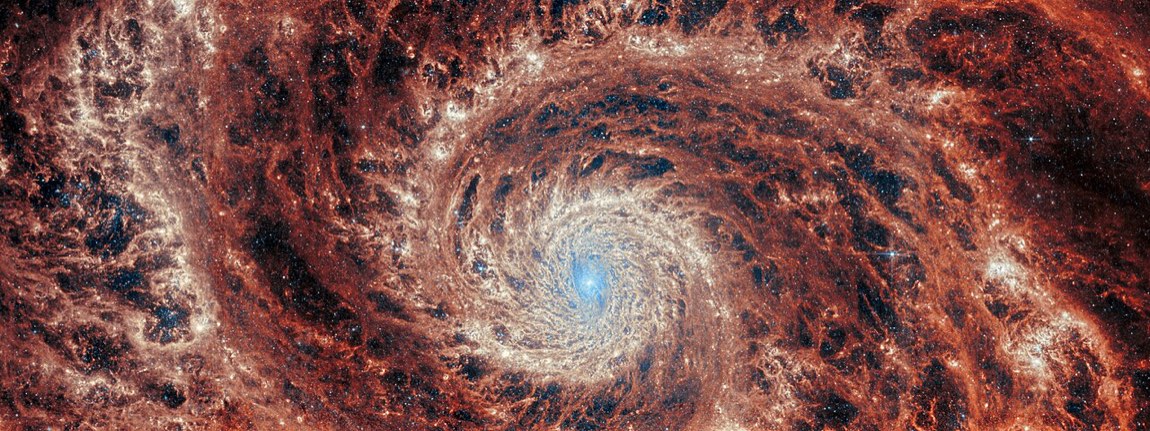
The Whirlpool Galaxy has been visited repeatedly by the most powerful observatories of each generation. In January 2005, the Hubble Heritage Project assembled a stunning composite image measuring 11,477 by 7,965 pixels using Hubble's Advanced Camera for Surveys, throwing the galaxy's spiral arms and their interior structures into sharp relief. Then in 2022, the James Webb Space Telescope observed the galaxy using its Mid-Infrared Instrument (MIRI) as part of the Feedback in Emerging extrAgalactic Star clusTers project — known by the acronym JWST-FEAST — designed to study how stellar feedback shapes young star clusters in nearby galaxies. Earlier, in 1984, a collaboration between French research institutions and the Canada-France-Hawaii Telescope on Mauna Kea used a then-novel high-speed image-photon-counting system to detect for the first time the double-component structure of the Whirlpool's very nucleus. Each technological leap has peeled back another layer of complexity in a galaxy that, despite being discovered over 250 years ago, continues to yield new surprises.