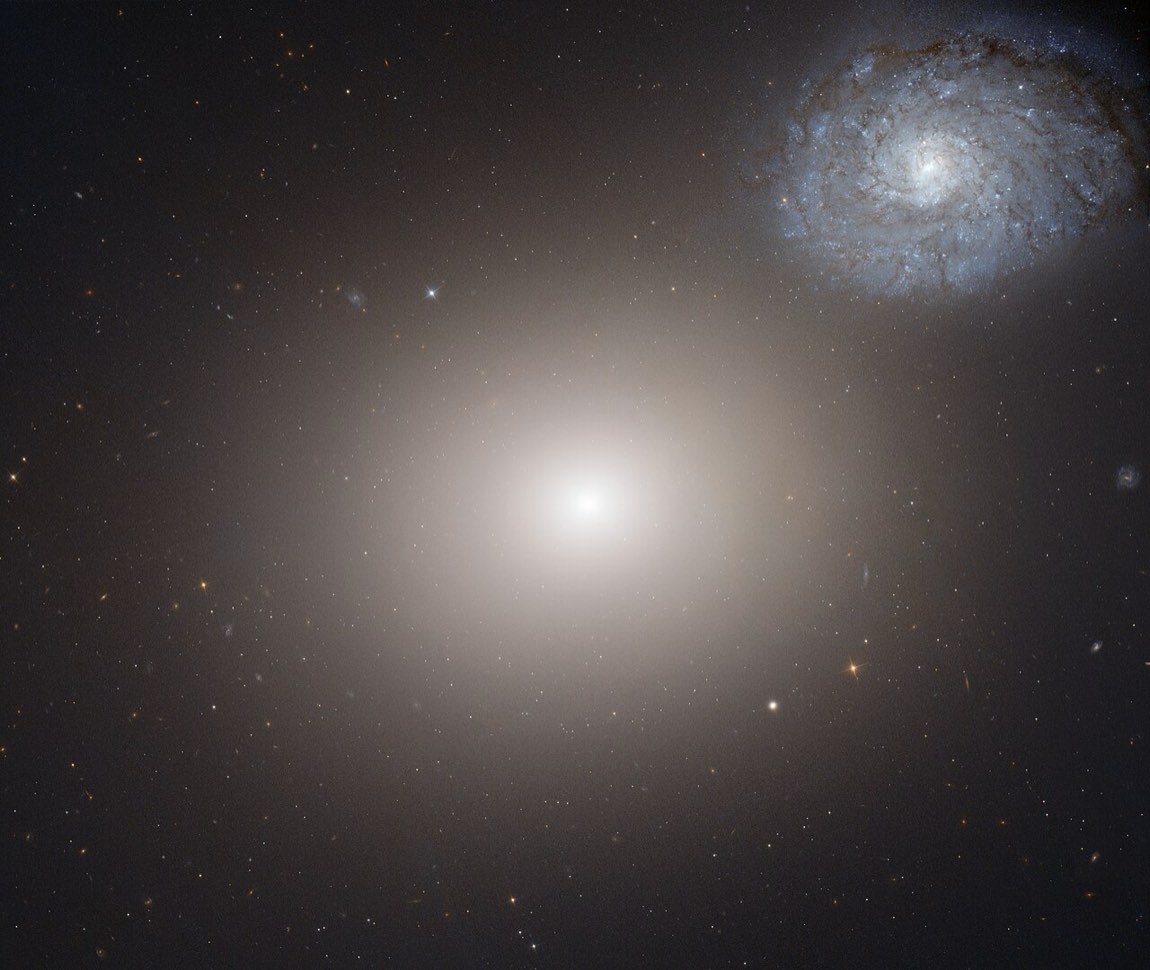
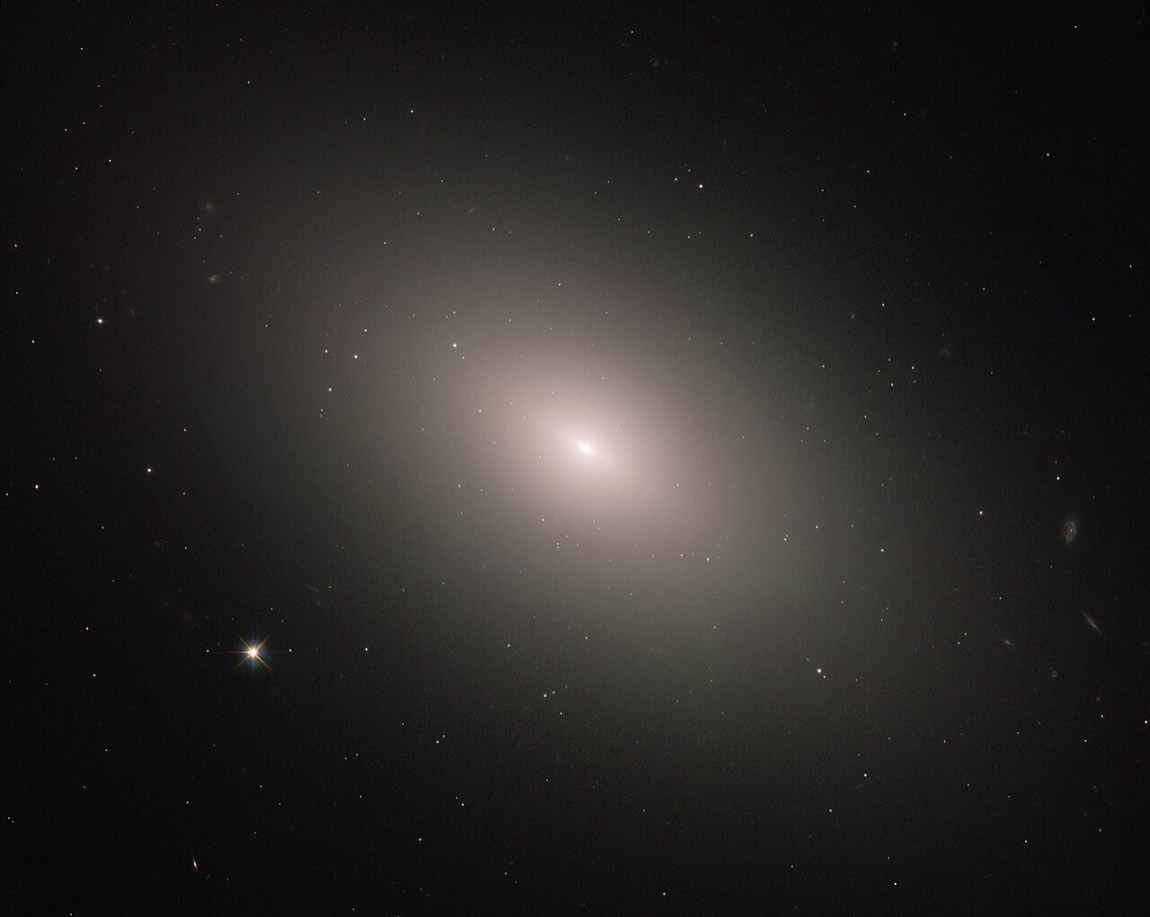
 Photograph · Credit: ESA/Hubble & NASA, L. Ho et al. · CC BY 4.0
Galaxy · Deep guide
Messier 59
Also called: M59 · NGC 4621 · UGC 7858 · PGC 42628
A flattened elliptical galaxy in Virgo with a black hole hundreds of millions of times the Sun's mass.
What is it?
Messier 59 is an elliptical galaxy in the Virgo Cluster. Johann Gottfried Koehler spotted it and its neighbour M60 in April 1779 while following a comet, and Messier listed both a few days later. M59 is noticeably stretched, about half as wide as it is long. Careful measurements show it has a main elliptical body, a flatter disk-like part and a round outer halo. Its core holds a supermassive black hole estimated at about 270 million Suns, and the central region spins the opposite way to the rest of the galaxy.
The deep dive
Researched for the Atlas from Wikipedia — Messier 59 (2,505 characters read) · updated Nov 15, 2026
01 Discovered While Chasing a Comet
Messier 59 owes its place in the catalog to a celestial coincidence. In April 1779, German astronomer Johann Gottfried Koehler was tracking a comet that happened to drift through the constellation Virgo. While following the comet's path, he noticed two fuzzy, unmoving smudges nearby — M59 and its neighbor Messier 60 — and recorded both. Charles Messier, compiling his famous catalog of objects that could be mistaken for comets, added both entries roughly three days after Koehler's discovery. It is a small irony of astronomical history that these two ancient, essentially changeless galaxies were found precisely because astronomers were hunting something fleeting and dynamic. Had the comet taken a slightly different route across the sky, M59 might have waited years or decades longer to be formally noted by European observers.
02 More Than a Simple Ellipse Deeper
At first glance M59 looks like a smoothly blurred oval, classified as type E5 — meaning it appears flattened by roughly 50% from a perfect sphere, with a position angle of 163.3°. But careful mathematical analysis of its isophotes, the contour lines of equal brightness, reveals something richer. Instead of tracing perfect ellipses, the isophotes show pointed, boxy shapes that require a three-component model to describe properly. The dominant part is a pure elliptical body contributing about 62% of the total luminosity. Superimposed on this is a flatter, disk-like feature contributing the remaining portion, with the whole system embedded inside a nearly circular outer halo that accounts for around 22% of the light. The disk's luminosity ratio relative to the main elliptical body is only 0.25, notably lower than the typical value of around 0.5 seen in lenticular galaxies, placing M59 in a genuinely intermediate structural category.
03 A Black Hole Spinning Against the Crowd
Deep inside M59 sits a supermassive black hole estimated to weigh 270 million times the mass of the Sun — roughly 90 times the mass of the entire Milky Way's central black hole. What makes it especially strange is its behavior relative to the surrounding galaxy: the black hole counter-rotates, spinning in the opposite direction to the bulk of the stars around it. It also appears bluer in color than its surroundings, hinting at a younger or differently composed stellar population close to the core. Although the black hole is currently quiescent and not actively devouring large amounts of material, it is not entirely silent. Observations in X-ray and radio wavelengths reveal a detectable outflow, meaning it is still pushing some material away into the galaxy even in this relatively quiet phase of its life.
04 A Merger's Fingerprint at the Core Deeper
The nucleus of M59 contains an embedded stellar disk that is noticeably bluer and therefore younger than the older, redder stars in the surrounding bulge region. This blue component stretches along a position angle of around 150° and stands out as structurally and chromatically distinct from the rest of the galaxy. Astronomers interpret this feature as a possible fingerprint of M59's past: the most likely explanation is that the galaxy underwent a galactic merger at some point in its history, and that the collision triggered a burst of new star formation — a starburst event — concentrated in this disk region. The resulting younger stars would naturally appear bluer. The counter-rotating supermassive black hole fits neatly into this narrative as well, since mergers are a known mechanism for delivering material with a different angular momentum into a galaxy's center, potentially reversing the spin direction of the central mass concentration.
05 An Extraordinary Swarm of Globular Clusters
Messier 59 is remarkably wealthy in globular clusters — the dense, ancient balls of hundreds of thousands of stars that orbit galaxies like a halo of loyal retainers. The estimated population surrounding M59 stands at around 2,200 globular clusters. For comparison, our own Milky Way hosts only about 150 to 160 known globular clusters, so M59's retinue is roughly 14 times larger. This abundance is a common trait of massive elliptical galaxies, which tend to accumulate globular clusters through mergers and tidal capture over billions of years. The sheer number of clusters around M59 makes it a particularly productive target for studies of stellar population ages, chemical abundances, and the history of galaxy assembly, since each cluster can be treated as a preserved sample of the conditions present when it formed.
06 Two Unusual Satellite Galaxies Deeper
Orbiting M59 are two notable dwarf companions that sit at the exotic edge of galaxy classification. The first is M59-UCD3, an ultra compact dwarf galaxy — a category of object so dense and small that astronomers debated for years whether such things should even be called galaxies. The second satellite, M59cO, is scientifically rarer still: it occupies a structural middle ground between compact elliptical galaxies like Messier 32 and ultra compact dwarfs, a category so sparsely populated that M59cO stands as an example of what might be a genuine transition class. Whether such objects are stripped remnants of once-larger galaxies, or formed in some other way entirely, remains an active area of research. Their proximity to a massive elliptical like M59 is itself suggestive — tidal forces and past interactions with the parent galaxy are plausible sculptors of their unusual sizes and structures.
07 The Supernova Fritz Zwicky Found in 1939
On 19 May 1939, the pioneering Swiss-American astronomer Fritz Zwicky discovered a supernova within M59, cataloged as SN 1939B. It was classified as a Type Ia supernova and recorded at a discovery magnitude of 15, brightening to a peak magnitude of 11.9 — easily within the reach of a modest amateur telescope had one been pointed at the right spot. A Type Ia supernova is not the collapse of a single massive star but rather a thermonuclear detonation of a white dwarf that has accumulated too much mass, often by siphoning material from a companion star. The region of M59 where SN 1939B occurred shows no sign of ongoing or recent star formation, which supports this interpretation: Type Ia supernovae can occur in old, star-forming-free environments, unlike the core-collapse supernovae that require young, massive progenitor stars.
08 M59's Place in the Virgo Cluster
Messier 59 is a card-carrying member of the Virgo Cluster, one of the nearest large galaxy clusters to the Milky Way and the gravitational anchor of the larger Virgo Supercluster that our own galaxy belongs to as a distant outlier. Within this cluster, M59 is not isolated: its nearest fellow cluster member sits just 8 arcminutes away on the sky, though that neighbor is about 5 magnitudes fainter — a brightness difference of roughly 100 times. The closest cluster member of comparable brightness is the lenticular galaxy NGC 4638, located about 17 arcminutes away. The angularly nearby Messier 60, co-discovered with M59 by Koehler, is another luminous elliptical in the same part of the cluster. This dense local environment of massive galaxies is consistent with M59's inferred merger history, since cluster cores are places where galaxy interactions have been frequent over cosmic time.
09 How to Find and Observe Messier 59
Messier 59 resides in the equatorial constellation of Virgo, which makes it accessible from both hemispheres during its spring observing season in the northern sky. With an apparent magnitude of around 9.6 it lies well beyond naked-eye visibility, but binoculars under dark skies can begin to reveal it, and a small telescope will show it as a soft, slightly elongated glow. Larger amateur telescopes begin to hint at the slight flattening that earns it its E5 classification, with the elongation oriented close to the north-south direction given its position angle of 163.3°. The galaxy is conveniently located near its brighter companion Messier 60, which can serve as a signpost. Because both were found in the same field by Koehler while chasing a comet, observers today can recreate something of that discovery experience by sweeping slowly through the region and letting these ancient ellipticals drift into the eyepiece.
10 Open Questions That M59 Still Poses Deeper
Despite being one of the more studied elliptical galaxies in the Virgo Cluster, M59 leaves several important questions unanswered. The counter-rotation of its supermassive black hole relative to the main galaxy body is intriguing but not fully explained — reconstructing the precise merger history that would produce such a configuration requires detailed modeling that depends on assumptions about the progenitor galaxies involved. The origin of the embedded blue stellar disk at the nucleus — whether it truly traces a starburst triggered by a merger, and when that merger occurred — also remains a matter of inference rather than certainty. The nature of the satellite M59cO as a transitional object between compact ellipticals and ultra compact dwarfs is itself unresolved: does it represent a genuinely distinct formation pathway, or simply a point on a continuous spectrum of stripped galaxy remnants? Each of these threads connects M59 to some of the broadest open problems in galaxy evolution.