 Photograph · NASA, ESA · CC BY 3.0
Galaxy · Deep guide
Messier 60
Also called: M60 · NGC 4649 · PGC 42831 · UGC 7898
A giant Virgo elliptical hiding one of the heaviest black holes ever measured.
What is it?
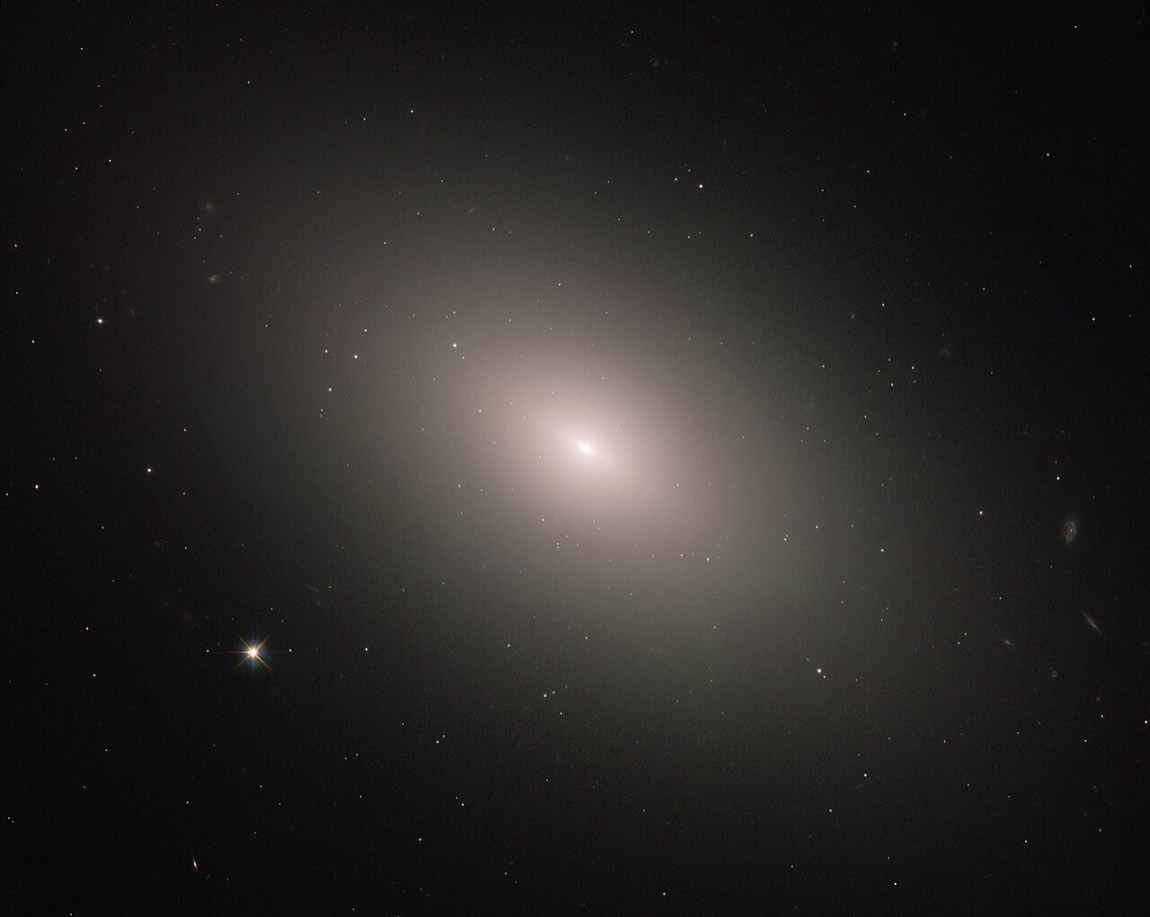
Messier 60 is a large elliptical galaxy in the Virgo Cluster, about 57 million light-years away. It sits beside the spiral NGC 4647, and the pair is catalogued as Arp 116. Koehler discovered it in 1779 together with M59. Its centre holds a supermassive black hole of roughly 4.5 billion solar masses, currently quiet. X-ray images show a cavity blown out by jets from that black hole during earlier active periods. Nearly half of the galaxy's mass is thought to be dark matter.
The deep dive
Researched for the Atlas from Wikipedia — Messier 60 (3,593 characters read) · updated Nov 15, 2026
01 A Giant Among Giants in Virgo
Messier 60 is not just any elliptical galaxy — it ranks as the third-brightest giant elliptical in the entire Virgo Cluster, one of the largest concentrations of galaxies in our cosmic neighbourhood. That cluster contains hundreds of galaxies, so earning a place in the top three is a mark of genuine distinction. M60 also sits at the head of its own smaller grouping, a tight quartet of galaxies called the M60 group. Remarkably, this compact gathering holds the title of the closest-known isolated compact group of galaxies anywhere in the sky. Think of it as a small city within a larger metropolis: Virgo is the sprawling metropolitan area, and the M60 group is a dense, self-contained neighbourhood right at its edge. This layered environment — a dominant galaxy leading a subcluster inside a vast supercluster — gives astronomers a rare chance to study how galaxies interact across multiple scales of cosmic structure at a relatively modest distance of 57 million light-years.
02 Shape, Structure, and Dark Matter Within Deeper
M60 is classified as type E1.5, meaning it appears nearly round but with a slight flattening — an E2 rating would indicate only a 20% flattening, and M60 falls just below that. Some sources push the classification further toward S0, the lenticular type that sits on the boundary between elliptical and spiral galaxies, so its precise morphology remains a matter of modest debate. What is unambiguous is the shape of its isophotes — the contour lines of equal brightness — which are distinctly boxy rather than the smooth, simple ellipses typical of many ellipticals. This boxy character is a subtle but telling signature that often hints at a merger history. The galaxy's effective radius is 128 arcseconds, corresponding to about 10 kiloparsecs at its distance. Within three times that volume, the estimated mass reaches roughly one trillion solar masses, and nearly half of that total is dark matter — invisible material detectable only through its gravitational influence. X-ray observations independently confirm a mass of (1.0±0.1)×10¹² solar masses within five effective radii.
03 A Black Hole That Once Roared
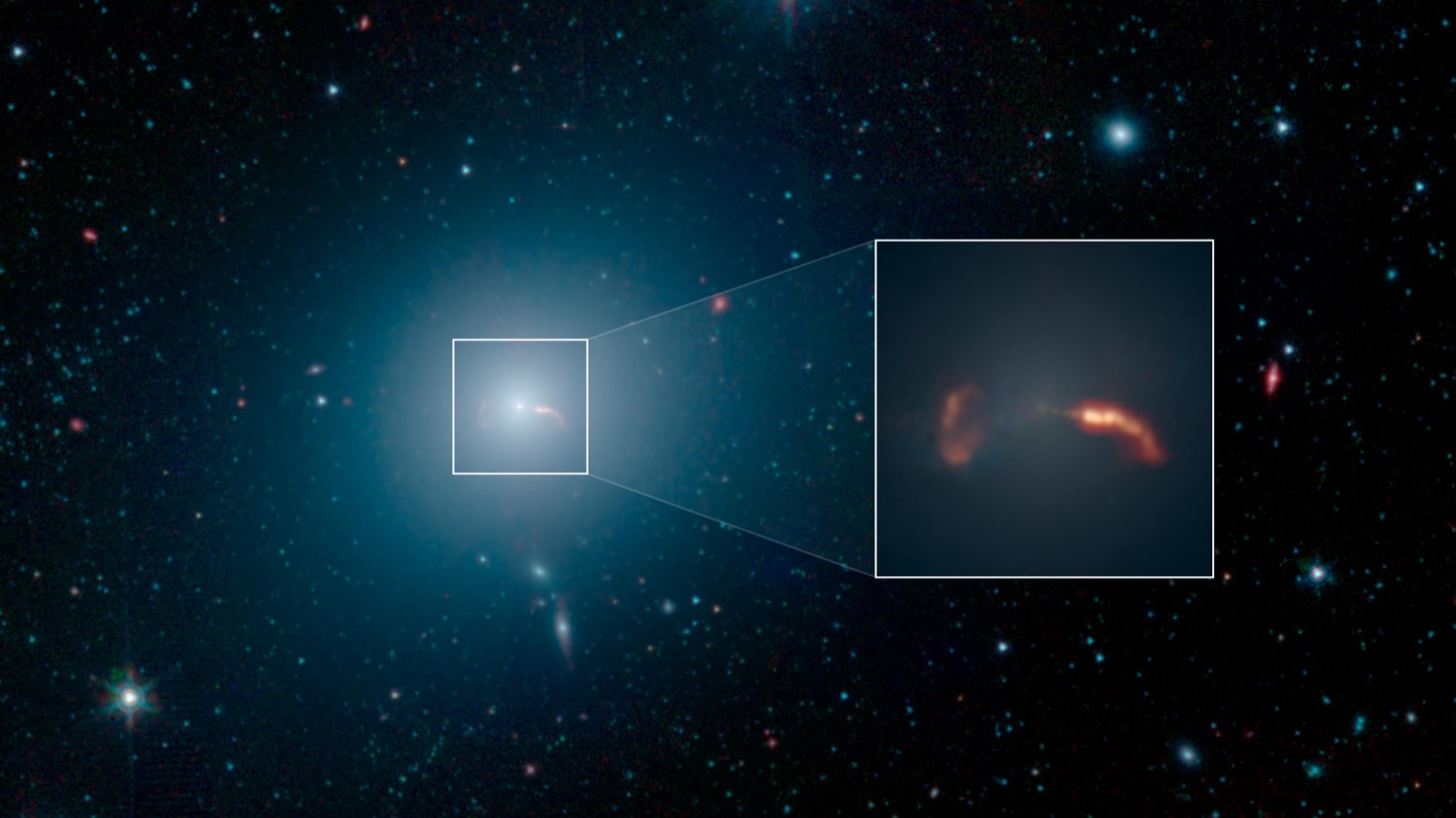
The supermassive black hole lurking at M60's centre weighs in at 4.5±1.0 billion solar masses, placing it among the largest black holes ever measured anywhere in the universe. For comparison, the black hole at the centre of our own Milky Way is roughly four million solar masses — M60's central monster is more than a thousand times heavier. Today it sits quietly, technically described as inactive, but the galaxy still bears the scars of its past ferocity. X-ray observations reveal a distinct cavity carved into the surrounding hot gas, the hollow signature of powerful jets that once blasted outward during active phases. Those jets correspond to weak radio lobes still faintly detectable today. Astronomers have calculated that sustaining those features required power in the range of six to seven times 10⁴¹ ergs per second — an almost incomprehensibly large energy output. The whole scene is a frozen record of violence: a once-roaring engine that has gone quiet, leaving its remodelled surroundings as the only testament to what it once was.
04 Ram-Pressure Stripping at the Halo Deeper
As M60 moves through the Virgo Cluster, it is not travelling through empty space. The cluster is filled with a diffuse, hot intercluster medium — a thin but vast ocean of gas that the galaxy plows through. The result is a process called ram-pressure stripping, essentially a galactic headwind that tears gas away from M60's outer regions. This stripping is currently occurring beyond a radius of 12 kiloparsecs from the galaxy's centre. The stripped material is not simply lost to M60; it joins the broader reservoir of gas that permeates the cluster environment. This ongoing process slowly starves the galaxy of the raw material it would need to form new stars, contributing to M60's character as a predominantly old, red stellar population typical of giant ellipticals. Ram-pressure stripping is one of the key mechanisms by which the cluster environment shapes and transforms its member galaxies over cosmic time, and M60's position and speed through the intracluster medium make it a live laboratory for observing this transformation in action.
05 A Companion Galaxy and a Contested Interaction
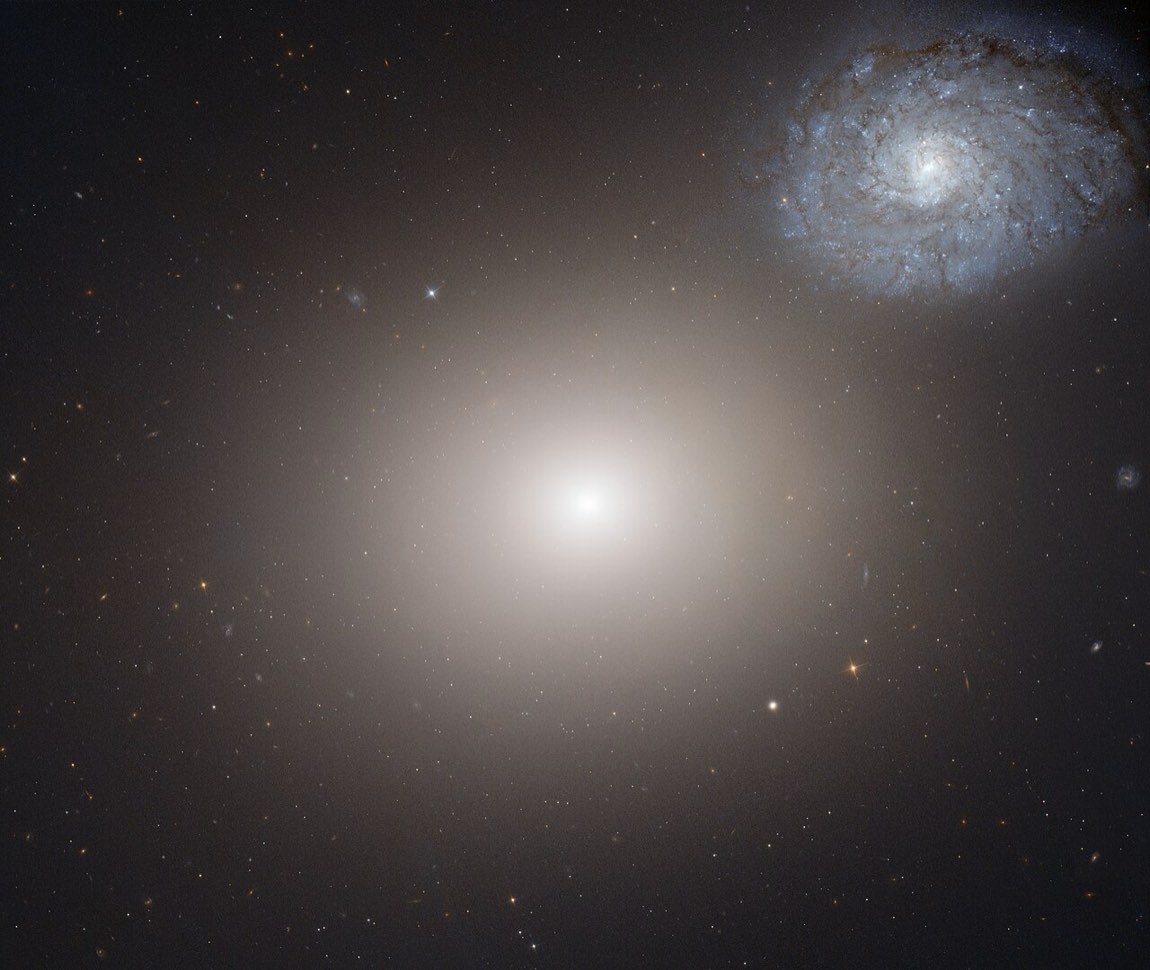
Just 2.5 arcminutes away from M60 in the sky — close enough that the optical disks of the two galaxies visibly overlap — sits the spiral galaxy NGC 4647. Together they are catalogued as Arp 116, part of Halton Arp's famous atlas of peculiar galaxies. Despite the dramatic appearance of overlapping disks, traditional photographic images reveal no obvious signs of gravitational distortion, tidal bridges, or the kind of warping you would expect if two galaxies were truly in close gravitational combat. This absence suggests the two may simply be at different distances, their apparent closeness a projection effect on the sky. Yet observations with the Hubble Space Telescope complicate that simpler picture, showing hints that a tidal interaction may have only just begun — an encounter in its very earliest stages, before dramatic visual signatures have had time to develop. The M60–NGC 4647 pair thus sits in an intriguing observational grey zone, neither clearly interacting nor clearly separate.
06 An Ultracompact Dwarf Orbiting Nearby
Among M60's satellite galaxies is a remarkable object discovered in 2013: M60-UCD1, classified as an ultracompact dwarf galaxy. Ultracompact dwarfs occupy a strange niche in the galactic zoo — they are too massive and dense to be ordinary globular clusters, yet far smaller and more compact than typical dwarf galaxies. Their origin is debated; one leading hypothesis is that they are the stripped remnant nuclei of once-larger galaxies that were tidally shredded by a more massive host. M60's known history of a powerful central black hole and its dominant position within the M60 group make it a plausible culprit for such stripping events. The discovery of M60-UCD1 added an important data point to ongoing research into how ultracompact dwarfs form and survive in dense galactic environments, and it underscores how even a single elliptical galaxy can host a diverse and scientifically rich ecosystem of smaller companions within its gravitational reach.
07 The Supernova That Briefly Lit the Galaxy
On 28 January 2004, the Lick Observatory Supernova Search — a systematic sky patrol known by its acronym LOSS — detected a supernova within M60. Catalogued as SN 2004W, it was classified as a Type Ia-peculiar event, meaning it broadly resembled the thermonuclear explosions of white dwarf stars used as cosmic distance markers, but with enough unusual features to warrant the "peculiar" designation. At peak, it reached an apparent magnitude of 18.8, far too faint to see without a telescope given M60's distance of 57 million light-years. Its position was recorded as 51.6 arcseconds west and 78.7 arcseconds south of the galactic nucleus — well off-centre, embedded in the galaxy's stellar halo. Type Ia supernovae are critically important tools in cosmology, so even peculiar variants like SN 2004W are studied carefully to understand how much natural variation exists among these supposedly standardisable explosions.
08 Koehler's Discovery and Messier's Catalogue
The story of M60's discovery is a pleasing example of scientific opportunism. In April 1779, German astronomer Johann Gottfried Koehler was tracking a comet passing through the constellation Virgo when he noticed both M60 and the neighbouring elliptical galaxy Messier 59 — two entirely unrelated deep-sky objects — in the same region of sky. Comet watches were among the most systematic sky-scanning activities of the era, and it was precisely this kind of careful, repeated attention to a small patch of sky that turned up faint fuzzy objects that might otherwise be missed. Charles Messier, who was building his famous catalogue largely to help comet hunters avoid confusion with stationary nebulae, added both galaxies to his list about three days after Koehler's observation. M60 thus entered the historical record not through a dedicated search for galaxies — a concept barely formed in 1779 — but as a byproduct of watching a solar system interloper drift across the sky.
09 Hubble's Fastest Galaxy and a Famous Mistake Deeper
Messier 60 holds a footnote in one of the most consequential papers in the history of science. In Edwin Hubble's landmark 1929 publication establishing the relationship between a galaxy's recession speed and its distance — the observational foundation of what became known as Hubble's Law — M60 featured as the fastest-moving galaxy in his sample. Hubble used a recession speed of 1090 km/s for M60, just 1.8% less than the modern value of about 1110 km/s derived from a redshift of 0.003726. His velocity measurement was impressively accurate. His distance estimate, however, was dramatically wrong: he placed M60 and the other Virgo galaxies in his sample at only two million parsecs, when the accepted distance today is around 16 million parsecs — a factor of eight too small. That distance error propagated into his estimate of the Hubble constant, which he set at 500 km/s per megaparsec. The modern accepted value is around 70 km/s per megaparsec, illustrating how a single systematic error in distance calibration can skew a fundamental cosmological result.
10 Light, Mass, and the Constant Ratio Deeper
One of the more revealing measurements astronomers make of a galaxy is its mass-to-light ratio — the amount of mass present for every unit of luminosity emitted. For M60, this ratio is a nearly constant 9.5 when measured in the visual band of the UBV photometric system. A ratio of 9.5 means that for every unit of light the galaxy produces, there are 9.5 units of mass present, far more than could be accounted for by the visible stars alone if those stars were similar to the Sun, which has a mass-to-light ratio of roughly 1. The fact that this ratio stays nearly constant across the galaxy rather than varying with radius is itself scientifically interesting, because it places constraints on how both the stellar population and the dark matter are distributed. It points toward a smooth, well-mixed interior — consistent with M60's nearly round, dynamically relaxed appearance — and reinforces the picture of a galaxy that has not undergone a major disruptive merger in the recent past.
11 How to Find and Observe M60
Messier 60 sits in the equatorial constellation of Virgo, making it accessible from both hemispheres at appropriate times of year. With an apparent magnitude of around 8.8 it is reachable with a modest amateur telescope, though at 57 million light-years it appears as a small, softly glowing oval without dramatic features visible through typical backyard instruments. The key to finding it is its proximity to the denser core of the Virgo Cluster — experienced observers often sweep eastward from the more famous Messier 87 to locate the M60 region. One observational bonus is the nearby companion NGC 4647, which appears only 2.5 arcminutes away and can be glimpsed in the same field of view with moderate aperture, giving the observer a live view of the Arp 116 pair. Under good seeing conditions with larger amateur telescopes, the galaxy's slightly boxy glow distinguishes it from a simple round smear of light, hinting at the complex internal structure that professional instruments have revealed in far greater detail.
 ⤢