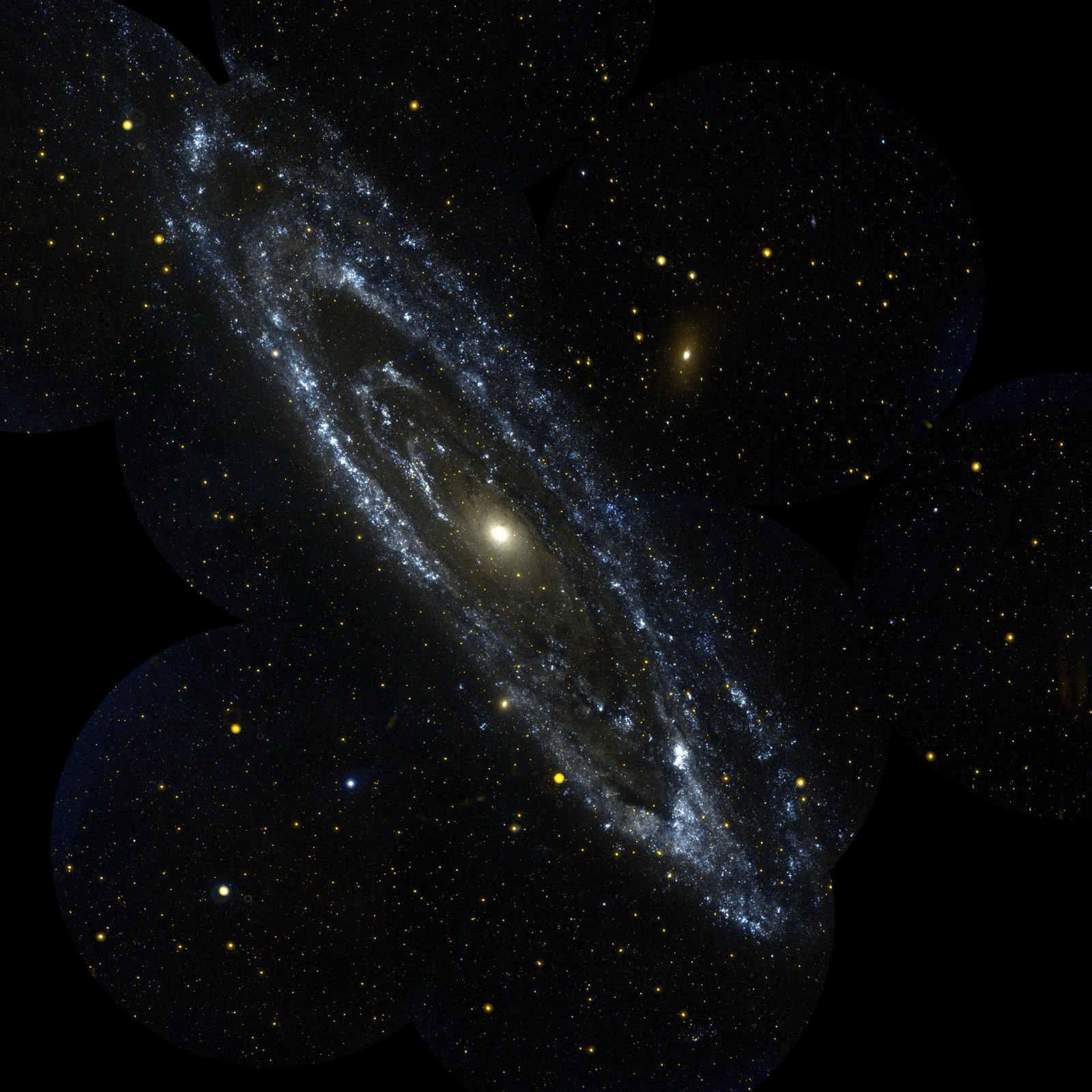
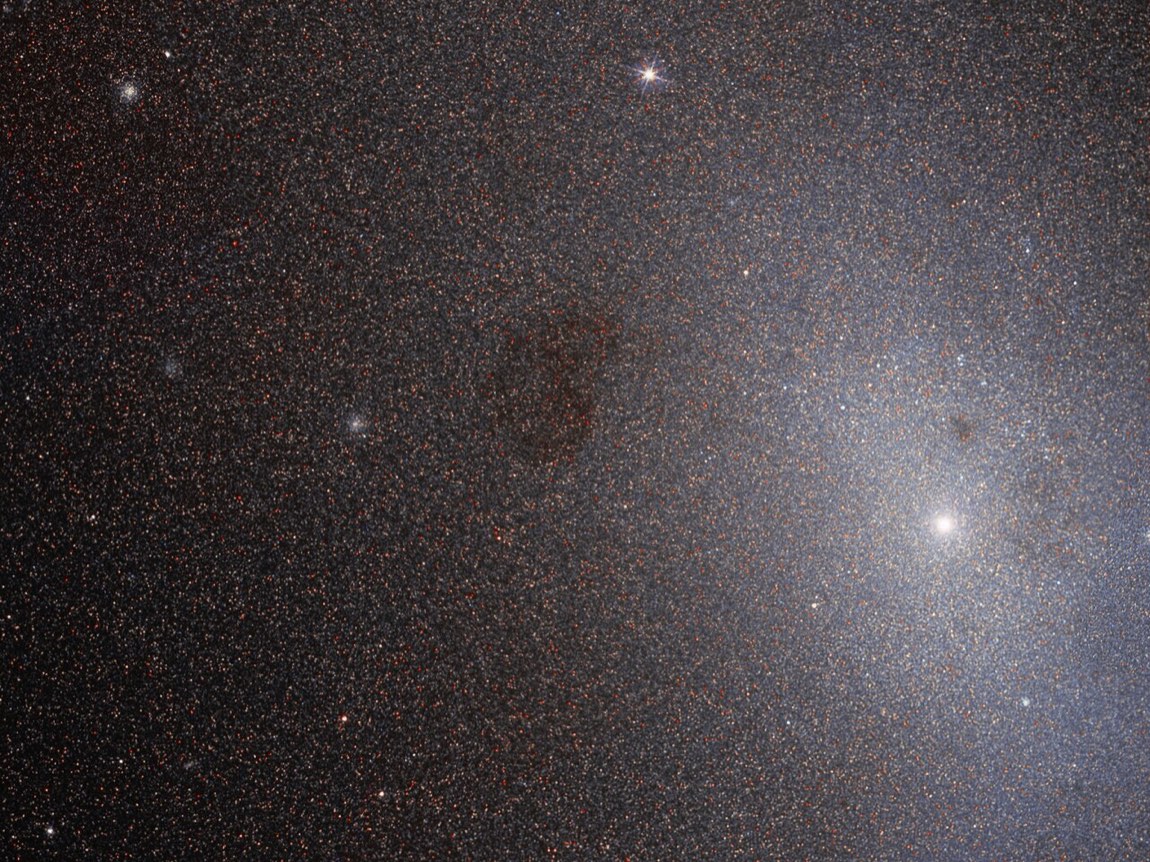
 Photograph · European Space Agency · CC BY 2.0
Galaxy · Deep guide
Messier 110
Also called: M110 · NGC 205
A small companion of the Andromeda Galaxy and the final entry on the Messier list.
What is it?
Messier 110 is a dwarf elliptical galaxy that orbits the Andromeda Galaxy in our Local Group, about 2.69 million light-years away. Messier drew it in 1773 on his sketch of Andromeda but never listed it; Caroline Herschel discovered it independently in 1783. It received its Messier number only in 1967, making it the last entry on the list. Unusually for a dwarf elliptical, it has patches of dust and young blue stars near its centre. Unlike its fellow companion M32, it shows no sign of a central supermassive black hole.
The deep dive
Researched for the Atlas from Wikipedia — Messier 110 (2,096 characters read) · updated Nov 15, 2026
01 The long road to a Messier number
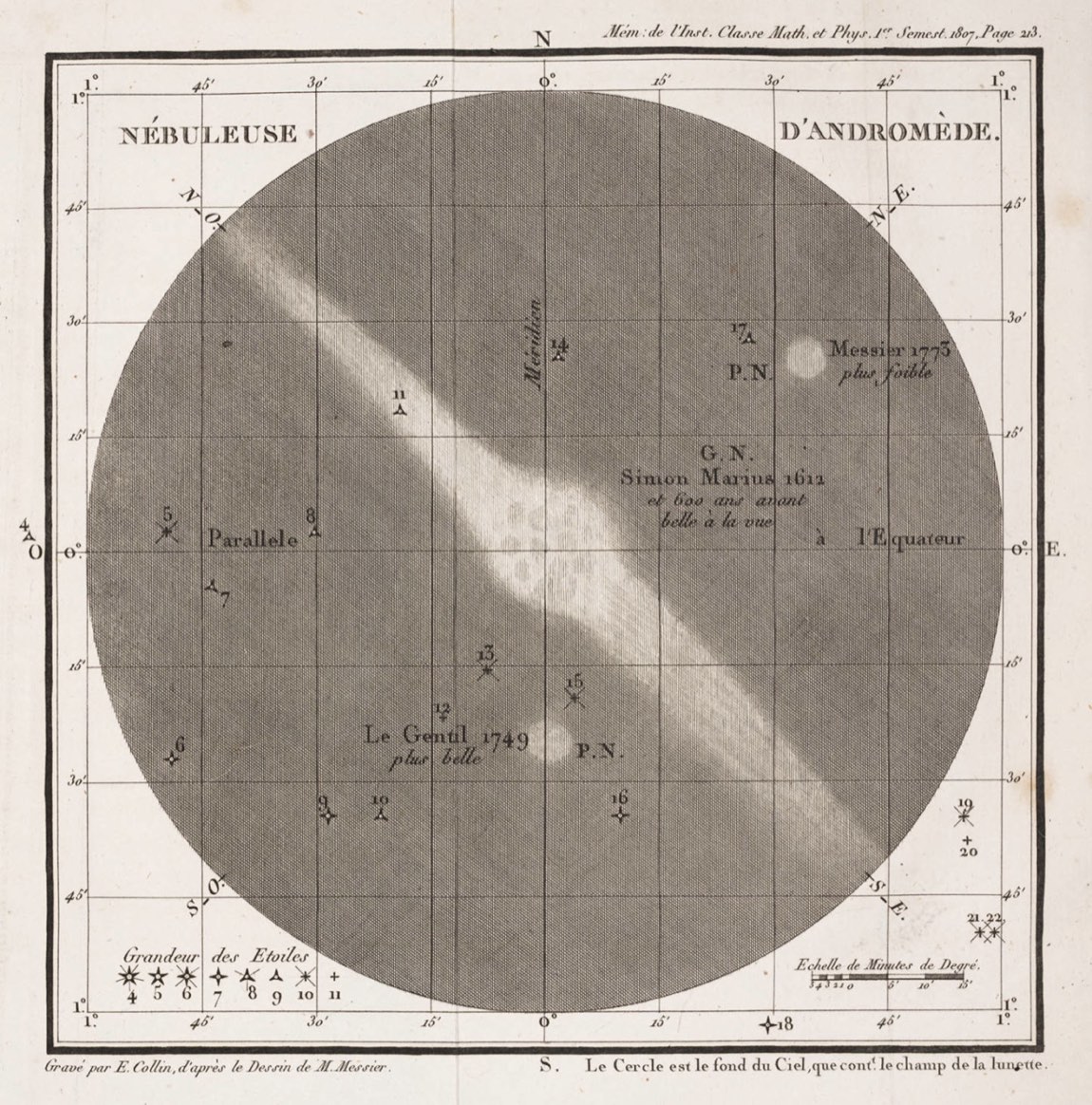
Few objects in the Messier catalog have a stranger administrative history than M110. Charles Messier himself never formally cataloged it, yet he clearly knew it existed — he drew it on his detailed sketch of the Andromeda Galaxy alongside M32, and a label on that drawing records that he first noticed it in 1773. The galaxy then slipped through the cracks for a decade until Caroline Herschel independently rediscovered it on August 27, 1783. Her brother William brought the discovery to wider attention in 1785, but even then the object remained catalogless. It took until 1967, when amateur astronomer and historian Kenneth Glyn Jones formally proposed assigning it a Messier number, for M110 to receive official recognition. That makes M110 the very last entry added to the Messier List — a catalog begun in the 1770s finally completed nearly two centuries later. It is a small irony that the man whose name the list bears never bothered to write down an object he had plainly seen and drawn.
02 What "peculiar dwarf elliptical" really means Deeper
M110 carries the morphological classification pec dE5, and each part of that label tells a story. The "dE" marks it as a dwarf elliptical, one of the most common galaxy types in the universe — compact, old-looking, and usually gas-poor. The "5" quantifies its shape: a flattening of 50%, meaning it is noticeably elongated rather than round. The prefix "pec," for peculiar, is where things get interesting. Near the galaxy's center, astronomers have found patches of dust and young blue stars — features that simply should not be prominent in a dwarf elliptical. Normal dwarf ellipticals are thought to have exhausted their star-forming material long ago, so the presence of young stars raises immediate questions. The article notes that the reason for this anomaly is unclear, which is an honest reflection of where the science stands. M110 is therefore a galaxy that breaks its own category's rules, and that rarity is precisely why it attracts continued research attention.
03 Dust, gas, and a depleted interior Deeper
Despite its small size, M110 contains measurable quantities of interstellar material. Its interstellar dust has a combined mass between 1.1×10⁴ and 1.8×10⁴ solar masses — roughly the mass of a modest star cluster, spread as fine grains throughout the galaxy — and that dust is extraordinarily cold, sitting at temperatures between 18 and 22 Kelvin, only a few degrees above absolute zero. The interstellar gas is far more substantial, ranging from 4×10⁶ to 7×10⁶ solar masses, comparable to a small globular cluster in mass. Yet the inner region of M110 is conspicuously depleted of this interstellar medium. The leading explanation is that supernova explosions drove much of the gas outward. On top of that, tidal interactions with the neighboring Andromeda Galaxy are thought to have stripped away a significant fraction of whatever gas and dust were expelled, leaving the galaxy as a whole deficient in interstellar medium density. M110 is, in a sense, a galaxy that has been hollowed out by its own stellar deaths and bullied by its massive neighbor.
04 No supermassive black hole at the center
One of the more striking facts about M110 is what it lacks. Its close neighbor M32 — also a satellite of Andromeda — hosts a supermassive black hole at its core, as do most large and many intermediate-sized galaxies. M110, however, shows no evidence for one. This absence is scientifically meaningful because it touches on a broader debate about whether all galaxies, including dwarf ellipticals, inevitably develop central supermassive black holes as part of their formation. M110 suggests that the answer may be no, or at least that the conditions required to build or retain such an object were not met in this galaxy's history. Combined with the puzzle of its young blue stars and central dust patches, the missing black hole gives M110 a character distinct from its companions in the Andromeda system, even though it orbits the same host galaxy at the same cosmic address.
05 Novae caught in the act
M110 is close enough and well-studied enough that individual explosive stellar events have been detected within it. Astronomers have identified novae — eruptions on the surfaces of white dwarf stars that briefly flare to extraordinary brightness — occurring inside the galaxy. One was discovered in 1999, and another followed in 2002. The 2002 nova was designated EQ J004015.8+414420, and it was not only caught in real-time observations but also turned up in archival images taken by the Sloan Digital Sky Survey that October, meaning the survey had inadvertently photographed the outburst while conducting its routine sky mapping. Detecting individual novae in a galaxy roughly 2.5 million light-years away is itself a testament to both the power of modern digital sky surveys and the relatively favorable viewing angle M110 offers. Each nova detection also provides astronomers with data about the stellar population inside the galaxy — white dwarfs require evolved, older stellar systems to form, consistent with M110's general character as an aged galaxy.
06 A satellite family and a strange shared orbit Deeper
M110 does not orbit Andromeda alone. The Andromeda Galaxy has at least 16 satellite galaxies that share a remarkable geometric arrangement: roughly half of Andromeda's satellites orbit within a single plane, and 14 of those 16 follow the same rotational direction around their host. This kind of coordinated orbital structure is not what you would expect if the satellites had been captured independently from random directions over cosmic time. One proposed explanation is that M110 itself was once a subhalo — a concentration of dark matter and ordinary matter — that hosted all 16 of these smaller galaxies as a group. According to this model, a close encounter between that subhalo and Andromeda shredded the group through tidal forces, scattering its former members into the flat, co-rotating plane we observe today. If correct, M110 was once something considerably more imposing: not just a satellite of Andromeda, but effectively the parent of an entire satellite family.
07 How and when to observe M110
M110 sits in the constellation Andromeda and appears at an apparent magnitude that places it within range of modest amateur equipment, though it is considerably fainter and more diffuse than its famous neighbor the Andromeda Galaxy itself. Because it is a dwarf elliptical with no sharp nucleus, it can be easy to overlook — it spreads its light across a wide area rather than concentrating it into a bright point. The best strategy for visual observers is to locate the Andromeda Galaxy first and then look slightly northwest of it, where M110 appears as a faint, oval smear of light. Dark skies away from city light pollution are essentially mandatory for a satisfying view. Under good conditions, even a small telescope will reveal its elongated shape, the "5" in its dE5 classification visible as a gentle but perceptible flattening. Patience and averted vision — the technique of looking slightly to the side of an object to engage the eye's more sensitive rod cells — help draw out the low-surface-brightness glow.
08 Caroline Herschel's overlooked discovery
The discovery credit for M110 belongs primarily to Caroline Herschel, who spotted it on August 27, 1783 — though for most of astronomy's history that credit was swallowed up by her brother William's towering reputation. Caroline Herschel was one of the first women to receive formal recognition as a professional astronomer, and her independent identification of M110 is one of several significant discoveries she made. The fact that the galaxy had already been seen by Messier a decade earlier, in 1773, adds a layer of complexity: Messier saw it but did not formally record it in his catalog, while Caroline Herschel rediscovered it without knowing Messier had been there first. William Herschel then described her discovery publicly in 1785. The galaxy thus passed through three notable observers before anyone bothered to give it a permanent catalog entry — and even then it took nearly two more centuries for Kenneth Glyn Jones's 1967 proposal to officially bring M110 into the Messier fold.
09 Open questions this galaxy still poses Deeper
M110 sits at the intersection of several unresolved problems in galaxy science. First, the presence of dust and young blue stars near its center defies the standard expectation for dwarf elliptical galaxies, and the article is explicit that the reason is unclear. Whether this star formation was triggered by tidal interactions with Andromeda, by infalling gas, or by some internal instability remains an open question. Second, the absence of a supermassive black hole invites the broader question of whether such objects are truly universal features of galaxies or only form under specific conditions. Third, the model proposing that M110 was once a subhalo that seeded Andromeda's entire co-rotating satellite plane is a hypothesis, not an established fact — it makes testable predictions about the kinematics and stellar populations of those 16 satellites, but confirmation awaits deeper surveys. M110 is therefore not a closed chapter in the textbook but an actively contested object whose full story is still being written.
 ⤢