 Photograph · NASA/ESA/Hubble Space Telescope · Public domain
Galaxy · Deep guide
IC 1101
One of the largest galaxies known, this giant grew fat on a billion years of mergers.
What is it?
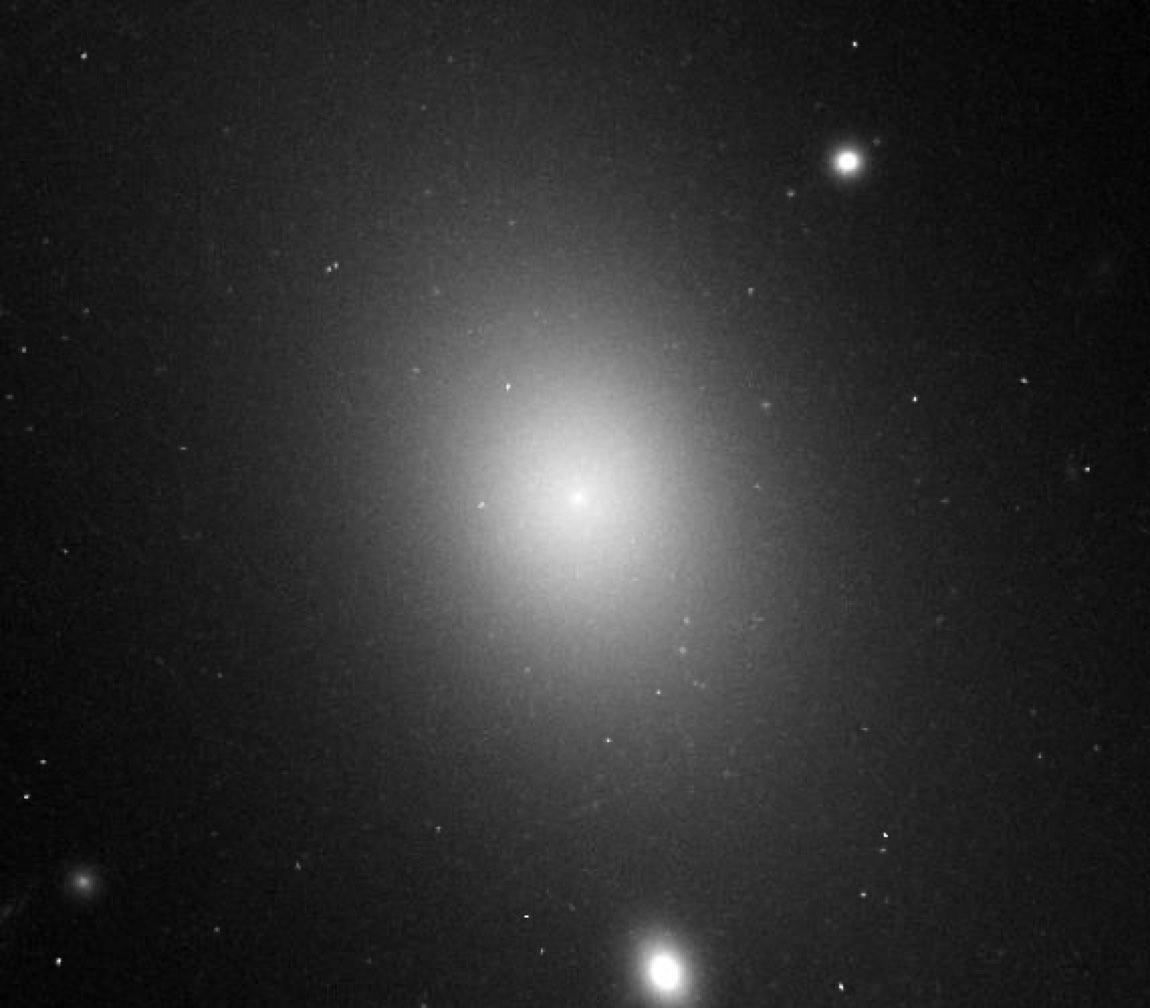
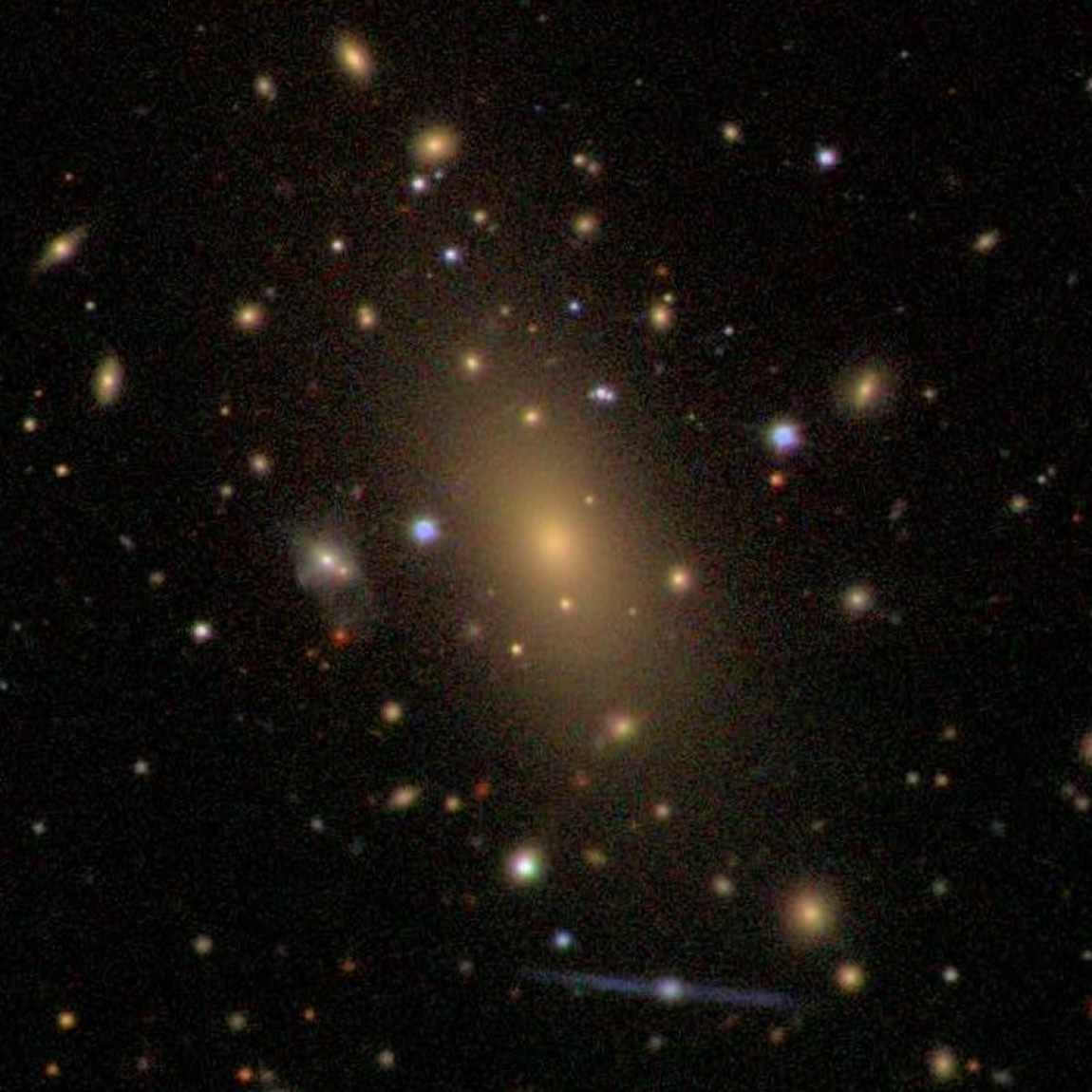
IC 1101 anchors a galaxy cluster a billion light-years away and ranks among the largest galaxies ever measured: counting its vast halo of diffuse starlight, it spans on the order of 4 million light-years — dozens of Milky Ways side by side — and may hold 100 trillion stars. Giants like this grow by devouring their neighbors at the centers of rich clusters; 'largest galaxy' claims, as always, depend on where you decide a halo ends.
The deep dive
Researched for the Atlas from Wikipedia — IC 1101 (10,813 characters read) · updated Sep 20, 2026
01 William Herschel's 1790 Discovery
IC 1101 was first spotted on 19 June 1790 by the German-British astronomer William Herschel, making it one of the earliest recorded extragalactic objects in history. Its modern designation comes not from Herschel's own cataloguing system, however, but from the Index Catalogue of galaxies, compiled in the late 1800s to early 1900s — that later compilation is where the "IC" prefix originates. The galaxy also carries the designation A2029-BCG, which stands for Brightest Cluster Galaxy in Abell 2029, a label that describes its dominant role within its home cluster as much as any proper name could. For nearly two centuries after Herschel logged it, IC 1101 remained a relatively obscure entry in galaxy surveys. It was not until a 1964 study of galaxies associated with radio sources that IC 1101 began attracting serious scientific scrutiny, when unusual radio emissions were detected from it even though it had not previously been flagged as a radio source.
02 A Shape That Refuses to Be Pinned Down
Classifying IC 1101's shape has proven genuinely tricky for astronomers. The galaxy sits in a debated zone between two morphological types: supergiant elliptical, labelled class E, and lenticular, labelled class S0. The Third Reference Catalogue of Bright Galaxies assigned it a morphological type of S0− in 1991, corresponding to a Hubble stage of −2. The difficulty arises because IC 1101 may actually be shaped like a flat disc, but if we happen to be viewing it from the direction of its broadest face, it would look deceptively round from Earth. Adding further complexity, the galaxy's halo is twisted by 20 degrees relative to its core and main body, and its isophotes — the contour lines connecting regions of equal surface brightness — shift from boxy shapes at larger radii to distinctly elongated shapes closer to the nucleus, hinting at a buried nuclear disc. This twisting halo is itself cited as one of the specific reasons the RC3 catalogue classified IC 1101 as lenticular rather than purely elliptical.
03 The Biggest Galactic Core Ever Measured Deeper
At the heart of IC 1101 lies the largest known galactic core of any galaxy yet identified. A 2017 analysis using Hubble Space Telescope imagery measured the core radius at approximately 4.2 ± 0.1 kiloparsecs, which translates to 13,700 ± 330 light-years across — roughly 130 times the distance from the Sun to its nearest stellar neighbor, scaled end to end. For comparison, the previously record-holding core in galaxy A2261-BCG spans only 3.2 kiloparsecs, and the cores of other famously large ellipticals such as NGC 4889 and NGC 1600 are roughly an order of magnitude smaller still. The leading explanation for why this core is so enormous and so depleted of stars is that when IC 1101 formed through repeated galactic mergers, the colossal black holes from each merging galaxy spiraled together and then merged themselves, releasing gravitational energy that flung surrounding stars outward. Quantifying that ejection, astronomers estimate a stellar mass deficit of 4.9 × 10¹¹ solar masses and a luminosity deficit of 1.1 × 10¹¹ solar luminosities — a staggering void carved into what should have been the galaxy's densest region.
04 An "Overmassive" Black Hole at the Center Deeper
The supermassive black hole anchoring IC 1101 is so extreme that astronomers have coined a special term for it: "overmassive." Its mass estimates push against the theoretical upper boundaries of what cosmological models say black holes should be able to achieve. The primary estimate, derived from measuring the break radius of the central core, places the black hole's mass at 97.7 billion solar masses, though the uncertainty range is enormous — stretching from 35.5 billion to 269.1 billion solar masses. Alternative methods give somewhat lower but still staggering figures: gas accretion rate and growth modelling yields 50–70 billion solar masses, while core dynamical models suggest 40–100 billion solar masses. The mass is also expressed via the quantity 10^(10.99 ± 0.44) solar masses in the scientific literature, reflecting the logarithmic scale typically used for such extreme values. By any of these estimates, this black hole is among the most massive ever discovered. Its mass-to-light ratio for the galaxy as a whole has been described as anomalously high, and astronomers also note a massive dark matter halo inferred from the galaxy's unique velocity dispersion profile.
05 A Galaxy Built from Consuming Its Neighbors
IC 1101 almost certainly grew to its extraordinary size by devouring other galaxies wholesale. The most telling clue is an absence rather than a presence: the Abell 2029 cluster has no other bright, luminous galaxies near its center — they appear to have been absorbed and consumed by the nascent IC 1101 over cosmic time. Astronomers estimate that the galaxy may have undergone as many as ten or even more separate galactic mergers and interactions, each one adding stars, gas, and dark matter to the growing behemoth. The galaxy's diffuse stellar halo, which is somewhat flattened in shape, likely preserves a memory of these ancient meals — its geometry reflecting the distribution of those consumed galaxies as they were assimilated. The remarkable smoothness of the halo is taken as evidence that this buildup happened early in the history of the cluster, giving gravitational dynamics billions of years to erase the seams left by each merger.
06 The Halo, the ICL, and the Boundary Problem Deeper
One of the genuinely difficult problems IC 1101 poses for astronomers is simply deciding where the galaxy ends. The galaxy is surrounded by an enormous diffuse stellar halo extending to a radius of 600 kiloparsecs — about 2 million light-years — but much of that outer glow is technically intracluster light, or ICL: stars that are gravitationally unbound to the galaxy itself and instead float freely within the cluster. Photometrically, the ICL is indistinguishable from the galaxy's own halo, meaning measurements based on brightness alone cannot separate them. Only kinematic measurements — analyzing the motions of individual stars — can disentangle the two populations. Using the 30 magnitudes per square arcsecond surface brightness standard and ultra-deep G- and R-band imaging from the Isaac Newton Telescope's Wide Field Camera, the most recent measurement yields a diameter of 520 kiloparsecs, or about 1.7 million light-years. The authors of the earlier halo study described IC 1101 as "possibly one of the largest and most luminous galaxies in the universe," though they noted that figure relied on an older assumed distance of 262 megaparsecs.
07 Why the Distance to IC 1101 Is Uncertain Deeper
Pinning down exactly how far away IC 1101 sits has been a recurring challenge, with different measurement techniques producing dramatically different answers. An early 1980 photometric estimate placed it at 262.0 megaparsecs, using a Hubble constant of 60 km/s/Mpc. The RC3 catalogue derived a redshift of z = 0.078 from optical emission lines. More recent work using luminosity, stellar mass, and velocity dispersion functions — calibrated to the modern Hubble constant of H₀ = 67.8 km/s/Mpc — converges on 354.0 megaparsecs, or 1.15 billion light-years, which is the currently accepted value. Complicating matters further, the Two Micron All-Sky Survey's 2014 photometric redshift gave z = 0.045, implying only 197.1 megaparsecs, while a 2005 Arecibo Observatory measurement using the 21-centimeter hydrogen emission line yielded z = 0.021 and a distance of just 97.67 ± 6.84 megaparsecs. Astronomers believe that last figure is almost certainly contaminated by hydrogen emission from a foreground galaxy, LEDA 5057632, which happens to lie along the same line of sight.
08 Decades of Targeted Scientific Investigation
The scientific campaign to understand IC 1101 has unfolded across more than half a century. The pivotal early figure was astronomer Alan Dressler, who in 1978 analyzed twelve very rich galaxy clusters including Abell 2029. The following year he published a paper focused entirely on IC 1101, revealing its distinctive rising velocity dispersion profile — the first detailed portrait of its unusual dynamics. By 1985, teams were obtaining spectra of gas inside X-ray-luminous clusters, and follow-up investigations examined the dynamics of IC 1101 and galaxies within a few hundred kiloparsecs of it. R-band luminosity profiles, obtained in the late 1980s to early 1990s, revealed IC 1101's enormous halo of light traceable hundreds of kiloparsecs from the center. The 2000s brought Chandra X-ray analysis of Abell 2029 in 2002. A 2011 survey covered more than 430 brightest cluster galaxies. In 2017, both a redshift survey of the cluster and a dedicated Hubble Space Telescope analysis of the galaxy's inner regions were completed, producing the current best estimate of its core size and black hole mass.
09 Signs of Activity: Radio Sources and a Possible Double AGN Deeper
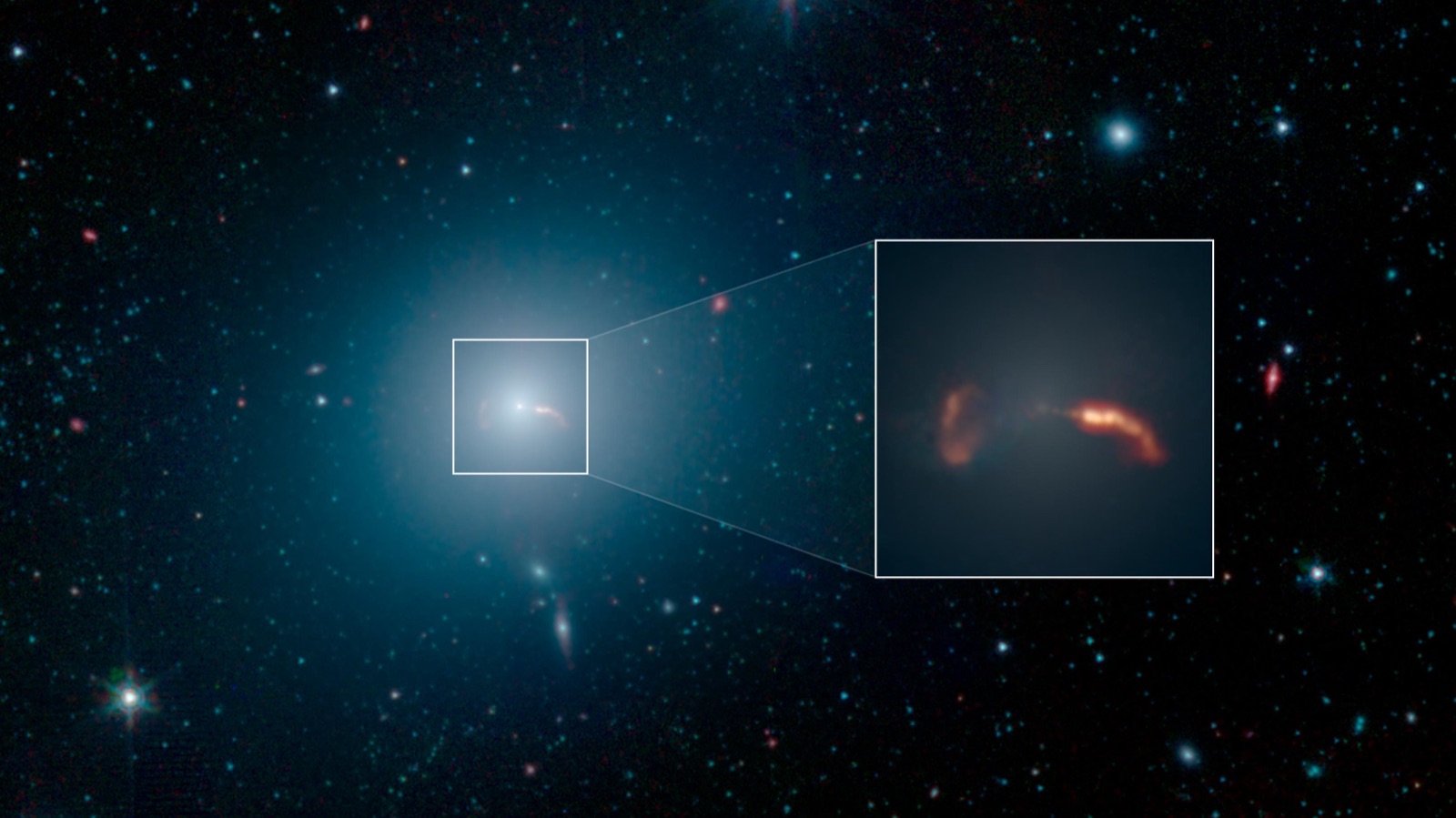
IC 1101 is not entirely quiet at its center. A very bright radio source sits at the galaxy's core, almost certainly associated with its ultramassive central black hole acting as an active galactic nucleus, or AGN. This radio emission was first detected in a 1964 study, which noted that it resembled emissions from galaxies known to be radio sources, even though IC 1101 had not been previously classified as one. More recently, the NRAO VLA Sky Survey confirmed a radio source near IC 1101's nucleus, consistent with AGN activity. Intriguingly, a second, weaker radio source has also been detected nearby. Astronomers have raised the possibility of a double AGN — two active black holes coexisting within the galaxy — though this cannot yet be ruled out or confirmed. The elongated isophotes observed close to the core independently hint at either an unresolved double nucleus or a low-intensity AGN. Some researchers suggest the elongation could alternatively result from a disrupted satellite galaxy perturbed by the central black hole, drawing comparisons to galaxies such as NGC 4438-B, NGC 5419, and VCC 128, which show similar double point-source features.
10 Star Colors, Ages, and What They Reveal
Like most large galaxies, IC 1101 is dominated by metal-rich stars — stars that contain heavier chemical elements forged in earlier stellar generations. Many of these stars are as much as seven billion years older than our own Sun, meaning their origins trace back to a period when the universe was only a few billion years old. This aged, metal-enriched stellar population gives IC 1101 a distinctly golden-yellow color when viewed in optical light, a hue characteristic of old, cool, red giant and subgiant stars that have long since exhausted their hydrogen fuel. There are no visible signs of recent star formation happening today — the galaxy lacks nuclear emission in visible light at its center, and there are no dust lanes in the core that might indicate the cold gas reservoirs typically needed to birth new stars. The galaxy's luminous life, in terms of creating new suns, appears largely finished. Yet the Abell 2029 cluster as a whole continues to accrete roughly 450 solar masses of material per year, feeding the system even as the central galaxy remains dormant.
11 How IC 1101 Aligns with Its Surrounding Cluster Deeper
The geometry of IC 1101 is not random with respect to its cosmic surroundings — it shows a striking alignment with the large-scale structure of the Abell 2029 cluster itself. The galaxy's major axis runs in the northeast-to-southwest direction, and this axis is aligned with the direction along which Abell 2029 accretes material from the neighboring cluster Abell 2033. Such alignments between brightest cluster galaxies and their host clusters are considered significant because they suggest the galaxy and cluster co-evolved, growing along the same cosmic filaments and merger axes over billions of years. Within the galaxy itself, the core and main body are well-aligned with each other, while the outer halo departs from this orientation by 20 degrees. That halo twist, combined with the boxy isophotes seen at larger radii and the elongated isophotes near the nucleus, paints a picture of a galaxy whose outer layers still bear the imprints of the many mergers that built it up, while the inner regions have had time to relax into a more orderly configuration.
12 Open Questions and Ongoing Surveys
Despite decades of study, IC 1101 still presents astronomers with genuine, unresolved puzzles. The mass of its central black hole carries an uncertainty range spanning from 35.5 billion to 269.1 billion solar masses — a factor of nearly eight between the lower and upper bounds, which is enormous even by the loose standards of extragalactic measurement. The nature of the elongated inner isophotes remains debated: double nucleus, low-level AGN, or disrupted satellite galaxy. The possibility of a double AGN is also live but unconfirmed. Even the galaxy's size is not fully settled, because separating its stellar halo from the surrounding intracluster light requires kinematic data that are difficult to obtain at such distances. Surveys continue to place IC 1101 in broader contexts: a 2019–2020 study surveyed 170 local galaxy clusters to examine brightest cluster galaxies, their structures, and surrounding intracluster light, with IC 1101 included among the targets. Each new instrument generation — deeper imaging, higher spectral resolution — peels back another layer of ambiguity surrounding this record-setting galaxy.
 ⤢
⤢