 Photograph · NASA/JPL-Caltech
Galaxy · Deep guide
The Cartwheel Galaxy
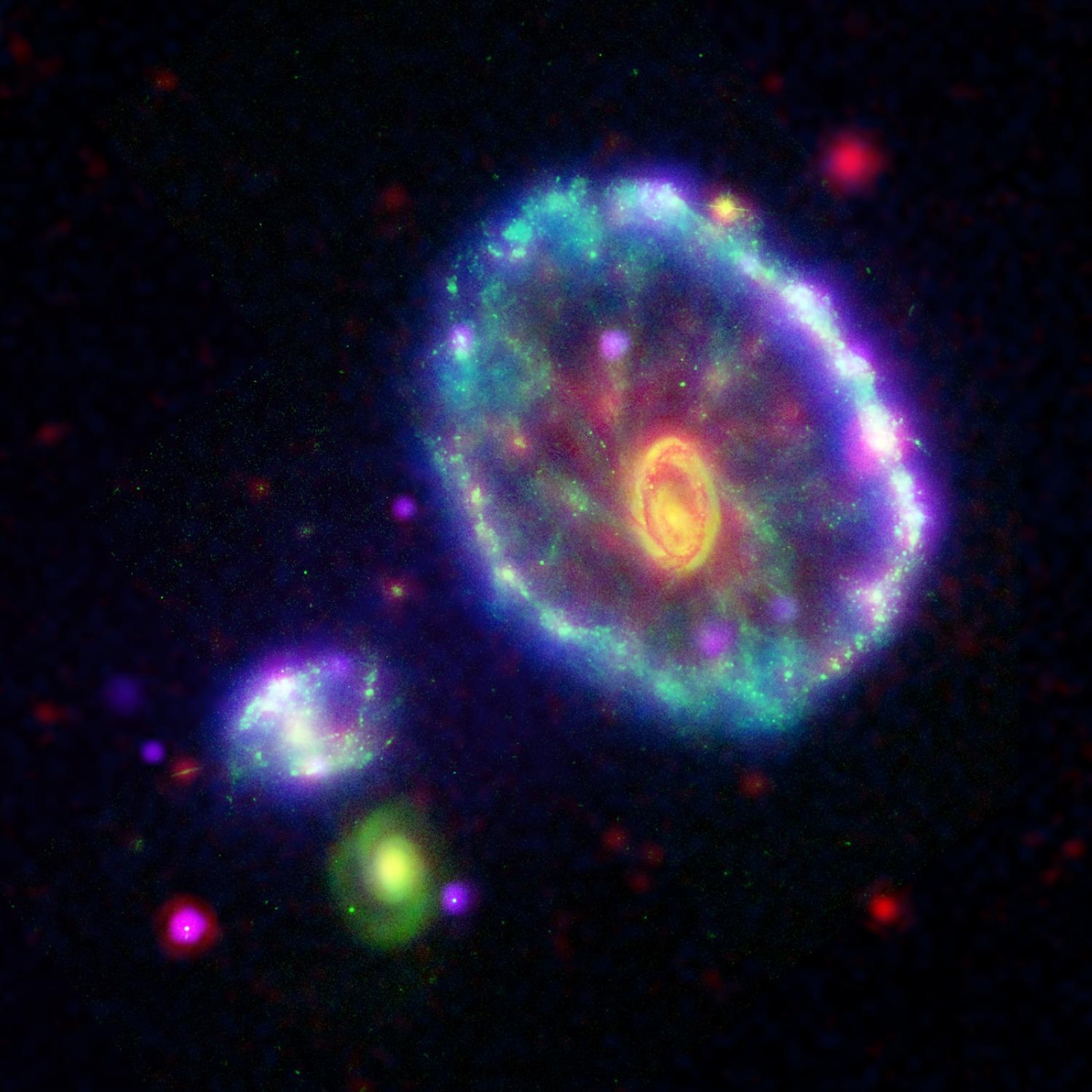
This cosmic bullseye is the wreckage of a galaxy shot through the heart.
What is it?
The Cartwheel, 500 million light-years away, is a ring galaxy: several hundred million years ago a smaller galaxy plunged straight through its center, sending a ripple of star formation outward like a stone dropped in a pond. The expanding outer ring, ablaze with newborn blue stars, now spans 145,000 light-years. JWST's 2022 portrait of it became an instant classic.
The deep dive
Researched for the Atlas from Wikipedia — Cartwheel Galaxy (6,287 characters read) · updated Nov 15, 2026
01 Fritz Zwicky and a bewildering discovery
Fritz Zwicky spotted the Cartwheel Galaxy in 1941, and his reaction was unusually candid for a scientist's formal writing. He described it as "one of the most complicated structures awaiting its explanation on the basis of stellar dynamics" — a admission that even one of the sharpest minds in twentieth-century astronomy was stumped. Zwicky was already famous for predicting dark matter and neutron stars, so his sense of bewilderment signals just how genuinely strange this object looked through the telescopes of the era. The galaxy is catalogued under two designations: ESO 350-40 in the European Southern Observatory catalogue and PGC 2248 in the Principal Galaxies Catalogue. It sits in the southern constellation Sculptor, about 500 million light-years from Earth — far enough that the light we observe today left the galaxy when the most complex animals on Earth were still primitive marine invertebrates.
02 A ring galaxy bigger than Andromeda
The Cartwheel Galaxy is classified as a lenticular ring galaxy, a relatively rare category defined by a prominent ring structure rather than the spiral arms most people associate with large galaxies. Its D25 isophotal diameter — the diameter measured out to where the surface brightness drops to 25 magnitudes per square arcsecond — is 57.69 kiloparsecs, which works out to 188,200 light-years. For comparison, the Andromeda Galaxy, the largest member of our Local Group, spans roughly 152,000 light-years; the Cartwheel is slightly larger. The RC3 catalogue measured the angular size as about 60.9 arcseconds, and when combined with a redshift-derived distance of 132.2 megaparsecs (431 million light-years), that angular measurement converts to the physical size quoted above. Despite its impressive girth, the Cartwheel is not especially massive: estimates put its total mass at only about 2.9 to 4.8 billion solar masses, far less than the Milky Way's roughly trillion solar masses.
03 Two rings, spokes, and a dust halo
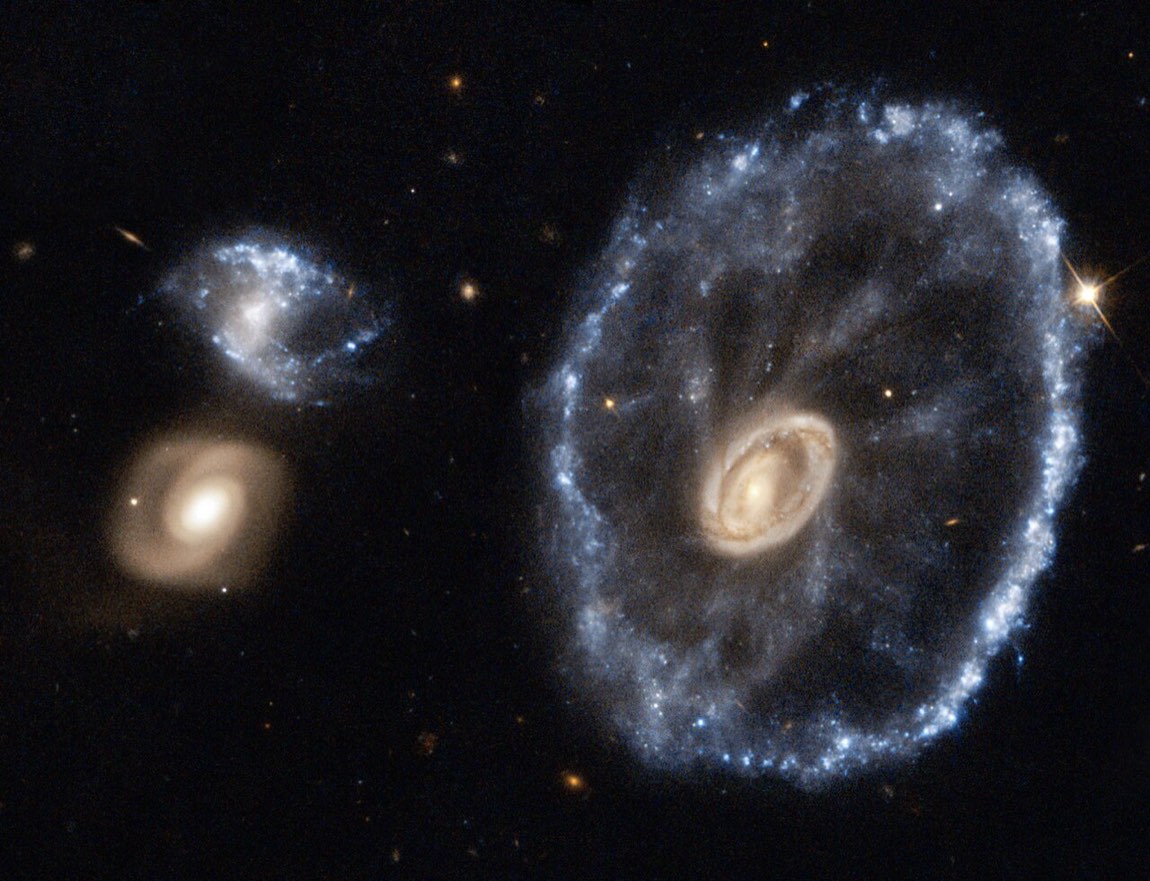
The Cartwheel's most striking feature is its dual-ring architecture. The outer ring is an enormous starburst zone where gas and dust have been compressed into furious star-forming activity. The inner ring encircles the galactic nucleus and is itself surrounded by a band of dark, light-absorbing dust within what astronomers call the nucleic ring. Connecting the two rings are several optical arms nicknamed "spokes," evoking the wheel of an old wagon — which is exactly where the galaxy's popular name comes from. One subtlety that has puzzled researchers is that observations reveal both non-thermal radio continuum emission and optical spokes, but the two sets of features do not appear to spatially overlap. This offset suggests the physical processes generating radio waves and optical light in these spoke structures are either occurring in different locations or are driven by distinct mechanisms, and the full explanation remains an open question in the literature.
04 The bullseye collision that made the wheel
The Cartwheel was once an ordinary spiral galaxy before suffering one of the most dramatic events in galactic astronomy: a nearly head-on collision with a smaller companion roughly 200 to 300 million years ago. As the intruding galaxy punched through the disk, it triggered an immense gravitational shock wave that radiated outward at high speed. That expanding wave swept up and compressed gas and dust as it traveled, igniting a broad starburst ring around the galaxy's center. The region at the core was left largely unscathed because the shock moved outward, leaving a quieter hub behind the advancing wave. The bright bluish ring visible in images marks this active star-formation front. Astronomers also note that the Cartwheel is now slowly recovering — spiral arms are beginning to re-emerge from the central region, suggesting the galaxy may eventually rebuild its original spiral structure if no further collisions intervene.
 ⤢
05 Identifying the intruder: the case for G3 Deeper
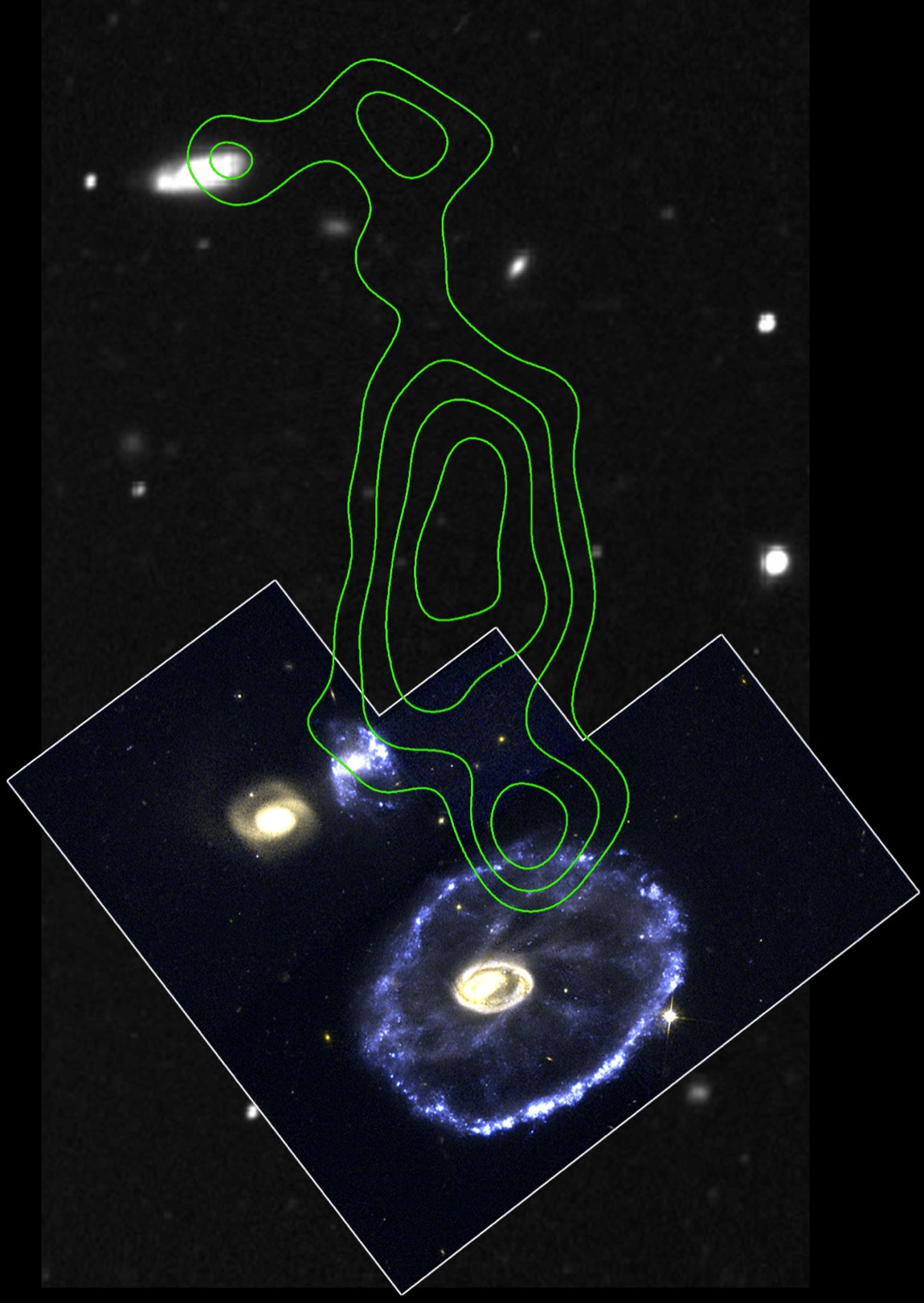
Three companion galaxies appear in most images of the Cartwheel system, labeled G1, G2, and G3 in the scientific literature. G1 is described as a smaller irregular blue Magellanic spiral; G2 is a yellow compact spiral bearing a tidal tail; G3 is a more distant spiral visible mainly in wide-field images. The question of which galaxy actually plunged through the Cartwheel is scientifically important, and the leading answer implicates G3. A trail of neutral hydrogen gas — an HI tail — has been mapped connecting G3 to the Cartwheel, and hydrogen gas is an ideal tracer because it is the lightest and most abundant element in galaxies, easily stripped away by gravitational forces. Because collisions typically create leading-dominant HI tails, the direction of G3's tail points back toward the Cartwheel in a way consistent with an intruder moving away after the collision. G3 currently lies roughly 88 kiloparsecs (about 287,000 light-years) from the Cartwheel — plausible given the estimated 300-million-year age of the ring structure. G1 and G2, by contrast, are still very close to the Cartwheel, which most researchers find inconsistent with their being the original bullet galaxy.
06 An alternative theory that didn't hold up Deeper
Not every researcher immediately accepted the collision hypothesis. An alternative model attempted to explain the Cartwheel's structure through the gravitational Jeans instability — the same physical mechanism that causes gas clouds to collapse and form stars. In this framework, both axisymmetric (radial) and nonaxisymmetric (spiral) small-amplitude gravity perturbations would naturally grow into clumps of matter, and these growing structures could mimic the visual appearance of a ring and spokes without requiring any external collision at all. The idea has theoretical elegance and applies successfully to some ring galaxy systems. However, when researchers tested this model against the specific observational data available for the Cartwheel Galaxy, it did not appear to fit. The article is explicit on this point: the Jeans instability model of ring galaxy evolution does not appear to apply to this specific galaxy. The collision scenario, bolstered by the HI tail evidence linking G3 to the system, remains the dominant explanation.
07 A galaxy slowly falling back into itself
The Cartwheel's spectacular ring structure is not permanent. The existing framework is expected to disintegrate over the next few hundred million years as the gas, dust, and stars that have not escaped the galaxy begin falling back toward the center in a process called infall. As material settles and redistributes, spiral density waves should gradually have the chance to reform, and astronomers expect the galaxy to regain something resembling a normal spiral morphology — provided no additional collisions occur. That caveat is significant: if companions G1, G2, or G3 drift close enough for another interaction, the rebuilding process would be disrupted and the galaxy's future shape could look very different. The Cartwheel is therefore a snapshot of galactic trauma and recovery, a rare chance to watch on a cosmic timescale how a large spiral galaxy is dismantled and might reconstitute itself.
08 A zoo of extreme X-ray sources on the rim Deeper
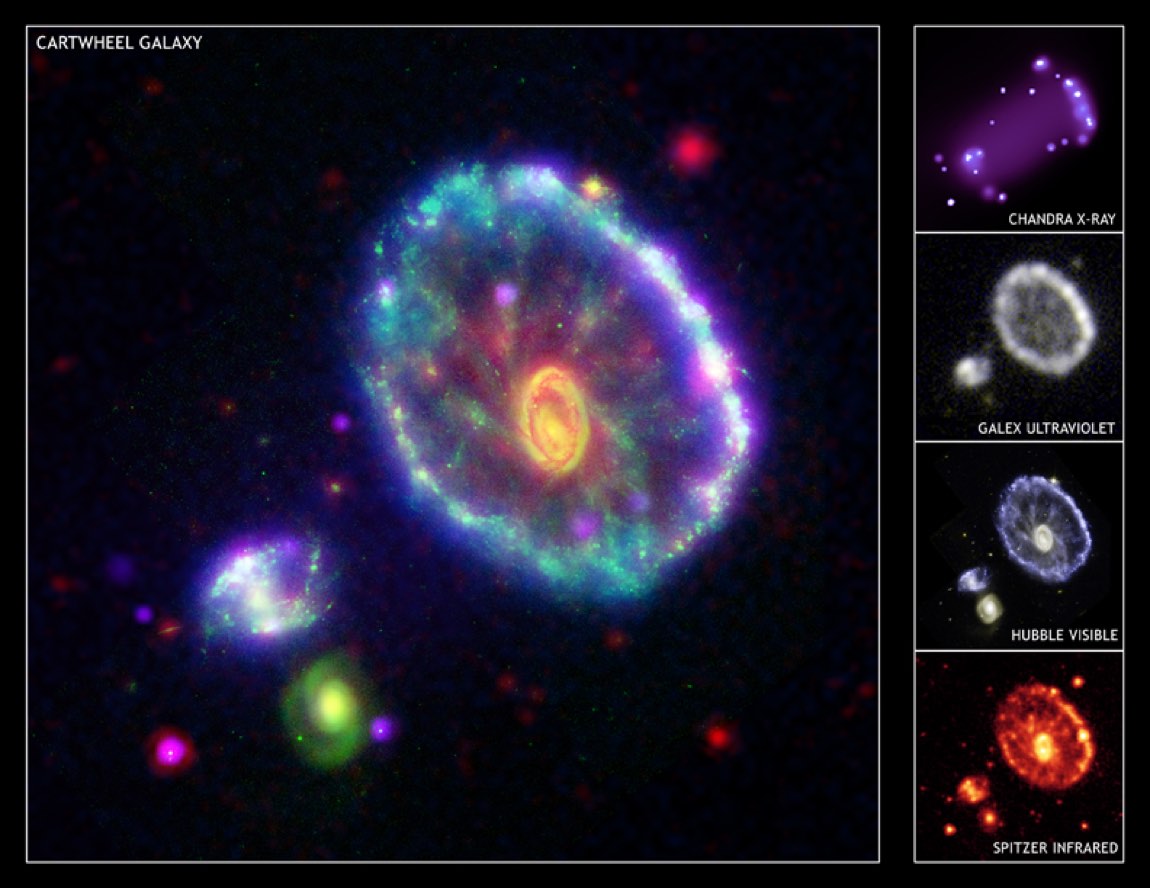
The starburst activity in the Cartwheel's outer ring produces enormous numbers of very massive stars. Because massive stars burn through their fuel quickly, many have already ended their lives as supernovae, leaving behind compact remnants — neutron stars and black holes. When one of these remnants has a nearby companion star, it can gravitationally pull matter from that companion. As the stolen gas falls onto the compact object it heats to millions of degrees and radiates prolifically in X-rays, creating what astronomers classify as ultra- and hyperluminous X-ray sources. The Cartwheel contains an exceptionally large number of these black hole binary X-ray sources precisely because the ring's starburst environment manufactured so many massive progenitor stars at once. The brightest among them are believed to be black holes actively feeding on companion stars; in X-ray images they appear as white dots arrayed along the galaxy's rim. The sheer density of these sources in one ring makes the Cartwheel a valuable laboratory for studying extreme accretion physics.
 ⤢
09 The outer ring's remarkable circular velocity Deeper
One of the more precise numbers astronomers have measured for the Cartwheel is the circular velocity of its outer ring: 217 km/s. To put that in everyday terms, an object traveling at that speed would circle the entire Earth in less than three minutes. This velocity reflects the balance between the ring's outward expansion driven by the collision's shock wave and the gravitational pull of the galaxy's mass trying to rein it back in. Circular velocity measurements are valuable because they allow astronomers to estimate how much mass is enclosed within the ring's radius, feeding into the overall mass estimates of 2.9 to 4.8 billion solar masses for the whole galaxy. The wide range in that mass estimate reflects the genuine uncertainties involved in deriving galactic mass from velocities and distances, and the fact that different measurement approaches and assumptions yield somewhat different answers.
10 The only supernova ever seen here
Despite the Cartwheel's extraordinary rate of star formation — a natural breeding ground for the massive stars that end as supernovae — only one supernova has been directly observed in the galaxy. SN 2021afdx was discovered on 23 November 2021 by the ATLAS survey, a wide-field astronomical patrol system designed specifically to catch transient events quickly. It was classified as a Type II supernova, the kind that occurs when a massive star exhausts its nuclear fuel and its core collapses, producing a catastrophic outward blast. Its recorded brightness at discovery was magnitude 18.796 — far too faint to see with the naked eye, but detectable with modern survey telescopes. The rarity of observed supernovae in the Cartwheel is a matter of geometry and distance: at 500 million light-years, even a stellar explosion releasing as much energy as the Sun produces in its entire lifetime appears as only a faint point of light.
11 Hydrogen gas as an astronomical detective tool Deeper
The identification of G3 as the likely intruder in the Cartwheel collision illustrates a broader technique in extragalactic astronomy: using neutral hydrogen gas, observed at the 21-centimeter radio wavelength, as a tracer of gravitational history. Hydrogen is the lightest and most abundant gas in galaxies, which makes it particularly susceptible to being stripped or drawn out by tidal forces and ram pressure. When a galaxy falls into a cluster environment, ram pressure stripping typically produces trailing-dominant HI tails — streamers of gas left behind in the direction the galaxy came from. By contrast, collisions and mergers like the Cartwheel event tend to create leading-dominant tails, where the intruder's gravity pulls the victim galaxy's gas forward in the direction of motion. Reading the orientation and structure of an HI tail can therefore point backward in time to identify which galaxy was the aggressor. The same technique has proven useful in interpreting other systems, including galaxies experiencing ram pressure stripping in clusters.
12 The Cartwheel as the anchor of a galaxy group
The Cartwheel Galaxy is not an isolated object: it is the dominant member of a small gravitationally associated group of four galaxies. This kind of compact group, where a few galaxies share a common envelope of dark matter and interact over billions of years, is an important setting for studying how environment shapes galactic evolution. The three companions — G1, G2, and G3 — each have distinct personalities. G1 is a smaller irregular blue Magellanic spiral, suggesting recent or ongoing star formation and an unsettled structure. G2 is a yellow compact spiral with a tidal tail, the yellow color hinting at an older stellar population and the tail showing it has itself been gravitationally disturbed. G3, the more distant fourth member often missed in narrower-field images, is linked to the main galaxy by an HI bridge. Compact groups like this one evolve through repeated interactions and mergers over cosmic time, eventually collapsing into a single elliptical galaxy.
 ⤢