 Photograph · GSFC / NASA Image Library
Galaxy · Deep guide
The Antennae Galaxies
Two galaxies mid-collision. The Milky Way's own future looks like this.
What is it?
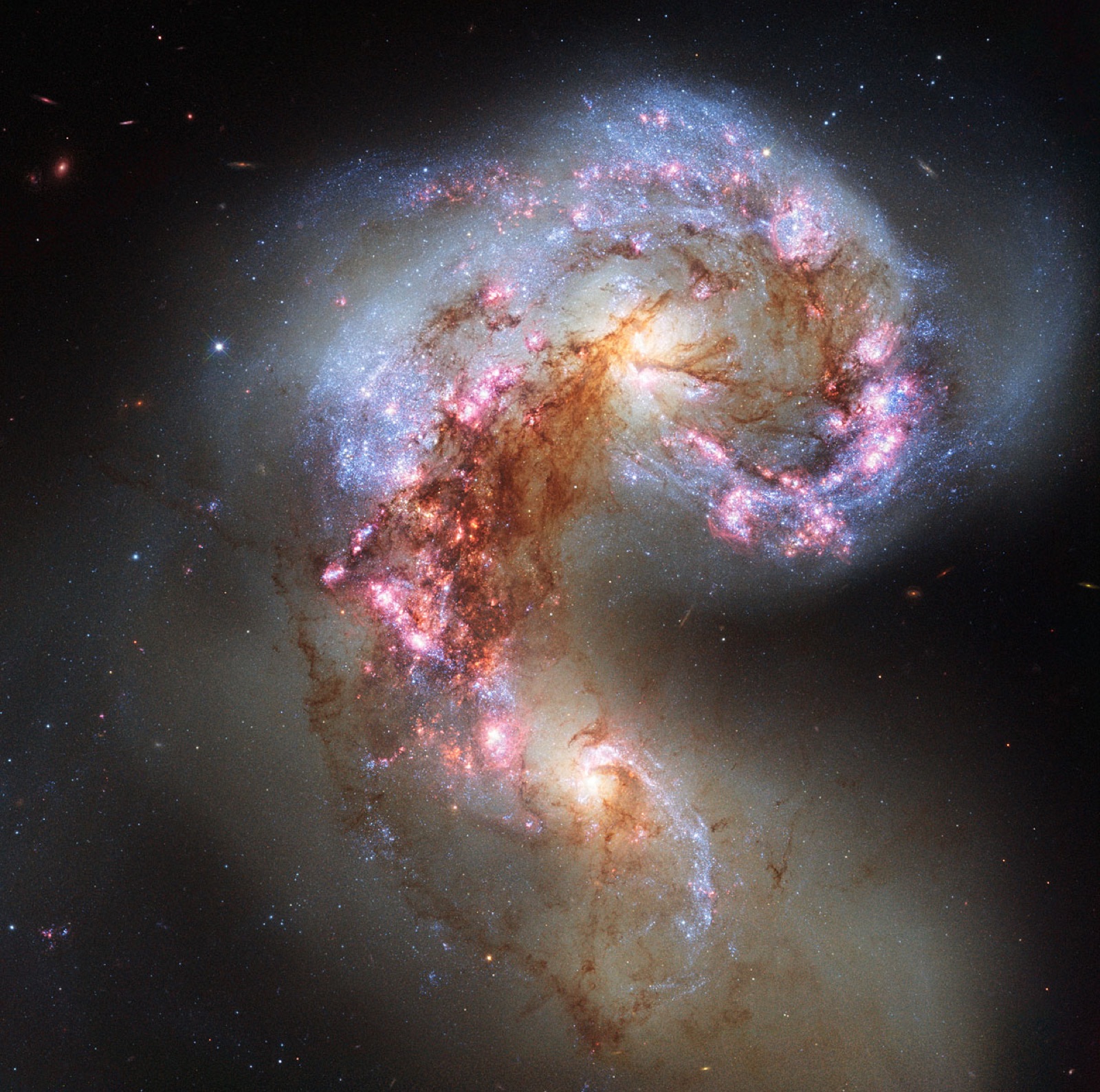
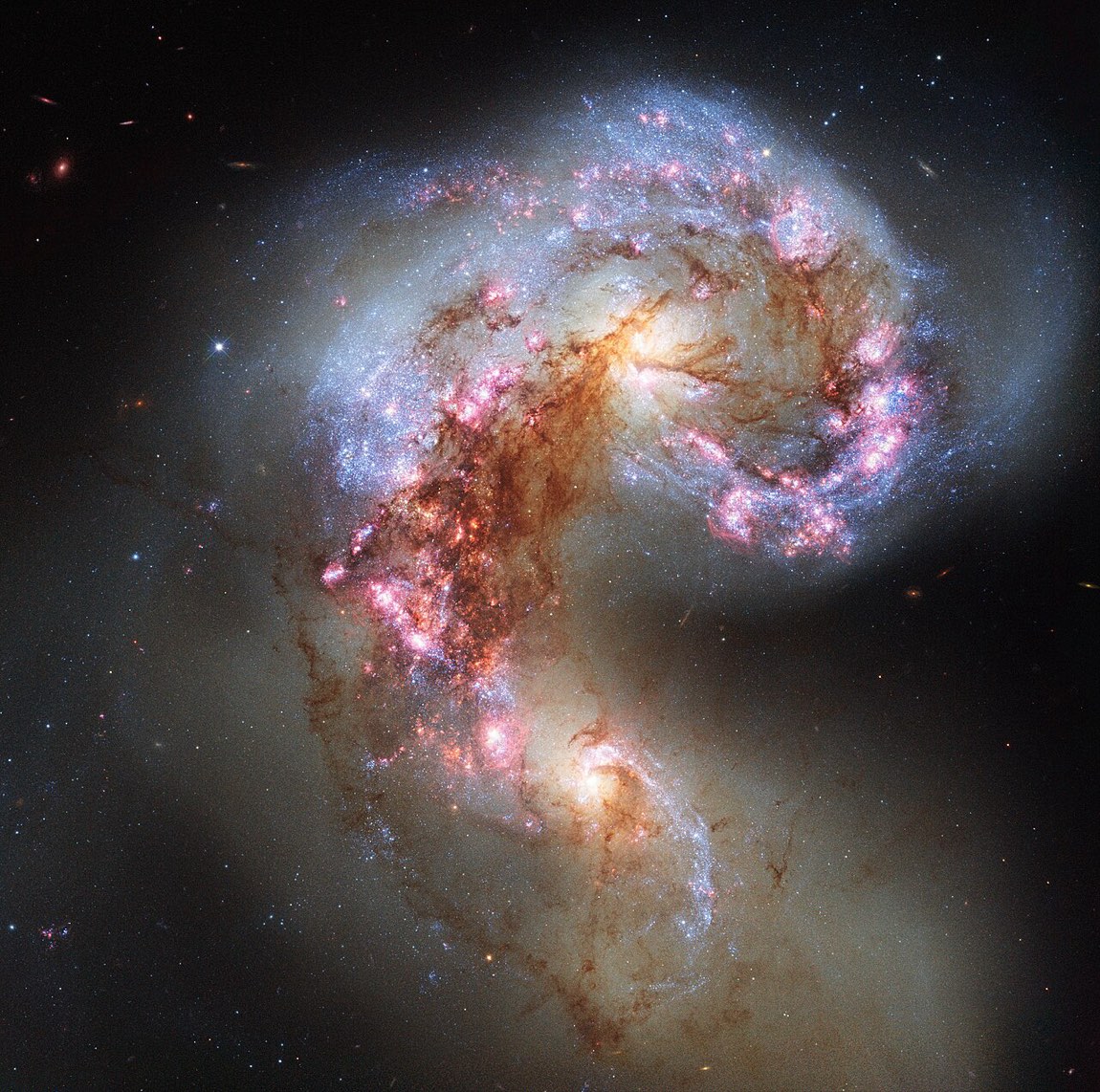
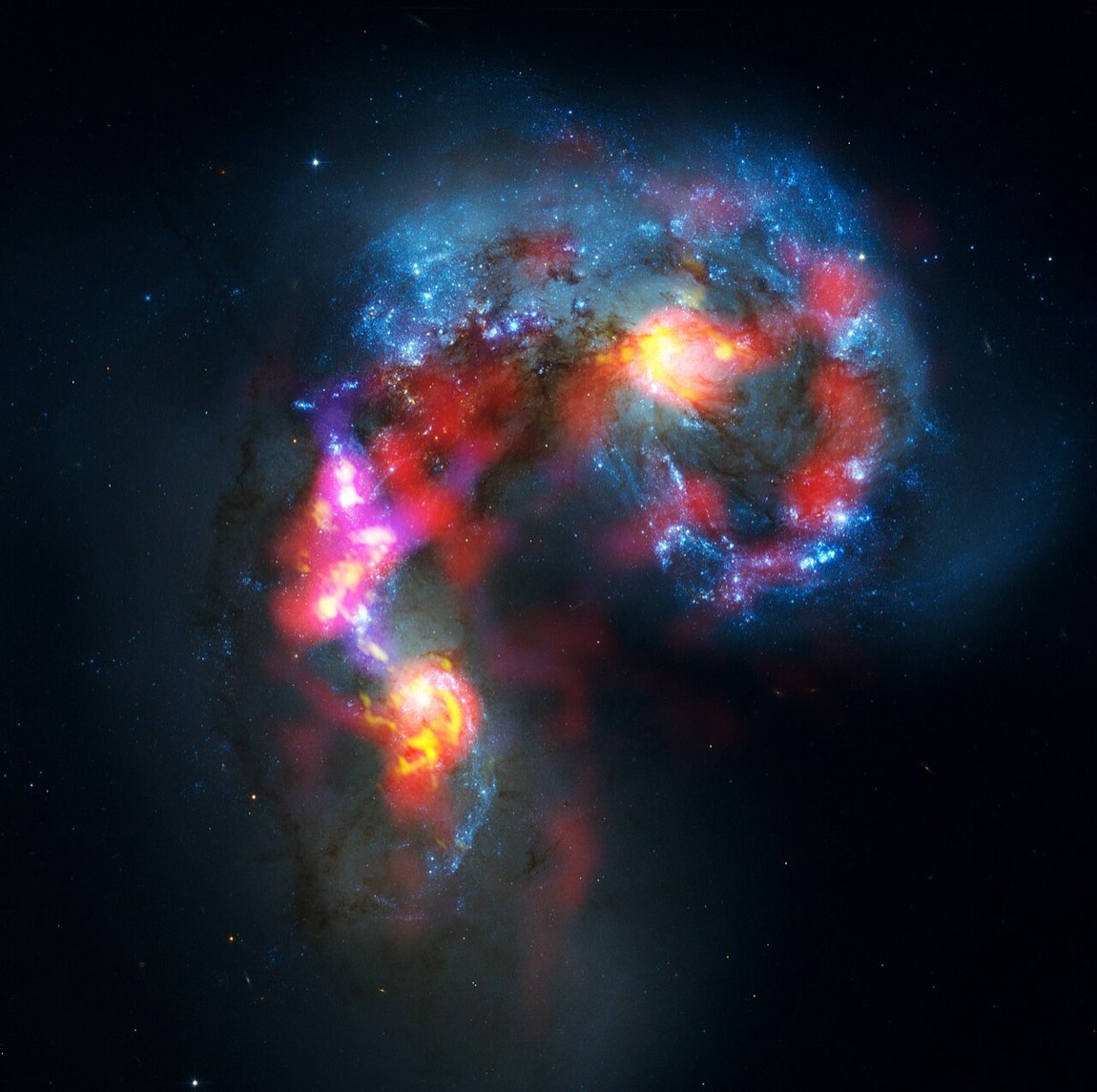
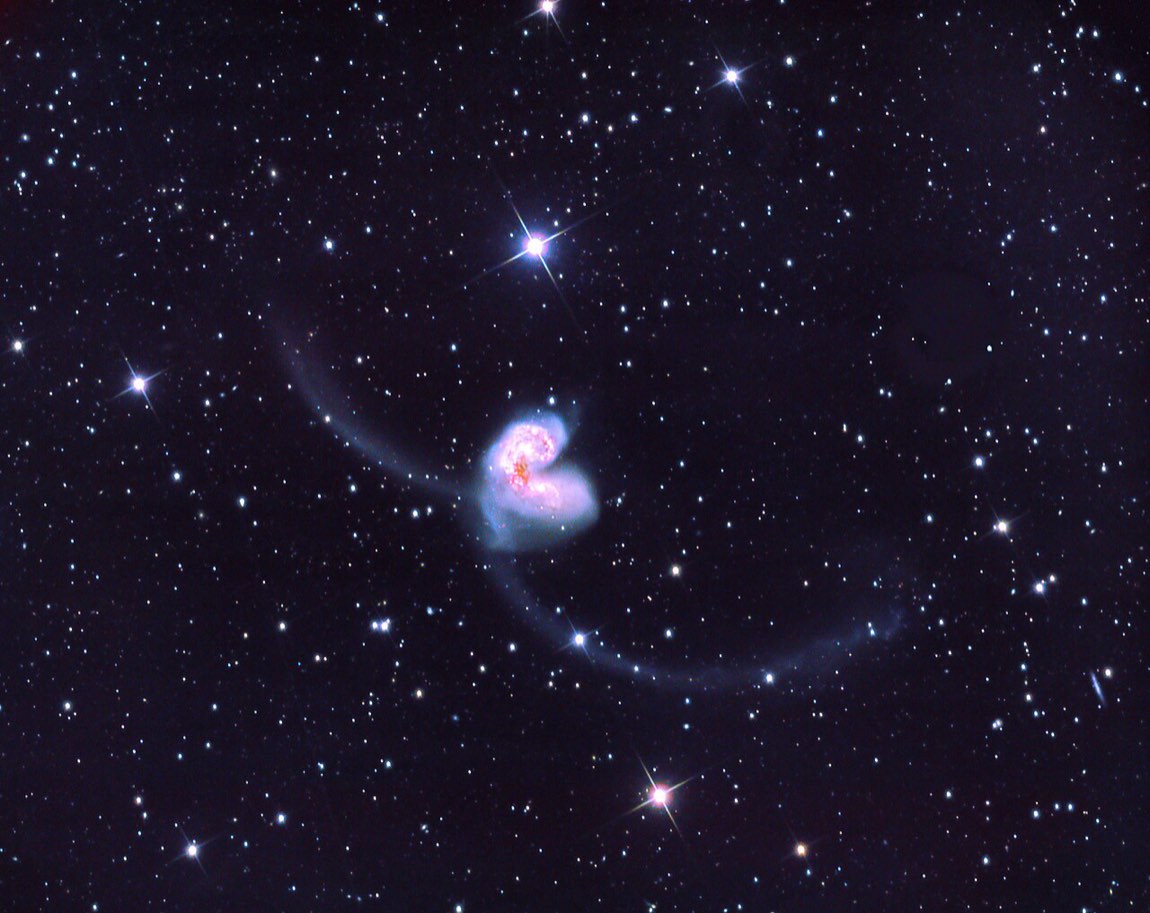
The Antennae, about 45 million light-years away in Corvus, are two spiral galaxies caught in the act of merging: their bodies have crashed together in a firestorm of star birth, while two immense streamers of flung-out stars — the insect-antenna 'tails' — arc across a quarter million light-years. This is what the Milky Way and Andromeda will look like billions of years from now.
The deep dive
Researched for the Atlas from Wikipedia — Antennae Galaxies (4,582 characters read) · updated Sep 20, 2026
01 Two Galaxies Becoming One
The Antennae Galaxies are not simply passing near each other — their nuclei are actively merging into a single giant galaxy. About 1.2 billion years ago, the two were entirely separate: NGC 4038 was a barred spiral galaxy and NGC 4039 was a spiral galaxy, drifting independently through the constellation Corvus. Nine hundred million years ago they began closing in on each other. Six hundred million years ago they passed through one another, briefly resembling the famous Mice Galaxies. Three hundred million years ago, stars began streaming free of both systems, creating the sweeping tails we see today. Within roughly 400 million years from now, the two remaining cores will collide and fuse into a single nucleus surrounded by a common envelope of stars, gas, and dust. Observations and simulations of colliding galaxies — including landmark work by astronomer Alar Toomre — strongly suggest the final product will be an elliptical galaxy, smooth and featureless compared to either of the spirals that created it.
02 The Toomre Sequence and Galaxy Evolution Deeper
The Antennae Galaxies played a central scientific role in establishing how galaxy mergers unfold over cosmic time. The collision-and-merger sequence known as the Toomre sequence — a framework for understanding how interacting galaxies evolve — was developed in part by successfully modeling the distinctive antennae-shaped tidal tails of NGC 4038 and NGC 4039. Those twin streamers of ejected stars, gas, and dust, which extend far beyond the original galactic disks and give the system its insect-like nickname, turned out to be a nearly ideal test case. Their shape and dynamics could be reproduced in simulations, lending strong support to the idea that most galaxies undergo at least one significant collision during their lifetimes. Astronomers have noted that our own Milky Way carries a roughly 50 percent chance of one day colliding with the Andromeda Galaxy — and if it does, the Antennae offer a vivid preview of what that multi-billion-year process might look like, stage by stage.
03 A Nursery of Young Globular Clusters
Scattered across the collision zone is a relatively young collection of massive globular clusters — tightly packed balls of hundreds of thousands of stars — that appear to have been born directly from the violence of the merger. This is striking because most known globular clusters are around 12 billion years old, formed in the earliest chapters of the universe. The clusters in the Antennae are far younger, likely produced by shockwaves generated when the two galaxies collided. Those shockwaves compressed large, massive molecular clouds, and the densest regions of those collapsing clouds are believed to be the actual birthplaces of the new clusters. The collision has effectively triggered a mode of star formation that is rarely witnessed elsewhere, giving astronomers a rare chance to study globular cluster birth in real time rather than inferring it from billion-year-old relics.
04 How Astronomers Pin Down the Distance Deeper
Pinning down exactly how far away the Antennae Galaxies are has proved surprisingly contentious. The widely accepted figure places them at roughly 20 megaparsecs, or about 70 million light-years from Earth. A 2008 study challenged that, claiming the system sits at only 13.3 ± 1.0 megaparsecs (43.4 ± 3.26 million light-years) based on photometry of the presumed tip of the red-giant branch — a standard distance indicator that relies on the predictable brightness of the brightest red giant stars. However, an immediate follow-up paper identified three major problems with that estimate and concluded it was a probable misidentification of the red-giant branch tip. A separate, more comprehensive analysis drew on observations of the Type Ia supernova SN 2007sr in the system's southern tail, large-scale flow models, and reanalyzed Hubble Space Telescope archival data using improved methods, arriving at an average distance of 22 ± 3 megaparsecs (71.8 ± 9.78 million light-years). The debate illustrates how difficult precision distance measurement remains even for a well-studied, relatively nearby system.
 ⤢
⤢
05 A Record of Supernovae
The intense star formation raging inside the Antennae means massive stars are being born — and dying — at an elevated rate, producing a remarkable record of supernovae. Five have been documented across the two galaxies. The oldest known is SN 1921A, discovered in NGC 4039 in March 1921 by Edwin Hubble and John Charles Duncan, though its type remains unknown. In NGC 4038, SN 1974E (also of unknown type, magnitude 14) was found by Miklós Lovas on 21 March 1974. SN 2004gt, a Type Ic event reaching magnitude 14.9, was discovered by Berto Monard on 12 December 2004. SN 2007sr, a Type Ia supernova and the brightest of the group at magnitude 12.9, was found by the Catalina Sky Survey on 18 December 2007 and later became important for distance estimates. Most recently, SN 2013dk, another Type Ic at magnitude 15.8, was detected by the CHASE Project on 22 June 2013. Together they span nearly a century of observation.
06 Heavy Elements Detected by Chandra Deeper
When NASA's Chandra X-ray Observatory analyzed the Antennae Galaxies, it revealed clouds of hot gas enriched with heavy elements — specifically neon, magnesium, and silicon. These are elements forged inside massive stars and scattered by supernova explosions, and they are considered essential building blocks for rocky planets and, by extension, for life as we understand it. The concentrations detected are extraordinary: the clouds contain 16 times as much magnesium and 24 times as much silicon as the Sun carries. That kind of enrichment points to the enormous rate at which massive stars are living and dying inside the system, seeding the surrounding interstellar medium with the raw chemical ingredients that future planetary systems might one day inherit. The Chandra observations thus tie the Antennae's violent merger directly to the long-term potential for planetary chemistry in any galaxies that eventually form from the wreckage.
07 What the Antennae Tails Are Really Made Of
The two sweeping streamers that give the Antennae Galaxies their name are not simply trails of stars flung outward by the collision. They are composed of stars, gas, and dust — complex mixtures of material ejected from both galaxies as gravitational forces during the passage tore matter free of their original disks. The tails extend far beyond the cores of the original galaxies, stretching into intergalactic space. This ejected material includes the kinds of molecular gas from which new stars can form, meaning the tails are not inert debris but potentially active sites of ongoing or future star formation. The system sits in the NGC 4038 group alongside five other galaxies, and the tails reach out into that broader environment. The shape closely resembles an insect's antennae, which is precisely why the system earned its popular name, a nickname that has stuck long enough to become the galaxies' standard designation in casual astronomical usage.
08 Discovery and Early Observations
The Antennae Galaxies were discovered by the British-German astronomer William Herschel in 1785, more than two centuries before the nature of galaxies themselves was understood. At the time, objects like these were catalogued simply as nebulae — faint smudges with no clear physical interpretation. The pair carries multiple catalog designations reflecting the history of systematic sky surveys: they appear as NGC 4038 and NGC 4039 in the New General Catalogue, and also as Caldwell 60 and Caldwell 61 in Patrick Caldwell-Moore's more modern list of objects suitable for amateur telescopes. In the sky they sit in the constellation Corvus, positioned 0.25 degrees north of the star 31 Crateris and 3.25 degrees southwest of Gamma Corvi — coordinates that place them in a relatively accessible part of the southern sky. The fact that Edwin Hubble and John Charles Duncan identified a supernova within the system as early as March 1921 shows how closely observed these galaxies have been almost since their true extragalactic nature was first established.
 ⤢
⤢
09 Cepheid Variables as Cosmic Rulers Deeper
NGC 4038 contains around 53 Cepheid variable stars — pulsating giants that brighten and dim with clockwork regularity. Cepheids are among the most important tools in observational astronomy because the period of their brightness variation is directly tied to their intrinsic luminosity. By comparing how bright a Cepheid appears against how bright it actually is, astronomers can calculate a precise distance. The presence of roughly 53 Cepheids in NGC 4038 makes it a potentially valuable target for distance measurement using this classical technique, independent of the red-giant branch or supernova methods that have already generated debate about the system's true distance. In a system where the distance estimate ranges from roughly 43 to 72 million light-years depending on the method used, the Cepheid population represents an important and relatively direct cross-check — one that anchors the Antennae to the same distance ladder used to calibrate measurements across much of the observable universe.
10 The Role of Magnetic Fields in Star Formation Deeper
The starburst gripping the Antennae Galaxies is driven not just by the raw collision of gas clouds but by the behavior of magnetic fields tangled up within them. As the two galaxies crash through each other, clouds of gas and dust are forced together at enormous velocities, and their embedded magnetic fields become entangled in the process. This interplay between turbulent gas dynamics and magnetic structure helps determine where and how quickly new stars condense out of the compressed material. The result is the rapid star formation that defines a starburst event — a regime in which stars are produced at rates far higher than in a typical undisturbed galaxy. The Antennae system, currently deep in this starburst phase, has become one of the closest and most studied examples of this process in action, offering observers an accessible laboratory for understanding how magnetic fields, gas physics, and gravitational shocks combine to drive one of the most energetically productive events in the universe.
11 Comparing the Antennae to Galactic Neighbors
To understand where the Antennae sit in the story of their own collision, astronomers compare them to other interacting pairs that represent earlier and later stages of the same process. Nine hundred million years ago, the two galaxies were approaching one another in a way that resembled the present appearance of NGC 2207 and IC 2163, another interacting pair still in an early stage of encounter. Six hundred million years ago, when they first passed through each other, they would have looked similar to the Mice Galaxies — a pair caught in the moment of interpenetration. The Antennae as seen today represent a more advanced stage, with the tails fully developed and the cores drawing together. This comparative approach — matching the current appearance of different interacting systems to different moments in the Antennae's simulated timeline — transforms the Antennae from a single snapshot into a kind of cosmic film strip, letting astronomers reconstruct 1.2 billion years of gravitational drama from objects scattered across the sky.
 ⤢
⤢