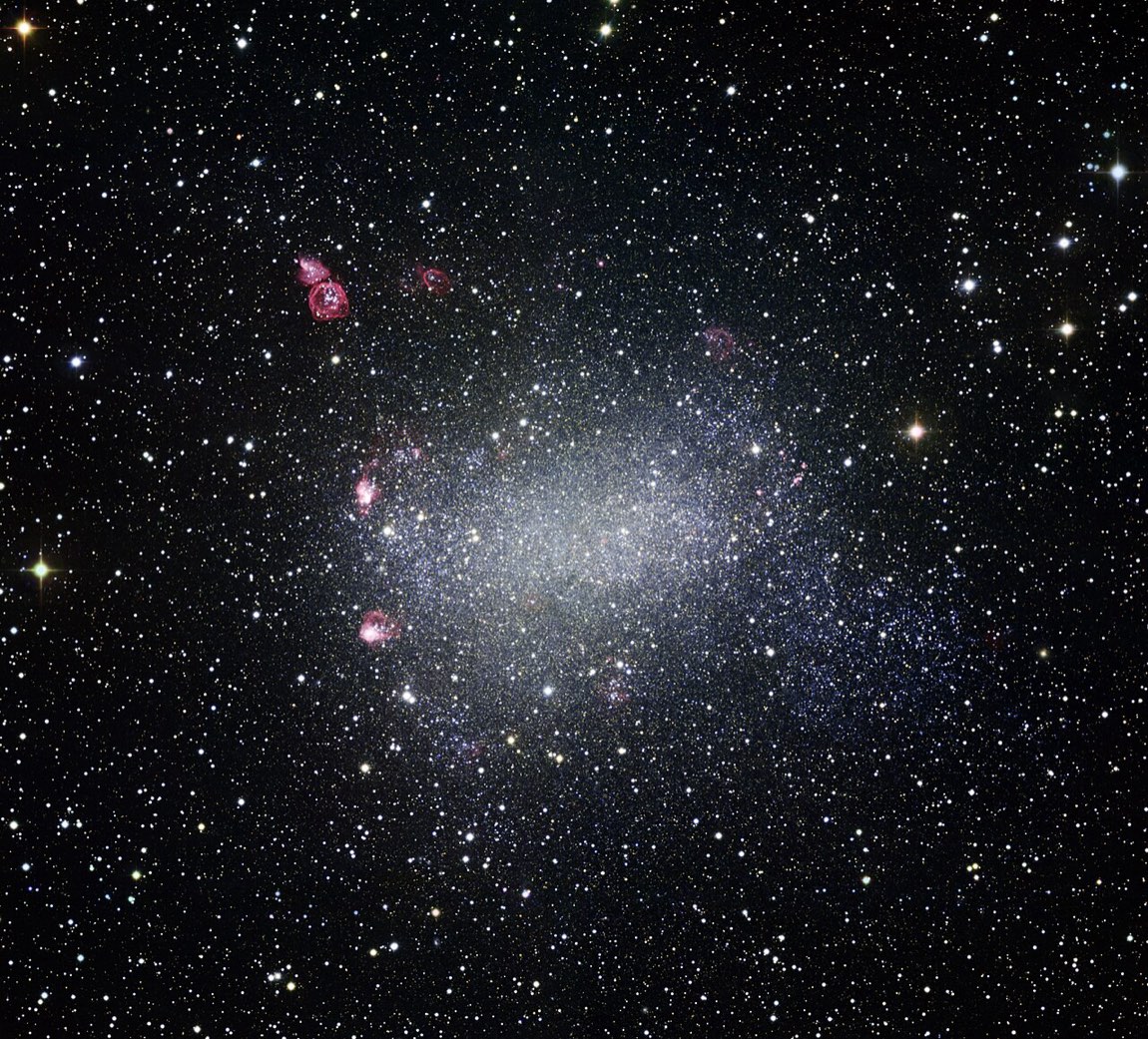
 Photograph · ESO · CC BY 4.0
Galaxy · Deep guide
Barnard's Galaxy (NGC 6822)
Also called: Caldwell 57 · NGC 6822 · IC 4895 · DDO 209
A small, irregular neighbour galaxy whose Cepheid stars helped Edwin Hubble measure the universe.
What is it?
Barnard's Galaxy is a barred irregular galaxy in the Local Group, the family of galaxies that includes the Milky Way and Andromeda. E. E. Barnard found it in 1884 with a six-inch telescope. In the 1920s Edwin Hubble studied its Cepheid variable stars and showed it lies far beyond the Milky Way, the first system past the Magellanic Clouds to have its distance measured that way. It resembles the Small Magellanic Cloud and contains more than 150 catalogued star-forming H II regions.
The deep dive
Researched for the Atlas from Wikipedia — NGC 6822 (2,722 characters read) · updated Nov 15, 2026
01 How E. E. Barnard first spotted it
On 17 August 1884, Edward Emerson Barnard turned a modest six-inch refractor telescope toward the constellation Sagittarius and recorded a faint, smudgy patch that most observers would have dismissed as a wisp of nebulosity. Because the galaxy is spread across a large area of sky at very low surface brightness, it had escaped earlier cataloguers — a striking reminder that aperture alone is not everything, and that careful, patient observers with small instruments can still make landmark discoveries. Barnard's name stuck to the object permanently, and it also appears in modern catalogues as NGC 6822, IC 4895, and Caldwell 57, giving it the rare distinction of carrying four separate designations. The galaxy sits inside the boundaries of Sagittarius, a part of the sky already crowded with Milky Way star fields, which makes picking out the faint irregular smear of a neighboring galaxy all the more demanding for today's amateur astronomers who try to repeat the feat.
02 Hubble's cosmic yardstick moment
In his landmark paper titled "N.G.C. 6822, A Remote Stellar System," Edwin Hubble identified 15 variable stars within the galaxy, 11 of which were Cepheid variables — stars that pulse in brightness on a precise, clockwork schedule. By applying the Cepheid Period-Luminosity relationship, which links a star's pulsation period directly to its true luminosity, Hubble calculated a distance of 214 kiloparsecs, or roughly 698,000 light-years. That figure shattered the prevailing picture of the cosmos: at the time, Harlow Shapley had estimated the entire universe to be only 300,000 light-years across. Hubble's measurement of NGC 6822 was the first distance determination to any system beyond the Magellanic Clouds, and it effectively settled the "Great Debate" of 1920 between Shapley and Heber Curtis over whether the mysterious spiral nebulae were small clouds inside the Milky Way or vast stellar systems far beyond it. NGC 6822 was the proof of concept that led Hubble onward to the Andromeda Galaxy and the Triangulum Galaxy, dismantling forever the idea that the Milky Way was the entire universe.
03 What Hubble found inside the galaxy Deeper
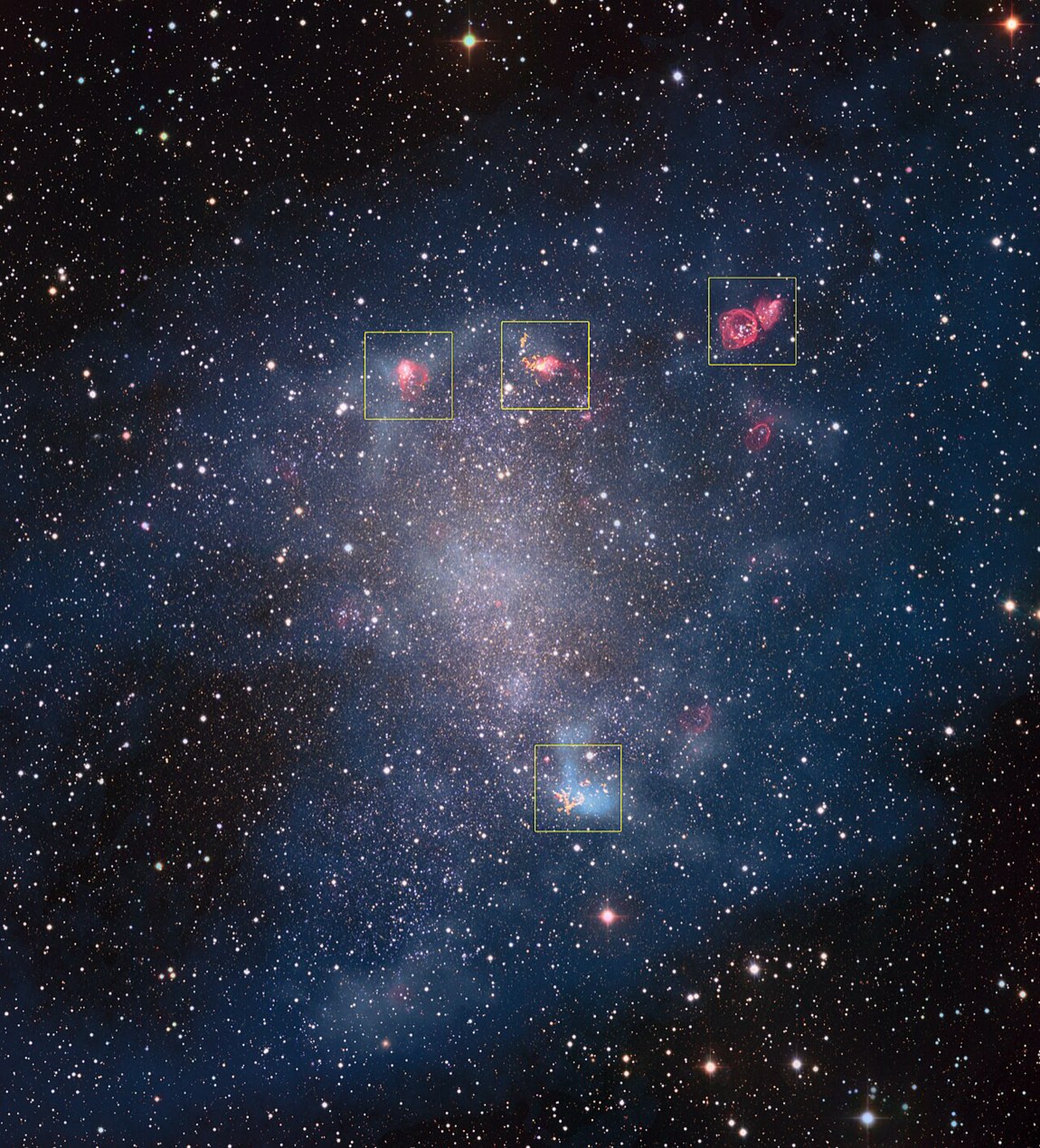
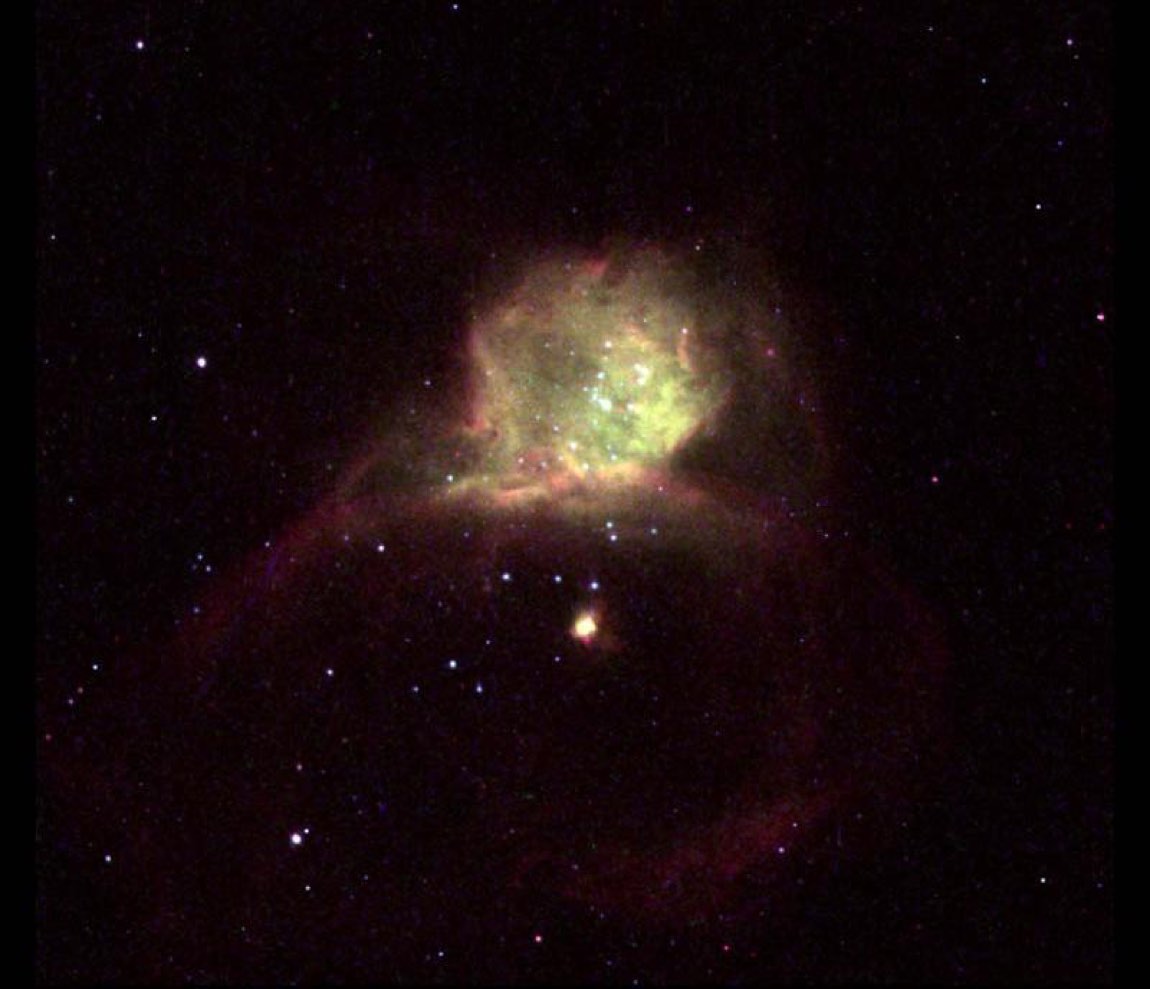
Beyond counting Cepheids, Hubble conducted a thorough survey of NGC 6822's stellar population down to magnitude 19.4, pushing to the faint limit of his photographic plates. He characterized the five brightest diffuse nebulae within the galaxy — regions he called giant H II regions — providing their spectral characteristics, luminosities, and physical dimensions. Among those five were features that bear names still recognized today: the Bubble Nebula and the Ring Nebula within NGC 6822 itself, not to be confused with the more famous objects sharing those names elsewhere in the sky. Hubble also computed the absolute magnitude of the entire galaxy, giving astronomers their first quantitative handle on its intrinsic brightness. This combination of Cepheid distances, stellar photometry, and nebular spectroscopy in a single paper set the template for how extragalactic astronomy would be practiced for decades. The observational record Hubble assembled was so thorough that an analysis of his original photographic plates by Susan Kayser in 1966 remained the most complete study of the galaxy until 2002 — nearly four decades during which no substantially better dataset existed.
 ⤢
04 A catalog of glowing gas clouds grows Deeper
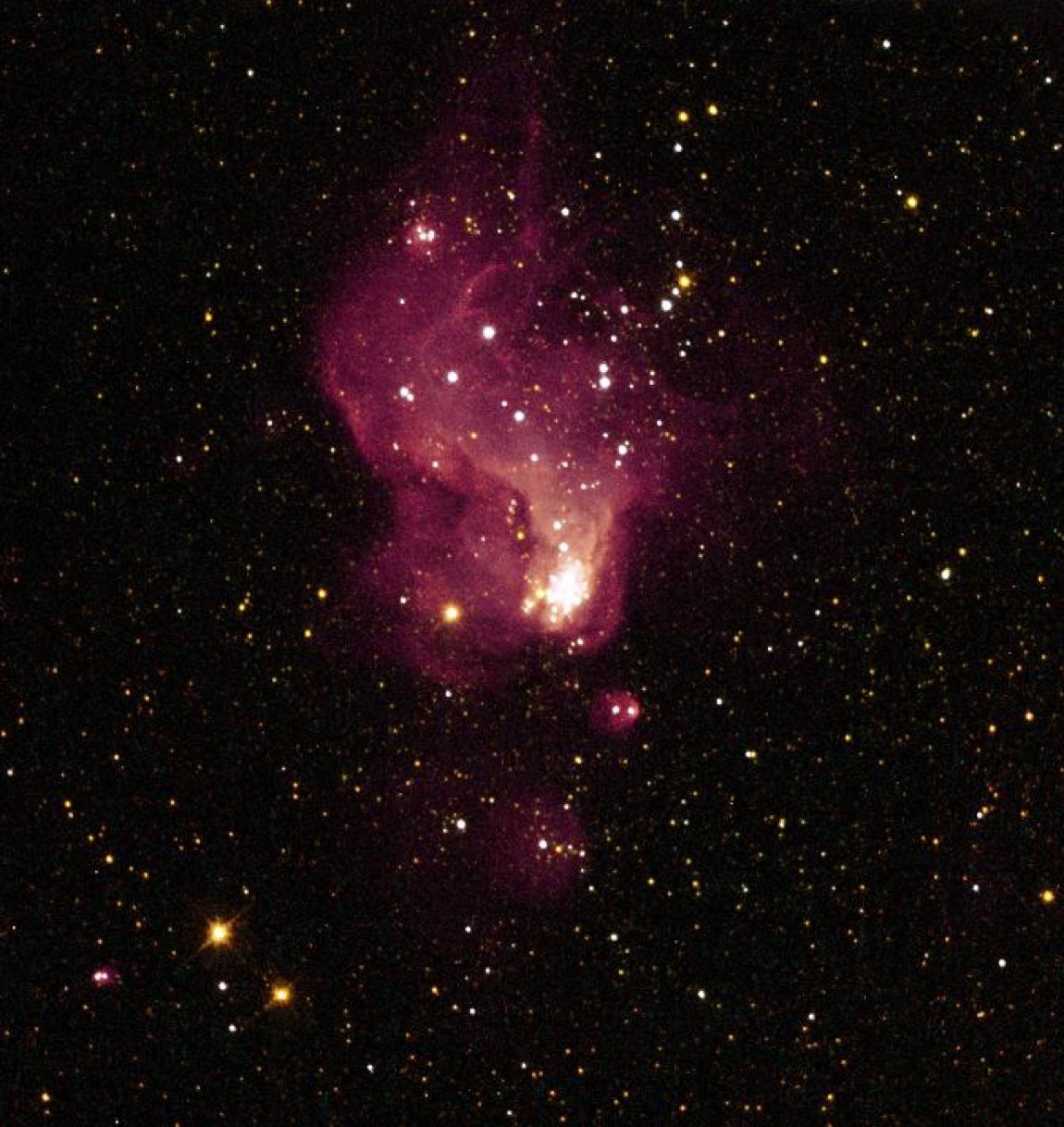
H II regions are clouds of hydrogen gas ionized and set aglow by the ultraviolet radiation of hot, young, massive stars embedded within them. Hubble originally described five of the brightest such regions in NGC 6822. In 1977, Paul W. Hodge extended the census to 16 known H II regions, adding detail to the galaxy's map of active star-forming sites. The catalog has expanded dramatically since then: today astronomers have identified more than 150 H II regions distributed across Barnard's Galaxy. Each of these regions marks a place where star formation is happening or has recently happened, so the growing list tells a story of widespread, ongoing stellar birth spread across the irregular body of the galaxy. The jump from 5 regions in Hubble's era to more than 150 today reflects not only improved telescope technology and detector sensitivity but also the sustained scientific interest this relatively nearby system attracts as a laboratory for understanding how stars and gas interact in a low-mass, metal-poor environment similar to the early universe.
05 Stars born from collapsing hydrogen clouds
Star formation in NGC 6822 follows the same fundamental physics seen across the universe: stars ignite inside the dense cores of giant molecular hydrogen gas clouds when gravity overcomes the pressure holding the gas up, and the cores collapse inward until nuclear fusion lights up. What makes the process visible to observers is that those surrounding gas clouds, heated and ionized by the newborn stars, shine as the H II regions catalogued across the galaxy. Observations confirm this active process is ongoing throughout Barnard's Galaxy today. Intriguingly, the distribution of that hydrogen gas is disk-shaped — giving the raw fuel for star formation a flattened, organized geometry — but that hydrogen disk is tilted at roughly 60 degrees relative to the plane defined by the galaxy's visible stars. Why the gas and the stars should be so dramatically misaligned remains unexplained, and it stands as one of the more puzzling structural mysteries about an otherwise well-studied galaxy. Most of the stars in NGC 6822 appear to have formed within the last 3 to 5 billion years, making the stellar population relatively young compared to the age of the universe.
06 A close brush with the Milky Way
NGC 6822 has spent the overwhelming majority of its existence in relative isolation, drifting through space without a large companion to stir it gravitationally. Today it sits just outside the virial radius of the Milky Way — that invisible boundary within which a galaxy's gravity dominates its surroundings — placing it technically in our neighborhood but not fully bound into our system the way the Magellanic Clouds are. However, the best current models suggest the galaxy likely passed within that virial radius somewhere between 3 and 4 billion years ago. That brief gravitational encounter may be directly connected to the surge in star formation that produced most of the galaxy's present stellar population in the last 3 to 5 billion years. If the timing holds up, a single relatively close passage by the Milky Way may have compressed gas clouds inside NGC 6822 enough to trigger a prolonged burst of star birth — a vivid illustration of how galaxies can influence one another across millions of light-years of space without ever physically colliding.
 ⤢
07 Its kinship with the Small Magellanic Cloud
Astronomers describe NGC 6822 as similar in structure and composition to the Small Magellanic Cloud, one of the Milky Way's two irregular dwarf satellite galaxies visible to the naked eye from the Southern Hemisphere. Both are classified as irregular galaxies — meaning they lack the grand spiral arms or the smooth elliptical shape that define the more familiar galaxy types — and both share a comparable chemical makeup, being relatively poor in elements heavier than hydrogen and helium compared to large spiral galaxies like the Milky Way. This chemical poverty makes them useful analogs for galaxies in the early universe, when heavy elements had not yet been built up through generations of stellar evolution. NGC 6822 is specifically categorized as a barred irregular galaxy, indicating it possesses a central elongated bar-like structure of stars even without organized spiral arms. At about 7,000 light-years in diameter, it is a small system — for comparison the Milky Way spans roughly 100,000 light-years — but it is rich enough in ongoing star formation to keep astronomers' attention firmly fixed on it.
08 Its place in the Local Group Deeper
The Local Group is the collection of galaxies gravitationally associated with the Milky Way, including the Andromeda Galaxy, the Triangulum Galaxy, the Magellanic Clouds, and several dozen smaller dwarf galaxies. NGC 6822 is a confirmed member of this group, sitting approximately 1.6 million light-years from Earth. Its distinction within the Local Group is a notable one: it is identified as the closest non-satellite galaxy to the Milky Way. The key qualifier is "non-satellite" — it does not orbit our galaxy the way the Magellanic Clouds do, yet it is closer to us than any other gravitationally independent galaxy in the group. At 1.6 million light-years, that distance is roughly 1.6 times the distance to the Large Magellanic Cloud, so while the Magellanic Clouds are closer in raw terms, they count as satellites. This positioning makes NGC 6822 a particularly valuable object for studying the properties of small independent galaxies: it is near enough for individual stars and H II regions to be resolved, yet it has evolved largely under its own conditions rather than being continuously shaped by the Milky Way's tidal forces.
09 Observing Barnard's Galaxy yourself
Barnard's Galaxy presents one of amateur astronomy's classic low-surface-brightness challenges. Its apparent magnitude places it within reach of modest backyard telescopes, but because that light is spread over a relatively large area of sky rather than concentrated into a star-like point, the galaxy can be surprisingly hard to see even when a telescope is pointed directly at it. Dark skies are essential: any light pollution bleaches out the faint glow almost completely. The galaxy resides in Sagittarius, a constellation best placed for Northern Hemisphere observers during summer evenings when it rises in the south, but its low declination means observers at high northern latitudes see it skimming the horizon, further dimming the view through thicker layers of atmosphere. Wide-field eyepieces and low magnification tend to work better than high power, since spreading the galaxy's light across fewer pixels of eye or detector only makes it harder to detect. Southern Hemisphere observers enjoy a significant advantage, as Sagittarius climbs much higher in their sky. Finding the galaxy rewards patience: once seen, its irregular, mottled texture distinguishes it immediately from a simple star or tight cluster.
 ⤢
10 Open questions still surrounding this galaxy Deeper
Despite more than a century of study since Barnard's original discovery and Hubble's landmark distance measurement, NGC 6822 retains genuine scientific mysteries. The most striking structural puzzle is the roughly 60-degree misalignment between the disk of neutral hydrogen gas — the raw fuel for star formation — and the distribution of the galaxy's stars. In most well-ordered disk galaxies, gas and stars share the same plane; a 60-degree tilt between them in an irregular dwarf is not easily explained by standard models of galaxy formation. Whether this misalignment reflects a past interaction, an asymmetric gas infall, or some intrinsic property of small irregular galaxies is not yet settled. The question of whether the close approach to the Milky Way between 3 and 4 billion years ago genuinely triggered the galaxy's elevated star formation rate is also still a hypothesis rather than a proven fact — the timing is suggestive but not conclusive. Additionally, the explosion of known H II regions from Hubble's original five to today's catalog of more than 150 raises questions about the full three-dimensional structure of star-forming activity across the galaxy that ongoing and future surveys are still working to answer.