 Diagram · Wyattmars · CC BY-SA 4.0
Dwarf Planet · Deep guide
20000 Varuna
Also called: 20000 Varuna · (20000) Varuna · 2000 WR106
A fast-spinning Kuiper belt body stretched into an elongated shape by its own rotation.
What is it?
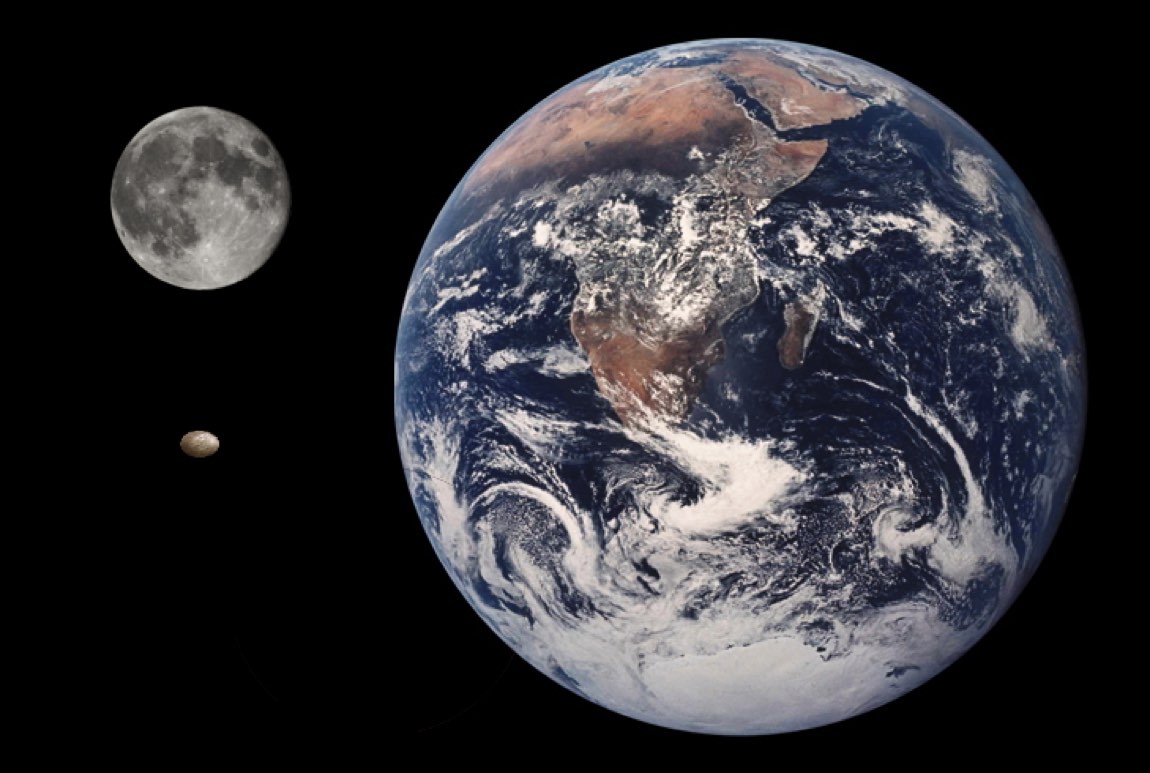
Varuna is a large Kuiper belt object roughly 650–670 km across that rotates in just 6.3 hours. Its brightness changes suggest the spin has pulled it into an elongated, egg-like shape. Its moderately red surface carries organic compounds and some water ice. It has been suggested as a dwarf-planet candidate, but its calculated low density makes some researchers doubt it qualifies, and the IAU has not recognized it.
The deep dive
Researched for the Atlas from Wikipedia — 20000 Varuna (26,668 characters read) · updated Nov 14, 2026
01 How Varuna Was Found in the Dark
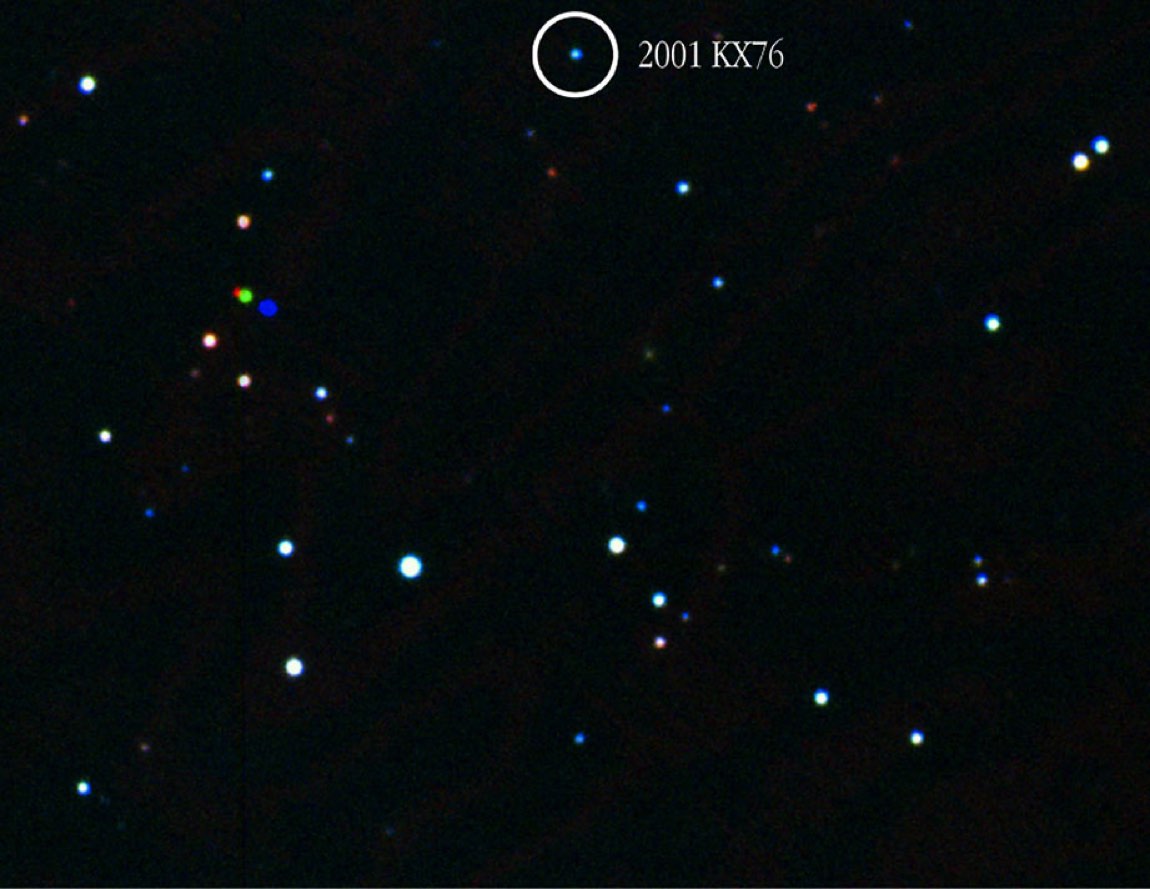
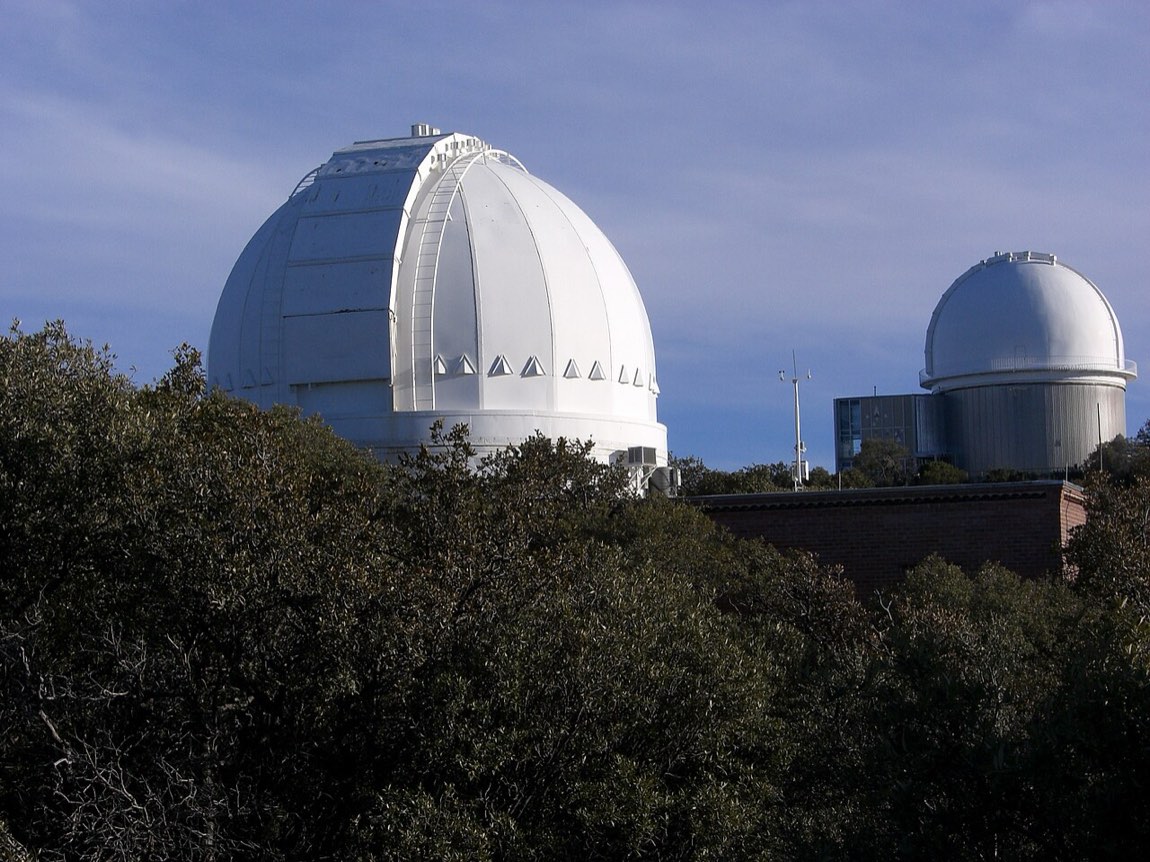
On 28 November 2000, American astronomer Robert McMillan was conducting a routine Spacewatch survey with a 0.9-meter telescope at Kitt Peak National Observatory near Tucson, Arizona. Varuna was hiding in a moderately dense star field close to the northern galactic equator — a crowded backdrop that made automated detection difficult. McMillan's real-time computer software failed to flag it, so he identified it the old-fashioned way: by manually blinking multiple scans of the same region side by side, watching for a point of light that crept slowly against the fixed stars. After his shift ended, astronomer Jeffrey Larsen carried out follow-up observations to confirm the find. Together the two men accumulated 12 observations spanning three nights. The discovery was formally announced on 1 December 2000 in a Minor Planet Electronic Circular. Its provisional designation, 2000 WR106, encodes the discovery date precisely: found in the second half of November 2000, it was the 2,667th object catalogued in that fortnight alone.
02 Precovery: Varuna's Secret Past
Almost immediately after Varuna's announcement, German astronomers Andre Knofel and Reiner Stoss began hunting through archival plates at Palomar Observatory and found it hiding in old images — a process called precovery. One precovery image taken with Palomar's Big Schmidt telescope in 1955 showed Varuna sitting three degrees away from the position predicted by the rough circular orbit calculated in December 2000, a reminder of how much an approximate orbit can drift. The oldest known precovery image dates all the way back to 24 November 1954, extending Varuna's observed arc by nearly half a century before its official discovery. Additional archival observations from Japan, Hawaii, and Arizona were folded in, allowing astronomers to pin down its orbit with enough precision that the Minor Planet Center assigned it the number 20000 in January 2001. That round number was deliberately chosen to honour Varuna's status as the largest classical Kuiper belt object known at the time, and also to mark the coincidental 200th anniversary of the discovery of Ceres, which fell in the same month.
03 A Deity of Cosmic Waters
The name Varuna was proposed by Indian choreographer Mrinalini Sarabhai and approved by the International Astronomical Union in March 2001, following the IAU's convention of naming non-resonant Kuiper belt objects after creator deities. Varuna is one of the oldest figures in Vedic literature, appearing in the earliest hymns of the Rigveda. In Hindu tradition, Varuna created and presided over the waters of heaven and the ocean, served as king of gods, men, and the universe, and possessed unlimited knowledge — a suitably vast conception for an object orbiting billions of kilometres from the Sun. Because planetary symbols have largely fallen out of use in modern astronomy, Varuna never received an official one. Software engineer Denis Moskowitz later designed an unofficial symbol derived from the Devanagari letter va (व) combined with Varuna's snake-lasso. It surfaces occasionally on astrology websites but is not formally adopted. A second informal symbol borrows from Neptune's design, reflecting the mythological parallel between Varuna, lord of cosmic waters, and the Roman sea god.
04 An Unusually Circular Path Around the Sun
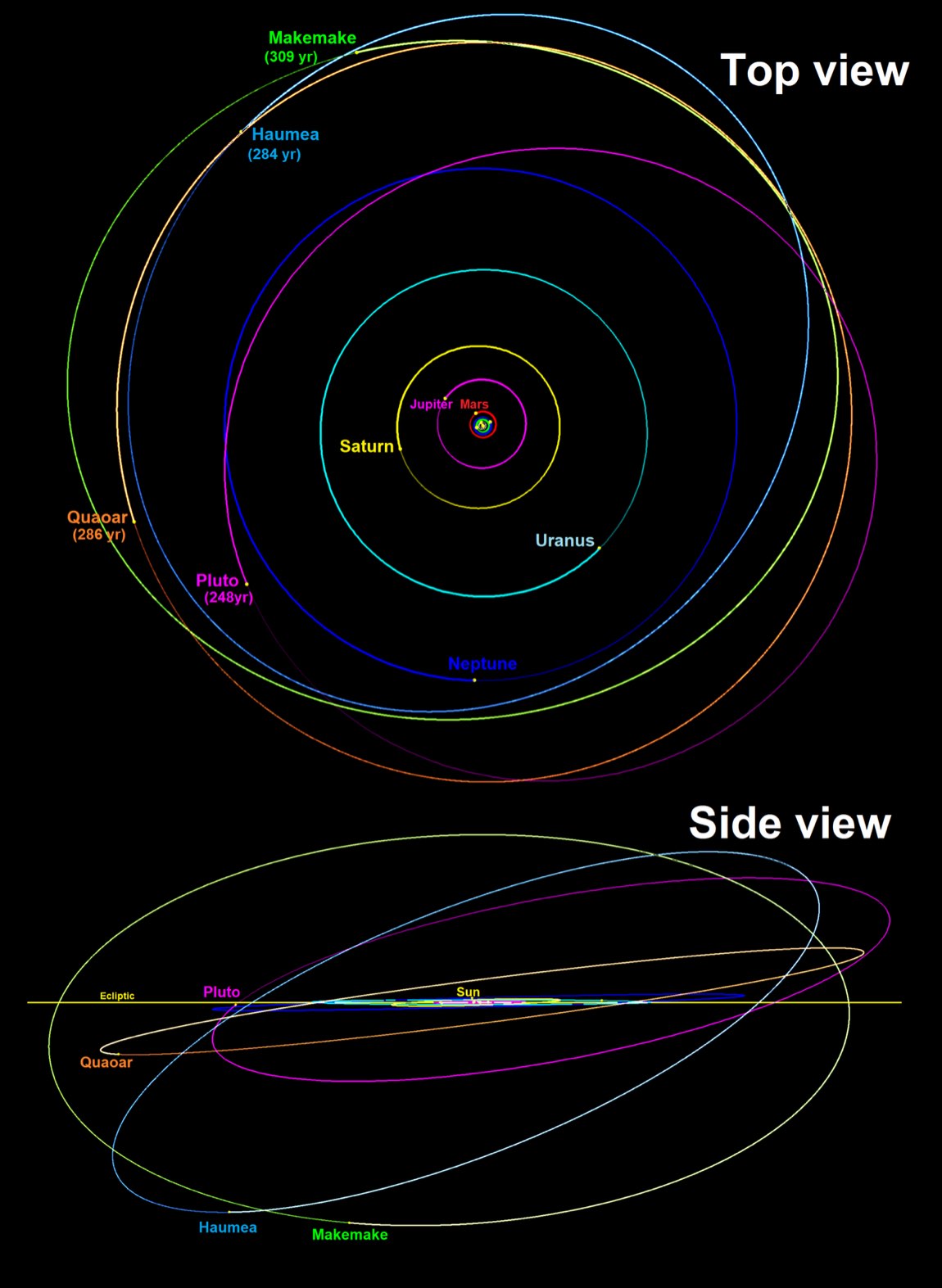
Varuna circles the Sun at an average distance of 42.7 AU — roughly 6.39 billion kilometres — taking 279 years to complete one orbit. That is so slow that the entire recorded history of modern astronomy covers less than two percent of a single Varuna year. Its orbit is nearly circular: an eccentricity of only 0.056 means its distance from the Sun shifts very little, ranging from 40.3 AU at closest approach (perihelion, which it passed in 1932) to 45.1 AU at its farthest point (aphelion, due in 2073). The orbit is tilted 17 degrees to the ecliptic, similar to Pluto's inclination. Its semi-major axis of 42.8 AU places it in company with other large classical Kuiper belt objects: Quaoar sits at 43.7 AU and Makemake at 45.6 AU. Because its minimum possible distance from Neptune is 12.04 AU, Neptune exerts no meaningful gravitational grip on Varuna, leaving it on a stable, undisturbed path that earns it the informal nickname cubewano — a classical KBO free of resonance.
05 Spinning So Fast It Warps Its Own Shape Deeper
Varuna rotates once every 6.34 hours — fast enough that centrifugal force has visibly deformed it into a triaxial ellipsoid, technically called a Jacobi ellipsoid. Its longest semi-axis is roughly 1.5 to 1.6 times longer than the intermediate axis, and detailed modelling constrains the axis ratios to b/a between 0.63 and 0.80, and c/a between 0.45 and 0.52. The first rotation measurement was made in January 2001 by Tony Farnham using the McDonald Observatory's 2.1-meter telescope; his photometry revealed brightness swings of about 0.5 magnitudes per cycle. Astronomers David Jewitt and Scott Sheppard followed up in February and April 2001 and confirmed the double-peaked, 6.34-hour solution as most plausible, because Varuna's visible colour shows no variation with rotation — ruling out the simpler idea of dark and bright patches on a sphere. Notably, the light-curve amplitude has grown by roughly 0.13 magnitudes between 2001 and 2019, consistent with our viewing geometry slowly shifting toward an edge-on perspective. The best-fit pole orientation sits at a right ascension of 54° and declination of −65°, confirming we now see Varuna's equator nearly face-on.
06 Why Varuna Spins So Quickly Deeper
Varuna's 6.34-hour rotation is believed to be the scar left by ancient, violent collisions during the Solar System's formation. The present-day collision rate among trans-Neptunian objects is minimal, but the early outer Solar System was far more crowded. Jewitt and Sheppard pointed out a tension in this explanation: the rate of truly disruptive collisions among large trans-Neptunian objects should have been extremely low even then, yet the Kuiper belt contains a surprisingly large number of both rapidly rotating bodies and binary systems — both thought to arise from such collisions. The leading resolution to this contradiction invokes Neptune's outward migration. As Neptune drifted to its current position it gravitationally stirred the orbits of countless trans-Neptunian objects, dramatically increasing encounter velocities and collision rates. This surge of impacts could have spun up bodies like Varuna while simultaneously fracturing others into the binary pairs we observe today. The same collisions that accelerated Varuna's spin are also thought to have shattered its interior into a granular structure and excavated fresh water ice that now shows through its surface layer of dark, radiation-processed material.
07 A Surface Stained by Radiation
Varuna's surface is moderately red, and that colour tells a chemical story. Organic compounds such as methane, exposed to billions of years of solar ultraviolet light and cosmic ray bombardment, undergo photolysis and produce tholins — dark, sticky, reddish polymers that lower the surface's reflectivity and tend to wash out spectral features. Models of Varuna's spectrum suggest its surface is a mixture of amorphous silicates (25%), complex organic compounds (35%), amorphous carbon (15%), and water ice (25%), with the possibility of up to 10% methane ice. That methane is puzzling: Varuna is not massive enough to have held onto primordial volatile methane, so something — most likely an energetic impact after formation — must have delivered or exposed it. Preliminary 2017 observations at NASA's Infrared Telescope Facility also tentatively identified absorption features between 2.2 and 2.5 μm possibly linked to ethane and ethylene, heavier volatiles that volatile-retention models by Schaller and Brown predict are more likely to survive at Varuna's size than lighter methane.
08 Water Ice Peeking Through the Grime Deeper
The first spectral analysis of Varuna, conducted in early 2001 with the Near Infrared Camera Spectrometer at the Galileo National Telescope in Spain, picked up strong absorption bands at 1.5 and 2.0 μm — the fingerprints of water ice. Compared to the similar Kuiper belt object Huya, observed in the same study, Varuna showed stronger water ice features and appeared relatively fresh, as if some process had continuously re-exposed clean ice beneath its tholin crust. Collisions that may have sped up Varuna's spin are the prime suspects. A 2008 spectral study muddied the picture by returning a featureless, slightly blue spectrum with no water ice signal at all, implying possible surface variation. However, a 2014 study closely reproduced the original 2001 results and suggested the 2008 data were likely erroneous rather than evidence of a patchy, changing surface. The geometric albedo measured in 2013 from combined Spitzer and Herschel data is 0.127 — roughly eight times brighter than the earliest ground-based estimates of 0.04 to 0.07, a large revision driven by the ability of space telescopes to measure thermal emission at wavelengths Earth's atmosphere blocks entirely.
09 Measuring a World by Its Shadow Deeper
Because Varuna is too small and distant to resolve directly with any current telescope, astronomers must catch it passing in front of a background star — a stellar occultation — to measure its size precisely. Two earlier attempts, in 2005 and 2008, failed due to uncertainties in Varuna's position and poor observing conditions. Success finally came on the night of 19 February 2010, when a team led by Bruno Sicardy watched Varuna blot out an 11.1-magnitude star. At São Luís in Maranhão, Brazil, the star disappeared for 52.5 seconds, translating to a chord length of 1,003 ± 9 km — close to the longest possible measurement because São Luís sat near the centreline of Varuna's shadow path. A second station at Camalaú, Paraíba, roughly 450 km to the south, recorded a 28-second occultation, yet a station at Quixadá lying between them saw nothing at all. This paradoxical gap forced the team to conclude that Varuna's apparent oblateness must be at least 0.56, with a polar dimension no smaller than about 441.3 km. Later occultations in 2013 and 2014 yielded mean diameters of 686 km and 670 km respectively, converging toward the ~668 km estimate from Herschel thermal measurements.
10 The Interior: Porous and Possibly Primitive Deeper
Varuna's estimated bulk density of 0.992 g/cm³ sits just barely below that of liquid water, and that surprisingly low value points directly at a porous interior rather than solid rock or ice. Lacerda and Jewitt proposed that Varuna has a granular internal structure — essentially a loosely packed rubble pile — whose voids have never been crushed out by gravity. The collisions thought to have spun Varuna up likely created the fractures that keep its interior open and low-density. Saturn's moons Tethys and Iapetus show comparably low densities for the same reason: a mix of water ice and rock with significant void space. Astronomer William Grundy and colleagues placed Varuna in a transitional size class — bodies roughly 400 to 1,000 km across — that are neither small, clearly porous rubble piles nor large, fully differentiated planetary bodies. In this view, Varuna's rocky interior may have partially settled but never reached temperatures high enough to melt and flow into pore spaces. The consequence is significant: if Varuna is not in hydrostatic equilibrium, it technically cannot be classified as a dwarf planet despite its size, and the low density calculation that assumed hydrostatic equilibrium may itself be circular.
11 A Possible Moon Hiding in the Light Curve
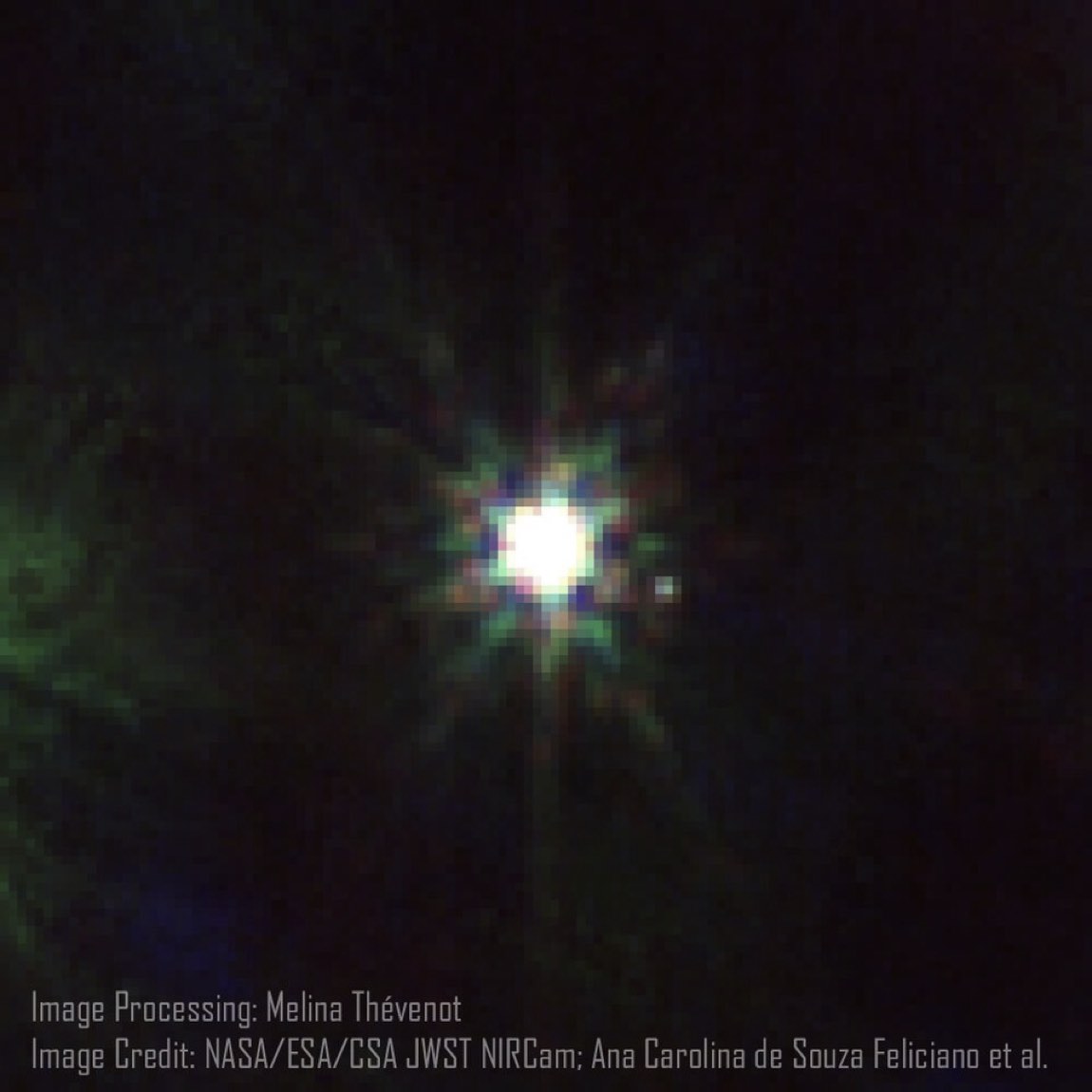
No moon around Varuna has ever been directly photographed — it would sit too close to Varuna to separate with any existing telescope, including Hubble. But in 2019, Valenzuela and colleagues noticed something subtle: when they combined four separate light curves using Fourier analysis, the residuals — the small leftover brightness variations after Varuna's own rotation signal is removed — showed a consistent periodic pattern. Plotting those residuals in a Lomb periodogram, they derived an orbital period of 11.9819 hours for a putative satellite. The proposed moon's brightness contribution varies by only 0.04 magnitudes as it orbits. Assuming Varuna has a density of 1.1 g/cm³ and that the satellite is tidally locked, the team estimates it orbits at a distance of 1,300 to 2,000 km — just outside Varuna's estimated Roche limit of roughly 1,000 km, the boundary inside which tidal forces would tear a loose body apart. Because we currently view Varuna nearly edge-on, there is a chance that mutual eclipses between Varuna and its possible companion could occur in the future, which would allow a much firmer detection.
12 How to Spot Varuna from Earth
Even at its brightest, Varuna reaches only about magnitude 20.3 at opposition — roughly 25,000 times too faint for the naked eye and beyond the reach of most amateur telescopes. Its apparent magnitude otherwise hovers between 19.5 and 20, making it accessible only to professional instruments or very large amateur setups under exceptional conditions. Despite this faintness, Varuna ranks among the twenty brightest known trans-Neptunian objects, a testament to its size relative to most of its Kuiper belt neighbours. Its dark surface, with a geometric albedo of only 0.127, means it reflects just one-eighth of the sunlight that strikes it. Interestingly, photometry carried out in 2004 and 2005 showed that Varuna's light-curve amplitude shrinks to about 0.2 magnitudes at opposition — well below its usual swing of 0.42 magnitudes — and its light curve becomes asymmetric near opposition, hinting at variations in surface scattering properties across its elongated body. The sharpness of this opposition surge, which kicks in within a phase angle of just 0.5 degrees, resembles that of other moderate-albedo Solar System bodies rather than dark asteroids, and was an early indirect clue that Varuna was brighter than the first ground-based thermal estimates suggested.
13 Could a Spacecraft Reach Varuna?
No mission has ever been sent to Varuna, but planetary scientist Amanda Zangari calculated that a flyby is feasible within a human career's worth of patience. Using a Jupiter gravity assist and a launch date of 2035 or 2038, a spacecraft could reach Varuna in just over 12 years. Alternative routes have been mapped out as well: a trajectory using gravity assists from both Jupiter and Uranus could reach Varuna in just over 13 years if launched in 2034 or 2037, while a slower path borrowing gravity from both Saturn and Uranus would take under 18 years, requiring an earlier launch of 2025 or 2029. Regardless of which trajectory is chosen, Varuna would be approximately 45 AU from the Sun by the time any spacecraft launched before 2050 arrived — placing it near aphelion, since it won't reach that most-distant point until 2073. For context, 45 AU is about 45 times the Earth–Sun distance, or more than ten times as far as Saturn. The object's elongated shape, possible satellite, and chemically complex surface make it a scientifically compelling target, though no such mission is currently funded or formally proposed.
 ⤢