 Diagram · Tomruen · CC BY-SA 4.0
Dwarf Planet · Deep guide
532037 Chiminigagua (2013 FY27)
Also called: 532037 Chiminigagua · 2013 FY27 · (532037) 2013 FY27
A large, reddish scattered-disc object with a big moon thought to come from a giant impact.
What is it?
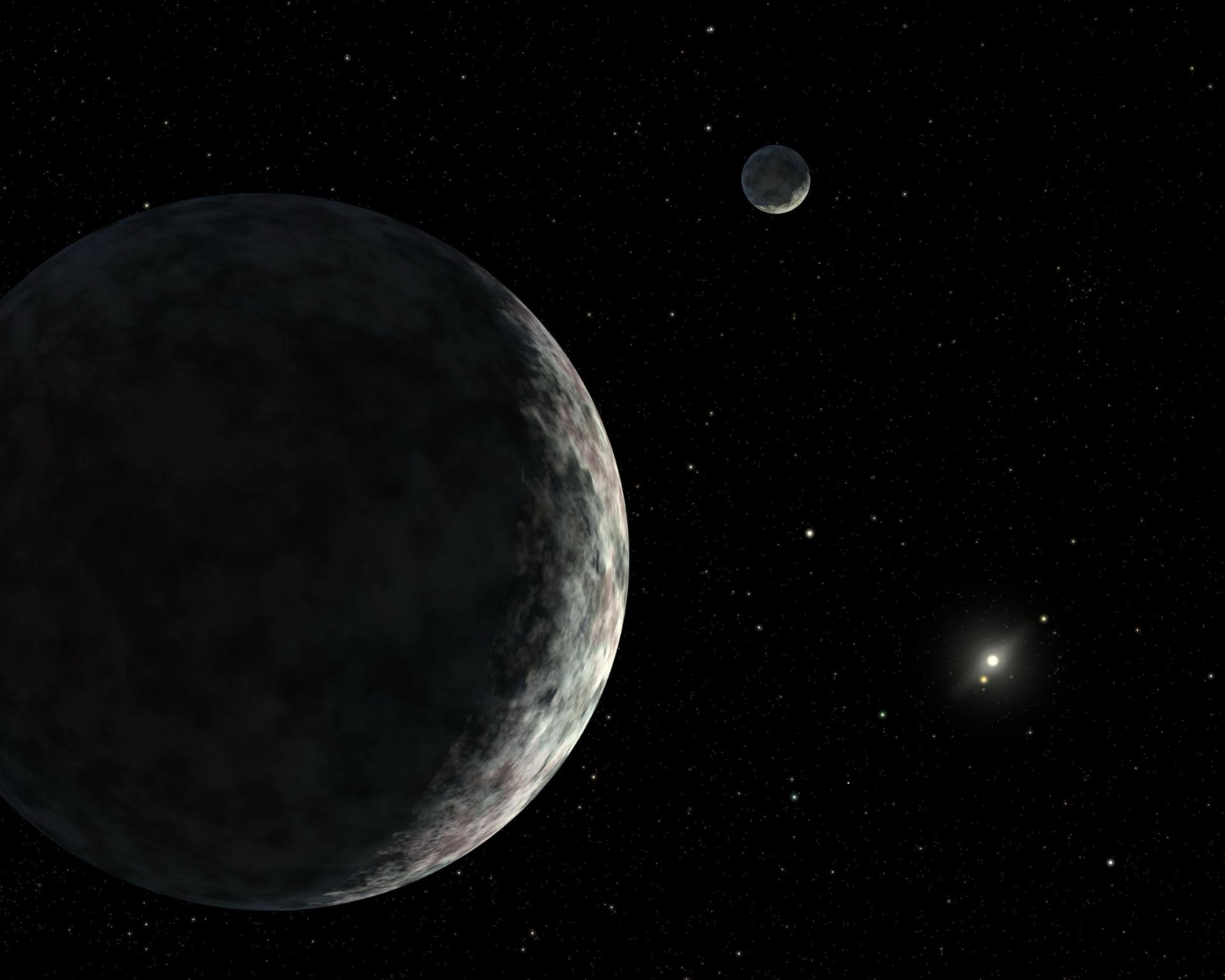
Chiminigagua, known for years only as 2013 FY27, is a trans-Neptunian object about 740 km across in the scattered disc. It is one of the intrinsically brightest known objects beyond Neptune. Its moderately red colour suggests an old surface dulled by cosmic rays and micrometeorites. It has an unnamed moon about 190 km across, probably formed in a giant impact; some astronomers list it as a possible dwarf planet, but the IAU has not recognized it.
The deep dive
Researched for the Atlas from Wikipedia — 532037 Chiminigagua (9,957 characters read) · updated Nov 14, 2026
01 How Sheppard and Trujillo Found It
The discovery of Chiminigagua was not a lucky accident but the result of a deliberate, years-long campaign. Scott Sheppard and Chad Trujillo had been hunting distant trans-Neptunian objects since 2007 using various telescopes, but their search gained serious power in 2012 when the Dark Energy Camera — DECam — came online at Cerro Tololo Observatory in Chile. Mounted on the 4.0-meter Víctor M. Blanco Telescope, DECam was built for cosmology but proved ideal for TNO searches: it could image enormous swaths of sky repeatedly, allowing slow-moving outer solar system bodies to betray themselves through their tiny shift against fixed background stars. Sheppard and Trujillo spotted Chiminigagua on 17 March 2013, then spent nearly a year confirming it, reobserving it with both DECam and the 6.5-meter Magellan–Baade Telescope at Las Campanas Observatory, also in Chile. The Minor Planet Center formally announced the discovery on 31 March 2014. Precovery images from the Pan-STARRS survey later pushed the observational record back to March 2011, giving astronomers almost two extra years of positional data to refine the orbit.
02 Why It Hid for So Long
When Chiminigagua was discovered in 2013, it was sitting almost exactly at aphelion — the farthest point in its orbit — roughly 80.5 AU from the Sun, more than twice as far as Pluto's average distance. At that remote location, with sunlight falling on it at only a tiny fraction of what Earth receives, the object shone at an apparent magnitude of about 22, far too dim for the sky surveys that preceded DECam. The combination of its enormous distance, its moderately red but not brilliantly reflective surface, and the limited sensitivity of earlier instruments conspired to keep it hidden. Only the exceptional light-gathering power and wide field of view of DECam made detection feasible. This episode illustrates a persistent challenge in outer solar system astronomy: the census of large TNOs is almost certainly incomplete, and objects comparable in size to Chiminigagua may still be lurking undetected at extreme distances where even modern surveys strain to reach them.
03 An Orbit of Extremes Deeper
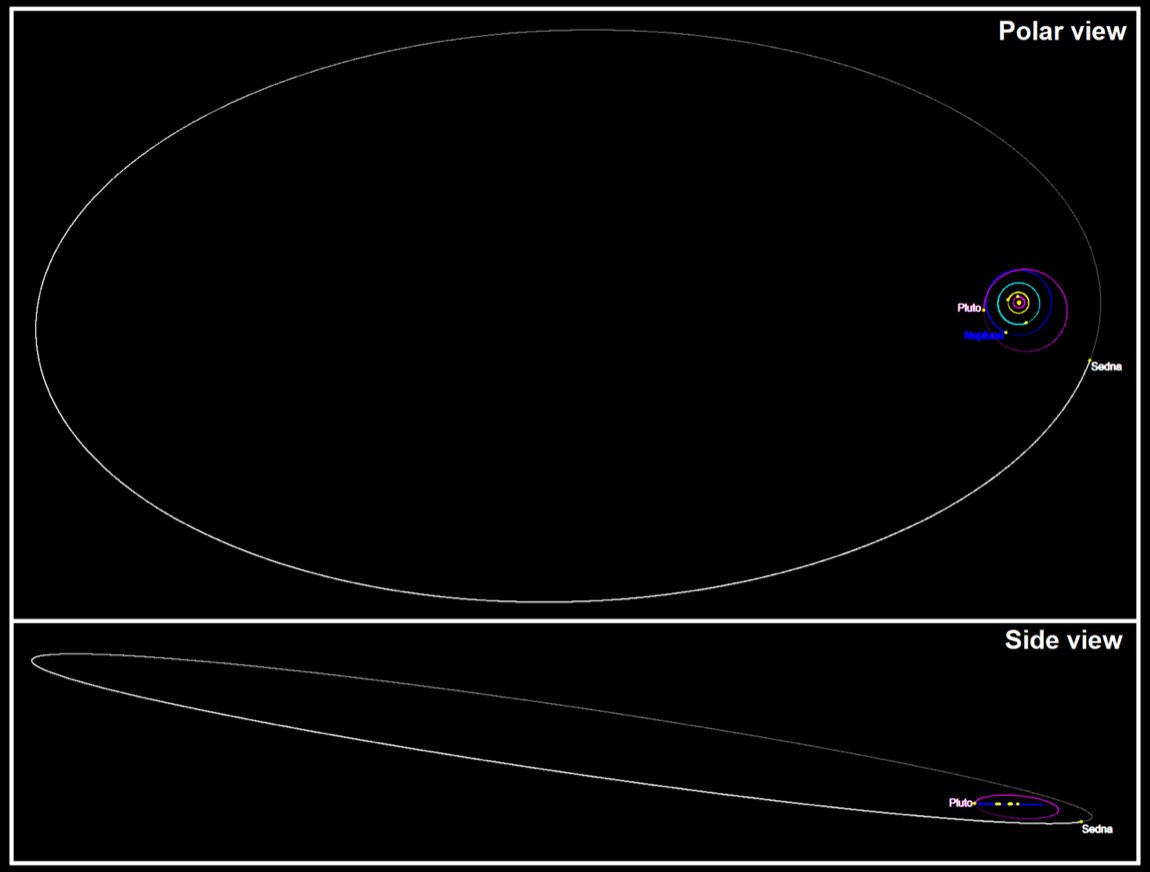
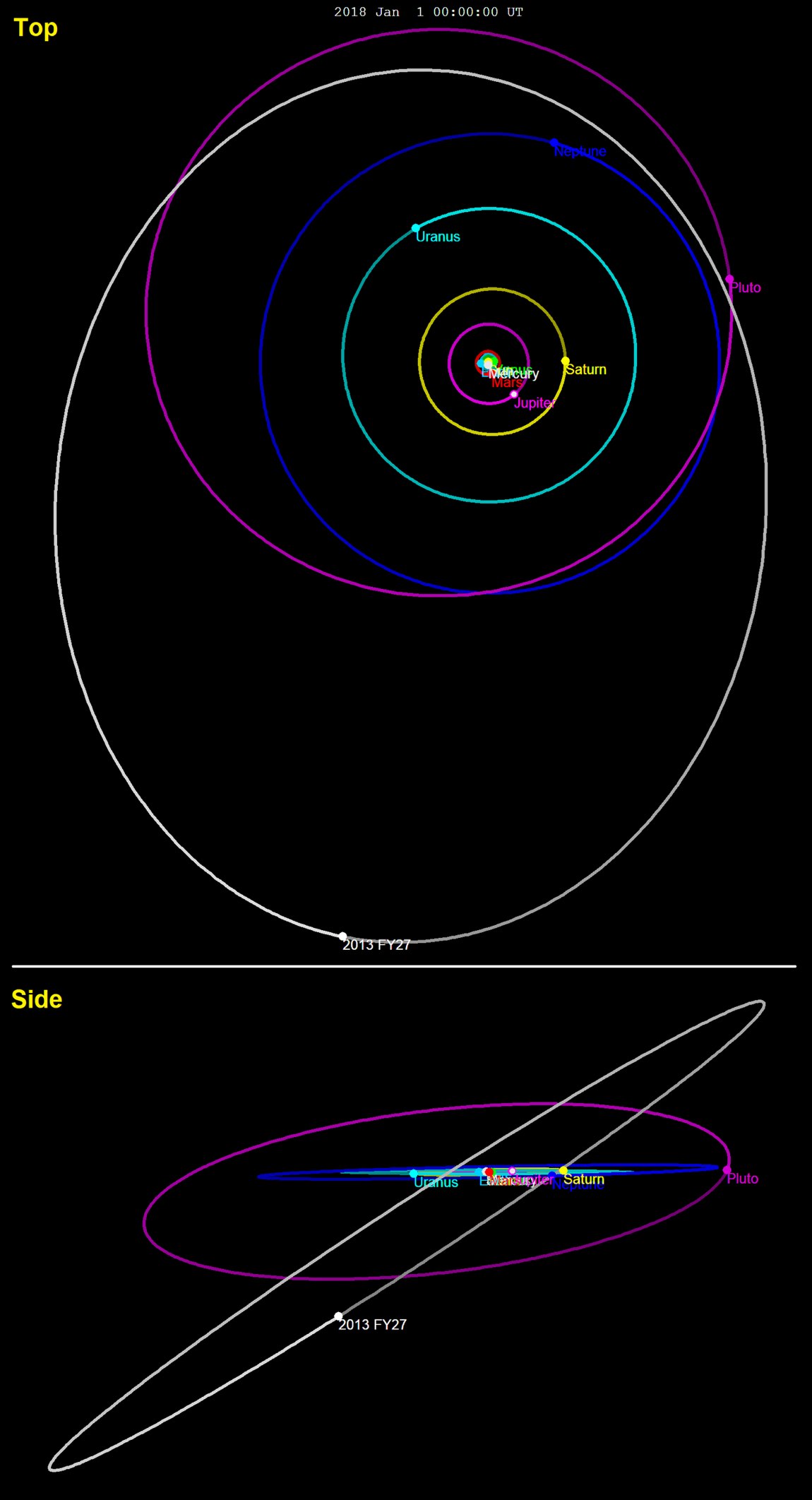
Chiminigagua traces a highly elongated path around the Sun, with an orbital eccentricity of 0.39 and an inclination of 33.1 degrees relative to the ecliptic — a tilt steep enough that its orbit cuts well above and below the plane shared by the major planets. Its semi-major axis of 58.9 AU means one complete circuit takes roughly 450 years. At perihelion, the closest approach, Chiminigagua comes within 35.6 AU of the Sun; at aphelion it recedes to 82.0 AU — a swing of more than 46 AU, comparable to the entire span from Earth to Neptune. This dramatic range produces a correspondingly dramatic temperature swing: surface temperatures estimated at 22 K at perihelion and 16 K at aphelion, a difference of 6 degrees Kelvin that plays out over centuries. Chiminigagua last reached perihelion in April–May 1752, passed aphelion in March–April 1978, and will not reach perihelion again until October–November 2202. As a scattered disc object, its orbit was likely shaped by gravitational scattering from Neptune, the same process responsible for the distant orbits of dwarf planets Eris and Gonggong.
04 The Puzzle of Its Interior Deeper
Chiminigagua sits in a scientifically fascinating size range that planetary scientists call "mid-sized" TNOs — objects between roughly 400 and 1,000 km in diameter. This bracket is thought to represent a transition zone between small, loosely packed bodies and the large, geologically active dwarf planets. In 2019, William M. Grundy and collaborators proposed that mid-sized TNOs should have highly porous and unheated interiors, drawing on density measurements of two similar objects — 55637 Uni and 229762 Gǃkúnǁʼhòmdímà — both of which came in around 1 g/cm³, far below the density of solid rock or ice. The implication is that bodies in this size range never generated enough internal heat from radioactive decay or impacts to compact themselves. Whether Chiminigagua follows this pattern is currently unknown: because the orbit of its moon has not yet been fully determined, astronomers cannot calculate the system's mass and therefore cannot derive a density. Hubble Space Telescope observations scheduled for December 2025 and January 2026 were specifically designed to resolve this gap.
05 A Surface Worn Down by Deep Time
Chiminigagua's color tells a story of extreme antiquity. Observations through different light filters reveal a moderately red hue that is common among mid-sized TNOs, and that color is interpreted as the signature of a surface long exposed to cosmic rays and micrometeoroid bombardment — a process called space weathering. Over billions of years, these relentless impacts break down and darken organic molecules and ices on the surface, gradually stripping away volatiles and leaving behind a reddish, ice-poor crust. This stands in stark contrast to larger dwarf planets such as Pluto, whose geologically active interiors and thin atmospheres continually resurface portions of the terrain with fresh nitrogen and methane ices. Chiminigagua's moderate geometric albedo of 0.170 — on the high end for moderately red mid-sized TNOs, but nowhere near Pluto's brilliant plains — is consistent with this picture of an ancient, processed surface. The albedo was derived from Atacama Large Millimeter Array measurements of the object's thermal emission, which allowed its size and reflectivity to be calculated simultaneously.
06 Spinning in the Dark — or Not?
Astronomers tracked Chiminigagua's brightness carefully during March and May 2016, hoping its lightcurve — the rise and fall of reflected sunlight as the body rotates — would reveal how fast it spins and whether its shape is elongated or irregular. The result was frustratingly ambiguous: no brightness variation beyond 0.06 ± 0.02 magnitudes was detected over hours to days of observation. Such a flat lightcurve can be interpreted in at least three ways. Chiminigagua might spin so slowly that its full rotation period exceeds the span of observations, leaving only a tiny slice of the lightcurve sampled. Alternatively, it may be nearly spherical with no strong albedo patches to modulate the signal as it turns. A third possibility is that its rotation axis happens to point almost directly toward Earth at present, so we are essentially looking down the pole and see only a circular, unchanging disk. Distinguishing among these scenarios requires either longer monitoring campaigns or observations at a future date when any pole-on geometry would have shifted.
07 The Small Moon and What It Implies Deeper
On 15 January 2018, Scott Sheppard turned the Hubble Space Telescope's Wide Field Camera 3 toward Chiminigagua and found a faint additional dot of light — a moon. The International Astronomical Union announced the discovery on 10 August 2018. As of 2026, the moon has neither an official designation nor a name. It is 3.0 ± 0.2 magnitudes fainter than the primary, implying a diameter somewhere between 160 and 211 km, or roughly one-quarter of Chiminigagua's diameter, assuming the two bodies share the same albedo. Hubble tracked the moon from January to July 2018 and found it orbiting at least 9,800 km from Chiminigagua but no farther than a separation corresponding to 0.25 arcseconds as seen from Earth. The orbit appears edge-on from our vantage point, meaning the moon can slip directly behind or in front of Chiminigagua, temporarily vanishing from view. Compared with the moon systems of larger TNOs, this secondary is relatively small and orbits relatively close — a combination that researchers interpret as evidence of formation through a giant impact on Chiminigagua, rather than capture of a passing object.
08 The Goddess of the First Light
The name Chiminigagua was announced by the International Astronomical Union's Working Group for Small Body Nomenclature on 11 August 2025, following the WGSBN's established practice of naming scattered disc objects after mythological creation figures. Chiminigagua is a universally good deity in the belief system of the Muisca — also known as the Chibcha — people of the Andes mountains in central Colombia. She is described as representing the only light that existed during primordial darkness, making her a creator god associated with illumination and origin. The name is therefore thematically resonant for an object that spent decades hidden in the outer darkness of the solar system before its own light — faint as it was at apparent magnitude 22 — was finally captured by sensitive cameras. Before August 2025 the object was known only by its dry provisional designation 2013 FY27, which encodes the year and half-month of discovery, and its catalog number 532037, assigned by the Minor Planet Center on 18 May 2019.
09 The Ninth-Brightest Known TNO
Intrinsic brightness in astronomy is measured by absolute magnitude — how bright an object would appear if placed exactly 1 AU from both the Sun and the observer, stripping away any effect of distance. Chiminigagua's absolute magnitude of 3.15 ± 0.03 makes it the ninth or tenth intrinsically brightest trans-Neptunian object known as of 2026, depending on the precise value used for a recently discovered rival, 2026 ED138, with which it is currently tied. A smaller absolute magnitude number means a brighter object, so sitting at 3.15 places Chiminigagua near the very top of the TNO brightness rankings and helps explain why planetary scientists including Scott Sheppard, Emily Lakdawalla, and Michael E. Brown consider it a likely dwarf planet. Its measured diameter from ALMA thermal observations is about 742 km, with an uncertainty range of 660 to 820 km — large enough that hydrostatic equilibrium, which defines a dwarf planet's rounded shape, is considered plausible but not yet confirmed.
10 How Missions Might Reach It Someday
A 2018 study examined trajectories for spacecraft flying past 45 Kuiper belt objects and Pluto, covering launches between 2025 and 2040. Chiminigagua was included because its absolute magnitude is below 4.0, the brightness threshold the study adopted for scientifically worthwhile targets. The analysis was explicitly modeled on the New Horizons mission strategy: a fast launch followed by a gravitational assist from Jupiter. Using a single Jupiter flyby, the study found that all 45 targets — including Chiminigagua — could in principle be reached within 25 years of launch. Alternate routes involving flybys of Saturn, Uranus, or Neptune were also examined, though these reach a more limited subset of targets. The authors noted that revisiting the giant planets during such a flyby could add substantial scientific value even if it constrains which TNOs are reachable. No mission to Chiminigagua is currently funded or approved, but the existence of viable trajectories means that a future outer solar system mission could plausibly add it to an itinerary.
11 Open Questions Waiting for Answers Deeper
Despite more than a decade of observations, Chiminigagua remains poorly characterized compared to dwarf planets that have received dedicated spacecraft visits. Its rotation period is completely unknown. Its mass and density — arguably the most fundamental bulk properties — are unknown because the orbit of its moon has not been solved; without orbital data, Kepler's laws cannot be applied to derive the system's total mass. The planned Hubble observations in late 2025 and early 2026 were specifically targeted at resolving this, and their results will test William Grundy's 2019 hypothesis that mid-sized TNOs are porous, low-density bodies. Whether Chiminigagua is in hydrostatic equilibrium — the defining condition for official dwarf planet status — has not been directly demonstrated. Its surface composition beyond the broad inference of a reddened, ice-poor crust is unknown: no spectroscopic identification of specific molecular species has been reported in the article. And the moon itself lacks even a provisional name or a measured orbit. Each of these gaps represents a tractable scientific problem waiting for more telescope time or, eventually, a flyby mission.
 ⤢