Lyra
“The Lyre” · Northern · best around August evenings
Real star positions and magnitudes (HYG database via D3-Celestial, BSD-3). Lines are the conventional stick figure; north is up.
The story
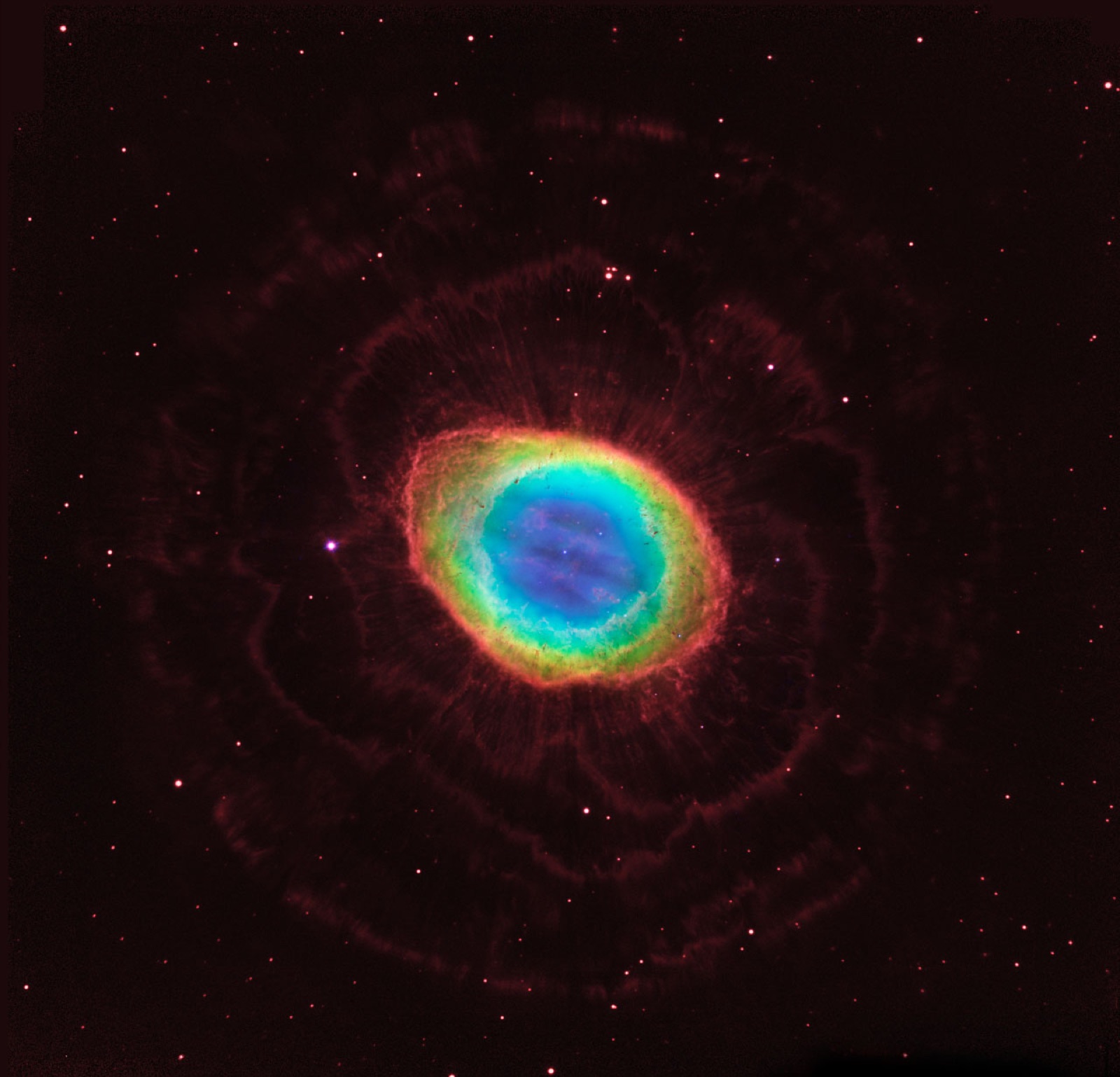
The harp of Orpheus, whose music charmed stones — a small constellation dominated by brilliant Vega, fifth-brightest star in our sky. Between its bottom stars floats the Ring Nebula, a dying star's glowing smoke ring, and its 'Double Double' star epsilon Lyrae splits twice over in a telescope.
How to find it
Overhead on northern summer evenings — Vega is the brightest star of the Summer Triangle.
✦ What lives inside it
The deep dive
Researched for the Atlas from Wikipedia — Lyra (19,235 characters read) · updated Sep 20, 2026
01 Lyra's place among the 88 constellations
Lyra is a genuinely small patch of sky, covering only 286.5 square degrees — ranking 52nd in size among the 88 modern constellations. Its boundary is not a simple rectangle but a 17-sided polygon, drawn by Belgian astronomer Eugène Delporte in 1930. Right ascension runs from 18h 14m to 19h 28m, and declination from +25.66° to +47.71°, placing it firmly in the northern sky. Despite its modest footprint, the constellation punches far above its weight: its main asterism uses just six stars, yet 73 stars altogether shine brighter than magnitude 6.5 within its borders. The International Astronomical Union officially abbreviated it "Lyr" in 1922, the same year it adopted standard abbreviations for all constellations. Observers as far south as latitude 42°S can still catch at least part of Lyra above the horizon at some point during the year, though from temperate northern latitudes it rides nearly overhead shortly after midnight at the start of summer — as dominant a presence as any constellation gets.
02 Vega: a star of many firsts
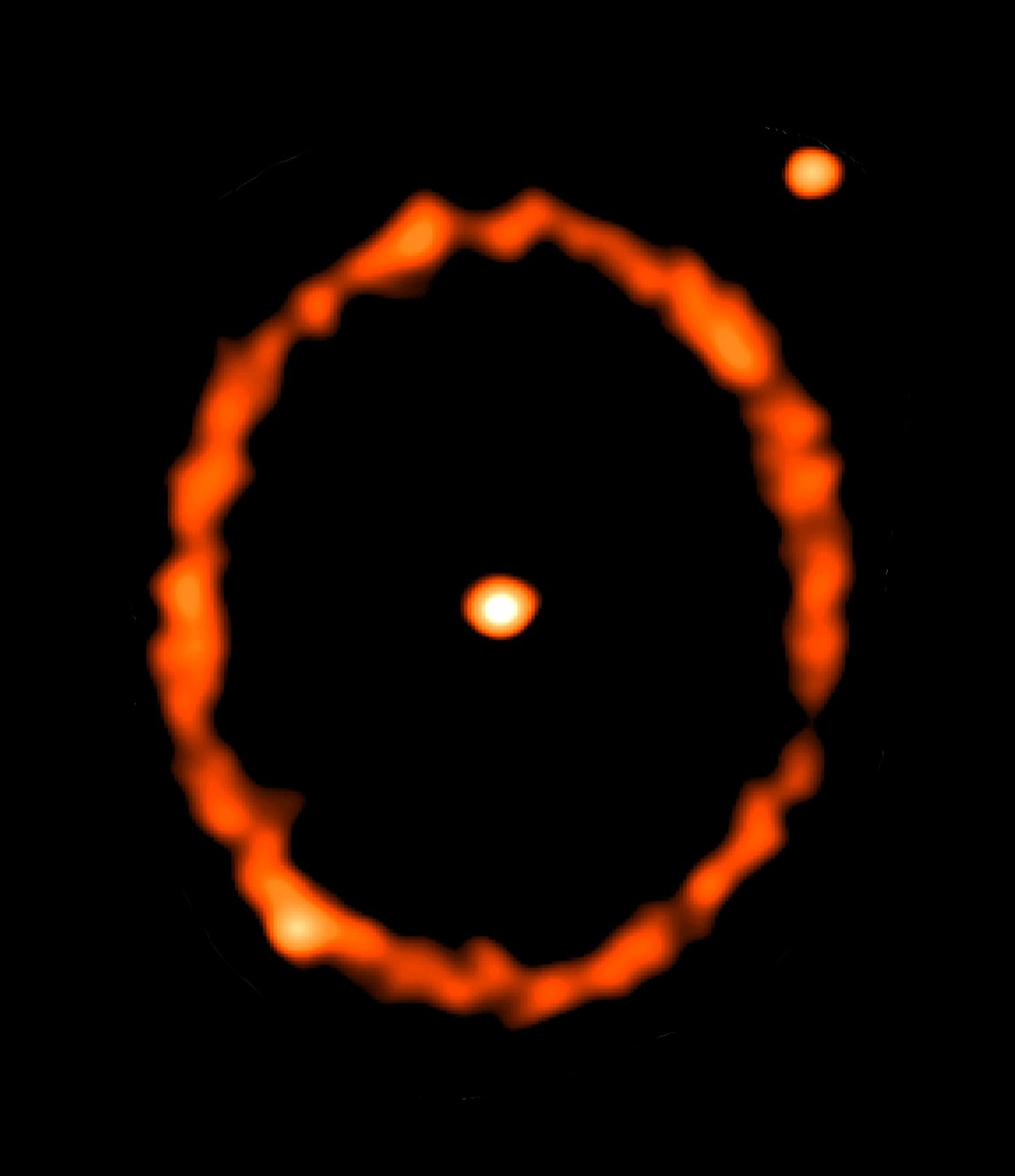
Vega, designated Alpha Lyrae, is a main-sequence star of spectral type A0Va sitting only 7.7 parsecs from Earth — close enough that its firsts pile up impressively. It was the first star other than the Sun to be photographed, the first to have a clear spectrum recorded showing absorption lines, and the first single main-sequence star other than the Sun known to emit X-rays. On average it ranks as the second-brightest star of the northern hemisphere after Arcturus, and fifth-brightest overall, surpassed only by Sirius, Canopus, Alpha Centauri, and Arcturus. It is technically a Delta Scuti variable, nudging between magnitudes −0.02 and 0.07 over just 0.2 days — a variation too subtle for casual naked-eye watching. Vega is also surrounded by a circumstellar debris disk analogous to our own Kuiper Belt, hinting at a planetary system in some stage of formation or evolution. Its pole-star history is equally striking: Vega held that title around 12,000 BCE and will reclaim it near 14,000 CE as Earth's axis slowly precesses.
03 Sheliak and the Beta Lyrae variables Deeper
Beta Lyrae, named Sheliak, is the prototype of an entire class of eclipsing binary stars, and it earns that honor through genuinely extreme physics. The system pairs a blue bright giant with an early B-type companion in an orbit so tight that the giant overflows its Roche lobe — the teardrop-shaped gravitational boundary beyond which material escapes — and streams steadily onto the secondary. So much mass has transferred that the originally less-massive star has become substantially more massive than the donor, though it remains smaller and is now buried inside a thick accretion disk. Because we view the orbital plane nearly edge-on, the system eclipses, dropping nearly a full magnitude from its 3rd-magnitude baseline every 13 days. More intriguingly, that 13-day period is not stable: it lengthens by roughly 19 seconds every year as mass transfer gradually widens the orbit. Beta Lyrae variables as a class are defined by this continuous brightness change — there are no sharp eclipse contacts, just a smoothly rolling light curve that never quite flattens, because the stars are egg-shaped rather than spherical.
04 Epsilon Lyrae, the famous Double Double
Epsilon Lyrae earns its informal nickname the Double Double honestly. Sharp-eyed observers under excellent conditions can split it into two stars with the naked eye alone; binoculars make the split easy. Point a telescope at it, though, and each of those two stars resolves again into a close pair — four stars in total, all gravitationally bound. The components are A- and F-type stars. Astronomers have since found a fifth member: a faint star in orbit around what the article calls component C. Five stars sharing a single system makes Epsilon Lyrae one of the more complex stellar households in an already-crowded constellation. By contrast, nearby Delta Lyrae is merely an optical double — two stars that happen to lie along the same line of sight without being physically connected — though both happen to be the two brightest members of a sparse open cluster called the Delta Lyrae cluster and share remarkably similar radial velocities. Delta2, the brighter and closer of the pair, is a 4th-magnitude red bright giant that varies semiregularly by about 0.2 magnitudes with a dominant period of 79 days.
05 RR Lyrae and the stars that measure the universe Deeper
Near Lyra's eastern edge sits RR Lyrae, one of the most scientifically important variable stars in the sky. It is the prototype of the RR Lyrae variables, a large class of pulsating stars similar to Cepheids but belonging to the older Population II, with spectral types A and F. Unlike Cepheids, which inhabit the thin galactic disk, RR Lyrae stars typically live in the galactic halo and in globular clusters. Because their pulsation periods are tightly linked to their intrinsic luminosities, they act as reliable standard candles — astronomers measure the period, infer the true brightness, compare it with the apparent brightness, and calculate distances to globular clusters with confidence. RR Lyrae itself varies between magnitudes 7 and 8 and also displays the Blazhko effect, a still-not-fully-explained modulation of its light curve over longer timescales. A similar phenomenon appears in V473 Lyrae, the only classical Cepheid in the Milky Way known to undergo periodic phase and amplitude changes — its period of 1.5 days was also the shortest known for a classical Cepheid at the time of its discovery.
06 The Ring Nebula in detail
The Ring Nebula, catalogued as M57 and NGC 6720, lies about 2,550 light-years away and stretches roughly one light-year across. It was discovered in 1779 by Antoine Darquier — fifteen years after Charles Messier found the Dumbbell Nebula, making M57 the second planetary nebula ever discovered. Astronomers estimate it is between 6,000 and 8,000 years old. Through a telescope it shows a green-tinged ring, and photographs reveal why different zones glow different colors: the outer regions shine red from ionized hydrogen, the middle zone glows greenish-blue from doubly ionized oxygen, and the innermost region closest to the central white dwarf appears blue from helium emission. That central white dwarf reaches a temperature of 120,000 kelvins — roughly 20 times the surface temperature of the Sun. The ring shape itself is an illusion of geometry: the nebula is actually a torus or cylinder that we view at a slight angle, making it appear slightly elliptical rather than perfectly circular. It sits conveniently halfway between Gamma Lyrae and Beta Lyrae, making it straightforward to star-hop to with a small telescope.
07 Lyra's extraordinary exoplanet harvest Deeper
Lyra sits inside the Kepler Space Telescope's field of view — one of only three constellations, along with Cygnus and Draco, to enjoy that distinction — and the result is a constellation unusually rich in confirmed exoplanets. Among the early Kepler finds, Kepler-7b is striking for its low density: it carries less than half the mass of Jupiter yet swells to nearly 1.5 times Jupiter's radius, implying an almost foam-like interior. Kepler-37 hosts the smallest extrasolar planet known as of February 2013. The Kepler-62 system, whose host star lies 1,200 light-years away, contains at least two planets — Kepler-62e and Kepler-62f, measuring 1.6 and 1.4 times Earth's diameter respectively — both within the habitable zone where liquid water could exist. Outside the Kepler haul, TrES-1b was detected by transit across its host star; it has about three-quarters of Jupiter's mass yet completes an orbit in only three days. Transit-timing irregularities once hinted at an Earth-like companion, but the anomalies are now attributed to a large starspot on the host star.
08 How cultures worldwide read the same stars
Greek mythology made Lyra the instrument of Orpheus, but the same stars inspired strikingly different images elsewhere. Arab astronomers saw the area as a vulture or eagle diving with folded wings — an image persistent enough that the constellation was long labeled Vultur Cadens or Aquila Cadens, meaning Falling Vulture or Falling Eagle, on European star maps. Welsh tradition called it King Arthur's Harp, Talyn Arthur, and also associated it with King David's harp. The Persian poet Hafiz named it the Lyre of Zurah. Christian tradition reinterpreted it as the Manger of the Infant Saviour, Praesepe Salvatoris. Half a world away, the Boorong people of Victoria in Australia saw the pattern as the Malleefowl constellation. In South America, the Inca knew the same stars as Urcuchillay and venerated the figure as an animal deity. Roman mythographer Hyginus also recorded a tradition linking the lyre not to Orpheus but to Theseus, suggesting the three neighboring constellations — Lyra, the figure now called Hercules, and Corona Borealis — may have been conceived together as a mythological group.
09 Orpheus and the three competing death stories
The Greek myth that placed the lyre in the sky is layered with competing accounts, and the disagreements are worth knowing. Everyone agrees that Orpheus descended into the Underworld, charmed Hades with his music, and won permission to reclaim his dead wife Eurydice — on the single condition that he not look back before reaching the surface. He failed at the last moment, and Eurydice remained in the Underworld forever. What happened next, though, the ancient sources cannot agree on. Eratosthenes blamed a religious slight: Orpheus revered Apollo above all gods and neglected a required sacrifice to Dionysus, who then sent his followers to tear Orpheus apart. Ovid told it differently — women, offended by Orpheus's rejection of every marriage offer after losing Eurydice, attacked him with stones and spears; his music initially deflected them, but their noise finally overwhelmed the lyre's power. A third version says the Thracian women killed him because he witnessed rites of Father Liber, another name for Dionysus. All three traditions agree on the aftermath: Zeus placed the lyre among the stars, and the Muses buried Orpheus's bones.
10 NGC 6791 and a cluster with three ages Deeper
NGC 6791 is one of the more scientifically intriguing clusters in Lyra. What makes it unusual is not its appearance but its internal chronology: the cluster contains three distinct age groups of stars. Some of its white dwarfs are approximately 4 billion years old, a second population of white dwarfs is around 6 billion years old, and the still-burning normal stars clock in at about 8 billion years old. Having three separate age populations within a single cluster raises questions about the cluster's formation history and what processes could produce such a spread. NGC 6745, also in Lyra, tells a different kind of story — it is an irregular spiral galaxy roughly 208 million light-years away that collided with a smaller galaxy several million years ago. That collision seeded the galaxy with young, hot, blue stars. Astronomers remain uncertain whether the encounter was merely a glancing blow or the opening act of a full merger that would eventually produce a single, probably elliptical galaxy from the two originals.
11 Nova, dwarf novae, and stranger outbursters Deeper
Lyra is unusually well stocked with eruptive and outbursting stars. The true nova HR Lyrae flared in 1919 to a peak magnitude of 6.5 — a rise of over 9.5 magnitudes above its quiescent brightness, a factor of roughly 8,000 in actual light output — and some of its characteristics resemble those of recurring novae. MV Lyrae is stranger still: a nova-like system pairing a red dwarf with a white dwarf that spent most of its history near maximum brightness, earning it a classification as a VY Sculptoris star. Since around 1979, however, it has spent most of its time near minimum brightness instead, with only periodic outbursts — a reversal of behavior that is not yet fully understood. AY Lyrae and V344 Lyrae are both SU Ursae Majoris-type dwarf novae, with V344 notable for an extremely short interval between superoutbursts combined with one of the highest amplitudes seen for such a period. At the edge of classification entirely is V361 Lyrae, an eclipsing binary blending features of Beta Lyrae, W Ursae Majoris, and cataclysmic variables — possibly caught in a brief transitional phase on its way to becoming a contact binary.
12 A gamma-ray burst with an unexplained rebound Deeper
In 2005 a long-duration gamma-ray burst, GRB 050525A, flared in the direction of Lyra. Its afterglow re-brightened 33 minutes after the initial burst — only the third gamma-ray burst found to show such a rebrightening in that timeframe — and existing physical models could not fully account for the behavior. Over the following 100 days, the light curve evolved in a way consistent with a supernova or possibly even a hypernova, subsequently designated SN 2005nc. Locating the host galaxy proved difficult at first, though it was eventually identified. The event illustrates how even a small, ancient constellation can become the temporary site of one of the most energetic phenomena the universe produces — and how such events can still challenge theorists working to explain the full sequence of a gamma-ray burst's aftermath.
13 Faint wonders worth a binocular sweep
Beyond the showpiece Ring Nebula and the naked-eye stars, Lyra rewards patient observers with modest equipment. Zeta Lyrae is a wide binary comfortably split in binoculars, its Am star paired with an F-type subgiant — and the Am star itself has a close companion, making the system a triple. R Lyrae, also catalogued as 13 Lyrae and sitting north of the main asterism, is a 4th-magnitude red giant semiregular variable with a complex multi-period rhythm dominated by cycles of 46 and 64 days; its ruddy color deepens noticeably as it fades. RR Lyrae hovers between magnitudes 7 and 8, within reach of binoculars on a dark night, and patient observers can track its variations across just a few nights. Gliese 758, only 16 parsecs (52 light-years) away, hosts a brown dwarf companion that was the coldest such object imaged around a sunlike star in thermal light when announced in 2009. None of these targets require large aperture — they reward curiosity and return visits more than aperture alone.