 Photograph · gjdonatiello · CC0
Nebula · Deep guide
The North America Nebula
Also called: Caldwell 20 · C20 · NGC 7000 · Sharpless 117
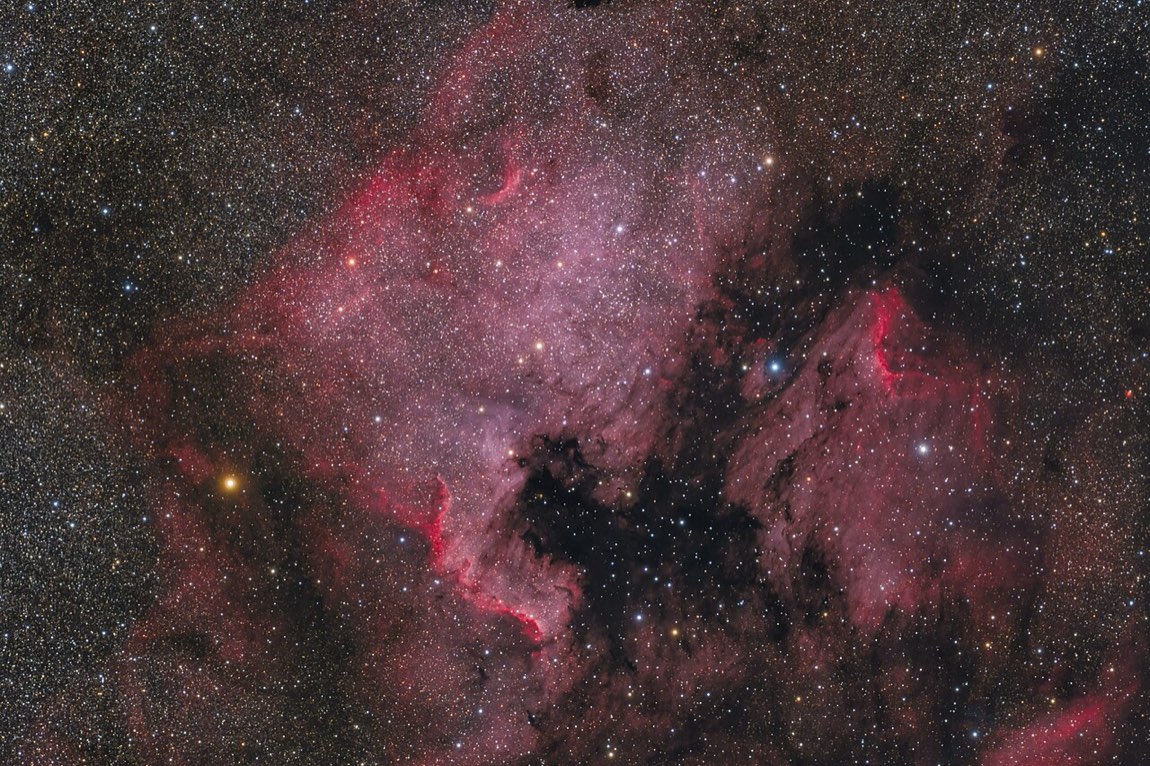
A glowing gas cloud near Deneb shaped, unmistakably, like the continent of North America.
What is it?
The North America Nebula is a huge cloud of glowing hydrogen in Cygnus, close to the bright star Deneb. On long-exposure photographs its outline looks remarkably like North America; the brightest edge, matching Mexico and Central America, is called the Cygnus Wall. It covers more than ten times the area of the full Moon, but its light is so spread out that the naked eye normally misses it. It is part of the same gas cloud as the nearby Pelican Nebula, separated only by a band of dust. Max Wolf named it in 1890.
The deep dive
Researched for the Atlas from Wikipedia — North America Nebula (5,502 characters read) · updated Nov 15, 2026
01 How the nebula got its name and shape
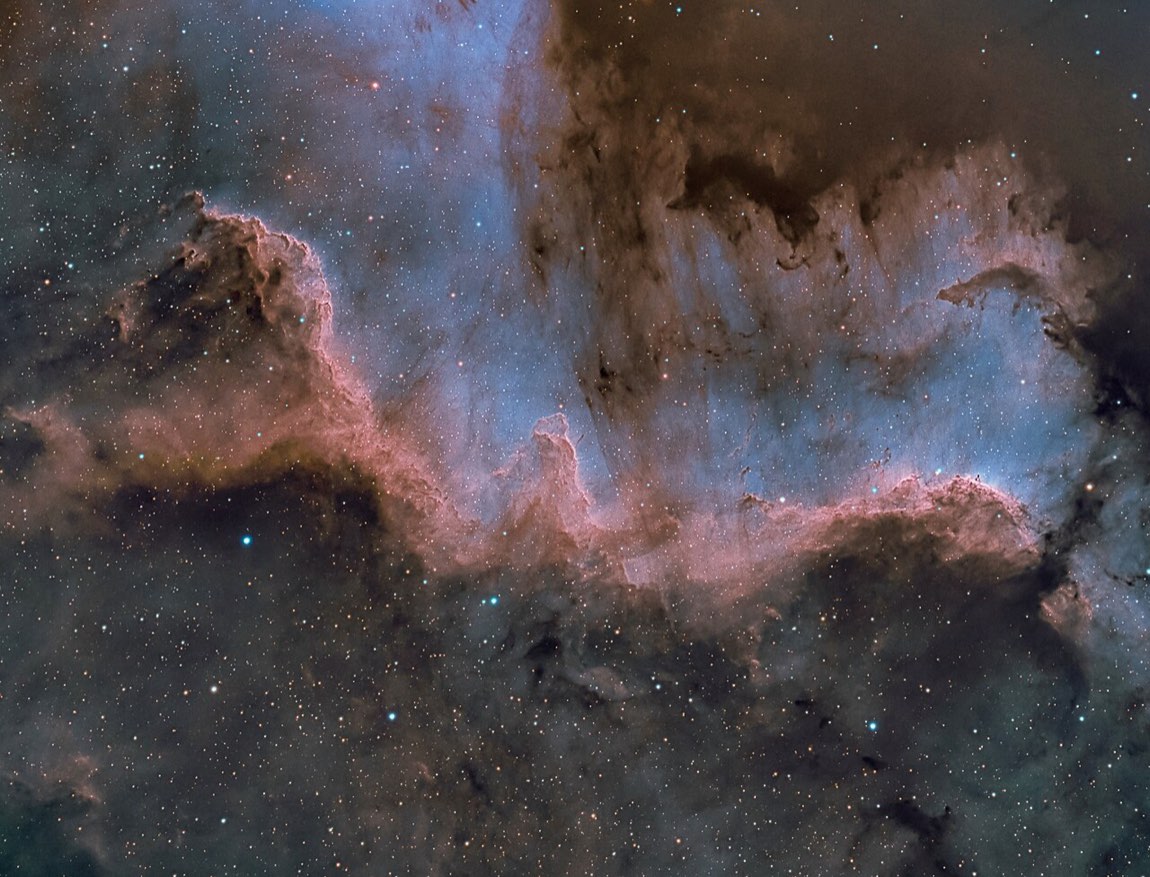
The geographic resemblance that defines this nebula was not noticed by eye at a telescope but by a camera. In 1890, German astrophotographer Max Wolf examined a long-exposure photograph and saw that the cloud's outline mimicked the continent of North America. That naming moment is a reminder of how photography revolutionized astronomy: features invisible to the human eye at an eyepiece became obvious on a glass plate left open to the sky for hours. Wolf's label stuck, and today specific sub-regions carry the geographic metaphor further. The portion of the nebula that traces the outline of Mexico and Central America is called the Cygnus Wall, the dense lane of dust blocking the nebula's center is nicknamed the Gulf of Mexico, and the hidden ionizing star is called the Bajamar Star — a name drawn from the original Spanish name for the Bahamas. The two earlier catalogue entries, made by William Herschel in 1786 and his son John Herschel in 1829, carried no such evocative labels; John Herschel's clinical description in the New General Catalogue reads simply "faint, most extremely large, diffuse nebulosity."
02 One cloud hiding as two nebulae
To the eye through a telescope, the North America Nebula and the nearby Pelican Nebula (IC 5070) look like separate objects, divided by a dark gap. But in 1959, American astronomer Stewart Sharpless, working through Palomar Sky Survey plates, recognized that the gap is an illusion: both glowing patches belong to a single continuous cloud of ionized hydrogen, catalogued together as Sh 2-117. The dark band between them is the dust cloud L935, identified and catalogued by American astronomer Beverly T. Lynds in 1962. Crucially, that dust only blocks visible light. When Dutch radio astronomer Gart Westerhout surveyed the Milky Way in 1958, his radio telescope saw straight through L935 and detected Sh 2-117 as a strong radio emitter spanning 3 degrees across the sky, logging it as W80. Infrared observations tell the same story, revealing highly luminous stars hidden inside the Gulf of Mexico that an ordinary optical telescope cannot see. The combined H II region is estimated to stretch 140 light years across in total, with the North America Nebula alone running 90 light years from north to south.
03 A distance debate settled by a spacecraft Deeper
For most of modern astronomy, the distance to the North America Nebula was genuinely uncertain. H II regions offer few reliable distance rungs, and estimates for this one ranged anywhere from 1,500 to 3,000 light years, with most astronomers settling on a round figure of 2,000 light years simply because it sat in the middle. That comfortable consensus was shaken in 2020, when the European Space Agency's Gaia spacecraft measured the distances to 395 individual stars known to lie inside the Sh 2-117 region. Gaia returned a distance of 2,590 light years, or 795 ± 25 parsecs — a measurement precise enough to put real error bars on the answer for the first time. The uncertainty of ± 25 parsecs is roughly ± 80 light years, a far cry from the previous spread of a thousand light years. The revision matters because distance feeds directly into physical size calculations, luminosity estimates, and comparisons with other star-forming regions. At 2,590 light years the nebula is farther away than most astronomers assumed, which means it is physically larger and its stars more intrinsically luminous than older papers suggested.
04 The long search for the ionizing star Deeper
Every emission nebula needs an energy source: a star hot enough to flood the surrounding gas with ultraviolet radiation and strip electrons from hydrogen atoms. In 1922, Edwin Hubble proposed that Deneb, the brilliant star right next to the nebula on the sky, was doing that job. The idea was soon ruled out. Deneb's surface temperature is about 8,500 K, but the nebula's spectrum implies it is being energized by something hotter than 30,000 K. By 1958, astronomer George Herbig had concluded that the true ionizing star must be hiding behind the dust cloud L935. It took until 2004 for European astronomers Fernando Comerón and Anna Pasquali to track it down. They used data from the 2MASS infrared sky survey to identify candidates that could be seen through the dust, then made detailed follow-up observations with the 2.2-meter telescope at Calar Alto Observatory in Spain. One star, catalogued J205551.3+435225, matched every requirement: it sits right at the geometric center of Sh 2-117, and its temperature exceeds 40,000 K. This star has since been confirmed as a spectral type O3.5 star with a type O8 companion in orbit around it, and it has been given the more memorable name the Bajamar Star.
05 The Bajamar Star: buried but brilliant
The dust cloud L935 dims the Bajamar Star by 9.6 magnitudes — a factor of almost 10,000 in apparent brightness — yet even so it is faintly detectable at optical wavelengths at magnitude 13.2. Strip away the obscuring dust and it would shine at magnitude 3.6, nearly as bright as Albireo, the well-known double star marking the swan's head in Cygnus. The Bajamar Star is not alone: it has a type O8 companion in orbit, and there is another massive O-type star in the wider region, HD 199579, nicknamed the Toronto star, which carries on the same geographic naming theme. Both the Bajamar Star and the Toronto star appear to be runaways, moving away from a compact grouping of young stars called the Bermuda cluster. Based on their current positions and velocities, astronomers estimate they were ejected from that cluster roughly 1.5 million years ago — a blink in cosmic time, but long enough for them to drift to their present locations far from their birthplace.
06 The Cygnus Wall: a hotbed of star birth
While the entire North America Nebula is an active star-forming environment, one section stands out for its intensity. The Cygnus Wall, the curving arc of gas and dust that maps onto the outline of Mexico and Central America in the continental silhouette, is where star formation is most concentrated. This kind of bright, sculpted rim is typical of what astronomers call a photodissociation region — the boundary where fierce ultraviolet radiation from hot stars carves into cooler molecular gas, compressing it and triggering the collapse of new stellar nurseries. The Cygnus Wall is essentially the shoreline of the nebula in a physical sense, the front where radiation pressure and ionization are actively reshaping the cloud. The reddish color that photographs reveal across the whole nebula comes from hydrogen's Hα emission line, the signature glow of gas being energized and re-emitting that energy as light at a specific wavelength deep in the red part of the spectrum.
07 Why you can't see it with your naked eye
The North America Nebula covers a region more than ten times the area of the full moon on the sky, making it one of the largest apparent objects in the night sky by sheer angular extent. Yet most people have never seen it, even under dark skies. The problem is surface brightness: the nebula's light is spread so thinly across that enormous area that no single patch appears bright enough to register without help. The apparent magnitude alone does not tell the full story because that number captures total light, not how concentrated it is. Under sufficiently dark skies, binoculars or a telescope with a wide field of view — roughly 3 degrees — will reveal it as a foggy patch of light. A UHC filter, which blocks wavelengths from streetlights and airglow while passing the hydrogen emission line, can make the nebula visible even without any magnification. Its characteristic shape and red color, however, only emerge in photographs, which is exactly how Max Wolf first recognized its continental outline back in 1890.
08 Radio waves and infrared: seeing through the gulf Deeper
The dust lane L935 that separates the North America and Pelican nebulae in visible light is essentially transparent at longer wavelengths, and observations in those wavelength ranges have transformed understanding of the entire Sh 2-117 complex. Gart Westerhout's 1958 radio survey detected the region as a strong source, designating it W80 and measuring it at 3 degrees across the sky — confirming that what optical astronomers saw as two distinct nebulae was a single connected structure. Infrared observations add another dimension: they reveal the hidden central regions of Sh 2-117 that lie behind L935, including many highly luminous stars that simply cannot be seen with ordinary telescopes. It was this infrared window that allowed Comerón and Pasquali in 2004 to search for and ultimately identify the Bajamar Star. The dust cloud that obscures so much at visible wavelengths is, paradoxically, essential to understanding the nebula's true structure, because it forces astronomers to work across the electromagnetic spectrum and in doing so exposes more of the physics at play.
09 The Bermuda cluster and its runaway stars Deeper
Buried within the Sh 2-117 complex is a compact grouping of young stars that astronomers have named the Bermuda cluster, in keeping with the geographic theme that runs through the nomenclature of this whole region. The cluster appears to have been a more violent nursery than its current quiet state suggests. Two of the most massive stars in the broader region — the Bajamar Star, a type O3.5 object at the nebula's heart, and HD 199579, the Toronto star — are both on the move, heading away from the Bermuda cluster at speeds that trace back to a common ejection event. The best estimate is that they were flung out of the cluster approximately 1.5 million years ago. Runaway O-type stars are not unusual; dynamical interactions between massive stars in dense young clusters can slingshot individual stars outward at high velocities. What makes this case notable is that two massive O-type stars appear to have been ejected together, and the ionizing star that now powers the entire North America and Pelican nebulae is one of the runaways.
10 William and John Herschel's first records
The observational history of the North America Nebula begins on October 24, 1786, when William Herschel, observing from Slough in England, logged what he called a "faint milky nebulosity scattered over this space, in some places pretty bright." That careful but cautious wording captures how difficult the object is to characterize by eye: vast, faint, and without obvious structure at the eyepiece. It was left to William's son John Herschel to follow up. On August 21, 1829, John catalogued the most prominent part of the nebula, and his description in the New General Catalogue — "faint, most extremely large, diffuse nebulosity" — became its official identity as NGC 7000. Neither Herschel knew they were looking at a small portion of a much larger ionized hydrogen complex, nor that the same cloud continued on the other side of a dust lane to form what would eventually be named the Pelican Nebula. That larger picture only emerged piece by piece over the following century and a half.
 ⤢