 Photograph · GSFC / NASA Image Library
Nebula · Deep guide
The Veil Nebula
The shredded ghost of a supernova, still glowing after 10,000 years.
What is it?
The Veil in Cygnus is the wreckage of a star that exploded perhaps 10–20 thousand years ago — prehistoric humans may have seen it outshine Venus. Today its shockwave, still plowing through interstellar gas, paints filaments of oxygen-blue and hydrogen-red across six full-Moon widths of sky. It is the finest supernova remnant amateur telescopes can reach.
The deep dive
Researched for the Atlas from Wikipedia — Veil Nebula (4,879 characters read) · updated Sep 20, 2026
01 A Star That Outshone Venus
The Veil Nebula did not always exist as a glowing cloud of gas. It was born in a catastrophic explosion when a star roughly 20 times more massive than our Sun reached the end of its life and detonated as a supernova. That event happened somewhere between 10,000 and 20,000 years ago — a wide range that reflects genuine uncertainty in our distance measurements. When the star exploded, the blast would have been extraordinary even from Earth: the supernova would have appeared brighter than Venus in the night sky and would have been visible in full daylight. Anyone alive at that moment — perhaps late Stone Age humans in Europe and Asia — could have watched a new star blazing overhead without any telescope. Nothing of the original star remains visible today, only the vast, still-expanding shell of gas it threw into space at unimaginable speed.
02 How Distance Changes Everything Deeper
Pinning down the Veil Nebula's distance has been surprisingly difficult, and the uncertainty matters enormously. Earlier estimates ranged all the way from 1,200 to 5,800 light-years — a factor of nearly five from one end to the other. Because the apparent size of the nebula is fixed by what we observe on the sky, a larger assumed distance translates directly into a physically larger and older remnant, while a smaller distance shrinks both estimates. A 2018 study resolved much of this ambiguity by using direct astrometric measurements — essentially tracking the precise positions of stars — to place the nebula at 2,400 light-years. That figure now anchors the current best estimates of the nebula's true physical size, its age, and even the energy of the original explosion. The article is candid that distance uncertainty still propagates into every derived quantity, so the 2,400 light-year figure should be understood as the best available answer, not a final one.
03 A Shell the Size of 36 Full Moons
The remnant has been expanding for thousands of years, and today it covers a patch of sky roughly 3 degrees in diameter. To put that in perspective, the full Moon spans about half a degree, so the Cygnus Loop stretches about six times the Moon's diameter across the sky — and because area scales as the square, it covers approximately 36 times the Moon's full-disk area. At the accepted distance of 2,400 light-years, that angular size translates to a physical radius of 65 light-years, giving the entire shell a diameter of 130 light-years. The sheer scale means the nebula is spread so thinly across the sky that even though its total integrated magnitude is a relatively bright 7, the surface brightness at any given point is very low — making it paradoxically hard to see despite being technically within binocular range.
 ⤢
⤢
04 Why Filaments Look Like Twisted Rope Deeper
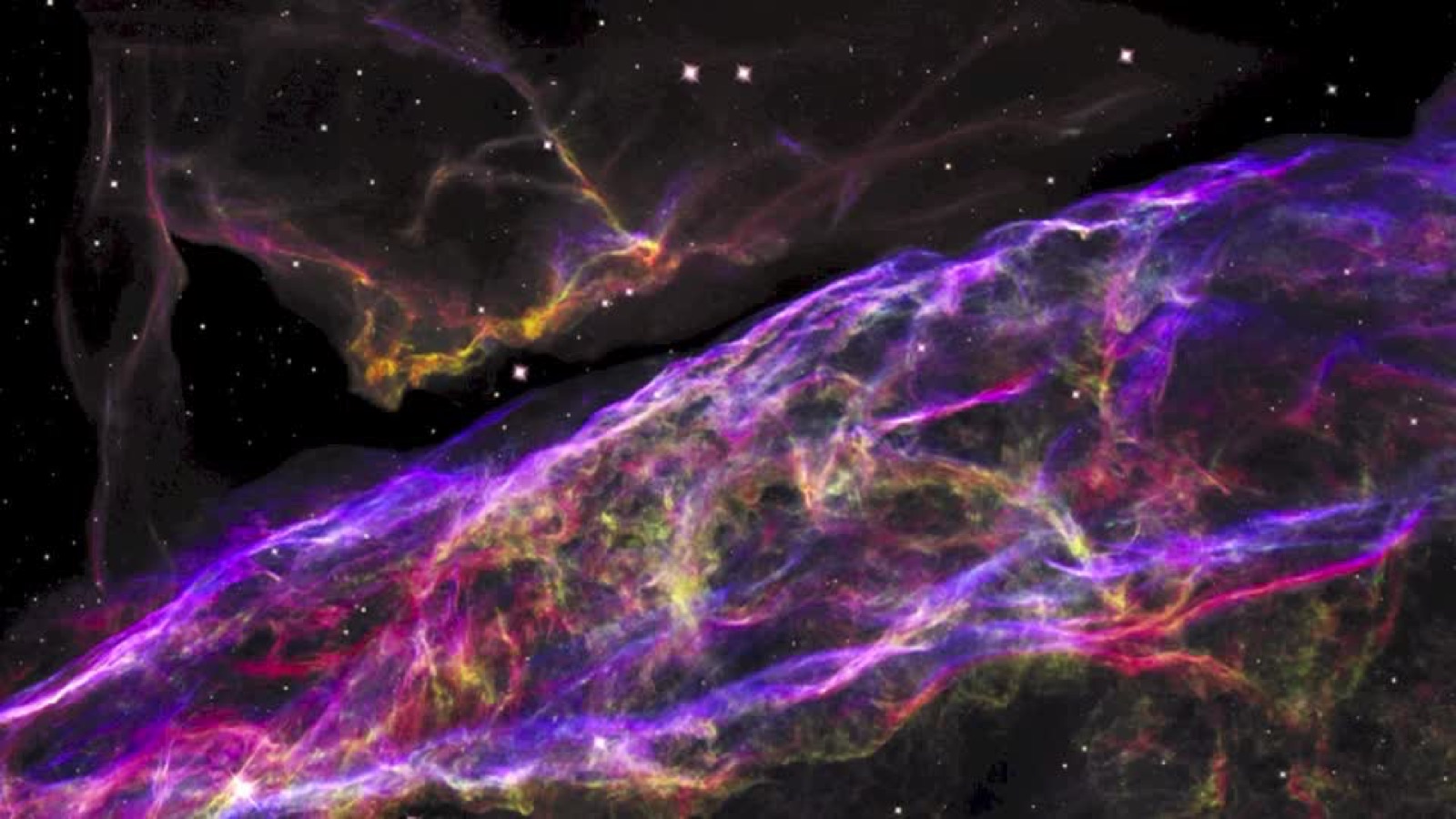
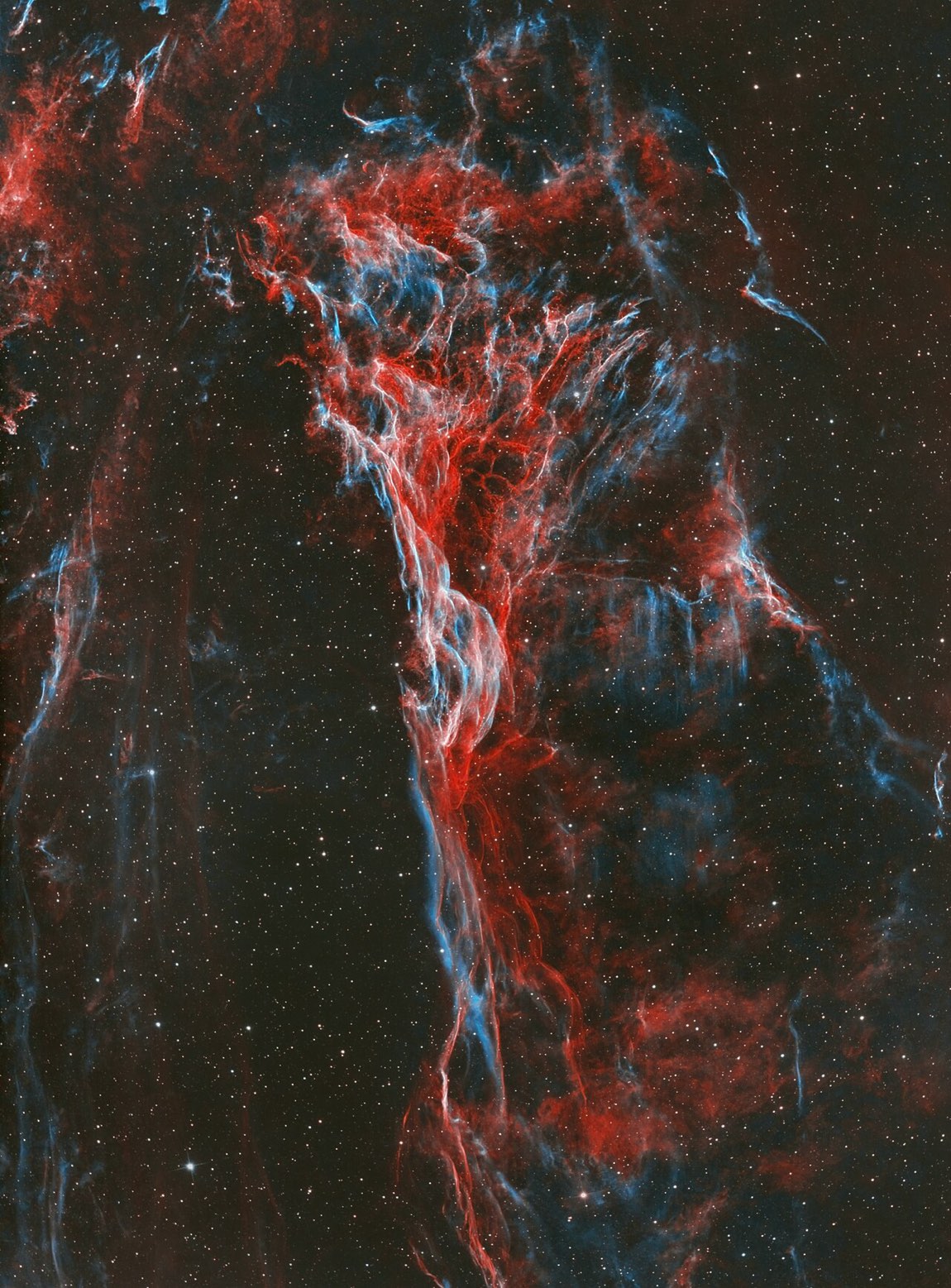
When observed at high resolution, large sections of the Veil Nebula resolve into structures that resemble coiled rope or intertwined threads rather than a smooth cloud. The standard explanation for this striking appearance is geometric. The shock wave driven by the supernova blast is extraordinarily thin relative to the overall shell — less than one part in 50,000 of the total radius. At a radius of 65 light-years, that works out to a filament thickness of roughly 4 billion miles, approximately the distance from Earth to Pluto. A shell that thin is only visible when it happens to lie exactly edge-on to the observer, and when undulations ripple across the shell's surface, multiple edge-on sections stack up in the line of sight. Those overlapping slivers produce the interwoven, rope-like appearance that makes the Veil Nebula one of the most photogenic objects in the sky.
05 William Herschel's Branching Nebulosity
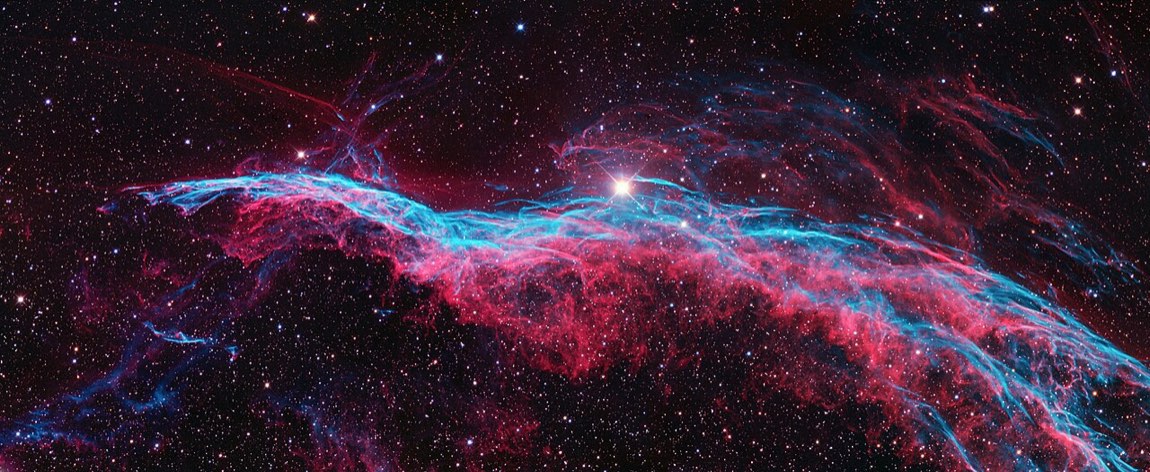
The nebula entered the scientific record on 5 September 1784, when William Herschel swept it up during one of his systematic sky surveys. His own words capture the structure with unexpected accuracy for the era. Of the western portion, he wrote that it was "extended; passes thro' 52 Cygni... near 2 degree in length." For the eastern side, he described "branching nebulosity" whose following part "divides into several streams uniting again towards the south." That description of streams diverging and then rejoining is a remarkably apt account of the filamentary structure we now explain through thin shock-wave geometry. Because the nebula is so large, Herschel effectively discovered several distinct regions in the same survey, and subsequent cataloguers assigned multiple separate NGC numbers to different arcs of what is actually a single connected remnant.
06 Pickering's Triangle and Williamina Fleming
Not all of the Veil Nebula's components were discovered visually. Pickering's Triangle, the arc visible at the north-central edge of the loop, was found photographically in 1904 — after the New General Catalogue had already been compiled, which is why it carries no NGC number. The actual discoverer was Williamina Fleming, a Scottish-born astronomer working at the Harvard College Observatory. However, in keeping with the customs of the day, credit was officially attributed to Edward Charles Pickering, the observatory's director, whose name the feature still bears. Fleming's contribution went unacknowledged in the formal record for decades. Because Pickering's Triangle was found photographically and appeared after the NGC was closed, it remains the faintest of the main components and the most difficult to trace visually, though photographs reveal it extending toward the central area of the loop.
 ⤢
⤢
07 Multiple Names, Multiple Catalogues
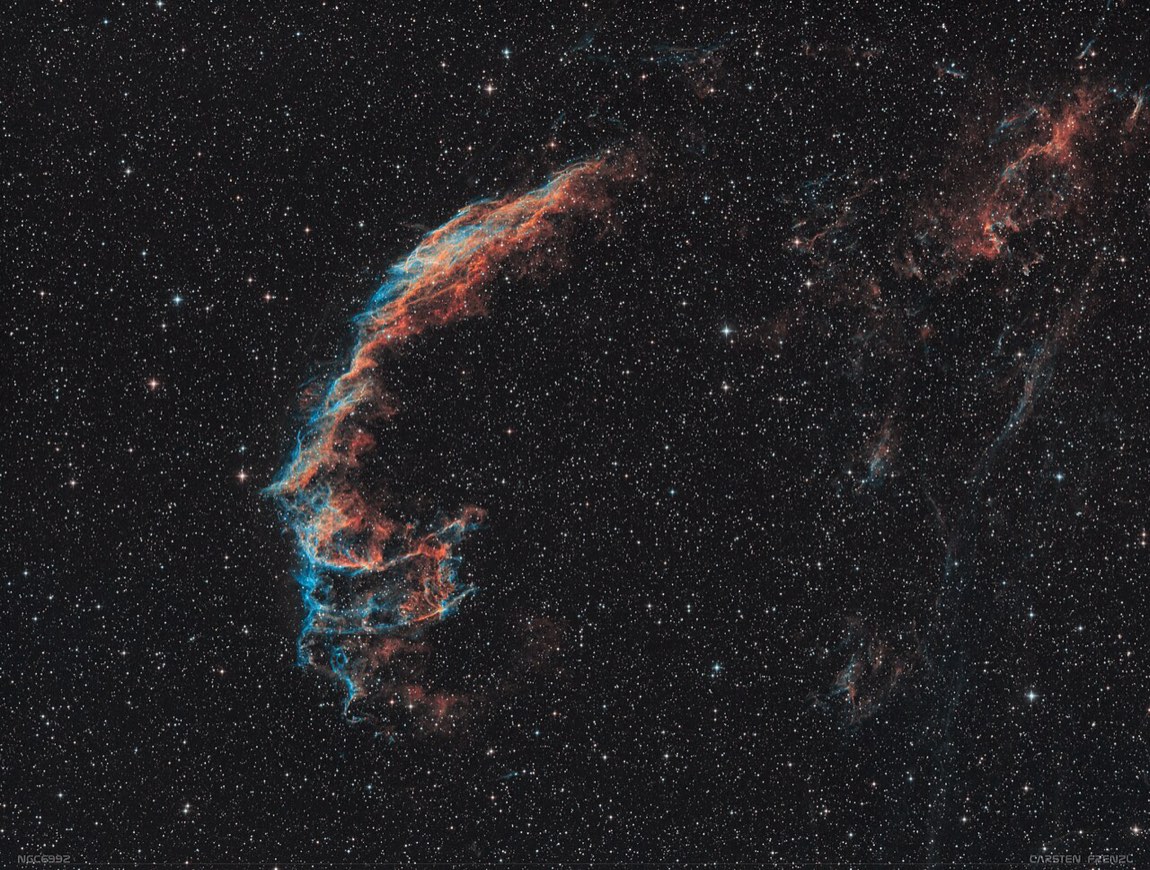
Few objects in the sky have accumulated as many overlapping names as the Veil Nebula. The overall structure is formally part of the Cygnus Loop, a supernova remnant. The brightest visible portions carry the collective names Veil Nebula, Cirrus Nebula, and Filamentary Nebula, often used interchangeably. Drilling deeper, the Western Veil is also catalogued as Caldwell 34 and NGC 6960, and nicknamed the Witch's Broom or Lacework Nebula. The Eastern Veil is Caldwell 33, with its brightest section designated NGC 6992 and a southern extension designated NGC 6995; together they are sometimes called the Network Nebula, with IC 1340 trailing further south. Two luminous knots on the northern rim carry the designations NGC 6974 and NGC 6979. This proliferation of names arose because the nebula is so enormous that early observers catalogued its arcs independently, not realizing they belonged to a single expanding shell.
08 Observing It: The O-III Filter Trick
The Veil Nebula is notorious among amateur astronomers as a beautiful object that is genuinely difficult to see without the right equipment. Its integrated magnitude of 7 suggests it should be accessible to small instruments, but that brightness is spread across 3 degrees of sky, leaving surface brightness very low. The solution is an O-III filter, which isolates the wavelength of light emitted by doubly ionized oxygen. Because almost all of the nebula's visible light emerges at this wavelength, the filter dramatically suppresses the background sky glow while passing nearly all of the nebula's signal. An 8-inch (200 mm) telescope with an O-III filter reveals the delicate lacework structure. Smaller telescopes equipped with the filter can also detect the nebula, and some experienced observers report seeing portions of it by holding an O-III filter directly to the eye without any telescope at all. The easiest starting point is NGC 6960, which conveniently runs behind 52 Cygni, a naked-eye star that serves as a natural signpost.
09 What the Nebula Is Made Of Deeper
Analysis of the light emitted by the Veil Nebula reveals the chemical fingerprints of several elements. Spectroscopic studies of the emissions confirm the presence of oxygen, sulfur, and hydrogen. The dominance of doubly ionized oxygen is so strong that, as noted above, an O-III filter passes almost all of the nebula's visible light. Beyond the optical regime, the Cygnus Loop is also a significant source of radio waves and X-rays, pointing to physical processes — energetic electrons spiraling through magnetic fields, and very hot shocked gas — operating alongside the cooler recombining gas that produces the visible filaments. These different wavelength regimes trace different temperatures and densities within the shock structure, making the Veil one of the most studied supernova remnants across the electromagnetic spectrum.
 ⤢
⤢
10 Hubble Watches the Shell Grow
The Veil Nebula is not a static picture in the sky — it is actively expanding, and that expansion has now been directly observed. The nebula is moving outward at a velocity of about 1.5 million kilometers per hour. By comparing images taken by the Hubble Space Telescope in 1997 with later images taken in 2015, astronomers were able to detect the actual shift of the filaments across the sky over that 18-year baseline. This is a remarkable measurement: even at 1.5 million kilometers per hour, the nebula is so far away that the apparent motion across the sky is tiny, yet Hubble's precision was sufficient to make it visible. The Hubble observations also provided some of the most detailed images of the nebula's fine filamentary structure, revealing rope-like textures and the complex layering of shock-excited gas that ground-based telescopes cannot fully resolve.
11 An Open Question: The Remnant's True Age Deeper
Despite centuries of observation and modern space-telescope imagery, the age of the Veil Nebula remains genuinely uncertain. The explosion is estimated to have occurred between 10,000 and 20,000 years ago — a range of a full 10,000 years. That uncertainty is not a minor rounding issue; it reflects the difficulty of working backward from the current size and expansion speed to infer when the blast occurred, compounded by the fact that the shock wave slows down as it sweeps up interstellar material. The distance uncertainty compounds the problem further, since the 2018 measurement of 2,400 light-years replaced estimates that had ranged from 1,200 to 5,800 light-years, each implying a different physical size and therefore a different age. Pinning down the age more precisely would require both a better distance measurement and detailed modeling of how the surrounding interstellar medium has shaped the expansion over millennia.
 ⤢
⤢