Carina
“The Keel” · Southern · best around March evenings
Real star positions and magnitudes (HYG database via D3-Celestial, BSD-3). Lines are the conventional stick figure; north is up.
The story
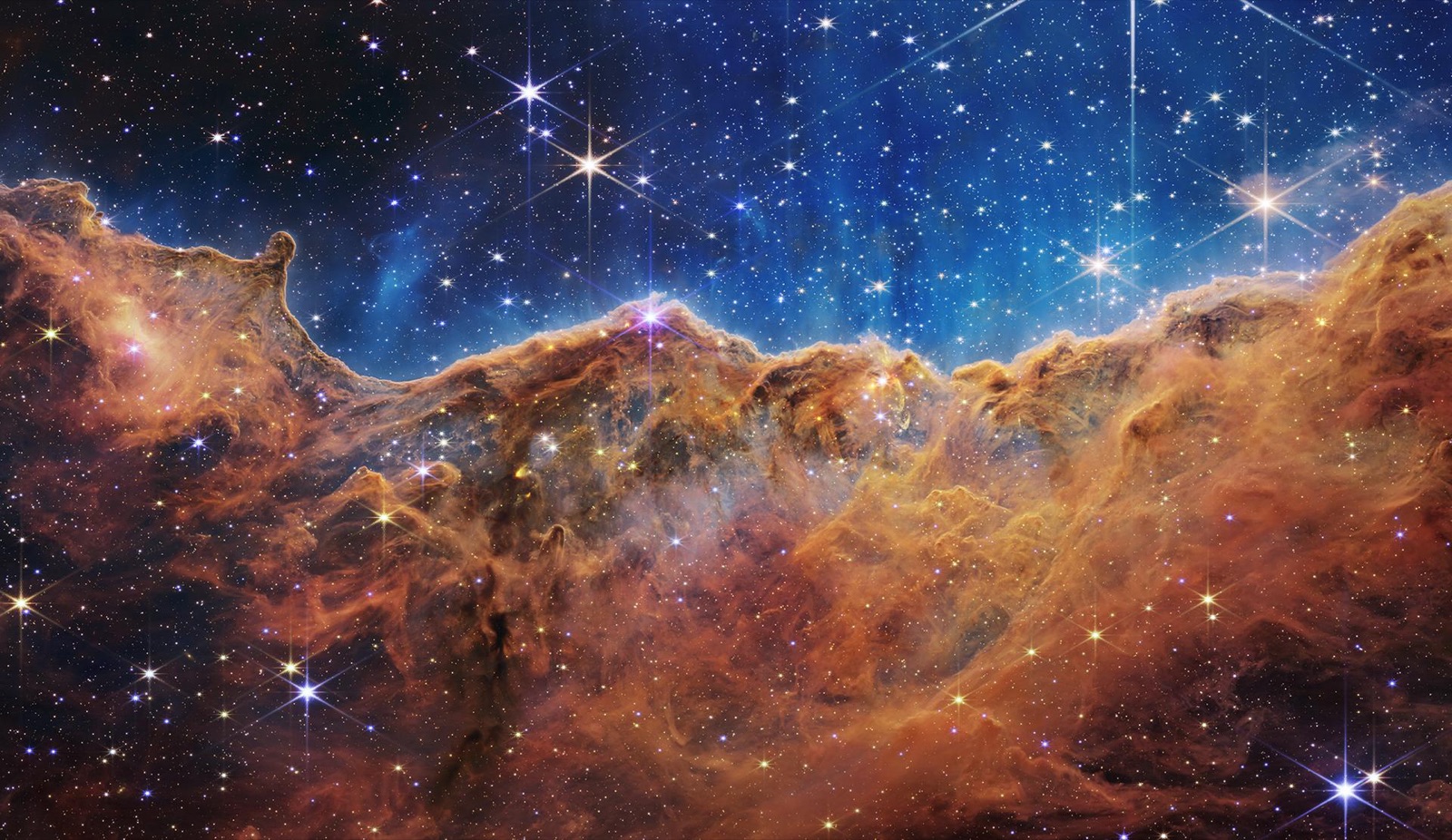
The keel of the great ship Argo — a southern constellation carrying Canopus, the second-brightest star in the sky and the traditional guide star of desert caravans and spacecraft navigation systems alike. It also holds the Carina Nebula, a star factory four times the Orion Nebula's size, home of the doomed giant Eta Carinae.
How to find it
Southern summer: Canopus blazes high; the Milky Way through Carina is dazzling.
✦ What lives inside it
- The Southern Pleiades
- Wishing Well cluster
The deep dive
Researched for the Atlas from Wikipedia — Carina (constellation) (10,263 characters read) · updated Sep 20, 2026
01 How Argo Navis became three constellations
For most of astronomical history, Carina did not exist on its own — it was simply the keel of Argo Navis, the vast celestial ship sailed by Jason and the Argonauts in their quest for the Golden Fleece. The constellation of Argo was introduced in ancient Greece, and for centuries it sprawled across the southern sky as a single enormous figure. The problem was practical: Argo Navis contained so many stars that giving them individual designations became unwieldy. In 1763, French astronomer Nicolas-Louis de Lacaille solved this by carving Argo into three pieces — Carina (the keel or hull), Puppis (the poop deck), and Vela (the sails). Lacaille made an unusual bookkeeping decision: he kept a single run of Greek letters across all three sections rather than starting fresh for each. This is why Carina holds alpha, beta, and epsilon, while Puppis owns zeta and Vela claims gamma and delta — there is no alpha Puppis or alpha Vela. The three pieces were formally recognized as separate constellations when the International Astronomical Union codified its list of 88 modern constellations in 1930.
02 Canopus: the navigator's star
Alpha Carinae — Canopus — is the second-brightest star in the entire night sky, shining at magnitude −0.72. It sits 313 light-years from Earth and is classified as a white-hued bright giant. Its name traces back to mythology: Canopus was the navigator of Menelaus, king of Sparta, making the star's role as a celestial waypoint feel almost poetically appropriate. Because of its extreme southern position, Canopus is circumpolar from most of the Southern Hemisphere and rarely clears the horizon for observers in mid-northern latitudes, which amplified its mystique across many cultures. The star's brilliance made it a reliable reference point for spacecraft navigation as well — several interplanetary probes have used Canopus as a fixed attitude reference. At magnitude −0.72, it is dramatically outshone only by Sirius at −1.46, yet it sits so far south that many northern-hemisphere skywatchers have never glimpsed it at all.
03 Eta Carinae's century of outbursts Deeper
Eta Carinae is one of the most extreme objects the Milky Way is known to contain. It carries a mass of approximately 100 solar masses and shines with a luminosity 4 million times that of the Sun. Its troubled history stretches back to 1677, when Edmond Halley noticed its magnitude had suddenly climbed to 4. A long outburst beginning in 1827 pushed it to magnitude 1, where it lingered before fading slightly to 1.5 in 1828. The climactic event came in 1843, when Eta Carinae reached magnitude −1.5, making it the equal of Sirius — the brightest star in the sky — briefly visible in daylight. The gas and dust hurled outward in that 1843 event formed the Homunculus Nebula that now surrounds the star. After 1843 it quieted to between magnitude 6.5 and 7.9 for decades, then flared again in 1998 to magnitude 5.0. Eta Carinae is a binary system; its companion orbits with a period of 5.5 years. Because it has apparently reached the theoretical upper mass limit for a stable star, astronomers consider it a prime supernova candidate over the next several hundred thousand years — though the exact timing is genuinely uncertain.
04 The Carina Nebula and its keyhole core
NGC 3372, the Carina Nebula, is an extended emission nebula discovered by Nicolas-Louis de Lacaille in 1751. It lies roughly 8,000 light-years away and spans about 300 light-years across — so wide that it subtends more than 2 degrees on the sky, over four times the apparent width of the full Moon. Its overall magnitude is 8.0. Inside this vast cloud of glowing gas sit several distinct nebulae and active star-forming regions. The most visually striking feature of the interior is called the Keyhole Nebula: a roughly seven-light-year-wide structure composed mostly of ionized hydrogen. John Herschel described it in 1847, and the keyhole comparison was coined by Emma Converse in 1873. The Keyhole contains two major star-forming regions embedded within it. The entire Carina Nebula complex is effectively a nursery on a grand scale, and it also houses Eta Carinae and its surrounding Homunculus Nebula, making this single patch of sky one of the most energetically active regions visible from Earth's southern latitudes.
05 Star clusters from naked eye to telescope
Carina is unusually rich in open clusters spread across a range of distances and characters. IC 2602, nicknamed the Southern Pleiades, is the showpiece: it contains roughly 60 stars spread across approximately one degree of sky, and several of its members are visible without optical aid. Its most prominent star is Theta Carinae at magnitude 2.7, sitting 440 light-years away. NGC 2516 is similarly bright to the naked eye and covers about half a degree; its approximately 80 stars lie 1,100 light-years from Earth, with the brightest being a red giant at magnitude 5.2. NGC 3114 is more distant at 3,000 light-years, looser and dimmer, its brightest stars only 6th magnitude. NGC 3532 is comparable in apparent size to IC 2602 and contains roughly 150 stars arranged in an unusual elliptical shape with a dark central void; several prominent orange giants pepper the group. Superimposed on NGC 3532 is Chi Carinae, a magnitude 3.9 yellow-white star that is actually far more distant than the cluster itself, a line-of-sight coincidence. The naked-eye globular cluster NGC 2808 rounds out the collection, giving observers targets ranging from binoculars to moderate apertures.
06 The Diamond Cross and the False Cross
Two prominent asterisms inhabit Carina, and both have their own stories. The Diamond Cross is formed by Beta, Theta, Upsilon, and Omega Carinae. It is visible from any location south of 20 degrees north latitude and is physically larger than the famous Southern Cross in neighbouring Crux — though it is also noticeably fainter. The False Cross is a trickier figure: it is composed of Iota and Epsilon Carinae together with Kappa Velorum and Delta Velorum from the adjacent constellation Vela. The False Cross has earned its name honestly, because navigators and casual stargazers have repeatedly mistaken it for the Southern Cross, leading to genuine errors in astronavigation. The confusion is understandable given that the Southern Cross itself is smaller and requires some practice to pick out confidently. Knowing which cross is which — and remembering that the true Southern Cross has a fifth fainter star and a distinctive long axis — is a practical skill for anyone trying to find south by the stars in the Southern Hemisphere.
07 Yellow and hypergiant variables: rarer than rare Deeper
Beyond the famous fireworks of Eta Carinae, Carina hosts a remarkable pair of less-celebrated variable stars. l Carinae is a Cepheid variable — the type of pulsating star that astronomers use as a standard candle for measuring cosmic distances — and it holds the distinction of being the brightest Cepheid variable detectable with the unaided eye. This yellow supergiant swings between magnitude 3.3 at maximum and 4.2 at minimum over a period of 35.5 days. V382 Carinae belongs to an even scarcer category: it is a yellow hypergiant, one of the rarest stellar types known. Yellow hypergiants occupy an unstable zone in the temperature-luminosity diagram, and V382 Carinae's slow irregular variability — ranging from magnitude 3.77 to 4.05 — reflects that inner turmoil. It shines with 212,000 times the Sun's luminosity and measures more than 480 times the Sun's diameter. To put that size in context, if placed at the center of our solar system, V382 Carinae would engulf every planet out past Jupiter.
08 The Bullet Cluster: dark matter's smoking gun Deeper
Hidden in the far background of Carina's sky lies one of modern cosmology's most important observations. The Bullet Cluster, catalogued as 1E 0657-56, sits at a distance of 4 billion light-years, corresponding to a redshift of 0.296. It is actually two galaxy clusters caught in the act of collision: a smaller cluster has been punching through the intracluster medium of a larger one at a relative speed of 3,000 to 4,000 kilometers per second — fast enough to generate a prominent bow shock in the hot gas between galaxies, a shock that resembles the wave produced by a supersonic bullet, hence the name. This interaction has been ongoing for hundreds of millions of years, and the smaller cluster is gradually being destroyed, destined eventually to merge with its larger companion. The Bullet Cluster became scientifically celebrated because X-ray observations of the hot gas and gravitational lensing maps of the total mass pointed in different directions, providing some of the most direct observational evidence that dark matter exists as a physical substance separate from ordinary baryonic matter.
09 Canopus across Pacific and Chinese skies
No star in Carina attracted more cross-cultural attention than Canopus, and the variety of names different peoples gave it reveals how deeply a single bright star can be woven into different worldviews. Chinese astronomers regarded Canopus as the south polar star in their system and placed it within the Vermilion Bird of the South, one of the four classical Chinese celestial symbols. The remaining stars of Carina were classified later by Xu Guangqi during the Ming dynasty, drawing on Western star charts, and were placed among The Southern Asterisms. Polynesian peoples, who lacked a name for the constellation as a whole, more than compensated with individual names for Canopus. The Māori called it Ariki, meaning High-born, and also Atutahi, meaning First-light or Single-light — both reflecting the star's isolated brilliance. The Tuamotu name Marere-te-tavahi translates as He who stands alone. Hawaiian navigators knew it as Ke Alii-o-kona-i-ka-lewa, The Chief of the southern expanse. From New Zealand it was Kapae-poto, Short horizon, because it barely sets, and Kauanga, Solitary, when it was the last star still shining before dawn.
10 Carina's future as a pole-star factory Deeper
Earth's rotational axis wobbles slowly in a cycle called precession, tracing a full circle over roughly 26,000 years. This motion gradually shifts which stars sit closest to the celestial poles, and Carina is directly in the path of the south celestial pole's future travels. By the year 4700, the south celestial pole will have moved into Carina. Three of the constellation's bright stars will then take turns serving as southern pole stars in succession: Omega Carinae at magnitude 3.29 will come within one degree of the pole around the year 5600, followed by Upsilon Carinae at magnitude 2.97 around 6700, and finally Iota Carinae at magnitude 2.21 around 7900. Further out, around 13,860 CE, Canopus itself will reach a declination greater than −82 degrees, making it closer to the south pole than any star that prominent has been in recorded history. For southern-hemisphere observers in those distant millennia, Canopus will serve as a near-perfect pole star, outshining anything the north has ever enjoyed.
11 Mira variables and long-period pulsations Deeper
Carina hosts two prominent Mira-type variable stars — R Carinae and S Carinae — both red giants whose outer layers expand and contract on timescales of months, driving enormous swings in brightness. R Carinae ranges from magnitude 4.0 at its peak, comfortably visible to the naked eye, all the way down to magnitude 10.0 at minimum — a factor of roughly 250 in actual brightness — over a period of 309 days. It lies 416 light-years from Earth. S Carinae covers the same minimum magnitude of 10.0 but peaks at a somewhat fainter magnitude 5.0, cycling in just 150 days. Despite its shorter period, S Carinae is far more distant, at 1,300 light-years. The difference in period between the two — 309 versus 150 days — reflects the complex relationship between a Mira star's pulsation cycle, its mass, and its evolutionary state. Both stars reward patient monitoring: following a Mira through a full cycle with binoculars or a small telescope, watching it fade to near-invisibility and then climb back into naked-eye range, is one of the most satisfying long-term observing projects available to amateur astronomers.
12 The Eta Carinids and a January meteor shower
Carina lends its name and its sky position to a meteor shower that peaks each year around January 21: the Eta Carinids. Like all meteor showers, the Eta Carinids are named for the constellation from which their meteors appear to radiate outward — the radiant point — which in this case sits within Carina itself. As Earth moves through a stream of debris left by a comet or asteroid along that region of its orbit, the particles burn up in the upper atmosphere and appear to streak away from that common point in the sky. The Eta Carinids are a southern-sky shower, best placed for observers in the Southern Hemisphere where Carina rises high. The article does not detail observed rates or the parent body, so those specifics remain uncertain from available sources, but the shower's January timing means it falls during southern summer nights — long, warm evenings well suited for watching the sky.