 Photograph · NASA · Public domain
Star · Deep guide
Canopus
The second-brightest star in the sky, and spacecraft navigators' favorite.
What is it?
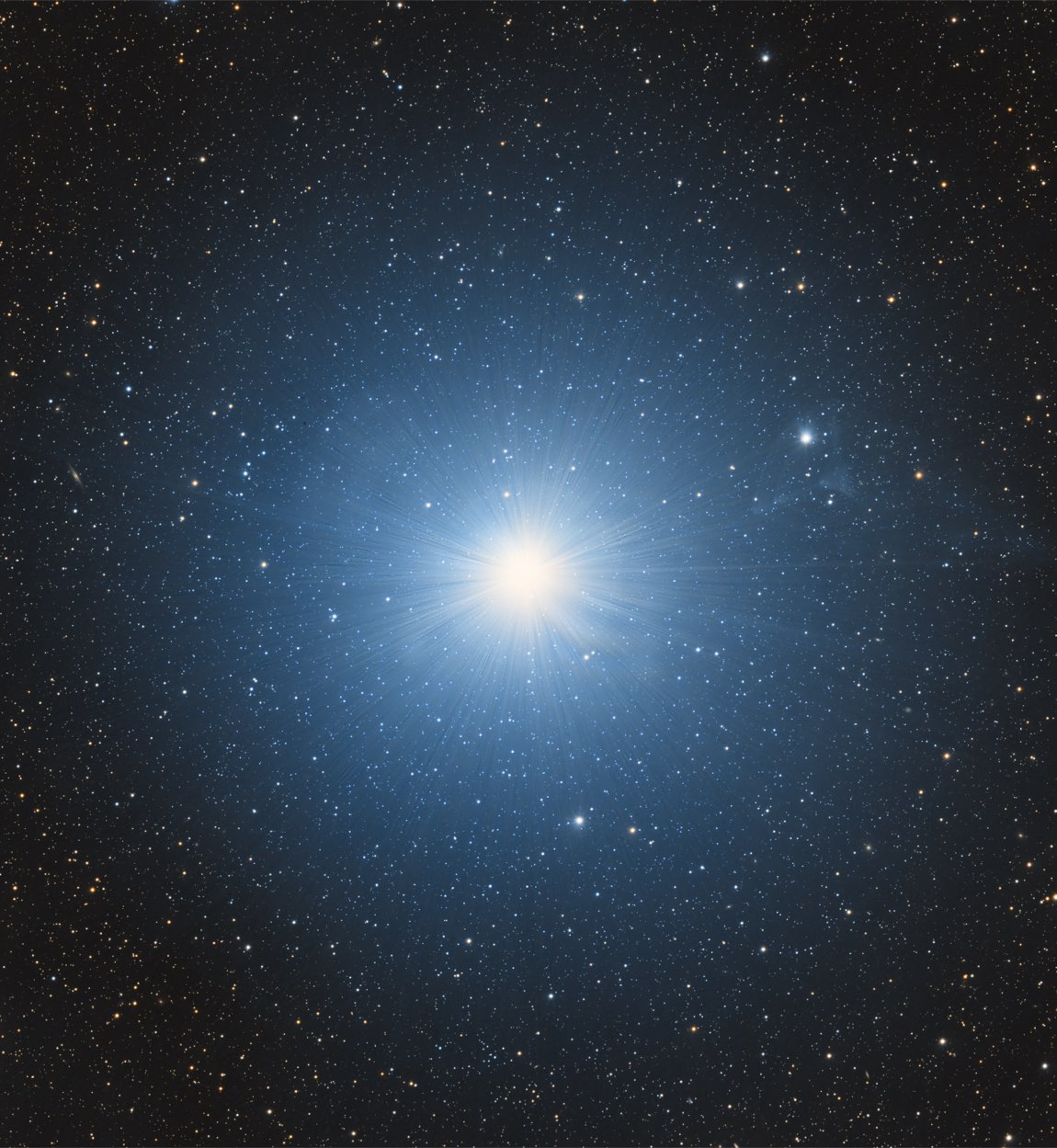
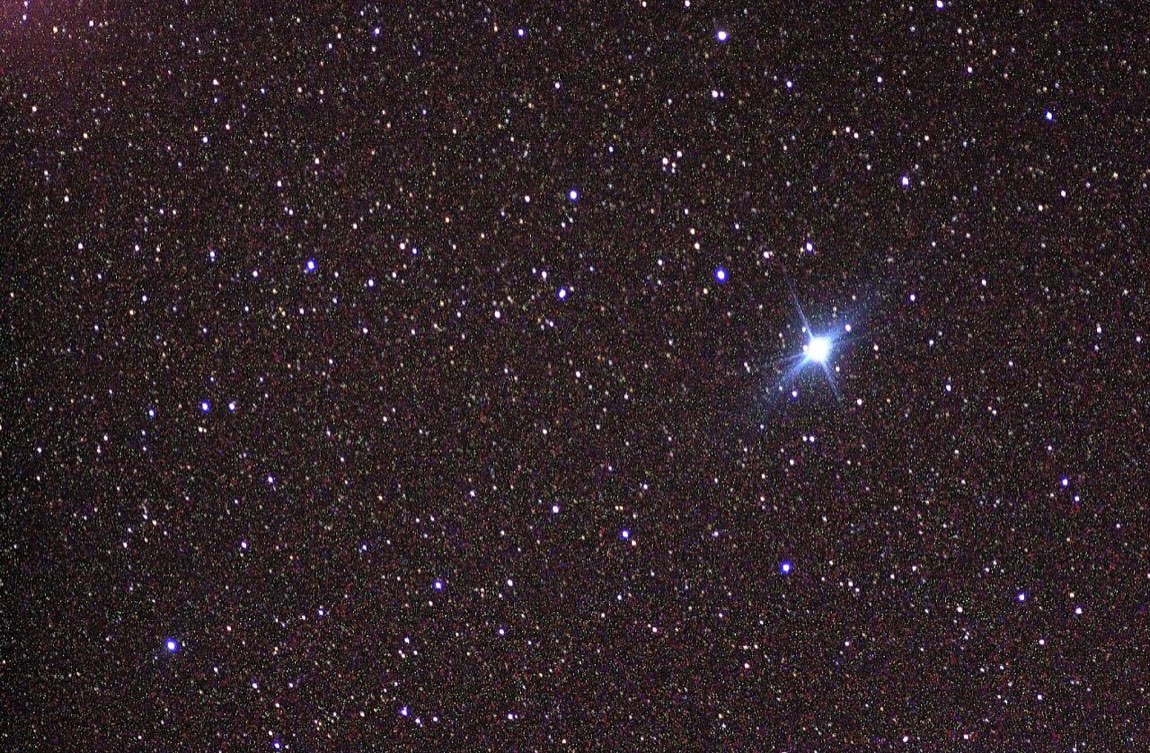
Canopus, 310 light-years away in Carina, is outshone only by Sirius — and unlike Sirius, it earns its rank with raw power: a bright giant radiating over 10,000 Suns. Too far south for most of Europe and North America to see, it is a fixture of southern skies — and of spaceflight, where star trackers have used steady, isolated Canopus as a pointing reference since the 1960s.
The deep dive
Researched for the Atlas from Wikipedia — Canopus (28,774 characters read) · updated Sep 20, 2026
01 A Navigator's Star Across the Ages
Long before GPS or magnetic compasses, Canopus served as one of the two great anchors of the southern night sky. The Bedouin of the Negev and Sinai relied on it alongside Polaris as their two principal navigational stars. Because it dips below the horizon from Middle Eastern latitudes, it earned a reputation for changeability — a wanderer — in contrast to the dependably circumpolar Polaris. The southeastern wall of the Kaaba in Mecca is physically aligned with Canopus's rising point. At sea, the star helped Polynesian voyagers cross the Pacific: it formed the southern wingtip of a constellation the ancient Polynesians called Manu, a "Great Bird" whose body was Sirius and whose northern wingtip was Procyon. Hawaiian navigators Hawaiʻiloa and Ki used it when they traveled to the Southern Ocean. In the modern space age the tradition continues: spacecraft carry dedicated "Canopus star trackers" for attitude determination, and Mariner 4 used it for second-axis stabilization in 1964 — the first time any star had been used that way.
02 How Canopus Shaped Cosmology's Early Proofs Deeper
Before telescopes existed, Canopus was already doing scientific work. The Muslim astronomer Ibn Rushd traveled from Córdoba all the way to Marrakesh in 1153 specifically to observe it, because it was invisible from his home city. He used that difference in visibility at different latitudes to argue, following Aristotle, that the Earth must be a relatively small sphere — a concrete observational demonstration rather than a purely philosophical one. A generation earlier in antiquity, the Greek astronomer Posidonius had used observations of Canopus to calculate Earth's circumference quite accurately, around 90 to 120 BC. The star's southern declination meant it grazed the horizon from Mediterranean latitudes, making it a precise geometric probe: its changing altitude against known angular separations gave the arc length of Earth's curved surface. These are not trivial footnotes — they represent some of the most rigorous empirical science of the ancient and medieval world, and a single star was the instrument.
03 When Canopus Reigns as the Brightest Star
Canopus is currently the second-brightest star in the night sky, but that ranking is temporary on astronomical timescales. Because it is more luminous than any star closer to Earth, it has actually been the single brightest star during three separate epochs over the past four million years. Other stars outshine it only when they happen to pass through the Solar neighborhood at much closer range. About 90,000 years ago, Sirius closed the distance enough to surpass Canopus in apparent brightness, and it will stay brighter for another 210,000 years. After that, as Sirius drifts further away and fades in our sky, Canopus will reclaim the top spot and hold it for roughly 510,000 years. At present, Canopus is itself drifting away from the Sun at a radial velocity of 20 km/s. Its nearest recorded approach to the Solar System was about 3.1 million years ago, when it came as close as approximately 172 light-years (53 parsecs).
04 A Star Surprisingly Hard to Measure Deeper
You might expect that pinning down the distance to the second-brightest star in the sky would be straightforward, but before the Hipparcos satellite flew, estimates for Canopus ranged wildly from 96 light-years all the way to 1,200 light-years. That spread of more than a factor of twelve led to correspondingly wild estimates of its luminosity: one old figure of 200 parsecs placed its luminosity at 80,000 times the Sun's, far above modern values. The confusion arose because Canopus is actually too bright to fall within the normal observation programs of the Gaia satellite, so even today there is no published Gaia parallax for it. Hipparcos settled the matter in its 2007 data release, measuring a parallax of 10.43 ± 0.53 milliarcseconds, placing Canopus at 310 light-years (95 parsecs). At that distance, interstellar extinction dims it by only 0.26 magnitudes — modest enough that its enormous intrinsic luminosity still makes it dazzling. An early interferometric measurement of its angular diameter in 1968 returned a limb-darkened value of 6.86 milliarcseconds, remarkably close to the modern very-long-baseline interferometry value of 6.9 milliarcseconds.
05 Interior Life: Burning Helium in a Blue Loop Deeper
Canopus spent roughly 30 million years as a blue-white main-sequence star of around 10 solar masses before exhausting its core hydrogen and swelling toward the red-giant branch. It has since left that branch — before its core became degenerate — and is now in what stellar physicists call a blue loop: a phase where the star moves back toward hotter temperatures while burning helium in its core. This makes Canopus a member of a particularly interesting evolutionary class. Blue loops are sensitive to the exact rotation rate and mixing processes inside the star, and because stars of different masses trace overlapping paths during this phase, it is genuinely difficult to tell whether Canopus is currently moving toward hotter or cooler temperatures. What is clear is that it sits on the warm side of the instability strip and does not pulsate as Cepheid variables of comparable luminosity do — though its atmosphere shows strong signs of convection and is described as unstable. At its current mass of 8.0 ± 0.3 solar masses, Canopus may eventually explode as a supernova or end its life as a massive white dwarf.
06 An Atmosphere That Breathes and Pulses Deeper
Canopus's outer layers are far from calm. The absorption lines in its spectrum shift slightly with a period of 6.9 days, a variation first detected in 1906 and initially — incorrectly — interpreted as evidence of an orbiting companion. An orbit was even published, but no such companion exists; the small radial velocity changes, reaching only 0.7 to 1.6 km/s at maximum, arise from motions within the stellar atmosphere itself. The star also has a detectable magnetic field that varies with that same 6.9-day period, revealed through Zeeman splitting of spectral lines. The calcium K line shows weak emission wings flanking a strong central absorption, first observed in 1966, and emission also appears in the h and k lines of ionized magnesium. These emission profiles are normally used as luminosity indicators via the Wilson-Bappu effect, but in Canopus they suggest a luminosity far lower than independent methods derive — a discrepancy attributed to variable plage regions on the stellar surface rather than the star's true luminosity. The projected rotational velocity is just 9 km/s, and the full rotation period may exceed three hundred days.
07 X-rays, Radio, and a Corona of Millions of Kelvin Deeper
Canopus radiates beyond the visible spectrum in ways that reflect a physically extreme corona. It is a source of X-rays almost certainly produced by coronal plasma magnetically heated to several million Kelvin — the same mechanism that heats the Sun's corona, but scaled to a far more luminous star. The X-ray emission divides into two components: a soft sub-coronal emission and a stronger hard coronal emission, behavior that has also been measured in other F-class supergiants such as Alpha Persei and is now considered a normal property of such stars. The heating is thought to be driven by fast rotation combined with strong convection percolating through the outer layers of the star. Beyond X-rays, Canopus is also detectable at microwave wavelengths, making it one of the very few F-class stars picked up by radio telescopes. Its spectrum was first formally classified in 1897, studied in detail by Jesse Greenstein using the Otto Struve Telescope at McDonald Observatory in a 1942 paper, and examined in the ultraviolet by the crewed spaceflight Gemini XI in 1966.
08 The Many Names Canopus Has Carried
Few stars have accumulated as many names across as many cultures. The Latin Canopus derives from the Ancient Greek Kanôbos, recorded by Claudius Ptolemy around 150 AD, and likely refers to the pilot of Menelaus's ship during the quest to recover Helen of Troy. A competing etymology links it to the Egyptian Coptic Kahi Nub, meaning "Golden Earth," describing the reddened color the star takes near the Egyptian horizon. In Arabic the star is Suhail or Suhayl, a word so associated with rarity that it entered the Persian expression for someone seldom seen: "becoming the star Soheil." Medieval Latin tables called it Suhel ponderosus — a Latinization of Al Suhayl al Wazn, connecting it to a ship's anchor stone rather than its low position. In Chinese tradition it is Shou Xing, the Star of Longevity, described as the southern counterpart of Sirius in Sima Qian's Shiji completed in 94 BC. The Babylonians called it MUL.NUNKI, "star of the city of Eridu," around 1100 BC. Johann Bayer assigned it Alpha Argus in 1603; Nicolas Louis de Lacaille renamed it Alpha Carinae in 1763 after splitting the huge constellation Argo Navis into three.
09 Canopus in Polynesian and Indigenous Skies
Indigenous astronomical traditions surrounding Canopus are remarkably rich and detailed. The Māori of New Zealand called it Atutahi or Aotahi — "Stand Alone" — viewing its solitary position outside the Milky Way as sacred, or tapu. One myth holds that when the god Tāne wove the basket of the Milky Way, Atutahi was left outside; another says it was the first-born child of the sky god Rangi, who refused to enter and turned sideways to rise before the galaxy itself. Its appearance at the start of the Maruaroa season predicted winter's character: light rays to the south meant a cold wet winter, to the north a mild one, and food offerings were made to the star. In southern Africa, the Venda tradition held that the first person each year to spot Canopus would blow a horn from a hilltop and receive a cow as reward. Sotho chiefs similarly offered cattle and consulted medicine men reading bone dice for the coming year's fortune. For the ǀXam-speaking Bushmen of South Africa, Canopus and Sirius together signaled the appearance of termites and flying ants, and were prayed to for good fortune.
10 How and Where to Spot Canopus Yourself
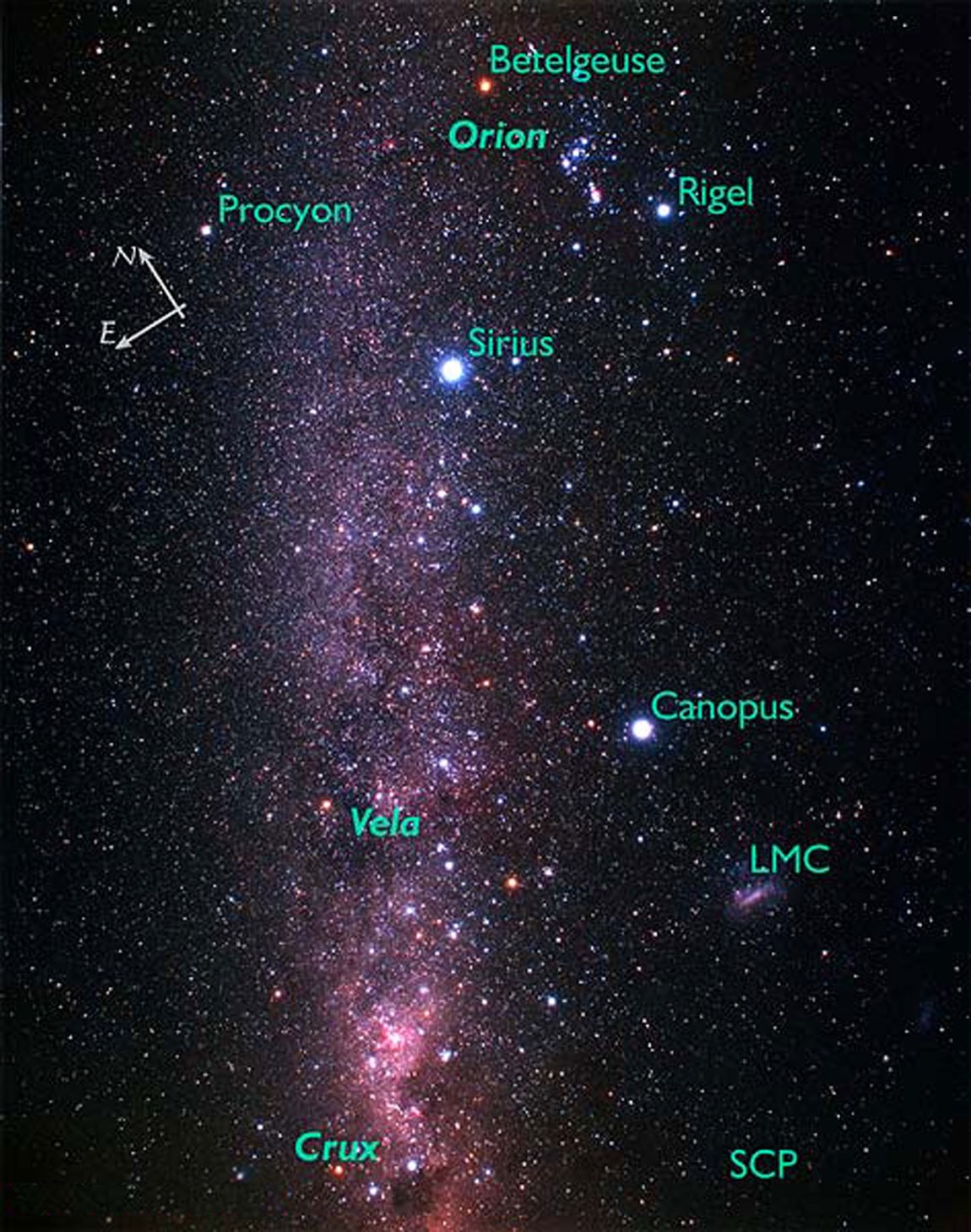
Canopus is invisible from most of the Northern Hemisphere, but the boundary is precise. In theory, the northern visibility limit is latitude 37° 18′ north — just south of Athens, San Francisco, and Seoul, and very close to Seville. From the Northern Hemisphere, it never climbs high, but at Lick Observatory on Mt. Hamilton, California, elevation and atmospheric refraction add roughly one additional degree of apparent altitude, making it visible there. Under exceptional conditions it has been spotted as far north as latitude 37° 59′ from Mount Nemrut in Turkey. Gulf Coast observers and those in Florida and Crete have better luck; the best window is around 9 p.m. in late January and early February. Canopus culminates at midnight on December 27 and at 9 p.m. on February 11. From latitudes south of 37° 18′ S it never sets at all, becoming a circumpolar star. In the Southern Hemisphere, Canopus and Sirius both stand high simultaneously, reaching the meridian just 21 minutes apart. Brighter than magnitude −0.74, it is visible to the naked eye even in early twilight, appearing essentially white — its B−V color index is +0.15, and astronomer Patrick Moore stated it never appeared anything but white to him.
11 A Possible Wide Companion — or Two Deeper
For most of its studied history, Canopus was assumed to be a solitary star. That picture has grown more complicated recently. In 2014, astronomer Eric Mamajek reported that an extremely magnetically active M dwarf — catalogued as 2MASS J06234738-5351131 and informally nicknamed "Canopus B" — located 1.16 degrees south of Canopus appears to share its proper motion through space. The projected separation is approximately 1.9 parsecs, an enormous gap, yet still within the estimated tidal radius of 2.9 parsecs for a star as massive as Canopus. Then in 2022, a study using data from Gaia Early Data Release 3 identified a second candidate companion: the object Gaia EDR3 5500822971164705792, with a mass of 0.2 times that of the Sun, showing a similar parallax and proper motion to Canopus. Its projected separation is 220.1 arcseconds, corresponding to 20,870 astronomical units at Canopus's distance — roughly 340 times the distance from the Sun to Pluto. Both companions remain candidates rather than confirmed members of a gravitationally bound system, and the vast separations involved make confirmation genuinely difficult.
12 Ancient Mesopotamia to Modern Spacecraft
The recorded human relationship with Canopus spans at least six thousand years. The Babylonians included it in their Three Stars Each star catalogues around 1100 BC under the name MUL.NUNKI, representing the ancient Sumerian city of Eridu — chosen because Eridu was the southernmost city from which the star's first rising could be observed. By 262 BC the Ptolemaic Egyptians had formalized its role: the acronychal rising of Canopus marked the date of the Ptolemaia festival, held every four years until 145 BC. Greek astronomers used it to measure Earth. Medieval Islamic scholars traveled to observe it. European knowledge was systematized in Robert Hues's 1592 Tractatus de Globis, which listed Canopus among three first-magnitude southern stars invisible from England. Jesse Greenstein analyzed its spectrum in detail in 1942 using the Otto Struve Telescope. Gemini XI observed it in ultraviolet in 1966. New Zealand astronomers Hearnshaw and Desikachary published a detailed spectral analysis in 1982. Today it remains important enough that spacecraft are routinely built with dedicated sensors locked to it. The star that ancient Babylonians named for a city still guides vehicles exploring the Solar System.
 ⤢
⤢