 Photograph · Tel Lekatsas · CC BY 2.0
Star Cluster · Deep guide
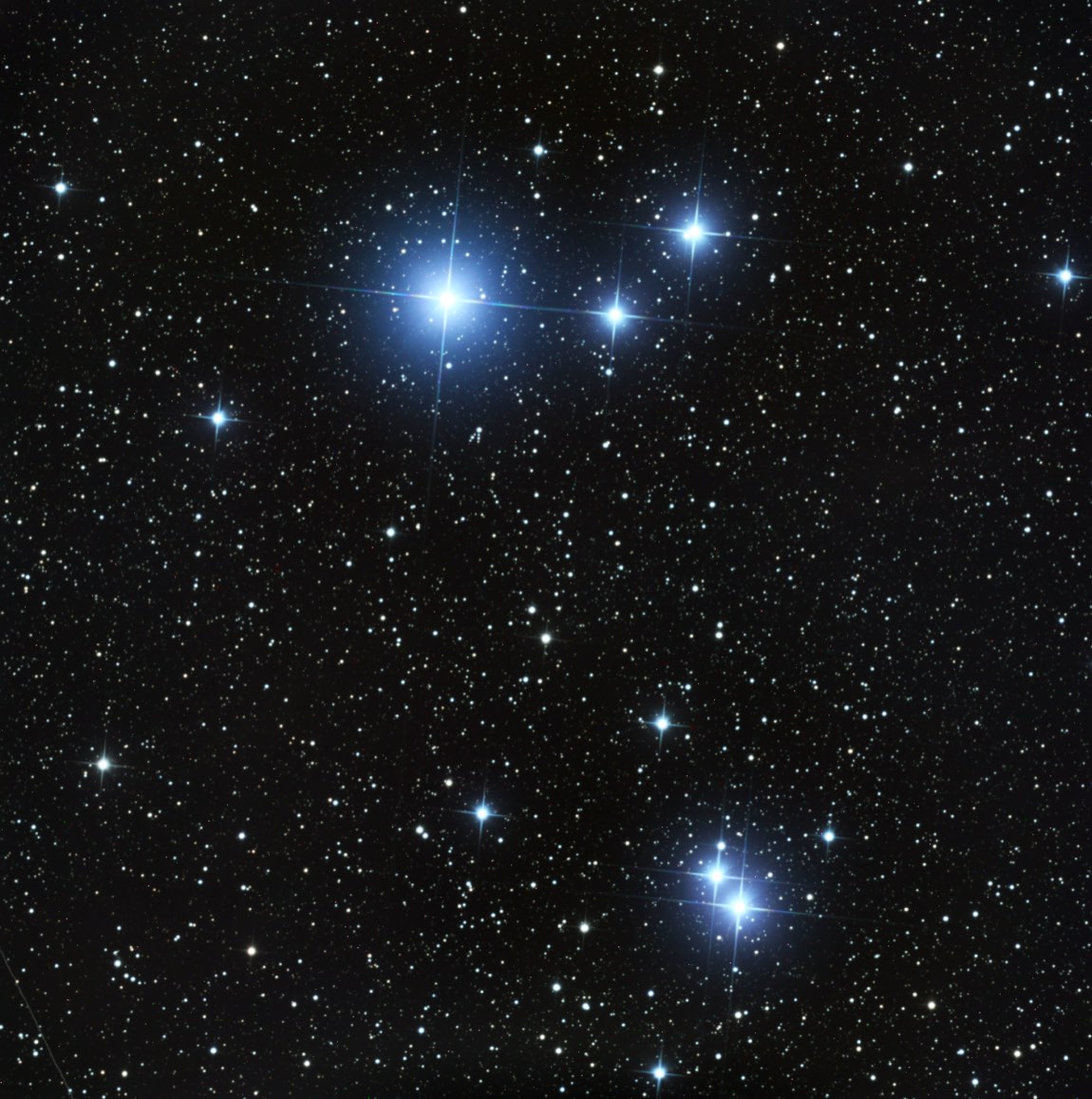
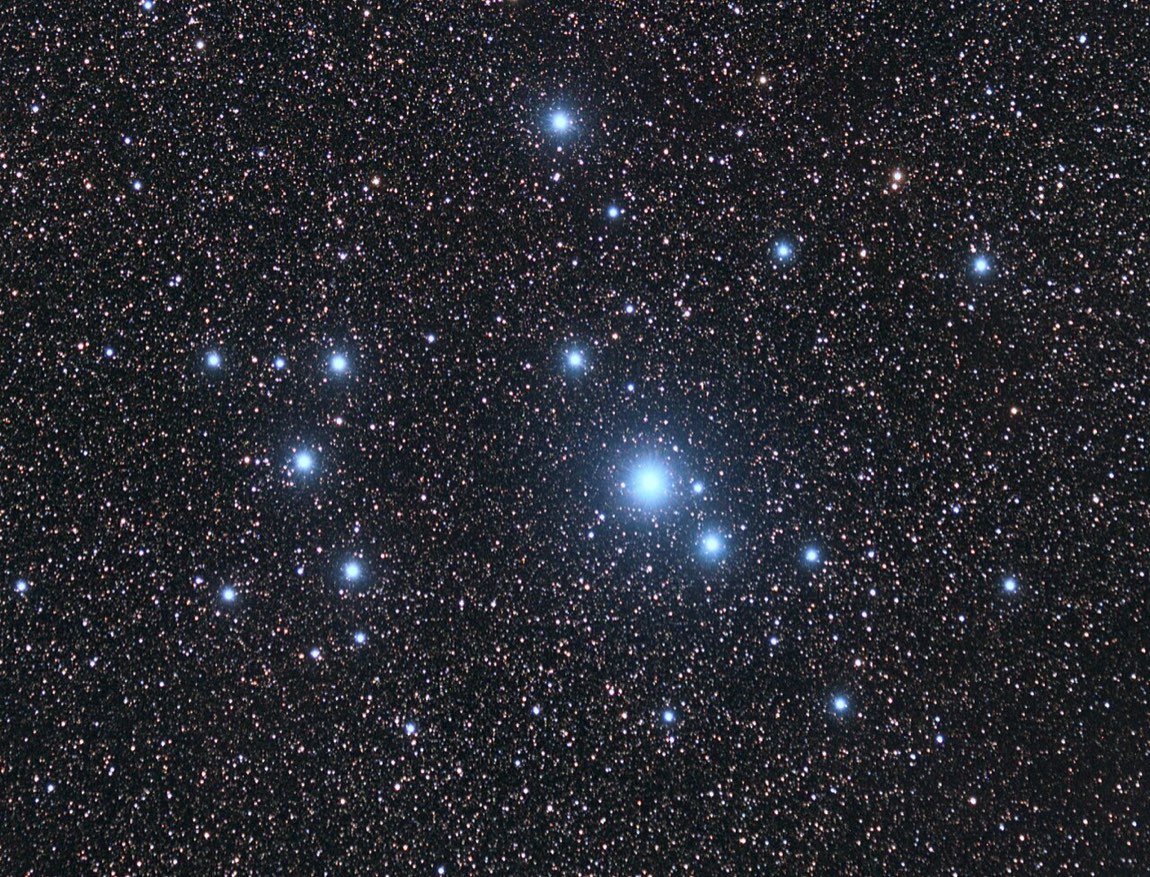
Southern Pleiades (IC 2602)
Also called: Caldwell 102 · IC 2602 · Theta Carinae Cluster
The third-brightest star cluster in the sky, a southern echo of the Pleiades.
What is it?
IC 2602, the Southern Pleiades or Theta Carinae Cluster, is an open cluster in Carina that Lacaille recorded in 1751. It is one of the nearest star clusters, about 486 light-years away, and is easily seen with the naked eye. Only the Hyades and the Pleiades are brighter open clusters. It contains about 75 stars led by Theta Carinae, and it is thought to be part of the Lower Scorpius–Centaurus association.
The deep dive
Researched for the Atlas from Wikipedia — IC 2602 (2,589 characters read) · updated Nov 15, 2026
01 The Night Lacaille Found It
On March 3, 1751, French astronomer and abbot Nicolas-Louis de Lacaille pointed his instruments at the southern sky from the Cape of Good Hope in South Africa and recorded a striking gathering of stars around a bright blue point of light. He logged that point as a third-magnitude star he called Theta Navis — or alternatively Theta Argus — referring to the now-defunct constellation Argo Navis, which has since been divided into smaller groupings including Carina. Lacaille was immediately struck by how much the cluster resembled the famous Pleiades of the northern sky, a comparison that eventually gave the cluster its popular nickname, the Southern Pleiades. His observation was foundational: Lacaille was conducting a systematic survey of the southern heavens, and IC 2602 was one of the most conspicuous objects he encountered. The catalog designation IC 2602 came much later, when the Index Catalogue of nebulae and star clusters was compiled. It is also listed as Caldwell 102, using the amateur-friendly Caldwell catalogue assembled centuries after Lacaille's pioneering southern survey.
02 Third Brightest Open Cluster in the Sky
IC 2602 ranks as the third-brightest open cluster visible in the entire sky, surpassed only by the Hyades and the Pleiades — both of which are northern showpieces familiar to observers worldwide. With a total apparent magnitude of 1.9, the cluster shines brighter than many individual naked-eye stars and is effortlessly visible without optical aid on any clear night from a southern location. Its apparent diameter stretches about 50 arcminutes across the sky, which is roughly the same angular size as the full Moon, meaning it spreads over a wide patch of Carina rather than appearing as a compact knot. That generous angular size, combined with its brilliance, makes it one of the most rewarding targets for the unaided eye or a wide-field pair of binoculars. The cluster contains around 75 member stars in total, though only a handful are bright enough to be easily picked out individually without optical aid. The surrounding star field, peppered with fifth- and sixth-magnitude stars of Carina, frames the cluster against a rich section of the southern Milky Way.
03 How Far Away Is IC 2602 Really? Deeper
IC 2602 sits approximately 149 parsecs from Earth, which works out to about 486 light-years. To put that in perspective, light leaving the cluster today will not reach Earth for nearly five centuries — longer than the entire era of telescopic astronomy. On cosmic scales, however, 149 parsecs is remarkably close: IC 2602 is counted among the nearest open clusters to our Solar System, which is precisely why it appears so large and luminous despite containing only around 75 stars. Its proximity also makes it scientifically valuable. Nearby clusters allow astronomers to resolve individual member stars with far greater clarity than more distant groupings, enabling detailed studies of stellar types, luminosities, and proper motions. The cluster's closeness contributes to its impressive total apparent magnitude of 1.9; were it placed at a typical cluster distance of several kiloparsecs, it would be invisible to the naked eye entirely. The combination of nearness, richness, and sky position has made IC 2602 a benchmark object for testing stellar evolution models and cluster membership criteria.
04 An Age Written in Lithium Deeper
Pinning down the age of IC 2602 turns out to be a genuinely tricky problem, and the cluster illustrates a tension that appears repeatedly in stellar astrophysics. When astronomers read the cluster's Hertzsprung-Russell diagram — essentially a plot of stellar temperatures against luminosities that reveals how far stars have evolved — they estimate an age of about 13.7 million years. Yet a different and often more reliable technique, the lithium depletion boundary method, suggests IC 2602 is likely around 50 million years old, an age shared with the nearby cluster IC 2391. Lithium depletion works by identifying the faintest, lowest-mass stars that have already burned through their lithium supply, since that process occurs at a predictable rate tied to stellar age. The discrepancy between 13.7 million and 50 million years is substantial — more than a factor of three — and reflects ongoing uncertainty about how accurately different age indicators can be calibrated against one another. Astronomers tend to regard the lithium depletion boundary age as more robust, making 50 million years the preferred estimate, though the question remains instructive about the limits of stellar dating.
05 Theta Carinae: The Cluster's Blazing Heart
The dominant star of IC 2602 is Theta Carinae, which shines at an apparent visual magnitude of +2.74 and gives the cluster one of its alternative names, the Theta Carinae Cluster. To the naked eye, Theta Carinae appears as a blue-white point noticeably more luminous than any of its neighbors in the grouping, and several fainter cluster members are distinguishable as a loose spray to its east on a clear dark night. Beyond its role as the cluster's anchor, Theta Carinae carries additional astronomical significance: it forms part of the asterism known as the Diamond Cross. That informal star pattern is frequently confused with the celebrated Southern Cross — the constellation Crux — particularly by travelers new to southern-hemisphere skies. The two patterns share enough visual similarity at a glance to cause genuine navigational confusion, and the mix-up has a long history among seafarers learning southern celestial landmarks. Crux is smaller and more precisely cruciform, while the Diamond Cross, anchored by the blue glare of Theta Carinae, is a looser, larger figure spanning a broader region of Carina's star fields.
06 A Variable Star on the Outskirts Deeper
Among IC 2602's confirmed members, p Carinae — also catalogued as PP Carinae — occupies an unusual position: it is a third-magnitude star definitely belonging to the cluster, yet it lies well outside the main visible grouping of stars rather than nestled within the central concentration. This spatial outlier status is not uncommon in open clusters, which are loosely bound systems whose member stars can stray considerably from the dense core. What makes PP Carinae additionally interesting is its variability: its apparent magnitude fluctuates between 3.22 and 3.55, a range of about 0.33 magnitudes that is detectable with careful naked-eye observation under stable conditions. The variability classification PP Carinae implies a periodic or semi-regular brightness change, though the article does not specify the precise variability type or period. Its membership in IC 2602 makes it useful for comparative stellar studies, since cluster members are assumed to share the same age, chemical composition, and distance, allowing differences in behavior like variability to be attributed to intrinsic stellar properties rather than environmental ones.
07 An Exoplanet Hidden Among the Stars
IC 2602 is not merely a showcase of stellar physics — it also hosts at least one confirmed exoplanet. A planet has been found orbiting the cluster member star TOI-837, making it one of the relatively rare exoplanets discovered within a named open cluster. Finding planets in clusters is scientifically valuable because cluster membership constrains the age of the host star tightly, something that is very difficult to establish for isolated field stars. If IC 2602's preferred age of around 50 million years is correct, then TOI-837 and its planet are remarkably young systems on the cosmic timescale — planetary formation would have concluded only recently in astronomical terms. This places the TOI-837 planet among the youngest confirmed exoplanets known, offering a window into the early dynamical evolution of planetary systems before billions of years of gravitational settling and atmospheric loss have had their effect. Young planets in clusters are high-priority targets for follow-up study precisely because they preserve signatures of formation that older, isolated planets have long since erased.
08 Links to Scorpius–Centaurus Deeper
IC 2602 is not an isolated island of star formation but is thought to form part of a much larger stellar association — the Lower Scorpius–Centaurus association. Stellar associations are vast, gravitationally unbound groupings of young stars that share a common origin in the same giant molecular cloud complex, spreading apart over time as they drift through the Galaxy. Scorpius–Centaurus is the nearest OB association to the Solar System, encompassing a sprawling population of hot, young, massive stars across the constellations Scorpius, Centaurus, and neighboring regions. IC 2602's membership in this association situates it within one of the most active recent star-forming regions in our galactic neighborhood and helps explain the cluster's youth — whether closer to 13.7 or 50 million years old, it is unambiguously a young system born during a broader episode of star formation that produced many related clusters and associations across a wide swath of the southern sky. The connection also provides context for understanding the cluster's chemical composition and kinematics as part of a shared stellar heritage.
09 Observing IC 2602 from Earth
With a declination of –64 degrees, IC 2602 sits deep in the southern sky, and its visibility is strongly tied to the observer's latitude. From southern subtropical and temperate regions, the cluster is circumpolar — it never sets and can be observed on any clear night of the year. For observers across southern Africa, Australia, New Zealand, South America, and similar latitudes, it is a permanent fixture of the sky. Northern hemisphere observers face a much harder time: the cluster is only accessible from tropical latitudes, and even there it hugs the southern horizon, compromising the view through additional atmosphere. The cluster presents itself a few degrees south of the main band of the southern Milky Way, which provides a glittering backdrop of star fields. To the naked eye, the blue tint of Theta Carinae is immediately apparent, and several fainter cluster members can be distinguished spreading to the east under good conditions. Wide-field binoculars reveal the full extent of the cluster's roughly 50-arcminute span beautifully, and a low-power telescope eyepiece at high magnification will show too small a field to appreciate the grouping as a whole — this is an object that rewards the widest possible view.
10 Naked-Eye Stars Beyond the Bright Pair Deeper
Beyond the dominant Theta Carinae and the outlying variable PP Carinae, IC 2602 contains a handful of additional naked-eye members that reward careful attention under dark skies. Catalogued stars including HR 4196 (also known as V518 Car), HR 4204, HD 93194, HR 4219, HR 4220, HR 4222, HD 92536, HD 93738, and V364 Carinae all carry fifth-magnitude or fainter rankings but remain detectable without optical aid under good conditions. The presence of V518 Car and V364 Carinae among this list indicates that variable stars are represented at multiple brightness levels within the cluster, suggesting that stellar variability is not a rare phenomenon confined to the brightest outlying members. All remaining cluster stars beyond these named individuals fall below fifth magnitude, blending into the rich background star field of Carina without binoculars. The catalog diversity among even these moderately bright members — mixing HR numbers, HD numbers, and variable-star designations — reflects the piecemeal history of stellar cataloguing, with different stars entered into different surveys over the decades before their cluster membership was established.
11 Why the Southern Pleiades Name Stuck
When Nicolas-Louis de Lacaille first documented IC 2602 in 1751, he explicitly noted its resemblance to the Pleiades, the celebrated northern star cluster in Taurus that has captured human imagination across cultures for millennia. That comparison was apt: both clusters are naked-eye open clusters of similar angular size, both feature a dominant pattern of moderately bright stars surrounded by fainter companions, and both sit against rich Milky Way star fields. The name Southern Pleiades consequently attached itself naturally and endured. It is one of three popular names the cluster carries alongside the Theta Carinae Cluster and Caldwell 102. The Caldwell designation reflects the modern amateur catalogue compiled by Patrick Moore, who assigned Caldwell numbers to notable deep-sky objects lacking Messier designations — IC 2602 as Caldwell 102 gives it a convenient handle for southern-hemisphere observers working through that catalogue. The Theta Carinae Cluster name anchors it to its brightest star, following the common convention of naming an open cluster after its most prominent member. Despite the multiple names, in southern astronomical culture the Southern Pleiades label carries the most poetry and remains the most recognizable to general audiences.