Astrophysics
Time Dilation
ConfirmedThe idea
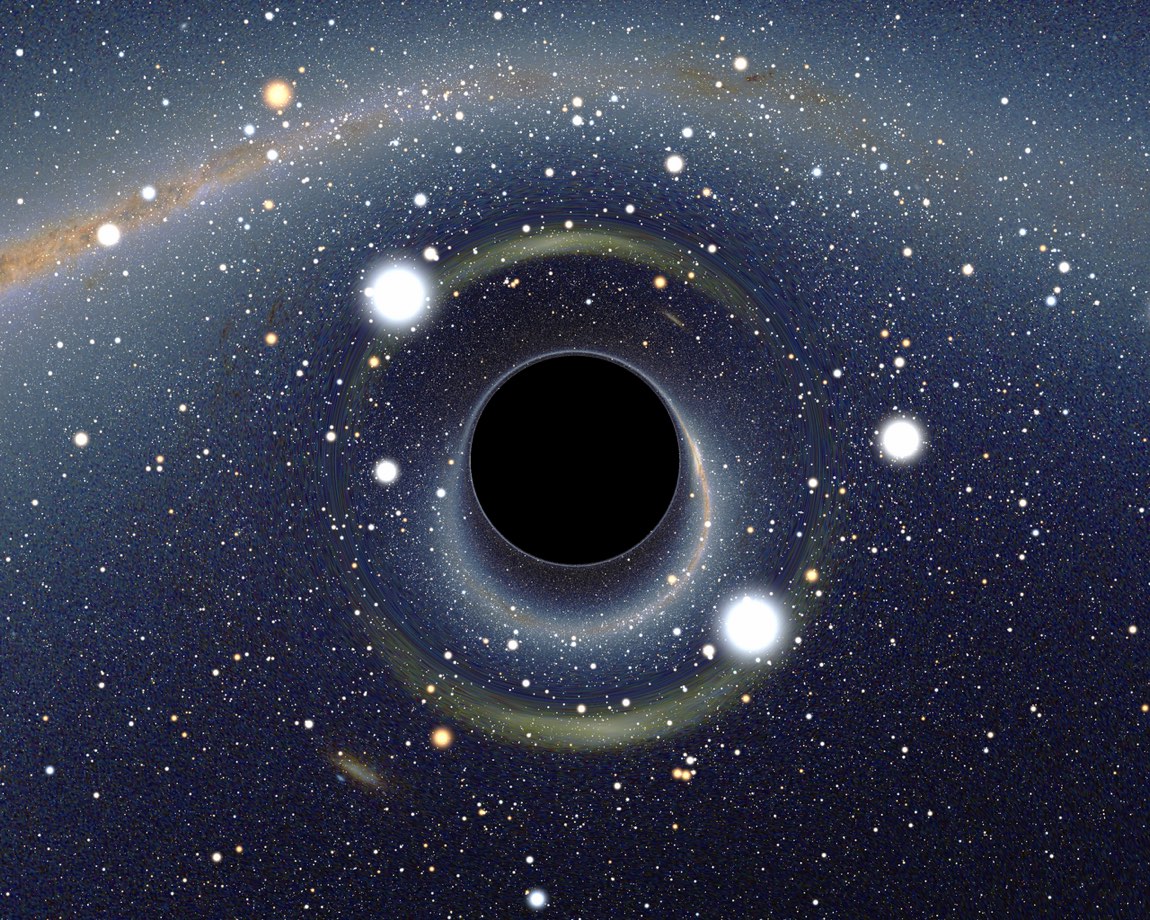
Time is personal. Move very fast, or sit deep in gravity, and your clock genuinely runs slower than your friend's. Not seems slower, IS slower. Astronaut Scott Kelly returned from a year in orbit about 13 milliseconds younger than his twin Mark. Near a black hole the effect goes extreme: hours there could be years elsewhere, exactly as the film Interstellar dramatized.
Go deeper Advanced
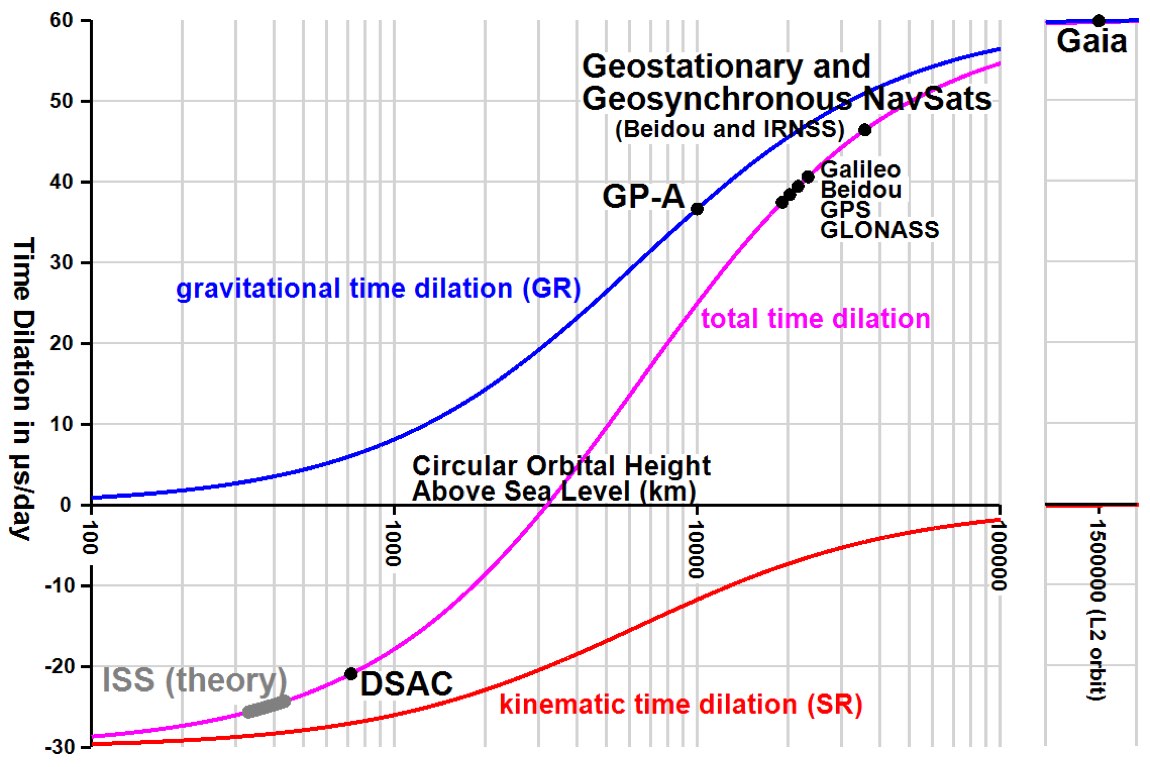
Velocity dilation: γ = 1/√(1−v²/c²). Gravitational dilation: deeper potential, slower clocks — measured across 33 cm of height with optical clocks. GPS satellites experience both (−7 μs/day fast-orbit, +45 μs/day weaker gravity; net +38). At an event horizon, an outside observer sees infalling clocks freeze — the infaller notices nothing at the crossing.
The deep dive
Researched for the Atlas from Wikipedia — Time dilation (55,168 characters read) · updated Sep 20, 2026
01 Who first predicted time dilation
The idea that motion slows time did not spring fully formed from Einstein's mind in 1905. Joseph Larmor got there first, at least mathematically. In 1897 he wrote that electrons orbiting a nucleus trace their paths in times shorter for the rest system by the factor that we now call the Lorentz factor. Emil Cohn in 1904 explicitly connected that same formula to the rate of clocks — a step closer to physical reality. Einstein's crucial contribution in 1905 was to show that the effect concerns the nature of time itself, not just some mechanical quirk of electrons, and he was also the first to point out that the slowing is reciprocal: each observer sees the other's clock running slow. Hermann Minkowski then sharpened everything in 1907 by introducing the concept of proper time, giving a clean geometric meaning to what had been an algebraic result. So the history is collaborative and spans about a decade, with credit spread across at least four scientists before the idea reached its modern form.
02 Why you cannot simply watch a clock slow down
Time dilation is a relationship between clock readings, not something you can see directly by watching a moving clock face. Any visual observation of a distant clock is contaminated by the travel time of light, which can dwarf the relativistic effect itself. The article gives a vivid example: two experimenters watch a train moving at 0.86 times the speed of light. They record a 2-second difference on their clocks while the train engineer reports only 1 second elapsed. But if the experimenters tried to watch a clock mounted on the front of the train, they would see something surprising — the clock would appear to run faster, not slower, because the light emitted when the train was far away takes 1.7 seconds to arrive, yet the train itself passes only 0.3 seconds later. That compression mimics a sped-up clock. This optical distortion is associated with the Doppler effect and must be carefully separated from genuine time dilation in any experiment. The upshot is that no one has ever directly watched a clock slow down; the effect is always inferred by comparing readings after the fact.
03 The light-clock thought experiment unpacked
One of the cleanest ways to understand velocity time dilation is the light clock: two mirrors facing each other with a pulse of light bouncing between them, ticking once each time the pulse hits the bottom mirror. In the clock's own rest frame, the pulse travels straight up and down across a gap of length L, so one tick takes a time equal to 2L divided by the speed of light c. Now imagine watching that same clock from a frame moving sideways relative to it. The pulse can no longer travel straight up and down — it must also drift sideways to keep up with the mirrors, tracing a longer, angled path. Because the speed of light is fixed at c for every observer, the longer path means more time between ticks. That lengthening is the Lorentz factor gamma. The logical power of the argument is that it does not depend on any special property of light clocks: because all clocks must agree with each other in any given frame, the same stretching applies to mechanical watches, atomic clocks, and biological processes alike. The geometry of the situation, not the clock's mechanism, is what matters.
04 Cosmic-ray muons: nature's own experiment
Perhaps the most elegant natural proof of time dilation comes from muons — unstable particles created when cosmic rays slam into the upper atmosphere. A muon at rest in a laboratory decays with a half-life of about 2.197 microseconds. At that rate, a muon travelling at 98 percent of the speed of light should cover only about 600 metres before vanishing, nowhere near enough to reach sea level from the upper atmosphere where it was born. Yet detectors at sea level routinely catch them. The resolution is time dilation: travelling at 98 percent of c, their internal clock runs roughly five times slower than a laboratory clock, stretching their effective lifetime long enough to complete the journey. Rossi and Hall demonstrated this in 1941 by comparing muon populations at the top of a mountain and at sea level, finding exactly the ratio relativity predicts. Particle accelerators confirm the same physics on demand: at CERN, muons circulating with a Lorentz factor of 29.327 were measured to have a dilated lifetime of 64.378 microseconds, matching the relativistic prediction to an accuracy of 0.9 ± 0.4 parts per thousand.
05 The Hafele–Keating experiment of 1971
In 1971, Joseph Hafele and Richard Keating packed caesium atomic clocks onto ordinary commercial airliners and flew them east and west around the Earth, then compared their readings against a reference clock that stayed at the U.S. Naval Observatory. The experiment was a direct test of the combined effect of velocity and gravitational time dilation. The two effects pull in opposite directions: flying higher in a weaker gravitational field speeds a clock up, while moving fast slows it down. Flying eastward adds the plane's speed to Earth's rotation, making the velocity effect dominant, so the eastward clocks were predicted to lose 40 ± 23 nanoseconds. Flying westward subtracts from Earth's rotation speed, making the gravitational effect dominant, so the westward clocks were predicted to gain 275 ± 21 nanoseconds. The measured results were −59 ± 10 nanoseconds eastward and +273 ± 7 nanoseconds westward. In 2005, the U.K. National Physical Laboratory replicated the experiment on a London–Washington return trip with more accurate clocks, reporting results within 4 percent of relativity's predictions.
06 How GPS satellites cope with time dilation daily
The Global Positioning System is, in a practical sense, a continuously running relativity experiment. Each satellite carries atomic clocks and orbits at a speed and altitude where both velocity and gravitational time dilation are significant. The two effects again work against each other: the satellite's speed tends to slow its clock relative to a ground receiver, while its higher altitude in a weaker gravitational field tends to speed it up. Left uncorrected, these shifts would accumulate into positioning errors of hundreds of metres per day — large enough to make the system useless for navigation. The satellite clocks are therefore adjusted so that, as observed from Earth's surface, they tick at the same rate as surface clocks. The same considerations apply to the European Galileo system. Every time someone uses satellite navigation to find a street corner, they are implicitly relying on calculations that only work because relativistic time dilation is real and has been quantified accurately enough to correct for it.
 ⤢
⤢
07 Gravitational time dilation is not reciprocal Deeper
Velocity time dilation has a symmetry that can feel paradoxical: each of two observers in relative motion measures the other's clock as running slow, and neither is wrong. Gravitational time dilation breaks this symmetry completely. When one clock sits lower in a gravitational well and another sits higher, both observers agree on which clock is running slower, and they agree on the exact ratio of the difference. There is no ambiguity about whose clock is behind. A striking illustration comes from Earth's interior: Richard Feynman suggested in a lecture that Earth's core must be younger than its crust because it sits deeper in Earth's gravitational field. Calculations following that idea put the difference at 2.5 years, out of a total age of 4.5 billion years — a tiny fraction, but a real one. At the other extreme, near the event horizon of a black hole, gravitational time dilation becomes extreme: one hour near such an object corresponds to seven years on Earth in the film Interstellar, a number that physicist Kip Thorne, who collaborated on the film, treats as scientifically plausible.
08 The Pound–Rebka experiment and gravitational redshift Deeper
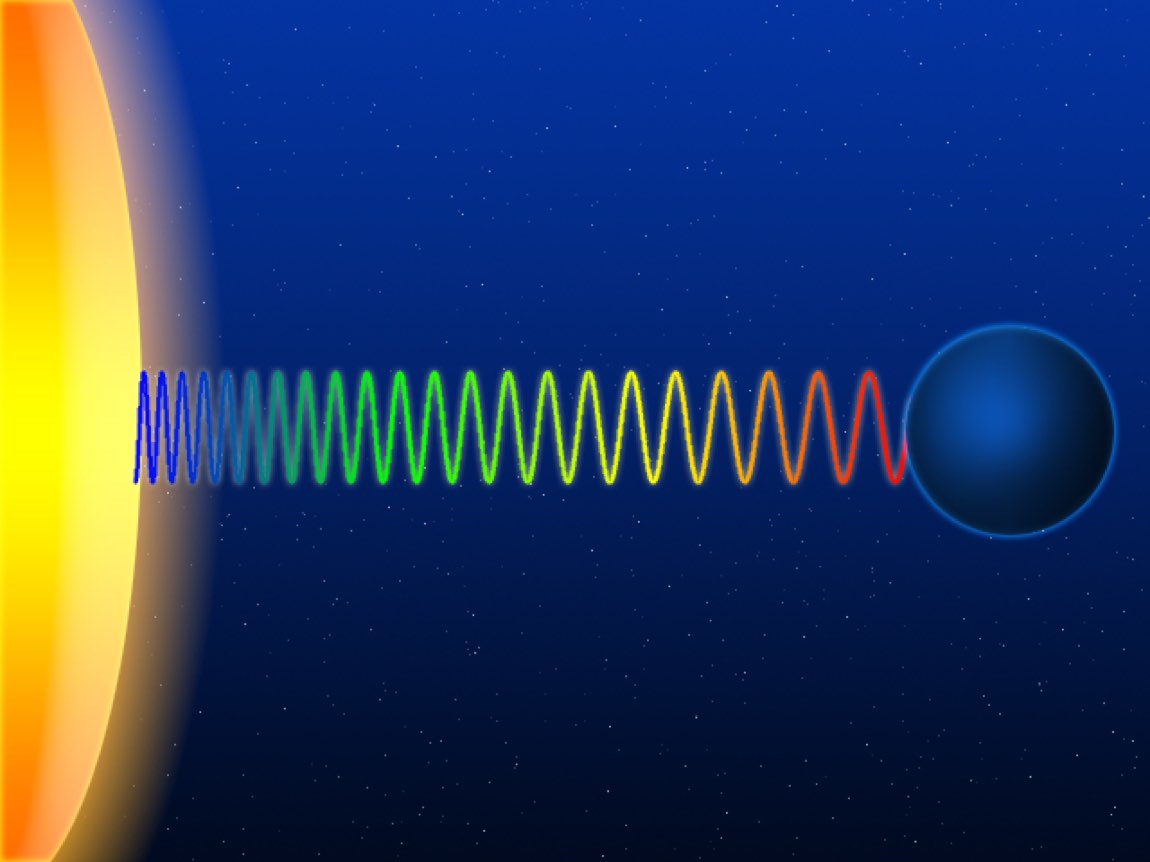
The first precise laboratory measurement of gravitational time dilation was the Pound–Rebka experiment, carried out at Harvard in 1959. Robert Pound and Glen Rebka measured the tiny shift in the frequency of gamma rays emitted at the bottom of a 22-metre tower and absorbed at the top — or vice versa. Because a clock lower in a gravitational field runs slower, light climbing upward loses energy slightly, shifting to a lower frequency (redshift), while light falling downward gains energy, shifting to a higher frequency (blueshift). The effect across a 22-metre height difference is extraordinarily small, but Pound and Rebka exploited the Mössbauer effect to detect it. Their 1959 result fell within 10 percent of general relativity's prediction. By 1964, Pound and J. L. Snider had refined the measurement to within 1 percent. In 2010, the technology had advanced so far that gravitational time dilation was measured with a height difference of only 33 centimetres using optical atomic clocks, confirming the effect at a scale smaller than a human knee.
09 The twin paradox and why it is not a contradiction
The twin paradox is the most famous apparent contradiction in relativity. One twin stays on Earth while the other travels into space at high speed and returns. Reciprocity seems to demand that each twin should see the other aging slower, implying that when they reunite both should be the same age — yet the travelling twin is younger. The resolution is that the situation is not actually symmetric. The twin on Earth remains in a single inertial frame throughout. The travelling twin must turn around, which means switching from one inertial frame to another — an experience that involves genuine acceleration and has real physical consequences. The proper time between two events, measured by an unaccelerated clock present at both events, is always the maximum time interval between those events compared to any accelerated path connecting them. The travelling twin's path is accelerated, so it accumulates less proper time. There is no paradox, only an asymmetry that special relativity handles cleanly through the mathematics of proper time and Minkowski geometry.
10 The clock hypothesis and what acceleration does not do Deeper
A subtle but important question lurks inside every time-dilation calculation involving changing speeds: does acceleration itself independently affect a clock's rate, beyond whatever velocity it happens to produce? The clock hypothesis answers no. It states that the rate at which a clock is affected by time dilation depends only on the clock's instantaneous velocity, not on its acceleration. Equivalently, a clock moving along any path — curved, oscillating, or otherwise — simply accumulates the proper time computed by integrating the instantaneous Lorentz factors along that path, regardless of how rapidly the velocity is changing. Einstein included this assumption implicitly in his 1905 paper, though he did not state it explicitly. It has since become a standard axiom of special relativity. Particle accelerators provide experimental support: particles there undergo enormous centripetal accelerations, yet their decay lifetimes match predictions based solely on their speeds, with no detectable additional effect from the acceleration itself. This separates time dilation cleanly from the kind of gravitational time dilation that equivalence-principle arguments would associate with acceleration.
11 Detecting time dilation at walking speed in 2010
For most of the twentieth century, experimental demonstrations of time dilation required either cosmic rays, particle accelerators, or aircraft. In 2010, that changed dramatically. Physicists observed time dilation at speeds of less than 10 metres per second — roughly the pace of a sprinting human — using optical atomic clocks connected by 75 metres of optical fibre. The same year, gravitational time dilation was measured between two clocks separated by only 33 centimetres in height. These results reflect how extraordinarily precise modern optical atomic clocks have become. They can detect frequency differences at the level of parts in 10^18 or better, making relativistic effects that were once only accessible in dramatic experiments now visible on a laboratory bench. The practical implication is that any future redefinition of timekeeping standards, or any attempt to compare atomic clocks across a country or a continent, must account for relativity as a matter of engineering necessity, not just theoretical elegance.
12 A misconception that would kill Schrödinger's cat
A persistent misconception holds that time dilation applies only to light-based clocks — like the bouncing-photon device used in textbook derivations — and leaves mechanical or atomic clocks untouched. This error can produce startlingly wrong conclusions about real experiments like the Hafele–Keating flight. To illustrate why the misconception fails, physicist Val G. Rousseau proposed a thought experiment called Einstein's Cat, featuring a device called the Sync-or-Die clock that couples a light clock to a mechanical stopwatch with lethal consequences for a cat if the two ever fall out of synchronisation. If time dilation affected only the light clock but not the stopwatch, the cat would die — but only as observed from frames moving relative to the apparatus. Observers at rest relative to the cat would see it survive. Since a cat cannot be simultaneously alive and dead depending on the observer's reference frame, the scenario forces the conclusion that both clocks must experience identical time dilation. The internal mechanism of a clock is irrelevant; what matters is its velocity relative to the observer.