Astrophysics
Special Relativity
ConfirmedThe idea
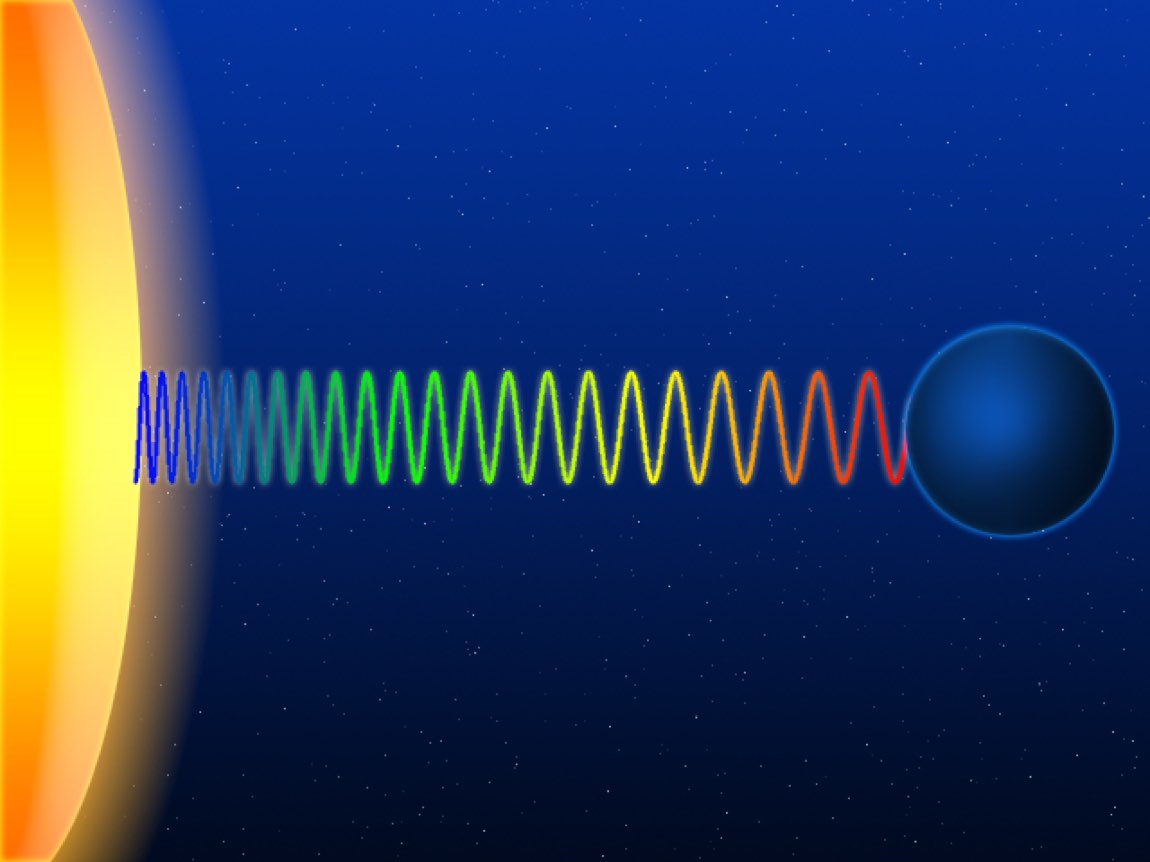
Two rules with wild consequences: light's speed is the same for everyone, and physics doesn't care how fast you're cruising. From these, Einstein showed that moving clocks tick slower, moving objects shorten, and mass is frozen energy (E=mc²). None of it is noticeable at highway speeds — all of it is measured daily in particle accelerators and cosmic rays.
Go deeper Advanced
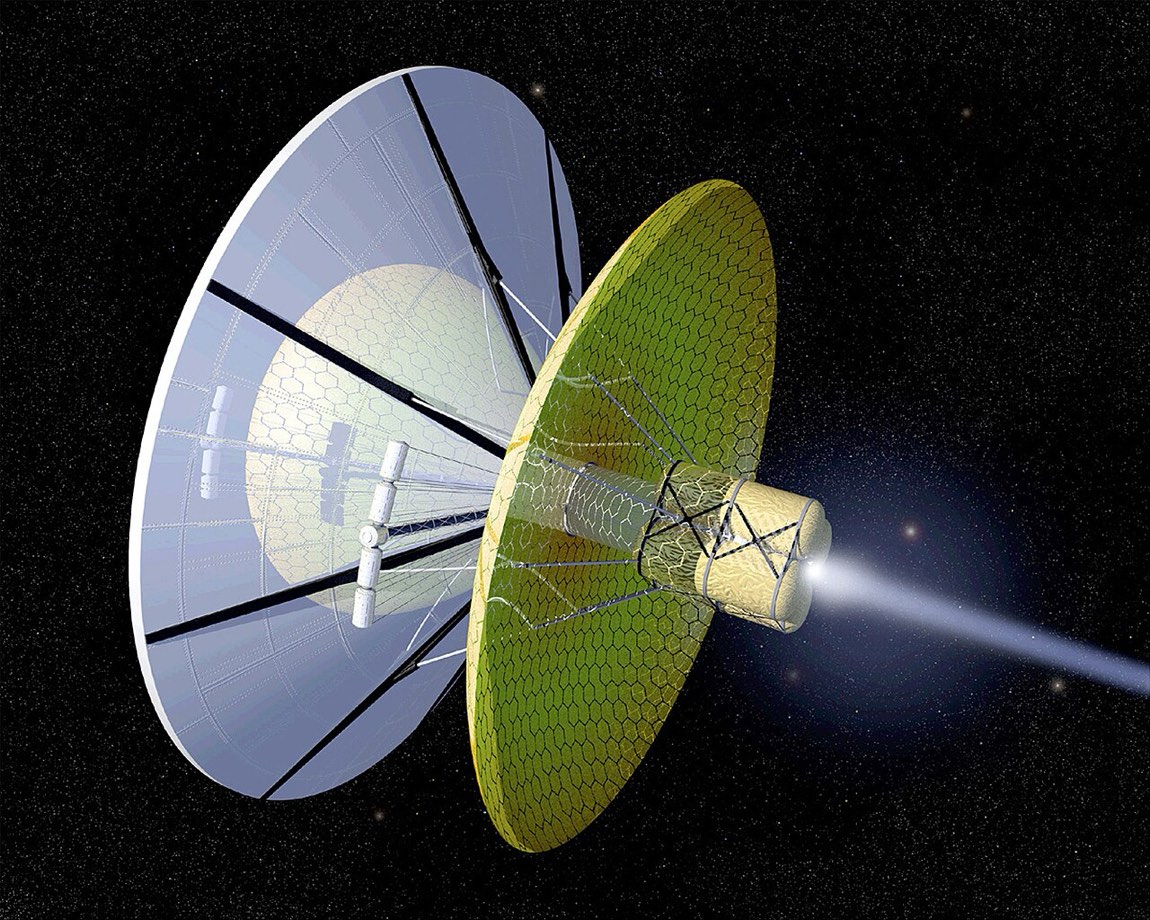
Muons made in the upper atmosphere live 2.2 μs — far too brief to reach the ground — yet they arrive constantly, because at 99.9% of light speed their internal clocks run ~20× slow. E=mc² is the Sun's business model: 4 million tonnes of mass become sunlight every second. The universal speed limit is why interstellar travel is a physics problem, not just an engineering one.
The deep dive
Researched for the Atlas from Wikipedia — Special relativity (58,000 characters read) · updated Sep 20, 2026
01 Galileo's ship and the first postulate
Long before Einstein was born, Galileo Galilei had already cracked open the first half of special relativity. In 1632 he described a thought experiment: go below deck on a smoothly sailing ship, watch butterflies flutter and water drip, and you cannot tell whether the vessel is moving or at anchor. Galileo summarized this as what we now call Galilean invariance — the laws of physics look identical in any frame that moves at constant speed. Isaac Newton folded this insight into his mechanics and noted carefully that it only holds for frames without acceleration, which he called inertial frames. For more than two centuries this principle sat quietly inside Newtonian physics, unchallenged and largely unexamined. Einstein's 1905 achievement was to recognize that Galileo's old ship argument had to be extended: it must apply not just to mechanics but to every law of physics, including the newly discovered equations of electromagnetism. That extension, combined with a single stubborn fact about the speed of light, was enough to overturn three hundred years of assumptions about time.
02 Maxwell, aether, and a crisis in physics
In 1864 James Clerk Maxwell published his theory of electromagnetism, and it immediately created a puzzle. Maxwell's equations predicted that light travels through vacuum at a fixed speed regardless of the motion, velocity, acceleration, frequency, wavelength, direction, polarization, or phase of either the source or the receiver. That was wonderful news for physics — but it flatly contradicted Galilean relativity. If you run toward a sound source, the sound appears faster; shouldn't the same be true of light? To rescue the situation, physicists invented the luminiferous aether: an invisible, perfectly elastic medium filling all of space through which light waves could propagate, and against which absolute speeds could be measured. The aether was imagined to offer no resistance to matter passing through it while still being stiff enough to carry electromagnetic waves. It was a desperately convenient fiction. Experimenters then set to work trying to detect Earth's motion through this aether, culminating in the 1887 Michelson–Morley experiment — which found nothing. The null result only confirmed what Maxwell's equations had always said: the speed of light in vacuum is constant. George Francis FitzGerald, Hendrik Antoon Lorentz, and Jules Henri Poincaré each proposed partial fixes to save the aether, all pointing toward what would become special relativity. Einstein cut the knot by discarding the aether entirely.
03 Einstein's paper and what it actually said
On 26 September 1905, Albert Einstein published "On the Electrodynamics of Moving Bodies," a paper that reorganized the foundations of physics using only two postulates and high-school-level mathematics. The first postulate restated Galileo: the laws governing how physical systems change are identical in any two frames moving at constant velocity relative to each other. The second postulate was bolder: light in vacuum always propagates at a definite speed c, independent of the motion of whatever emits it. Einstein then applied the Lorentz transformations — mathematical relations already known to be compatible with Maxwell's equations — to the classical laws of mechanics, changing how Newton's framework handles all motion, especially speeds approaching that of light. There is some historical debate about how much Einstein was influenced by the Michelson–Morley null result directly, but the article notes that the null result certainly helped the constancy of light speed gain rapid and widespread acceptance. Henri Poincaré contributed the mathematical framework by proving that Lorentz transformations form a subset of a larger symmetry group now called the Poincaré group. The theory became essentially complete two years later, in 1907, when Hermann Minkowski recast it in the language of four-dimensional spacetime.
04 When simultaneity breaks down
One of the most unsettling consequences that flows directly from the two postulates is the relativity of simultaneity: two events that appear to happen at exactly the same moment for one observer may happen at different times for an observer moving relative to the first. This is not an illusion or a trick of signal delay — it reflects a genuine difference in what "simultaneous" means in different inertial frames. The reason is that the Lorentz transformation mixes spatial and temporal coordinates together. In the transformation equations, the new time coordinate t′ depends not only on the old time t but also on the spatial position x and the relative velocity v, divided by c squared. Because c squared is enormous, the effect is negligible at everyday speeds; at speeds comparable to c it becomes dramatic. Crucially, the temporal order of events that are timelike separated — meaning more time separates them than space, measured in compatible units — is absolute and the same for all observers. Only events that are spacelike separated, where more space than time divides them, can swap their chronological order depending on the reference frame. This distinction between timelike and spacelike separation is one of the deepest structural features of Lorentzian geometry.
 ⤢
⤢
05 The Lorentz factor: a number that changes everything Deeper
Almost every quantitative prediction of special relativity is controlled by a single number called the Lorentz factor, written as gamma (γ) and defined as one divided by the square root of the quantity one minus v-squared over c-squared. At everyday speeds the factor is indistinguishable from one: a car at 100 kilometres per hour gives a gamma so close to unity that the deviation is smaller than one part in 10²⁸. As v approaches c, however, gamma climbs without limit, heading toward infinity. This factor appears in time dilation — moving clocks run slow by exactly the factor gamma — and in length contraction, where distances along the direction of motion are compressed by the same factor. It also appears in the Lorentz transformation equations that relate the spacetime coordinates of any event as seen from two frames in relative motion. The transformation affects only the coordinates along the direction of motion and the time coordinate; the two perpendicular spatial axes are completely unchanged. The article notes that these transformations form a one-parameter group of linear mappings, where the parameter is called rapidity, a quantity that adds simply even when velocities do not.
06 Spacetime intervals: what everyone agrees on Deeper
In ordinary Euclidean geometry the distance between two points is fixed regardless of how you rotate your coordinate axes — that invariance is what makes distance a useful concept. Special relativity needs its own equivalent: a quantity that all inertial observers, regardless of their relative velocities, assign the same value to. That quantity is the spacetime interval, Δs², defined as c²Δt² minus the sum of the squared spatial separations in all three directions. The minus sign in front of the spatial part is the signature of Lorentzian geometry and marks space and time as genuinely different kinds of dimension, not merely interchangeable. When Δs² is positive the two events are timelike separated; a single observer can be present at both events, and the interval divided by c gives what is called the proper time between them. When Δs² is negative the events are spacelike separated; no material object moving below c can attend both, and the square root of the absolute value of the interval gives the proper distance. When Δs² equals zero the events are lightlike separated, connected only by a signal traveling at exactly c. This threefold classification of event pairs is a frame-independent fact about nature, not a convention.
07 Minkowski's geometry of spacetime
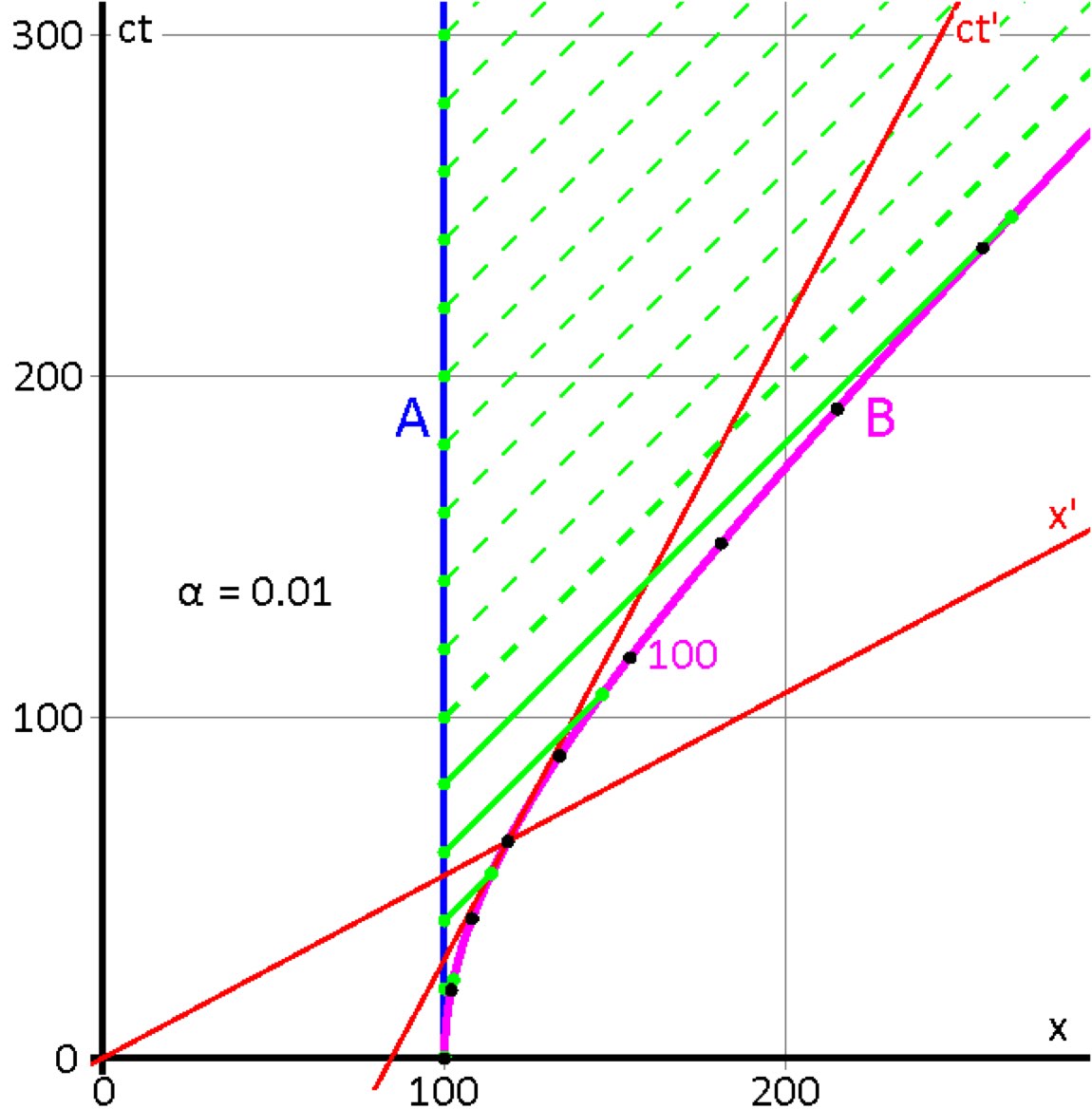
Hermann Minkowski's 1907 papers gave Einstein's physics its permanent mathematical home. Rather than treating space and time as separate arenas, Minkowski merged them into a single four-dimensional structure — spacetime — where each point is an event with three spatial coordinates and one time coordinate. To visualize this, physicists draw Minkowski diagrams, sometimes called spacetime diagrams, with space along the horizontal axis and time (multiplied by c so it has units of length) along the vertical axis. A particle sitting still traces a vertical line; a photon traces a 45-degree diagonal. When a second frame S′ moving at velocity v is drawn on the same diagram, both its time axis and its space axis tilt toward that 45-degree light line by an angle whose tangent equals v divided by c. The two frames look asymmetric on the flat page, but the article is explicit that they are physically equivalent — the apparent asymmetry is an unavoidable distortion from representing Lorentzian geometry on a Euclidean sheet of paper. Crucially, the worldlines of photons always plot as 45-degree lines regardless of which frame is drawn, because the speed of light is invariant. Special relativity is restricted to the flat version of this geometry, called Minkowski space; general relativity extends to curved spacetime.
08 Velocities that refuse to add simply
In Newtonian mechanics, velocities add the way common sense suggests: if a train moves at 50 metres per second and you throw a ball forward at 20 metres per second inside it, a trackside observer sees the ball at 70 metres per second. Special relativity replaces this with the Lorentz transformation of velocities, where the speed of light acts as a ceiling that can be approached but never exceeded. The article states this consequence plainly: covering ten times more distance on the ground in the same time according to a moving watch does not produce a tenfold speed increase as measured from the ground. The underlying reason is that the Lorentz transformation mixes space and time coordinates together, so adding velocities in the naive way ignores the time-stretching that also occurs. No matter how many times you stack velocities below c, the result stays below c. Light itself, traveling at c in one frame, still travels at c in every other frame — a direct consequence of the invariant interval equaling zero for lightlike-separated events, which is frame-independent by construction.
 ⤢
⤢
09 Where E = mc² really comes from
The equation E = mc² is probably the most recognized formula in science, but its origin is often misunderstood. It does not appear in Einstein's two postulates directly; instead, the article describes it as a consequence that emerges when the two postulates of special relativity are combined with other laws of physics. The result is the equivalence of mass and energy, where c is the speed of light in vacuum. Because c is approximately 300,000 kilometres per second, c² is an astronomically large number, meaning that even a tiny amount of mass corresponds to an enormous amount of energy — a fact that has profound consequences for nuclear physics and astrophysics. The formula represents one of the most far-reaching predictions that follow from the theory, yet it is derived rather than assumed. The article also notes that special relativity explains how electricity and magnetism are related — Maxwell's electromagnetism, which triggered the whole crisis in the first place, turns out to be automatically consistent with special relativity once the theory is properly formulated.
10 Why visual descriptions of relativity go wrong
The article includes a pointed warning that visual descriptions of special relativity are especially prone to mistakes, and the reason is worth dwelling on. Special relativity replaces absolute universal time with a time that is local to each observer. Information about distant objects can arrive no faster than the speed of light, so any observation you make of a remote event actually reports something that happened in the past — and the length of that delay depends on where and how fast you are. Two observers in relative motion who receive information about the same two events via light signals will receive those signals at different times on their own local clocks, because their motion during the transit time of the light shifts when the signals arrive. This makes it tempting to attribute relativistic effects to mere signal-travel delays, but the effects — time dilation, length contraction, the relativity of simultaneity — are real changes in physical measurements, not optical illusions. The article explicitly states that time dilation, for instance, reflects a genuine difference in time measured between two events by observers in motion, not simply a confusion about when signals arrive.
11 Special versus general relativity: knowing the limits Deeper
Einstein himself coined the phrase "special theory of relativity" only later, in two short papers in November 1915 and in a long review article in 1916, to distinguish his 1905 work from the broader general theory. The word "special" signals a deliberate restriction: the 1905 theory applies only to inertial frames — those moving at constant velocity with no acceleration — and only in the absence of significant gravitational fields. Just as Galilean relativity is a valid approximation of special relativity at low speeds, special relativity is a valid approximation of general relativity in weak gravitational fields, at sufficiently small scales where tidal forces are negligible, and in conditions of free fall. General relativity incorporates non-Euclidean geometry to represent gravity as the curvature of spacetime, whereas special relativity is confined to the flat Minkowski space. The article specifies that as long as the universe can be modeled as a pseudo-Riemannian manifold, a Lorentz-invariant frame obeying special relativity can always be defined for a sufficiently small neighborhood around any point, even in curved spacetime — making special relativity locally valid everywhere.
12 Deriving relativity from one postulate instead of two Deeper
Einstein's original 1905 presentation rested on two explicit postulates, but subsequent work has shown that the structure of the theory can be compressed further. The article describes an approach starting from the principle of relativity alone — without assuming the constancy of the speed of light — combined with the isotropy of space and the symmetry implied by the relativity principle. From these assumptions alone it can be shown mathematically that spacetime transformations between inertial frames must be one of three types: Euclidean, Galilean, or Lorentzian. Experiments then select the Lorentzian case, and within that case a finite limiting speed emerges as a derived result rather than a postulate. Experiments suggest that this limiting speed is the speed of light in vacuum. Equivalently, modern textbooks by authors such as Taylor and Wheeler and by Callahan base the entire theory on the single postulate of Minkowski spacetime — the geometric structure itself — from which both the constancy of light speed and the Lorentz transformations follow. Henri Poincaré had already established that Lorentz transformations are a subset of the larger Poincaré group of symmetry transformations, providing the mathematical backbone that Einstein later derived from his axioms.
13 Open questions and the boundaries of the theory Deeper
Special relativity is, by its own construction, an incomplete picture of nature. The article states it has proven to be the most accurate model of motion at any speed when gravitational and quantum effects are negligible — but those two caveats define enormous territories where it cannot stand alone. Quantum mechanics and special relativity were united in quantum field theory, the framework underlying particle physics, but a fully consistent quantum theory of gravity remains unfinished. The article also notes that the derivation of special relativity depends not only on its two explicit postulates but on several tacit assumptions: the isotropy and homogeneity of space, and the independence of measuring rods and clocks from their past history. These assumptions are well supported experimentally but are assumptions nonetheless. Additionally, there is explicitly noted conflicting historical evidence on the extent to which Einstein was influenced by the null result of the Michelson–Morley experiment — a debate among historians of science that remains unresolved. Finally, the theory sets the speed of light as the maximum speed of information, but the deeper reason why nature chooses this particular value of c, rather than any other, is not explained by the theory itself.
✦ Keep exploring