Observing
How Telescopes Work
ConfirmedThe idea
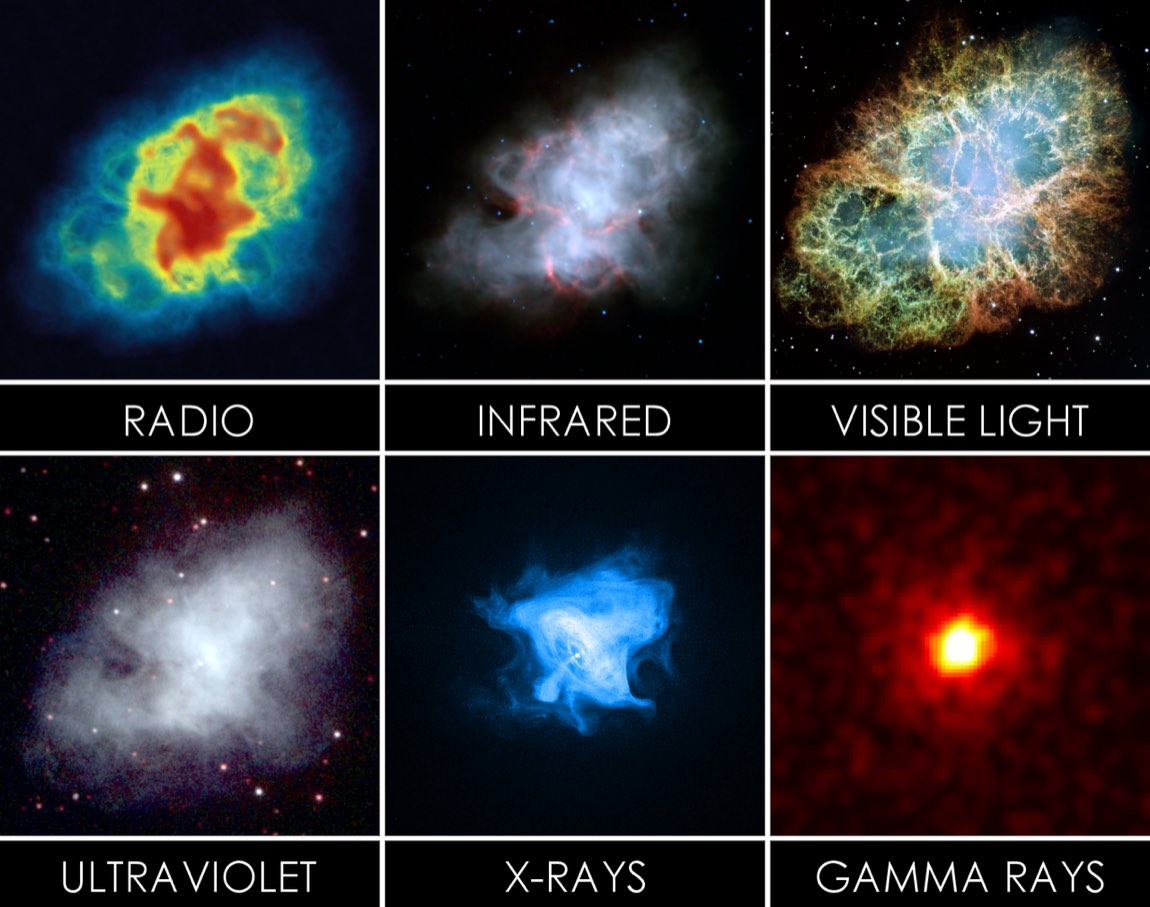
A telescope is a light bucket: the bigger the mirror, the more photons and the finer the detail. Refractors bend light through lenses; reflectors (every big modern scope) focus it with mirrors. Beyond visible light, 'telescopes' become dishes for radio, orbiting detectors for X-rays — each opening a sense humans never had.
Go deeper Advanced
Resolution ∝ wavelength/aperture — hence interferometry, linking separated dishes into virtual giants (the EHT's Earth-sized black-hole imager). Adaptive optics deform mirrors hundreds of times a second to cancel atmospheric blur, beating space telescopes at some tasks. The 2030s bring 30-m-class ground giants and, in orbit, the Habitable Worlds Observatory — built to photograph Earth-like exoplanets directly.
The deep dive
Researched for the Atlas from Wikipedia — Telescope (11,819 characters read) · updated Sep 20, 2026
01 Who really invented the telescope?
The earliest existing record of a telescope is a 1608 patent submitted to the Dutch government by Middelburg spectacle maker Hans Lipperhey for a refracting telescope. Yet the article is frank about this: the actual inventor is unknown. Word of the device spread rapidly through Europe, and within a year Galileo Galilei had heard about it, built his own version, and turned it on the sky. The word itself came slightly later — coined in 1611 by Greek mathematician Giovanni Demisiani at a banquet of the Accademia dei Lincei, where he named Galileo's instrument from the Ancient Greek roots tele, meaning 'far,' and skopein, meaning 'to look or see.' Before that evening, Galileo had been calling it by the Latin term perspicillum in his landmark work the Starry Messenger. So the telescope had a working life of several years before it even had a proper name.
02 The mirror alternative: why reflectors won
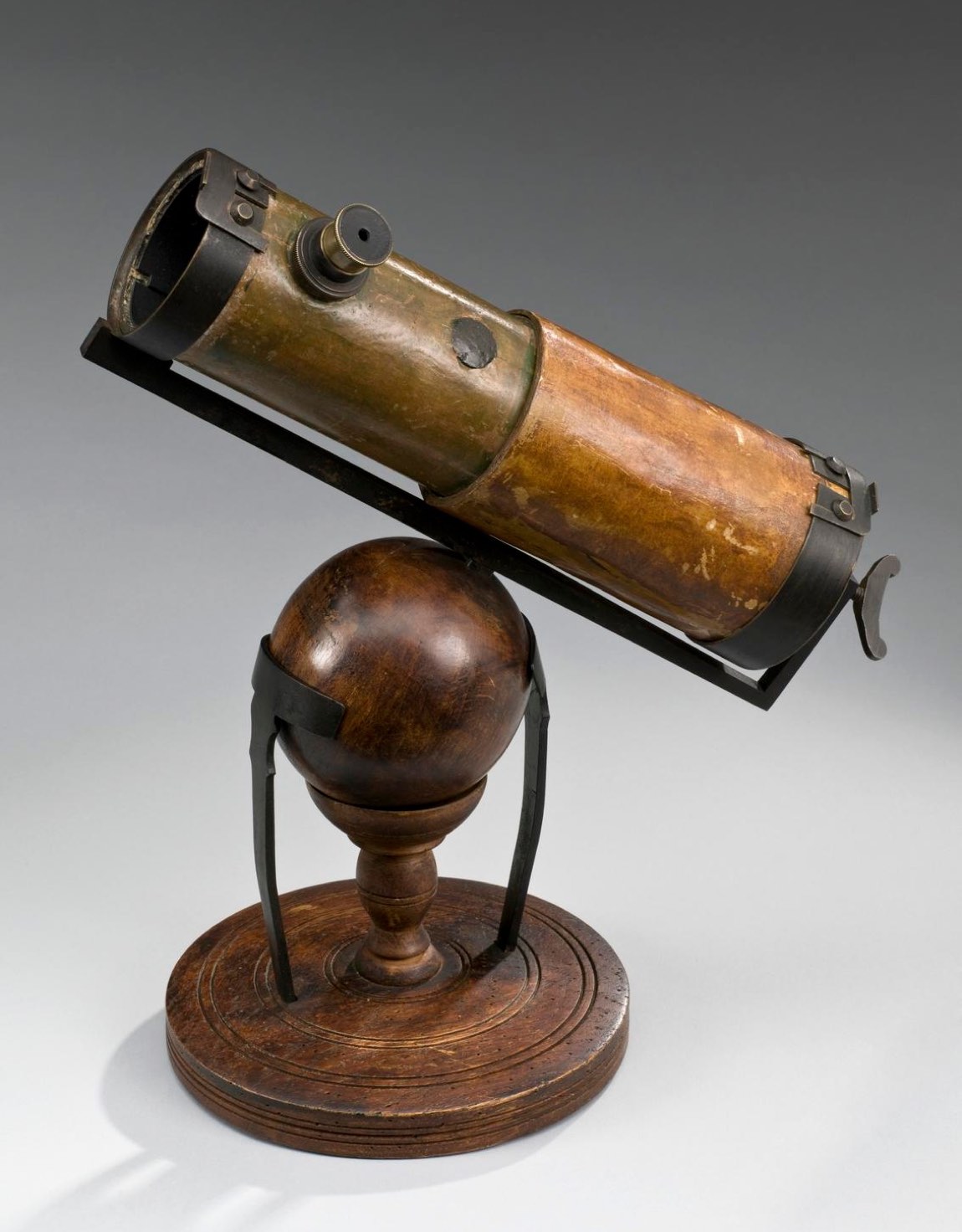
Almost as soon as the refracting telescope appeared, astronomers and opticians began wondering whether a mirror could do the job of the front lens. The appeal was practical: mirrors suffer from neither chromatic aberration nor spherical aberration in the same way lenses do, making parabolic mirrors particularly attractive. Many designs were proposed, but it was Isaac Newton who in 1668 built the first practical reflecting telescope — the design still called the Newtonian reflector in his honour. Early reflectors had a serious weakness: their mirrors were made of speculum metal, an alloy that tarnished quickly, robbing the telescope of light. This problem persisted through the 18th and early 19th centuries. Relief came in 1857 with the introduction of silver-coated glass mirrors, and again in 1932 when aluminized mirrors arrived. These advances meant reflectors could be made large and kept bright, and they have dominated professional astronomy ever since.
 ⤢
⤢
03 Why refractors hit a hard size ceiling
The achromatic lens, invented in 1733, partially corrected the color aberrations that plagued simple glass lenses and allowed builders to make shorter, more useful refracting telescopes. But no matter how clever the lens design, a fundamental physical limit applies: the maximum practical size for a refracting telescope objective is about 1 meter, or roughly 39 inches. A lens must be supported only at its edge, so as it grows larger it sags under its own weight and distorts the image. A mirror, by contrast, can be supported across its entire back surface. This is why the vast majority of large optical research telescopes built since the early 20th century have been reflectors. Today the largest reflecting telescopes have objectives exceeding 10 meters — about 33 feet across, roughly the width of a two-lane road — and several designs in the 30 to 40 meter range are currently under development.
04 Radio astronomy's surprisingly recent birth
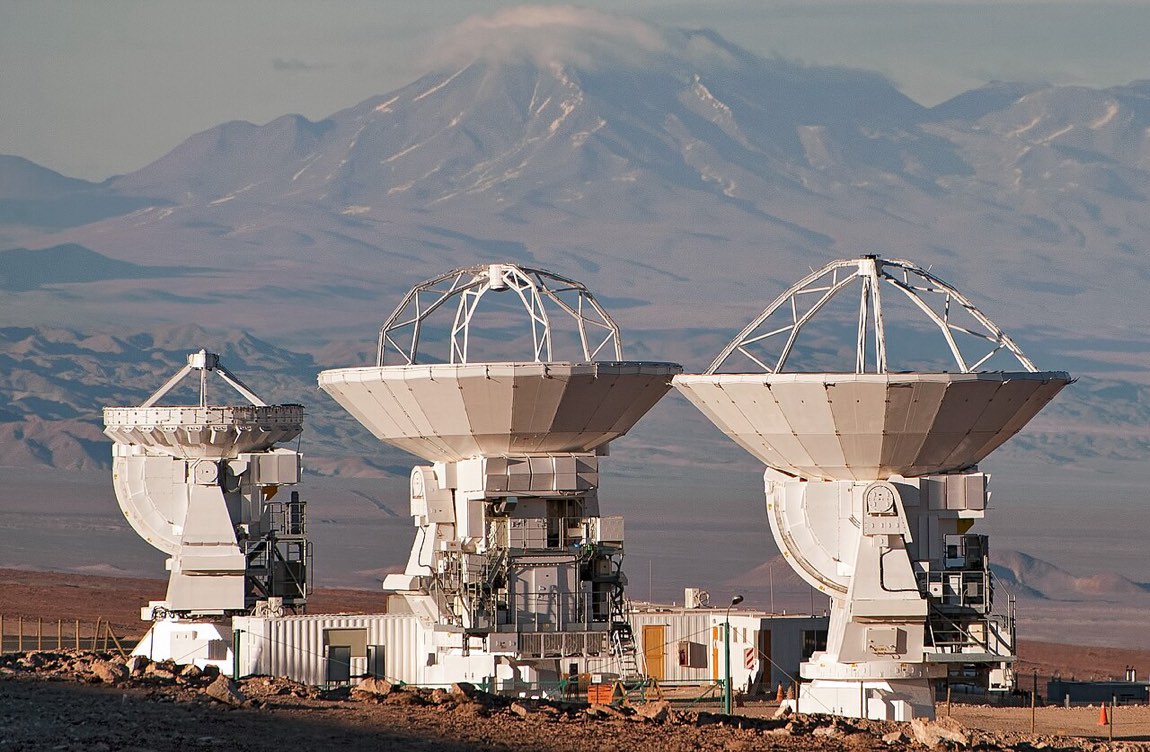
It might seem as though radio telescopes have always been part of astronomy's toolkit, but the first purpose-built radio telescope only went into operation in 1937 — just a few decades before humans landed on the Moon. Radio telescopes are directional antennas that typically use a large dish to collect radio waves. The dish can even be constructed from a conductive wire mesh, provided the gaps in the mesh are smaller than the wavelength being observed. Unlike an optical telescope, which delivers a magnified picture of a patch of sky, a traditional single-dish radio telescope contains one receiver and records a single time-varying signal that can be sampled at various frequencies. Newer designs place an array of several receivers in the focal plane — a focal-plane array — capturing more of the sky in one pass. Some radio telescopes, including the Allen Telescope Array and the Arecibo Observatory, have been used by SETI programs searching for signs of extraterrestrial life.
 ⤢
⤢
05 Interferometry: Earth-sized virtual mirrors Deeper
A single radio dish is limited in its sharpness by its physical size, but astronomers found a way around this by linking multiple dishes together in a technique called aperture synthesis. By collecting and correlating signals received simultaneously by several dishes, researchers can compute high-resolution images as though they had a single mirror as wide as the distance between the outermost dishes. These linked networks are called astronomical interferometers, and their 'virtual' aperture matches the separation between their components. By 2005, the record array size reached many times the diameter of the Earth, achieved using space-based very-long-baseline interferometry with satellites such as the Japanese HALCA — the Highly Advanced Laboratory for Communications and Astronomy — operating under the VSOP program. The same aperture synthesis principle has since been extended to optical wavelengths, using both arrays of separate optical telescopes and a technique called aperture masking interferometry applied at single large reflecting telescopes.
06 The atmosphere as gatekeeper of wavelengths
Earth's atmosphere is opaque to most of the electromagnetic spectrum, leaving only a few windows through which ground-based telescopes can peer. The transparent bands include visible light, near-infrared radiation, and a portion of radio waves. This opacity is the reason no ground-based X-ray or far-infrared telescopes exist — those observations must be made from orbit. Even wavelengths that do penetrate the atmosphere can still benefit from a space-based platform, since clouds, atmospheric turbulence (astronomical seeing), and light pollution all degrade ground-based images. High-energy X-ray and gamma-ray telescopes are typically placed on high-altitude balloons or Earth-orbiting satellites. The Fermi Gamma-ray Space Telescope, an example of this class, was launched in June 2008. For ultraviolet observations, the situation is similar: most ultraviolet light is absorbed by the atmosphere, requiring instruments to operate from the upper atmosphere or from space entirely.
 ⤢
⤢
07 Grazing mirrors: the trick behind X-ray vision Deeper
X-rays are far harder to focus than visible light because they pass straight through conventional mirrors rather than reflecting cleanly off them. The solution is to bounce X-rays off ring-shaped metal mirrors at very shallow angles — just a few degrees from the surface — in what are called glancing-incidence or grazing-incidence optics. In 1952, Hans Wolter outlined three distinct ways to build a telescope using only this kind of mirror, typically pairing a section of a rotated parabola with either a hyperbola or an ellipse. Observatories built on Wolter's designs include the Einstein Observatory, ROSAT, and the Chandra X-ray Observatory. In 2012 the NuSTAR X-ray Telescope was launched, using Wolter-design optics mounted at the end of a long deployable mast, which enables it to detect photon energies up to 79 keV — energies far beyond what earlier X-ray observatories could capture. That same year, a separate discovery suggested that at photon energies greater than 700 keV, the index of refraction begins to increase again, potentially opening a path toward true focusing gamma-ray telescopes.
08 Catching the highest-energy light ever seen Deeper
Very high energy gamma rays — with shorter wavelengths and higher frequencies than ordinary gamma rays — cannot be focused by any current mirror technology, so astronomers use two entirely different strategies to detect them. The first approach uses Imaging Atmospheric Cherenkov Telescopes, or IACTs, which detect the faint blue flash of Cherenkov radiation produced when a gamma-ray-initiated particle shower hits the atmosphere at speeds exceeding light's speed in air. H.E.S.S. and VERITAS are working examples; the next-generation Cherenkov Telescope Array, known as CTA, was under construction at the time the article was written. The second strategy uses Water Cherenkov Detectors, which catch the same Cherenkov light but inside large tanks of ultra-pure water. HAWC and LHAASO are examples of this water-based approach. For gamma rays that fall just below the very-high-energy threshold, coded aperture masks are used: the shadow pattern cast by the mask onto a detector can be mathematically reconstructed into an image of the sky.
09 Space telescopes: remarkable reach, real trade-offs
Placing a telescope in orbit removes the blurring atmosphere and opens otherwise inaccessible wavelength windows, but the article is careful to list the genuine disadvantages: cost, constrained size, and difficulty with maintenance and upgrades. Several NASA space telescopes illustrate the range of what becomes possible. The Hubble Space Telescope detects visible light, ultraviolet, and near-infrared wavelengths. The Spitzer Space Telescope was designed for infrared radiation, observing from about 3 micrometres to 180 micrometres and using a mirror-based reflecting optical system. The Kepler Space Telescope discovered thousands of exoplanets. Most recently, the James Webb Space Telescope was launched on 25 December 2021 on an Ariane 5 rocket from Kourou, French Guiana. Webb detects infrared light and orbits the L2 Lagrange Point of the Earth-Sun system, a gravitationally stable location roughly 1.5 million kilometres from Earth that keeps the telescope in a cold, shadow-friendly position ideal for infrared observations.
10 How wavelength shapes the instrument's design Deeper
There is no single 'correct' design for a telescope — the right technology depends almost entirely on the wavelength being observed. At near-infrared wavelengths, light can be handled much like visible light, using mirrors and lenses. Move to far-infrared or submillimetre wavelengths and the instrument starts to resemble a radio telescope. The James Clerk Maxwell Telescope illustrates this: it observes across a range from 3 micrometres to 2000 micrometres but uses a parabolic aluminium antenna rather than conventional reflecting optics. By contrast, the Spitzer Space Telescope covers a comparable range — roughly 3 micrometres to 180 micrometres — yet uses a mirror system. The Hubble Space Telescope's Wide Field Camera 3 operates from about 0.2 micrometres in the ultraviolet out to 1.7 micrometres in the infrared. At the short-wavelength, high-frequency end of the spectrum, glancing-incidence optics become necessary, as used by solar telescopes such as TRACE and SOHO, which employ special mirrors to reflect extreme ultraviolet and achieve higher resolution and brighter images than otherwise possible.
11 Aperture: more than just collecting more light
A common assumption is that a telescope's aperture — the diameter of its light-collecting element — matters only because a bigger opening gathers more photons, making faint objects visible. That is true, but it is only half the story. A larger aperture also enables finer angular resolution, meaning the telescope can distinguish objects that are closer together on the sky. This is why professional observatories pursue ever-larger mirrors: the gain is not just brightness but sharpness. The Dobsonian telescope, invented by John Dobson in 1956, made large-aperture reflecting telescopes accessible to amateur astronomers by mounting a Newtonian reflector on a simple, inexpensive alt-azimuth mount. Meanwhile, at radio wavelengths, aperture synthesis using interferometer arrays mimics the resolution of a mirror as large as the baseline between the most widely separated dishes — achieving resolutions that no single physically constructed dish could ever match.
✦ Keep exploring