Cosmology
Dark Energy
Strong EvidenceThe idea
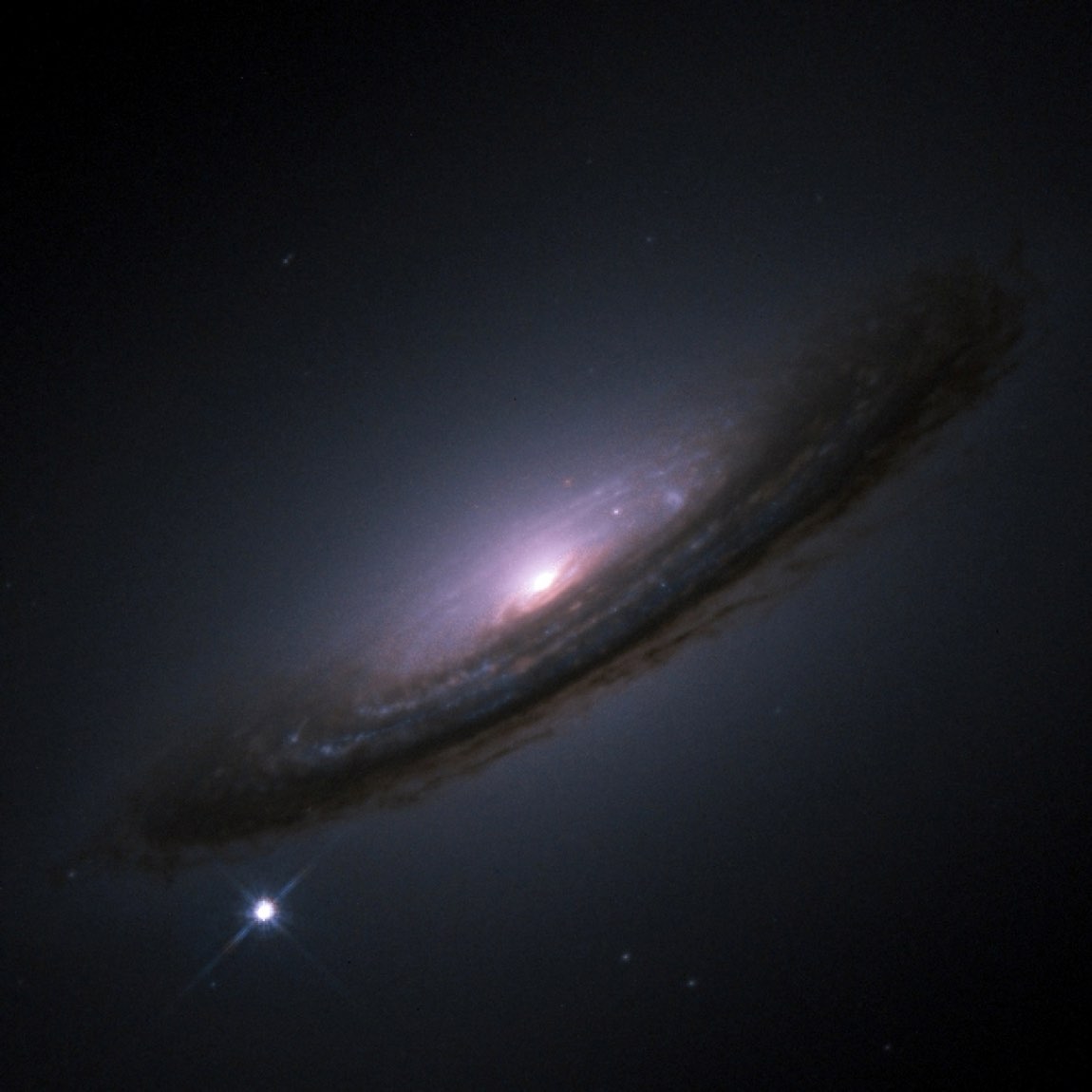
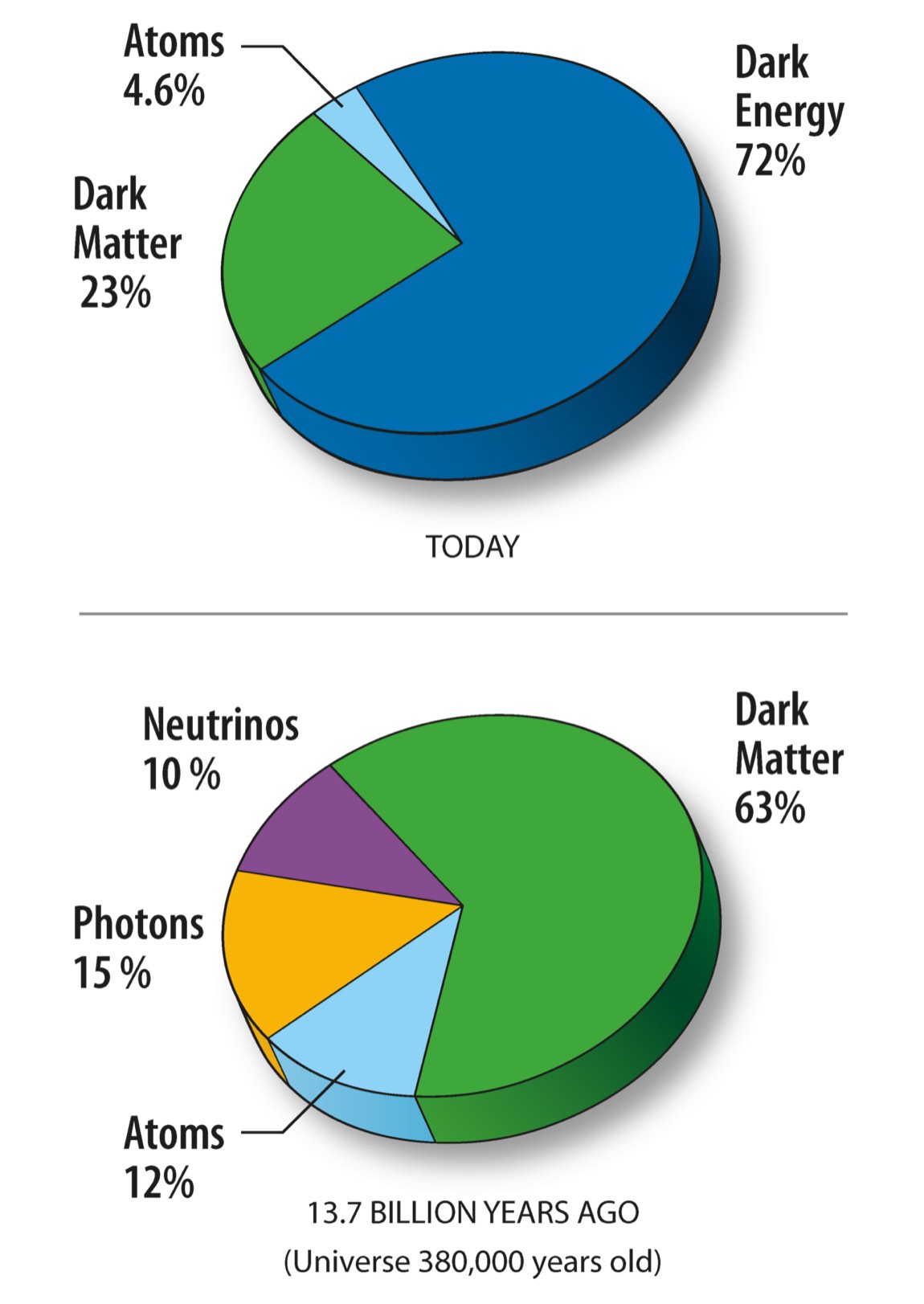
In 1998, astronomers measuring distant supernovae expected to find the universe's expansion slowing under gravity. It's speeding up. Something — named 'dark energy' as an honest placeholder — acts like a stretchiness of empty space itself, and it makes up about 68% of everything. What is it? Nobody knows. It may decide whether the universe ends in cold emptiness or something stranger.
Go deeper Advanced
Two independent supernova teams (Nobel 2011), corroborated by CMB + baryon acoustic oscillations. Simplest fit: a cosmological constant Λ — but quantum estimates of vacuum energy miss by ~120 orders of magnitude, physics' worst prediction. DESI's 2024–25 results hint dark energy may weaken over time; if confirmed, the fate-of-universe question genuinely reopens. Watch this space.
The deep dive
Researched for the Atlas from Wikipedia — Dark energy (35,883 characters read) · updated Sep 20, 2026
01 Who named it and when
The phrase "dark energy" is surprisingly young. Cosmologist Michael S. Turner coined the term in 1998, in a paper he wrote together with Saul Perlmutter and Martin White — the same year the supernova teams first published evidence for accelerating expansion. Before that, physicists talked about the cosmological constant, vacuum energy, or a smooth additional component, but there was no single catchy label. Turner's coinage arrived at exactly the right moment: within a few years it had become the standard name used by researchers worldwide. Perlmutter would go on to share the 2011 Nobel Prize in Physics with Brian P. Schmidt and Adam G. Riess for leading the discovery that prompted the term in the first place.
02 Einstein's biggest blunder — and why it wasn't
When Einstein wrote his general relativity field equations in the 1910s, the prevailing assumption was that the universe is static and eternal. To prevent his equations from predicting either an expanding or a collapsing universe, he introduced an extra term he called the cosmological constant, symbol Λ. He described the effect as if 'empty space takes the role of gravitating negative masses that are distributed all over the interstellar space.' When Edwin Hubble's 1929 observations showed the universe is in fact expanding, Einstein reportedly called his failure to predict a dynamic universe his greatest blunder. The irony is that his constant, discarded as an embarrassment, turned out to be one of the leading candidates for what we now call dark energy. The idea he regretted may have been right all along — just for the wrong reason.
03 Why a static universe could never have worked Deeper
Even if Einstein's cosmological constant had perfectly balanced gravity at some moment, that balance would have been fatally unstable. If the universe expanded by even a tiny amount, the release of additional vacuum energy would have driven yet more expansion — a runaway. Equally, a slight contraction would have cascaded into collapse. Because matter is not perfectly smoothly distributed throughout the universe, local lumps and voids are inevitable, and these perturbations would have pushed the universe away from the equilibrium in one direction or the other. A truly static universe was therefore impossible even under Einstein's own equations, making his attempt at fine-tuning an exercise that could never have succeeded regardless of the observational evidence Hubble later provided.
04 How supernovae became cosmic measuring sticks
Measuring distances across billions of light-years is extraordinarily difficult, but Type Ia supernovae offer a remarkable shortcut. These stellar explosions all reach very nearly the same peak brightness, making them what astronomers call standard candles: objects whose true luminosity is known. By comparing that true luminosity with how faint the supernova appears from Earth, researchers can calculate its distance precisely. Then, by measuring the supernova's redshift — how much its light has been stretched by the expansion of space — they know how fast the universe was expanding when that light was emitted. Plotting distance against recession speed across many supernovae revealed in 1998 that distant supernovae were fainter than expected: the universe was expanding more slowly in the past and is speeding up now. Recent supernova observations are consistent with a universe composed of 66.6% dark energy and 33.4% matter combined.
05 Three independent clues pointing the same way
The case for dark energy does not rest on supernovae alone. The first independent pillar came in 2000, when the BOOMERanG and Maxima balloon experiments measured the first acoustic peak in the cosmic microwave background, showing that the universe's total mass-energy density is very close to 100% of the critical density needed for a flat geometry. The second pillar came in 2001, when the 2dF Galaxy Redshift Survey showed that matter — dark and ordinary combined — accounts for only about 30% of that critical density. The gap between 100% and 30% demands something else, and dark energy is the leading candidate to fill it. The third pillar, confirmed in 2008, is the late-time Integrated Sachs–Wolfe effect: accelerating expansion flattens gravitational wells as photons cross them, leaving subtle temperature imprints on the microwave background that align with large cosmic voids and superclusters.
06 Baryon acoustic oscillations as standard rulers Deeper
Sound waves that rippled through the hot plasma of the early universe left a preferred scale stamped into the distribution of matter — a characteristic void size of approximately 150 megaparsecs in diameter. Because that scale is known from theory and from microwave background measurements, these baryon acoustic oscillation (BAO) voids act as standard rulers: measuring their apparent size at different distances reveals how fast the universe was expanding at each epoch. The 2011 WiggleZ galaxy survey used data from more than 200,000 galaxies scanned by the Australian Astronomical Observatory to exploit exactly this technique, confirming cosmic acceleration out to redshift 0.6, corresponding to roughly half the current age of the universe, or about 7 billion years ago. This confirmation was entirely independent of supernovae. More recently, data from the Dark Energy Spectroscopic Instrument suggest that dark energy's density may be about 10% lower now than it was 4.5 billion years ago.
 ⤢
⤢
07 DESI's hint that dark energy might be changing Deeper
For decades the simplest model held that dark energy is a fixed cosmological constant — the same everywhere and at all times. In March 2025 the Dark Energy Spectroscopic Instrument (DESI) collaboration announced a significant challenge to that picture. By combining DESI's baryon acoustic oscillation measurements with cosmic microwave background data, weak gravitational lensing, and supernova datasets, the team found evidence that the density of dark energy is slowly decreasing with time. The statistical significance of this finding ranged from 2.8 to 4.2σ depending on which combination of datasets was used. This is not yet strong enough to definitively rule out a cosmological constant, but it is the most compelling observational hint so far that dark energy might be a dynamic field rather than a fixed property of empty space. If confirmed, it would rule out the simplest version of Einstein's constant.
08 The vacuum energy disaster: 120 orders of magnitude Deeper
Quantum field theory predicts that empty space should hum with energy from particle-antiparticle pairs that flicker in and out of existence within the limits set by Heisenberg's uncertainty principle. General relativity says this vacuum energy should gravitate. The problem is the scale: quantum calculations give a vacuum energy density roughly 120 orders of magnitude larger than what is actually observed. That is not a small discrepancy — it is arguably the worst quantitative mismatch in all of physics. To make the numbers work, some enormous positive quantum contribution would need to be almost perfectly cancelled by an equally enormous negative term, with the cancellation precise to 120 decimal places. No one knows what mechanism could enforce such extraordinary fine-tuning. This cosmological constant problem remains completely unsolved, and it means that even if dark energy equals the cosmological constant, physicists still lack a satisfying explanation for why its value is so small but not exactly zero.
09 Quintessence: dark energy that moves and changes Deeper
Where the cosmological constant is fixed and featureless, quintessence is a dynamical scalar field that can vary across both space and time. In the simplest quintessence models the field carries potential energy — analogous to a ball rolling slowly down a very shallow hill — and this energy drives expansion. To avoid clumping into structures the way ordinary matter does, the quintessence field must have a very large Compton wavelength, meaning it responds only to variations on the largest cosmic scales. Some quintessence models feature 'tracker' behavior, in which the field's energy density closely follows, but stays below, the radiation energy density of the early universe until a natural transition triggers dark energy domination — potentially explaining why acceleration started when it did rather than much earlier. No evidence for quintessence has yet been found, nor has it been ruled out. A 2004 proposal called Quintom, advanced by Xinmin Zhang's group, requires at least two scalar field types and predicts that the equation-of-state parameter ω crossed below −1 at some point.
10 Why dark energy doesn't thin out as space expands
Ordinary matter becomes less dense as the universe grows: double the volume of a box and the density of its contents falls by a factor of eight. Radiation dilutes even faster, because expansion also redshifts each photon, reducing its energy. Dark energy behaves fundamentally differently. If it is the cosmological constant, its energy density stays exactly the same regardless of how large the volume becomes, because it is an intrinsic property of space itself — not something contained within space. As new space is created by expansion, new dark energy comes with it. In the standard notation of cosmology this is written ρ ∝ a⁰, where a is the scale factor: any power of zero gives one, meaning density is unchanged. This is why dark energy, despite being extraordinarily dilute at roughly 7×10⁻³⁰ g/cm³, comes to dominate the universe's energy budget: matter thins away while dark energy stays constant.
11 Cosmic chronometers: clocks made of galaxies Deeper
A relatively new technique for probing dark energy uses passively evolving, early-type elliptical galaxies as natural clocks. Because these old, red galaxies stopped forming stars long ago, their stellar populations age predictably, allowing astronomers to estimate how much time elapsed between two different redshifts without assuming any particular cosmological model. The approach, called observational Hubble constant data or OHD, directly measures the Hubble parameter H(z) as a function of redshift by tracking the differential age evolution Δz/Δt. This is advantageous because supernova and baryon acoustic oscillation analyses rely on integrals of H(z), which smooth over variations, whereas cosmic chronometers measure H(z) itself. The method can therefore catch changes in dark energy's behavior that integrated methods might miss, and it sidesteps many systematic effects that can bias other approaches.
12 What a constant dark energy means for the far future
If dark energy is a true cosmological constant and continues accelerating expansion indefinitely, the consequences for the far future are stark. Cosmologists calculate that the current distance to the cosmological event horizon — the boundary beyond which no signal can ever reach us — is about 16 billion light-years. Galaxies beyond that boundary are already, in a meaningful sense, permanently out of contact. As time goes on, more and more galaxies will cross this horizon, their light growing ever more redshifted until they fade completely from view. The Milky Way and the Local Group of galaxies would remain gravitationally bound to each other and would survive, but they would be increasingly isolated. Eventually even this remnant would succumb to heat death. The phantom dark energy variant is more dramatic: its density grows with time, and would ultimately tear apart galaxies, solar systems, and finally individual atoms in an event called the Big Rip.
13 Alternatives that don't require dark energy at all Deeper
A significant minority of researchers investigate whether modifications to general relativity, rather than a new energy component, could explain cosmic acceleration. The 2017 gravitational wave event GW170817 — the first gravitational wave source also detected in non-gravitational light — measured the speed of gravity and ruled out many of these modified-gravity theories. Another class of alternatives, grouped under inhomogeneous cosmology, argues that if our galaxy sits inside an emptier-than-average region of space, measurements could give a false impression of acceleration — essentially a local underdensity masquerading as a universal force. Shockwave cosmology, proposed by Joel Smoller and Blake Temple in 2003, reimagines the Big Bang as an explosion inside a black hole; a related proposal by Smoller, Temple, and Vogler predicts a positive cubic correction to the redshift-luminosity relation of C = 0.359, compared with C = −0.180 for a standard dark energy universe — a potentially testable difference. Most professional astrophysicists, however, remain confident that none of these alternatives match observations as precisely as the standard dark energy model.