Space Travel
Interstellar Travel: The Honest Physics
TheoreticalThe idea
The stars are absurdly far: our fastest-ever probe would need 75,000 years to reach the nearest one. Chemical rockets will never do it. The concepts that could — in principle — include fusion rockets, antimatter engines, and laser-pushed light sails (the nearest-term idea: gram-scale probes at 20% light speed reaching Proxima in ~21 years). Crewed starflight would demand generation ships or technologies not yet invented.
Go deeper Advanced
Energy is the wall: 1 kg to 0.2c carries ~2×10¹⁵ J kinetic. Project Orion (nuclear pulses) and Daedalus (fusion) were serious engineering studies; Breakthrough Starshot is funded research. Warp drives (Alcubierre) satisfy GR's equations only with negative energy densities never observed — Theoretical, verging Speculative. No physics forbids slow interstellar arks; economics and biology are the open questions.
The deep dive
Researched for the Atlas from Wikipedia — Interstellar travel (46,408 characters read) · updated Sep 20, 2026
01 Why the nearest star feels impossibly far
Numbers alone rarely convey how vast interstellar distances truly are, so consider this scale model: shrink the Earth–Sun distance down to exactly one meter, roughly the length of a guitar. On that same scale, Alpha Centauri A — one of Proxima Centauri's two companions and the nearest Sun-like star to us — would sit 276 kilometers away, about the distance from London to Newcastle or from Los Angeles to Las Vegas. Every planet in our Solar System, every probe we have ever launched, every human who has ever left Earth, would be crammed into that single meter. Neptune, the outermost planet, lives just 29.8 centimeters from your hand. The gap to the next star is a cross-country drive. Proxima Centauri itself lies approximately 268,332 AU from the Sun, which works out to more than 9,000 times farther away than Neptune. Expressed in the units astronomers prefer, that is 4.243 light-years — meaning light itself, traveling 300,000 kilometers every second, takes more than four years to make the crossing.
02 Voyager 1: our fastest messenger, still crawling
Voyager 1 is the fastest and farthest human-made object ever launched. As of March 2026 it sits 173 AU from Earth, exiting the Solar System at 17 km/s — a blistering speed by any everyday standard, yet only 0.006 percent of the speed of light. In 46 years of flight it has covered just 1/390 of a light-year. At that rate, a journey to Proxima Centauri would require roughly 75,000 years. To put that in human terms: 75,000 years ago, anatomically modern humans were sharing the planet with Neanderthals. Voyager is not, strictly speaking, an interstellar craft — it was never designed to explore another star system. It simply has enough residual velocity to eventually drift beyond the Sun's gravitational influence. The probe's trajectory makes clear that reaching even the nearest star within a human lifetime, let alone a human generation, demands a completely different order of propulsion technology than anything currently flying.
03 The rocket equation's brutal arithmetic Deeper
The central mathematical obstacle to interstellar travel is the Tsiolkovsky rocket equation, which relates the change in velocity a rocket can achieve to its exhaust velocity and the ratio of its starting mass to its final mass. To reach a significant fraction of light speed, you need either an extraordinarily fast exhaust or an enormous mass ratio — meaning the ship must be almost entirely fuel at launch. The most advanced electric rocket engines flying today reach a characteristic velocity of only about 100 km/s, which experts such as Edgar Choueiri have said is far too slow for any star voyage. Chemical engines offer high thrust but burn for only minutes and carry chemically stored energy too modest for the task. Nuclear-electric systems convert nuclear energy into electricity to drive ion thrusters, but the heavy conversion equipment yields tiny acceleration — Dr. Tony Martin calculated it would take a century to reach even 15 percent of light speed. Even fusion rockets, which release roughly 0.3 to 0.9 percent of their fuel mass as energy, face severe engineering difficulties that may remain unsolved for decades or centuries.
04 How much energy does interstellar flight cost? Deeper
The kinetic energy needed for interstellar flight is almost incomprehensible on a human scale. Accelerating just one ton of payload to one-tenth of the speed of light requires at least 450 petajoules — that is 4.50×10¹⁷ joules, or 125 terawatt-hours. For comparison, total world energy consumption in 2008 was 143,851 terawatt-hours, so that single one-ton acceleration would consume roughly 1/1,150 of everything humanity produced that year, without accounting for the efficiency of the engine. If the spacecraft must also decelerate on arrival using its own engines rather than some external means, the energy requirement doubles. And because kinetic energy scales with the square of velocity, a ship traveling several thousand times faster than current spacecraft — necessary for a round trip to even the nearest star within a few decades — needs millions of times more energy than those vehicles carry. Brice N. Cassenti of Rensselaer Polytechnic Institute has stated that sending even a probe to the nearest star would require at least 100 times the total annual energy output of the entire world.
 ⤢
⤢
05 Dust, gas, and the danger of cruising at 10% light speed
Interstellar space is not a perfect vacuum. It contains gas and dust — on average roughly one atom per cubic centimeter — and occasional larger grains and macroscopic objects. At the speeds required for interstellar travel, even tiny particles become lethal. A single gram of matter moving at 90 percent of the speed of light carries kinetic energy equivalent to a small nuclear bomb, approximately 30 kilotons of TNT. Larger dust grains, though far rarer, would be far more destructive. The distribution of this material is not uniform: it varies along different trajectories out of the Solar System, meaning some routes are more hazardous than others. Various shielding concepts have been proposed, but many unknowns remain. Interestingly, one proposed engine type — the interstellar ramjet — would actually benefit from a denser interstellar medium, since it would scoop up that hydrogen as fuel. Some deceleration concepts similarly exploit the medium rather than fight it.
06 Time dilation: the physics of arriving younger Deeper
Einstein's special relativity offers interstellar travelers a strange gift: time passes more slowly the closer you travel to the speed of light, a phenomenon called time dilation. The effect becomes noticeable above roughly 80 percent of light speed. A concrete worked example from the article illustrates this vividly. A ship accelerating at a constant 1.03 g — just slightly more than normal Earth gravity, comfortable for passengers — toward a star 32 light-years away, coasting at constant speed, then decelerating, could complete a round trip in just 40 years of shipboard time. Earth clocks, however, would show 76 years had elapsed. At higher speeds the effect compounds dramatically: a ship capable of sustained 1 g acceleration could theoretically reach the center of the Milky Way, 30,000 light-years away, and return within 40 years of ship time — but would arrive home to find that more than 60,000 years had passed on Earth. From the astronaut's perspective aboard such a ship, the universe itself appears compressed along the direction of travel, so that a 32-light-year journey looks like only 16 light-years.
07 Should you wait for a faster ship? The Kennedy calculation
There is a genuine strategic puzzle in interstellar mission planning: if propulsion technology keeps improving, a slow probe launched today might be overtaken by a faster one launched decades later. Physicist and speculative fiction writer Robert L. Forward argued that any mission requiring more than 50 years to complete should not be started at all, because advancing technology would almost certainly produce a faster successor that would arrive first — a principle called the incessant obsolescence postulate. In 2006, Andrew Kennedy worked through the mathematics more precisely, asking: given a sustained annual growth rate in propulsion capability, when is the optimal departure date for a specific destination? For a journey of 6 light-years, Kennedy concluded that the best departure point — the mission that overtakes all earlier launches and will not itself be overtaken — would come if growth continues at about 1.4 percent per annum, placing the ideal launch approximately 635 years from his writing, around the year 2641. Kennedy described this as potentially the most significant calculation for competing civilizations or cultures occupying the galaxy.
08 Nuclear pulse propulsion and Project Daedalus Deeper
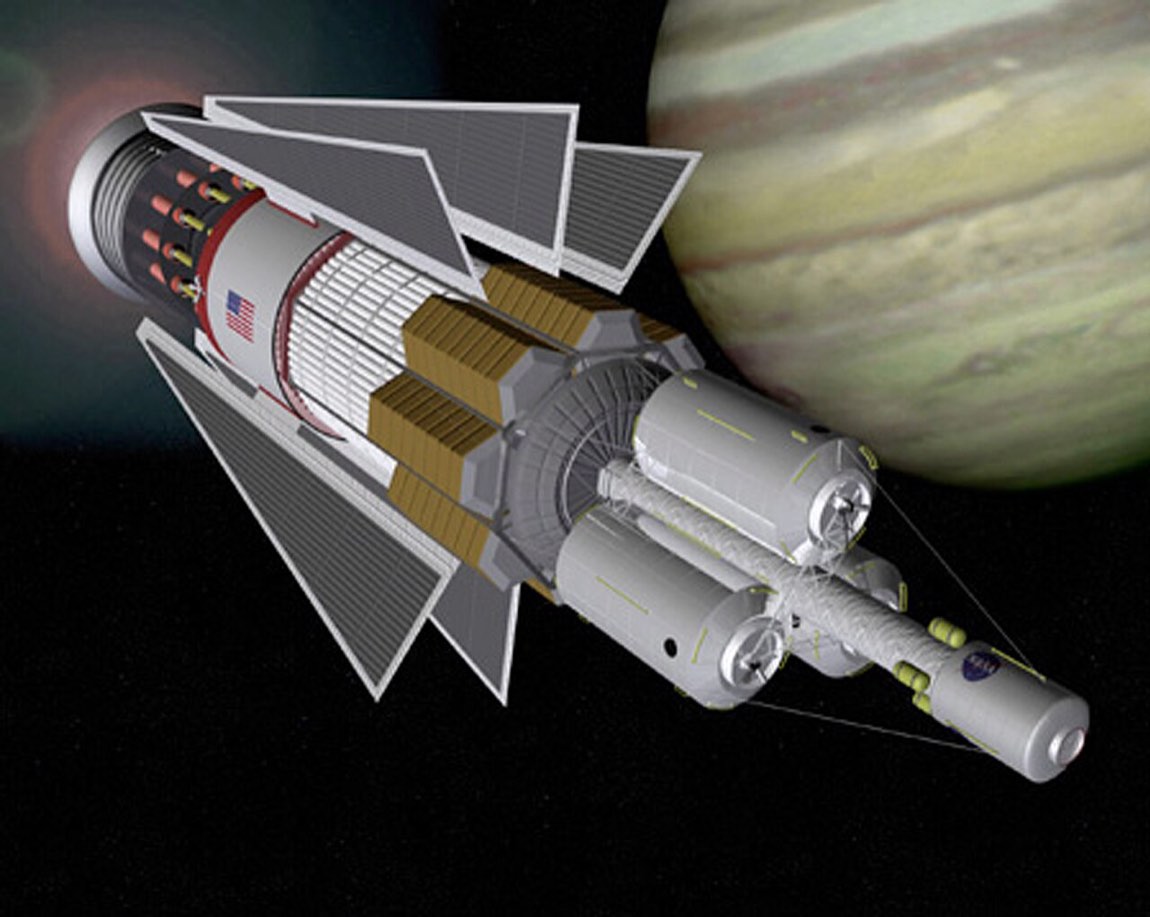
The most thoroughly studied candidate for an actual interstellar probe is thermonuclear pulse propulsion. Project Orion team member Freeman Dyson proposed in 1968 a spacecraft driven by pure deuterium fusion detonations, computing an exhaust velocity of 15,000 km/s and concluding that a 100,000-tonne vehicle could achieve a delta-v of 20,000 km/s — enough for a 130-year flight to Alpha Centauri. Later analysis suggests that a Teller-Ulam thermonuclear Orion could achieve roughly 8 to 10 percent of the speed of light without saving fuel for deceleration; a fission-only Orion reaches perhaps 3 to 5 percent. In the 1970s the British Interplanetary Society's Project Daedalus refined the concept using inertial confinement fusion — compressing fuel pellets with high-powered electron beams — and concluded this was the only propulsion method suitable for the probe they were designing. A key legal obstacle today is the 1963 Partial Test Ban Treaty, which prohibits detonating any nuclear device in space, meaning any such program would require international renegotiation before it could proceed.
 ⤢
⤢
09 Lightsails, lasers, and stopping at the destination
Beamed propulsion sidesteps the rocket equation entirely by leaving the energy source at home. A powerful laser array in the Solar System pushes a lightweight sail and payload without the ship needing to carry fuel. Robert L. Forward worked out an elegant solution to the deceleration problem that such craft face: as the ship approaches its target, a secondary sail of 30 kilometers is deployed behind the spacecraft. The large primary sail — 100 kilometers across — is then detached and continues forward; light reflected back from it strikes the secondary sail, slowing the payload without any laser array needing to exist at the destination. Geoffrey A. Landis of NASA's Glenn Research Center proposed a diamond sail just a few nanometers thick, driven by solar-energy-powered lasers, capable of reaching 10 percent the speed of light, making a trip to Alpha Centauri possible in roughly 43 years in a fly-by mode. Slowing to stop at Alpha Centauri, Landis estimated, could stretch the journey to 100 years. Breakthrough Starshot, announced on 12 April 2016, represents the most publicized current effort to pursue this approach with small laser-propelled probes.
10 Generation ships and suspended animation: slow roads
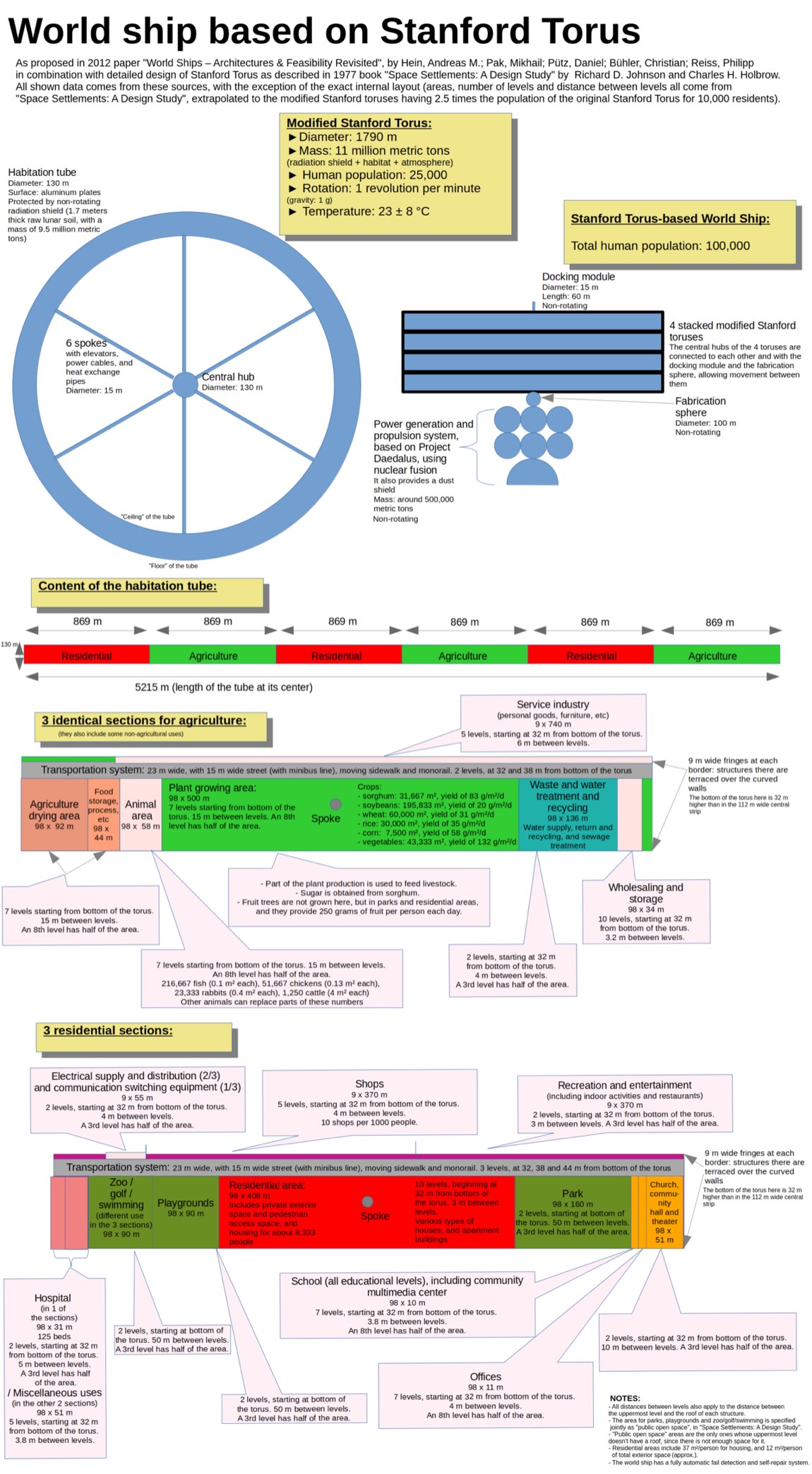
Not every interstellar concept races toward the destination. Generation ships carry crews who know they will never arrive — their descendants, born and raised on the vessel, will complete the voyage. The idea requires constructing a ship of enormous scale capable of sustaining a biologically and socially stable population across centuries, challenges that remain unsolved. Suspended animation offers a different answer: passengers sleep through the journey in human hibernation or cryonic preservation, arriving without having experienced subjective time. Neither approach is currently practical. A third option bypasses living adults entirely: a robotic ship carrying frozen human embryos would travel to a pre-identified habitable planet, where a fully autonomous system would gestate and raise the embryos using artificial uteruses and educational robots. This path requires the prior detection of a genuinely habitable terrestrial world and advances in autonomous robotics that do not yet exist. Interstellar space also contains trillions of icy bodies — from Oort Cloud asteroids to possible rogue planets — which some researchers have proposed using as waystations, allowing a slow island-hopping migration across the void.
11 Why nearby targets are rarer than hoped
There are 59 known stellar systems within 40 light-years of the Sun, containing 81 visible stars. This sounds like a rich catalog of destinations, but astrophysicist Sten Odenwald has pointed out a sobering reality: intensive study of thousands of detected exoplanets shows that most of the closest destinations within 50 light-years do not host Earth-like planets in their star's habitable zones. On August 24, 2016, astronomers announced Proxima Centauri b, an Earth-size planet orbiting within the habitable zone of Proxima Centauri at 4.2 light-years — the nearest known potentially habitable exoplanet. In February 2017, NASA's Spitzer Space Telescope revealed seven Earth-size planets around the ultra-cool dwarf star TRAPPIST-1, located 40 light-years away, three of them firmly in the habitable zone. Even with promising targets identified, Odenwald notes that travelers would have to spend up to 200 years at 20 percent the speed of light to reach the best known candidates — and upon arrival would face the question of whether the atmosphere is survivable without a permanent sealed habitat.
12 Antimatter rockets and their energy trade-offs Deeper
Matter-antimatter annihilation offers the highest energy density of any proposed propulsion method. In principle, pure annihilation rockets could achieve velocities between 50 and 80 percent of the speed of light, making relativistic time dilation meaningfully useful to crew members. The physics, however, impose hard limits. When antimatter annihilates, a large fraction of the energy escapes immediately as gamma rays and neutrinos that cannot be captured for thrust; only about 40 percent of the total mc² is actually available even in an idealized system. That still surpasses fusion's roughly 1 percent yield substantially. The second problem is heat: even assuming excellent shielding for passengers, penetrating gamma radiation would inevitably deposit enormous energy into the vehicle structure. For a ship accelerating at 0.1 g, this works out to approaching 0.3 trillion watts per ton of ship mass — a thermal engineering challenge of staggering proportions. Whether antimatter propulsion could realistically push a vessel above 90 percent of light speed, where time dilation becomes most dramatic, is considered doubtful given the vast quantities of antimatter that would be required to produce and safely store.