Cosmology
The Multiverse
SpeculativeThe idea
Might our universe be one bubble in an endless foam? Some versions of inflation never stop everywhere: new universes bud off eternally, possibly with different physical constants. It would explain why our constants seem 'tuned' for complexity (we could only exist in a hospitable bubble). It also may be forever untestable — which is why this page wears the site's most honest label: Speculative.
Go deeper Advanced
Levels (Tegmark): beyond-horizon regions (uncontroversial), eternal-inflation bubbles, quantum many-worlds, mathematical ensembles — each more contentious. Potential tests (bubble-collision CMB scars) have found nothing. Critics argue unfalsifiability places it outside science; defenders answer that it's a PREDICTION of theories testable elsewhere. The debate itself is about what science is.
The deep dive
Researched for the Atlas from Wikipedia — Multiverse (26,362 characters read) · updated Sep 20, 2026
01 Where the word 'multiverse' comes from
The word 'multiverse' did not originate with physicists. The American philosopher and psychologist William James coined it in 1895, though he used it in a completely different context from the cosmological one familiar today. That same year the term found its first genuinely scientific footing — not in a paper about cosmic inflation or quantum mechanics, but in the celebrated debate between Ludwig Boltzmann and Ernst Zermelo over statistical mechanics and the arrow of time. So the vocabulary of parallel universes is older than relativity, older than quantum theory, and older than the discovery of other galaxies. The idea itself is older still: the pre-Socratic philosopher Anaximander may have gestured toward infinite worlds in the sixth century BCE, though historians still debate whether he meant coexisting worlds or successive ones. The Greek Atomists Leucippus and Democritus in the fifth century BCE are the first thinkers to whom historians can confidently attribute the concept of innumerable simultaneous worlds, a line of thought continued by Epicurus (341–270 BCE), the Roman Epicurean Lucretius in the first century BCE, and Giordano Bruno (1548–1600) during the Renaissance.
02 Schrödinger's quiet bombshell in Dublin
One of the most consequential early gestures toward a physical multiverse happened not in a journal but in a public lecture. In 1952, in Dublin, Erwin Schrödinger warned his audience that what he was about to say might 'seem lunatic.' He then explained that when his wave equations appeared to describe several different histories unfolding at once, those histories were 'not alternatives, but all really happen simultaneously.' Schrödinger was describing what physicists call superposition — the quantum mechanical feature that a system genuinely occupies multiple states until a measurement is made. He was not yet fully fleshing out the many-worlds interpretation; that formal step came later with Hugh Everett III. But Schrödinger's Dublin lecture marks a striking moment when a founder of quantum theory publicly entertained the notion that reality might be irreducibly plural, and did so with enough self-awareness to preemptively call his own conclusion potentially lunatic.
03 Hugh Everett and the branching worlds idea
The many-worlds interpretation (MWI) of quantum mechanics, credited to Hugh Everett III, forms what Max Tegmark calls a Level III multiverse. The core insight is that quantum mechanics predicts not a single outcome for any measurement but a range of outcomes, each with a different probability. The MWI says every one of those outcomes actually occurs, each in its own 'world' within a universal wave function. To make this concrete: imagine throwing a six-sided die whose result is tied to a quantum event. All six outcomes happen, each in a different branch of reality equally real to its inhabitants. In the famous Schrödinger's cat thought experiment, both the live cat and the dead cat exist — in separate worlds. Tegmark points out something subtle here: a Level III multiverse does not add new possibilities beyond what a Level I multiverse already contains. All the branches generated by quantum splits, if they share the same physical constants, can in principle be found somewhere in the infinite space of a Level I multiverse. The only difference, Tegmark writes, is where your 'doppelgängers' live — in Level I they occupy distant regions of ordinary three-dimensional space; in Level III they inhabit other branches of infinite-dimensional Hilbert space.
04 How cosmic inflation conjures bubble universes
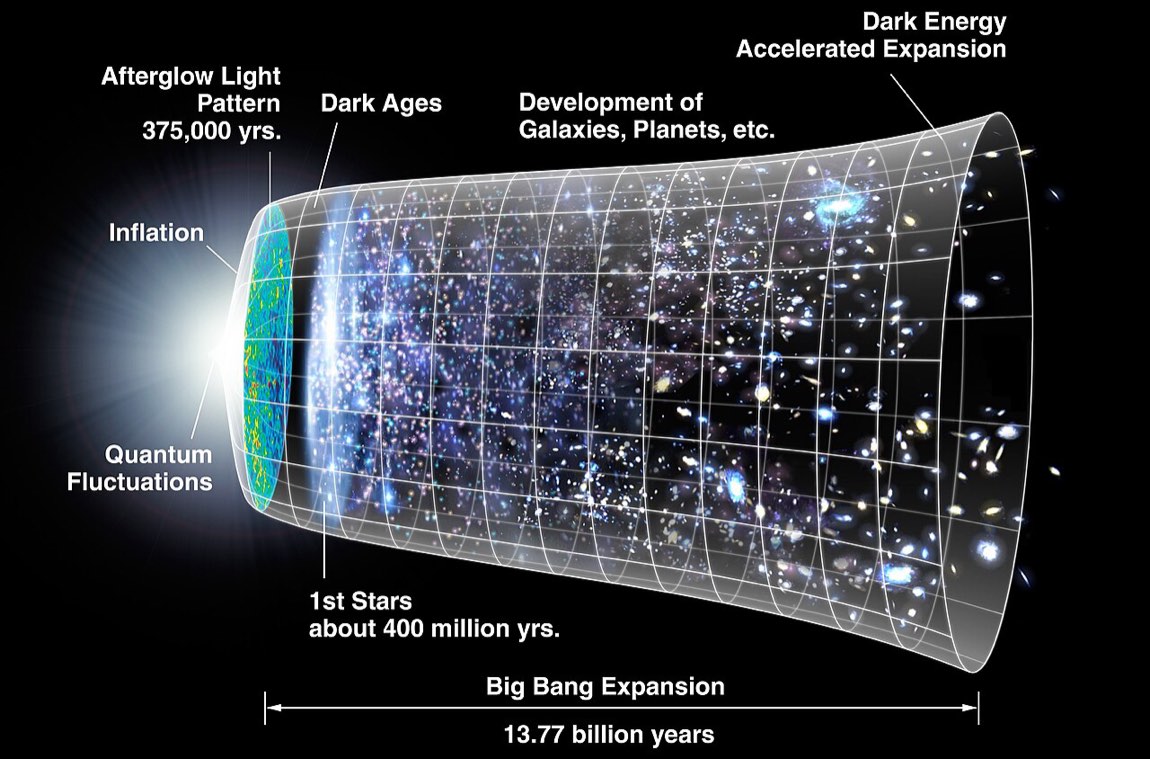
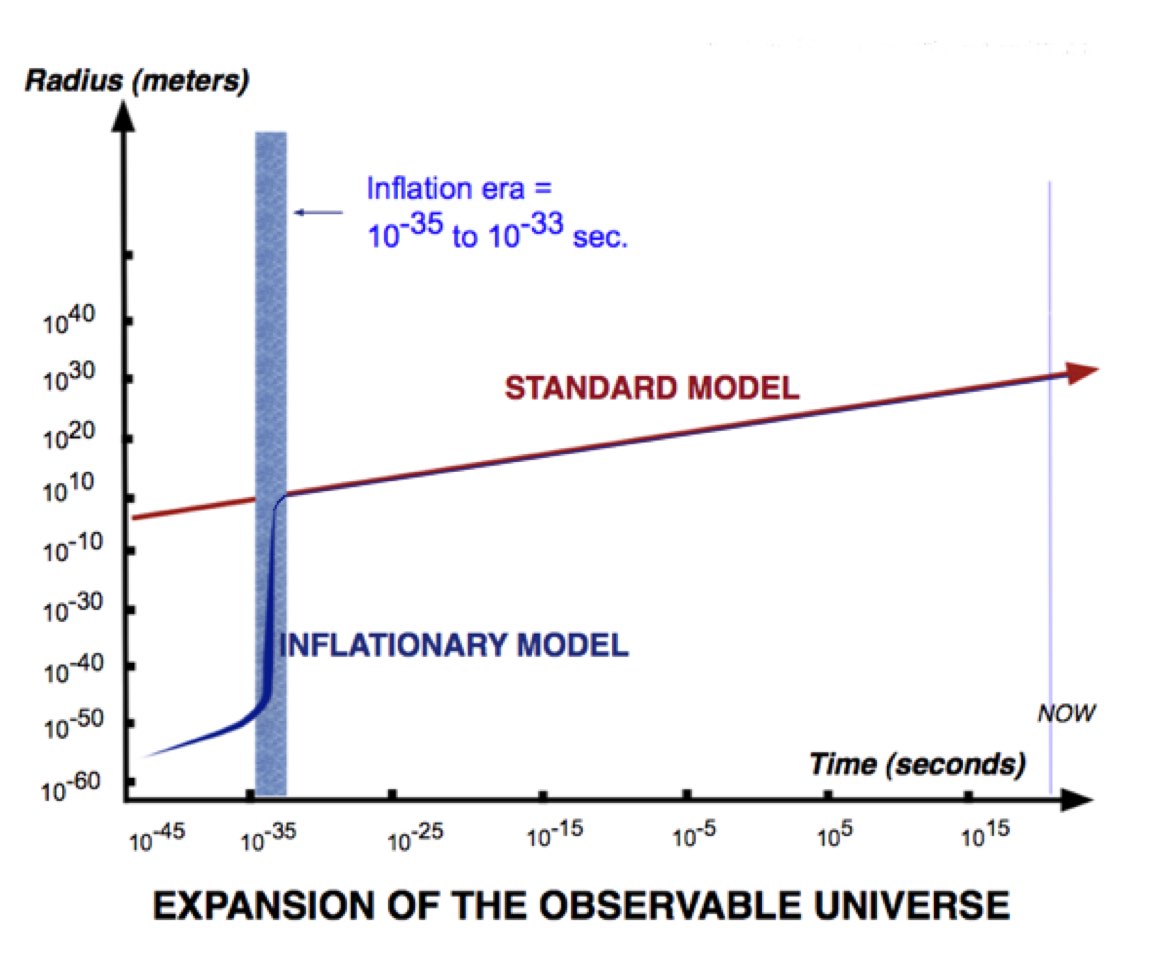
Eternal inflation, a variant of the cosmic inflation hypothesis, provides the engine behind Tegmark's Level II multiverse. In this picture, space as a whole stretches and will continue doing so forever. But within that relentlessly expanding substrate, certain regions stop inflating and collapse into distinct bubbles — an image the article likens to gas pockets forming inside a loaf of rising bread. Each bubble becomes an embryonic Level I multiverse: a vast region with its own uniform physical laws. Crucially, different bubbles can undergo different spontaneous symmetry breaking as they cool, which means they can end up with genuinely different physical constants — a different strength of gravity, a different mass for the electron, a different cosmological constant. This is what gives the Level II multiverse its power as an explanation for fine-tuning: if enormously many bubbles exist, each with its own parameter settings, it becomes statistically unsurprising that at least one has the narrow combination of constants that allows atoms, stars, planets, and life to form. Level II also encompasses John Archibald Wheeler's oscillatory universe theory and Lee Smolin's fecund universes theory.
05 Tegmark's Level IV: math as reality Deeper
The most radical entry in Max Tegmark's classification is Level IV: the Ultimate Ensemble. Here Tegmark proposes that every mathematical structure that can be described in purely formal terms corresponds to a real universe. His argument rests on a symmetry: any Theory of Everything expressed without vague human language is, by definition, a mathematical structure — what mathematicians call a set-theoretical model. If one universe described by mathematics is real, why should others be less so? Tegmark argues that Level IV subsumes all lower levels and 'brings closure to the hierarchy of multiverses,' making a Level V unnecessary. The hypothesis has a notable critic in Jürgen Schmidhuber, who objects that the set of all mathematical structures is not even well-defined. Schmidhuber prefers a more restricted ensemble: universes whose representations are describable by constructive mathematics, essentially computer programs, including non-halting programs whose output bits converge after a finite time even if the convergence time itself is not predictable — a subtlety rooted in the undecidability of the halting problem.
06 The 2010 search for bubble-universe bruises
Around 2010, scientists including Stephen M. Feeney analyzed data from the Wilkinson Microwave Anisotropy Probe (WMAP) and reported tentative evidence that our universe had collided with other bubble universes in the distant past — a collision that would leave characteristic circular imprints in the cosmic microwave background. The claim generated excitement: if true, it would be the first direct observational fingerprint of another universe. However, a more thorough re-analysis of WMAP data and data from the Planck satellite — which has a resolution three times higher than WMAP — found no statistically significant evidence of any bubble-universe collision. Planck also turned up no evidence of a gravitational pull from neighboring universes on our own. The episode is a useful case study in how multiverse science proceeds: an intriguing signal appears, a higher-precision instrument tests it, and the signal does not survive scrutiny. As of the article, no statistically significant observational evidence for other universes has been reported.
07 Chary's anomalous glow from recombination Deeper
In 2015, astrophysicist Ranga-Ram Chary reported a striking anomaly after analyzing the cosmic radiation spectrum. He found a signal 4,500 times brighter than models predicted, based on the accepted number of protons and electrons present in the very early universe. The signal is an emission line produced during the era of recombination — the epoch when electrons and protons first combined into neutral atoms — and it is more consistent with a universe whose ratio of matter particles to photons is about 65 times greater than our own. One exotic explanation: a parallel universe dumped some of its matter into ours; extra protons and electrons would produce more atoms, more photons during their formation, and a dramatically enhanced emission signature. Chary himself was careful to note that 'unusual claims like evidence for alternate universes require a very high burden of proof.' He acknowledged the signal might instead be contamination from distant galaxies or from dust clouds surrounding our own galaxy. The probability that the signal is simply noise stands at roughly 30 percent, leaving the interpretation genuinely open.
08 M-theory, branes, and hidden dimensions Deeper
String theory and its higher-dimensional extension, M-theory, generate a multiverse of a distinctly different character from inflation-based models. String theory requires 10 spacetime dimensions; M-theory requires 11. The extra six or seven dimensions beyond the familiar four are either compactified — curled up on an extremely small scale — or our entire universe is confined to a dynamical object called a D3-brane, floating in a higher-dimensional space called the bulk. In Brian Greene's brane multiverse, other membranes drifting through the bulk can host entirely separate universes. When two branes collide, the energy released is sufficient to trigger a Big Bang. According to this picture, branes drift near each other in the bulk and collide every few trillion years, each collision generating a new Big Bang in what Greene calls the cyclic multiverse — a repeated destruction and renewal of cosmic contents. Greene's landscape multiverse is also string-theory-based, relying on Calabi–Yau spaces whose quantum fluctuations drop to lower energy configurations, each producing a pocket of space with a distinct set of physical laws.
09 Twin-world models and dark-energy puzzles Deeper
Beyond the grand classification schemes of Tegmark and Greene, a quieter class of proposals imagines just two interacting universes rather than infinitely many. Several twin-world or 'bi-world' models have been constructed to address specific observational puzzles. One attempts to explain baryon asymmetry — why the early universe contained more matter than antimatter — by pairing our universe with a mirror anti-universe. Another two-universe cosmological model has been proposed as a way to ease the Hubble constant tension, the stubborn disagreement between different methods of measuring the universe's expansion rate, via interactions between the two worlds. A further bi-world cosmology addresses the cosmological constant problem, closely related to dark energy: two interacting worlds each carrying a large cosmological constant could, through their interaction, produce a small shared effective cosmological constant — potentially explaining why the vacuum energy we observe is so much smaller than quantum field theory naively predicts.
10 Black-hole cosmology and white holes
Black-hole cosmology proposes that our entire observable universe is the interior of a black hole existing inside a larger parent universe — one of possibly many such black-hole universes nested within that larger cosmos. The model connects to the theory of white holes, which sit on the opposite side of spacetime from their black-hole counterparts. While speculative, the framework offers a way to think about universe creation that sidesteps the need for an unexplained initial singularity: the Big Bang of our universe would correspond to the formation event of the black hole from the parent universe's perspective. The idea also resonates with Lee Smolin's fecund universes theory, listed under Tegmark's Level II, in which black holes in one universe seed new universes with slightly varied physical constants, and natural selection over cosmic generations could favor constants that maximize black-hole production.
11 Occam's razor cuts both ways here
One of the liveliest philosophical disputes surrounding the multiverse concerns Occam's razor — the principle that explanations should not multiply entities beyond necessity. Critics argue that proposing an almost infinite number of unobservable universes just to explain the one we inhabit is the most extravagant possible violation of parsimony. Proponents, including Max Tegmark, counter this with an argument drawn from algorithmic information theory, specifically Kolmogorov complexity: the length of the shortest computer program needed to produce a description. Tegmark's point is that the set of all integers is actually simpler to generate — by a trivially short program — than any single very large integer, which might require a program as long as the number itself. By analogy, he argues, the entire ensemble of universes at each multiverse level is simpler than a single arbitrarily specific universe. Going from our universe to a Level I multiverse eliminates the need to specify initial conditions; upgrading to Level II eliminates the need to specify physical constants; Level IV eliminates the need to specify anything at all. Whether this reframing of 'simplicity' satisfies skeptics remains, as the article honestly acknowledges, an open debate.
12 The falsifiability problem and open questions
The deepest scientific objection to multiverse theories is not that they are wrong but that they may be impossible to prove wrong — which, by Karl Popper's criterion of falsifiability, would place them outside science proper. Cosmologist Paul Davies, writing in the New York Times in 2003, argued that invoking an infinity of unseen universes to explain our universe's peculiarities is 'just as ad hoc as invoking an unseen Creator,' requiring the same leap of faith. George Ellis, writing in August 2011, acknowledged the multiverse likely exists far beyond the cosmological horizon and emphasized that it is 'theorized to be so far away that it is unlikely any evidence will ever be found.' Ellis nonetheless argued that abandoning observational testability as a core scientific standard would be a serious mistake, even while calling multiverse contemplation 'an excellent opportunity to reflect on the nature of science.' Philosopher Philip Goff raises a separate logical objection: inferring a multiverse to explain fine-tuning, he argues, commits the Inverse Gambler's Fallacy. These critiques leave the central questions genuinely open: Does the multiverse exist? If so, which type? And can any version of it ever be tested?