How the Universe Ends
The idea
If dark energy keeps pushing, the far future is the 'Big Freeze': galaxies beyond our local group recede from view, stars burn out over trillions of years, and the cosmos fades toward cold, dark, dilute quiet. Alternatives — a Big Rip that shreds everything, a Big Crunch that recollapses — depend on dark energy's true nature, which is exactly what we don't know yet.
Go deeper Advanced
Under a constant Λ: star formation ends ~10¹⁴ yr, stellar remnants evaporate via (theoretical) proton decay or black-hole accretion, black holes themselves Hawking-evaporate by ~10¹⁰⁰ yr — heat death by entropy. Phantom dark energy (w < −1) implies a Big Rip; evolving dark energy (DESI hints) reopens recollapse. All timelines are physics-grounded extrapolation — labeled Hypothesis because the engine (dark energy) is unidentified.
The deep dive
Researched for the Atlas from Wikipedia — Ultimate fate of the universe (20,270 characters read) · updated Sep 20, 2026
01 Einstein's blunder that turned out to matter
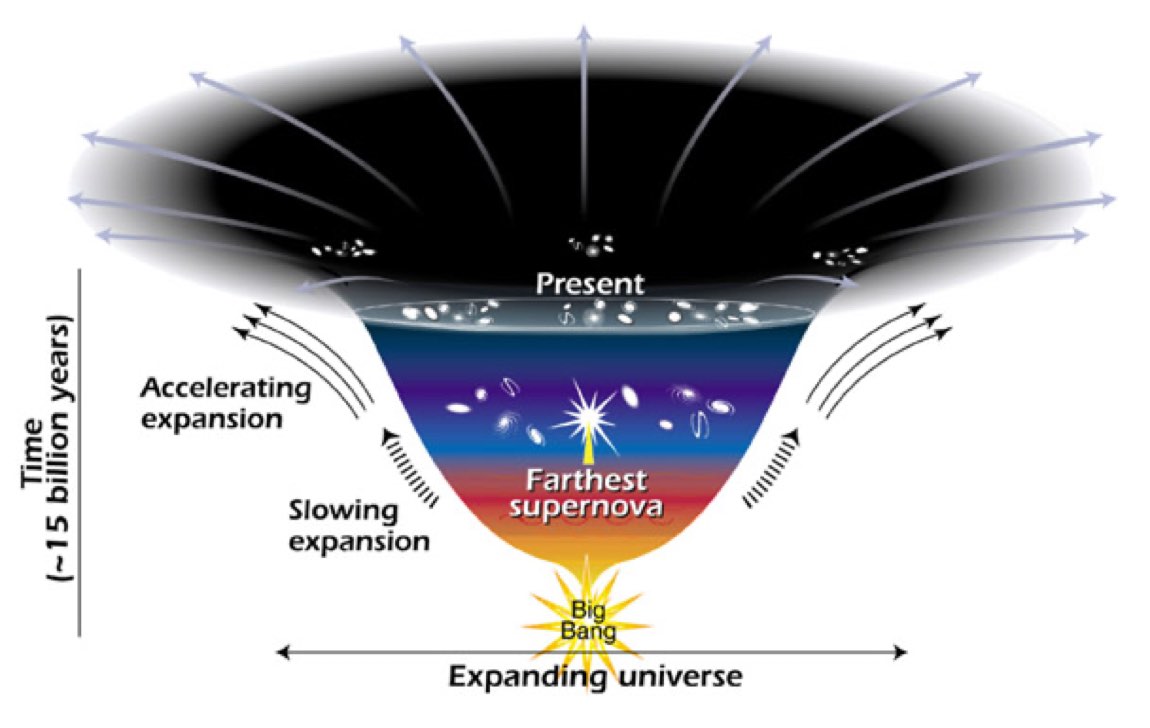
When Albert Einstein applied his 1915 theory of general relativity to the cosmos, the equations kept insisting the universe was either expanding or contracting — never sitting still. That disturbed him deeply, because he and his contemporaries believed in a static, eternal universe. His fix was to insert a fudge factor into the equations: a "cosmological constant" representing a constant energy density unaffected by expansion or contraction, precisely tuned to balance gravity and hold the universe motionless. It worked mathematically. Then Edwin Hubble published his 1929 observations of Cepheid variable stars in distant galaxies showing the universe was genuinely expanding, and Einstein's careful patch became an embarrassment. He reportedly called it "the greatest blunder of my life." The twist is that the cosmological constant has staged a spectacular comeback. Starting in 1998, observations of distant supernovae showed the expansion is actually accelerating, and the simplest mathematical description of whatever is driving that acceleration is — exactly — a positive cosmological constant. The blunder, it seems, was in abandoning it.
02 How Penzias and Wilson killed the Steady State
For decades, two origin stories competed for the universe. Georges Lemaître's Big Bang theory, formalized in 1927, held that everything erupted from an initial singularity. Fred Hoyle's Steady State theory, introduced in 1948, countered that the universe perpetually expands but replenishes itself with freshly created matter, keeping its overall character unchanged forever. Both sounded equally speculative until 1965, when Arno Allan Penzias and Robert Woodrow Wilson, working with a radio antenna in New Jersey, detected a faint microwave hiss coming uniformly from every direction in the sky. The Big Bang theory had straightforwardly predicted the existence of this cosmic microwave background radiation — the cooled afterglow of the hot early universe. The original Steady State theory had no room for it. That discovery effectively ended the competition. The Big Bang theory rapidly became the consensus view of the universe's origin, and with it came the serious scientific question of how the universe would eventually end.
03 The density parameter: one number, three fates Deeper
Cosmologists captured the geometry and fate of the universe in a single dimensionless ratio called the density parameter, given the symbol omega. It is defined as the actual average matter density of the universe divided by a critical value of that density. When omega equals exactly 1, space is flat — parallel lines stay parallel forever, triangles have angles summing to exactly 180 degrees, and the universe expands forever at a continually slowing rate. When omega exceeds 1, space curves like the surface of a sphere, all lines eventually converge, and without dark energy gravity would eventually halt expansion and pull everything back into a Big Crunch. When omega falls below 1, space curves like a saddle, lines that never meet nonetheless grow apart, and the universe expands forever even without dark energy. Measurements from the Wilkinson Microwave Anisotropy Probe confirmed the universe is flat within a 0.4 percent margin of error. Knowing omega alone, however, is no longer enough to determine the ultimate fate, because dark energy — which accounts for roughly 68 percent of the total energy content in the Lambda-CDM model — changes the rules for every geometry.
04 Why a closed universe still need not collapse Deeper
Intuition says a closed universe — one where omega exceeds 1 and space curves like a sphere — must eventually stop expanding and fall back on itself in a Big Crunch. That intuition is correct only if dark energy is absent. In the currently accepted Lambda-CDM model, dark energy's repulsive force can overpower gravity and drive perpetual expansion even in a closed geometry. The numbers make this concrete: according to Lambda-CDM, the universe would need an average matter density roughly seventeen times greater than its measured value today before dark energy's influence could be overcome and collapse made inevitable. That is an enormous threshold. Any realistic increase in measured matter density would push omega above 1, making the geometry technically closed, yet still nowhere near the seventeen-fold excess needed to reverse the expansion. In other words, the geometry of the universe and its ultimate fate have become decoupled concepts. A universe can be geometrically closed — curved, finite — and yet expand forever because the energy budget is dominated by something that pushes outward rather than pulling inward.
05 Heat death: the universe fading to silence
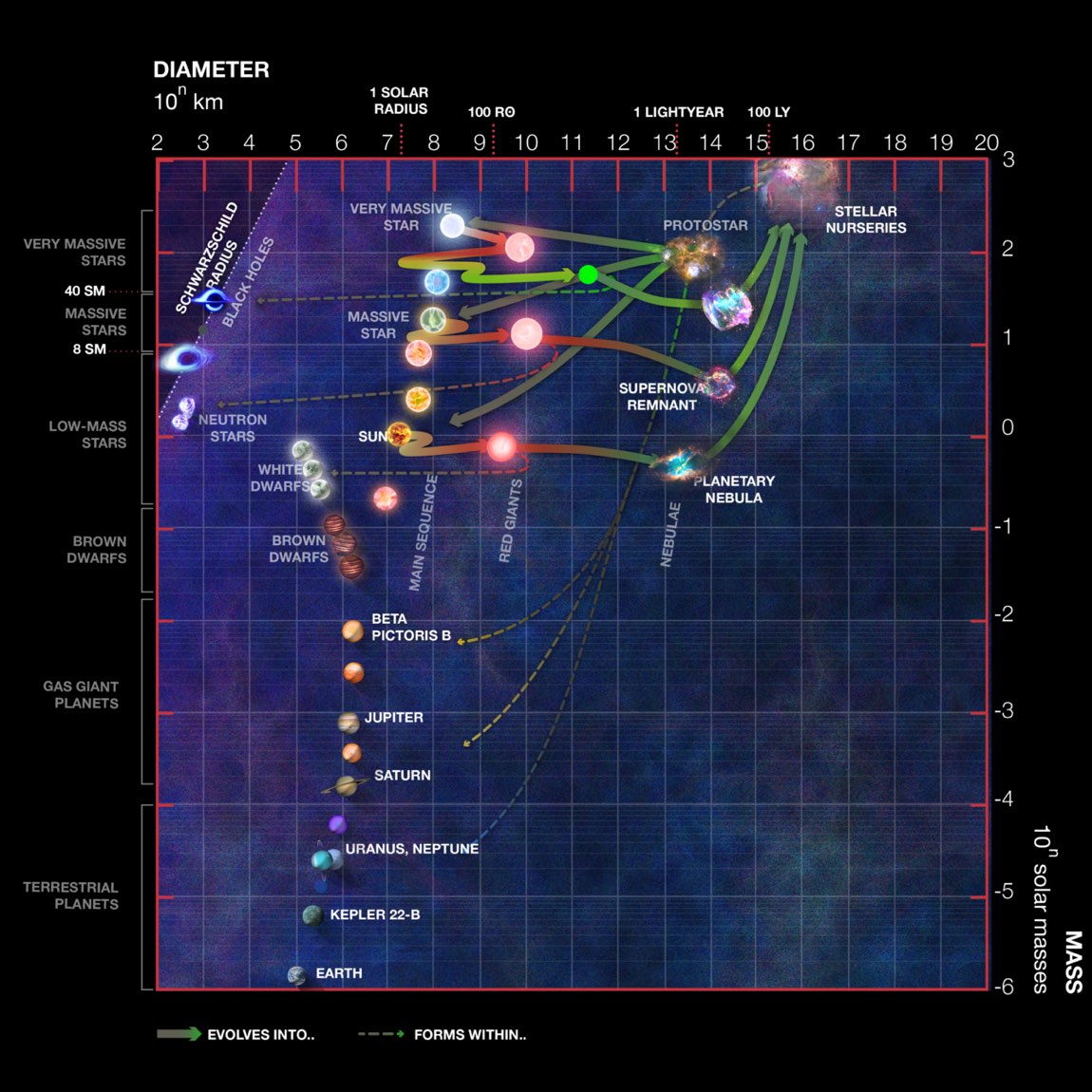
The scenario cosmologists currently consider most likely is called heat death, or sometimes the Big Freeze or Big Chill. It requires no catastrophic event — just the remorseless logic of thermodynamics applied to an ever-expanding universe. Stars are expected to keep forming for somewhere between 1 trillion and 100 trillion years, but eventually the gas reservoirs needed to birth new stars will be exhausted. Existing stars will exhaust their fuel and go dark one by one. Black holes will come to dominate the universe, but even they are not permanent: they gradually leak energy through Hawking radiation and eventually evaporate. What remains is a universe asymptotically approaching absolute zero, in which matter is spread so evenly and thinly that no energy gradients exist anywhere. Energy gradients are what drive every process — including life, which is one form of information processing. Heat death is compatible with flat, open, or even closed geometries, provided dark energy or geometry ensures the universe keeps expanding to that eventual temperature minimum.
06 Freeman Dyson's bet on infinite thought Deeper
In his 1979 paper "Time Without End: Physics and Biology in an Open Universe," physicist Freeman Dyson proposed one of the most audacious ideas in the literature on the far future. He argued that intelligent life need not be extinguished by the universe's slow cooling. His strategy: store a finite amount of energy and spend it in ever-smaller increments. Between each burst of computation — each "thought" — the intelligent beings would hibernate for increasingly vast stretches, allowing the universe to cool further. Because the minimum energy required to perform a computation falls as ambient temperature falls, each thought becomes cheaper than the last. Dyson calculated that this scheme could, in principle, sustain an infinite number of thoughts over infinite subjective time using only a finite energy reserve. The scheme was predicated on an open universe without a cosmological constant, where cooling is gradual and endless. The 1998 discovery of accelerating expansion undermined the proposal: a positive cosmological constant means the universe does not cool indefinitely, and causally disconnected regions eventually become unreachable, making the hibernation-and-compute strategy unworkable.
07 The Big Rip: when dark energy tears everything apart
The current measured rate of cosmic acceleration — captured by the Hubble constant — is large enough to push distant galaxies apart but not large enough to disrupt structures held together by gravity, such as galaxies themselves. The Big Rip scenario asks what happens if that acceleration grows without limit. If the Hubble constant were to increase steadily toward infinity, the repulsive force acting on smaller and smaller scales would first scatter galaxy clusters, then tear apart individual galaxies, then shred solar systems, then rip planets and stars to pieces, and eventually — in a finite amount of time — unbind atoms and elementary particles themselves. The universe would end as what is effectively a singularity of infinite energy density and expansion rate. A particularly abrupt version of the Big Rip is predicted by "phantom dark energy," a hypothetical form of dark energy with negative kinetic energy that would produce an even faster acceleration than a standard cosmological constant. Phantom dark energy remains speculative, but it illustrates how sensitive the ultimate fate is to the precise nature of dark energy, which is still not understood.
08 Vacuum decay and the Big Slurp
A more exotic possible end involves the Higgs field, which permeates all of space and gives particles their mass. If the universe currently exists in a "false vacuum" — a local energy minimum that is not the absolute lowest possible energy state — then quantum tunneling could at any moment trigger a transition to the true vacuum, a process called vacuum decay. A bubble of true vacuum would nucleate at some point and expand outward at the speed of light, altering physical constants as it went and potentially destroying all structures it encountered instantaneously and without warning. This scenario is called the Big Slurp. Crucially, it would not end the entire observable universe: galaxies more than 4.2 gigaparsecs, equivalent to 13 billion light-years, away from the originating point are receding faster than light, so the vacuum decay bubble could never reach them. For context, the observable universe extends roughly 46 billion light-years in every direction from Earth, so large regions would remain unaffected — though fundamentally altered physics in the destroyed region would still represent an extraordinary catastrophe.
09 Cyclic models and the entropy problem Deeper
The Big Crunch naturally invites the question of what comes after: perhaps another Big Bang, launching a new universe from the wreckage of the old one. This cyclic or oscillatory universe idea is conceptually appealing — it replaces a singular beginning and end with an eternal rhythm. The immediate problem is thermodynamic. The second law of thermodynamics says entropy — the measure of disorder — always increases within a closed system. If each universe inherits the entropy of its predecessor, successive cycles would grow larger and longer, with entropy accumulating until the cyclic machine grinds down into permanent heat death anyway. This observation led most cosmologists to abandon the classical oscillatory model. A more recent variation, called the cyclic model, attempts to evade this by invoking an expansion of branes — membranes in higher-dimensional space — that dilutes the entropy accumulated during each previous cycle before the next one begins. Current observational evidence also indicates the universe is not in a closed geometry, which removes another prerequisite for a simple Big Crunch, making these cyclic scenarios increasingly difficult to reconcile with data.
10 Dark energy's unknown equation of state Deeper
Every specific scenario for the end of the universe — Big Freeze, Big Rip, Big Crunch — assumes a particular mathematical relationship between dark energy's pressure and its density, called the equation of state. In the simplest case, this is just a fixed cosmological constant. But dark energy might instead be a dynamical field whose density changes as the universe expands. Some cosmologists study whether a time-varying dark energy, possibly connected to a scalar field active in the early universe, could resolve tensions in current cosmological measurements. The article describing these considerations points to upcoming data from the Euclid, Nancy Grace Roman, and James Webb space telescopes, as well as next-generation ground-based observatories, as the tools most likely to sharpen understanding — specifically whether dark energy is best described as a constant energy intrinsic to space, a time-varying quantum field, or something else entirely. Inflation theory adds another layer of complexity: if inflation is real, the early universe was dominated by a different form of dark energy that eventually switched off, demonstrating that equations of state can change. There is no established reason why present-day dark energy could not change again, with consequences that are genuinely difficult to predict.
11 Measuring the universe's weight to find its future
Deciding among the rival end-of-universe scenarios is fundamentally an observational challenge. Cosmologists describe the method as "weighing" the universe — determining the relative contributions of ordinary matter, radiation, dark matter, and dark energy to the critical density. The observational toolkit has three main components. First, the clustering patterns of galaxies on large scales reveal how gravity has organized matter over cosmic time, constraining the total matter density. Second, observations of distant supernovae — the same type of observations that revealed accelerating expansion starting in 1998 — measure the rate at which expansion has changed over billions of years, constraining dark energy. Third, the precise pattern of temperature variations in the cosmic microwave background, as mapped by instruments like the Wilkinson Microwave Anisotropy Probe, encodes the universe's geometry and composition in its ripples. These three independent lines of evidence must be made consistent with one another, and none yet points unambiguously to a single fate. Observations are described as not yet conclusive, and alternative models remain possible.
12 Alexander Friedmann and the first calculated fates Deeper
The idea that the universe's ultimate fate could be derived mathematically rather than imagined mythologically became possible with Einstein's 1915 general relativity. The equations could describe the universe at its largest scales, and they admitted multiple solutions — each corresponding to a different geometry and a different destiny. The first person to systematically work out several of these solutions was the Russian mathematician Alexander Friedmann, who published them in 1922. Georges Lemaître, the Belgian physicist-priest who would later propose what became the Big Bang theory, independently produced further solutions in 1927. These Friedmann-Lemaître solutions form the mathematical backbone of modern cosmology and are the framework within which all the end-of-universe scenarios — flat, open, closed; heat death, Big Rip, Big Crunch — are still discussed today. Their work transformed eschatology from a domain of theology and mythology into a field of testable physics, making it possible, as later observations of expansion rates and matter densities accumulated, to actually constrain which mathematical solution describes the universe we live in.