Cosmology
How Galaxies Work
ConfirmedThe idea
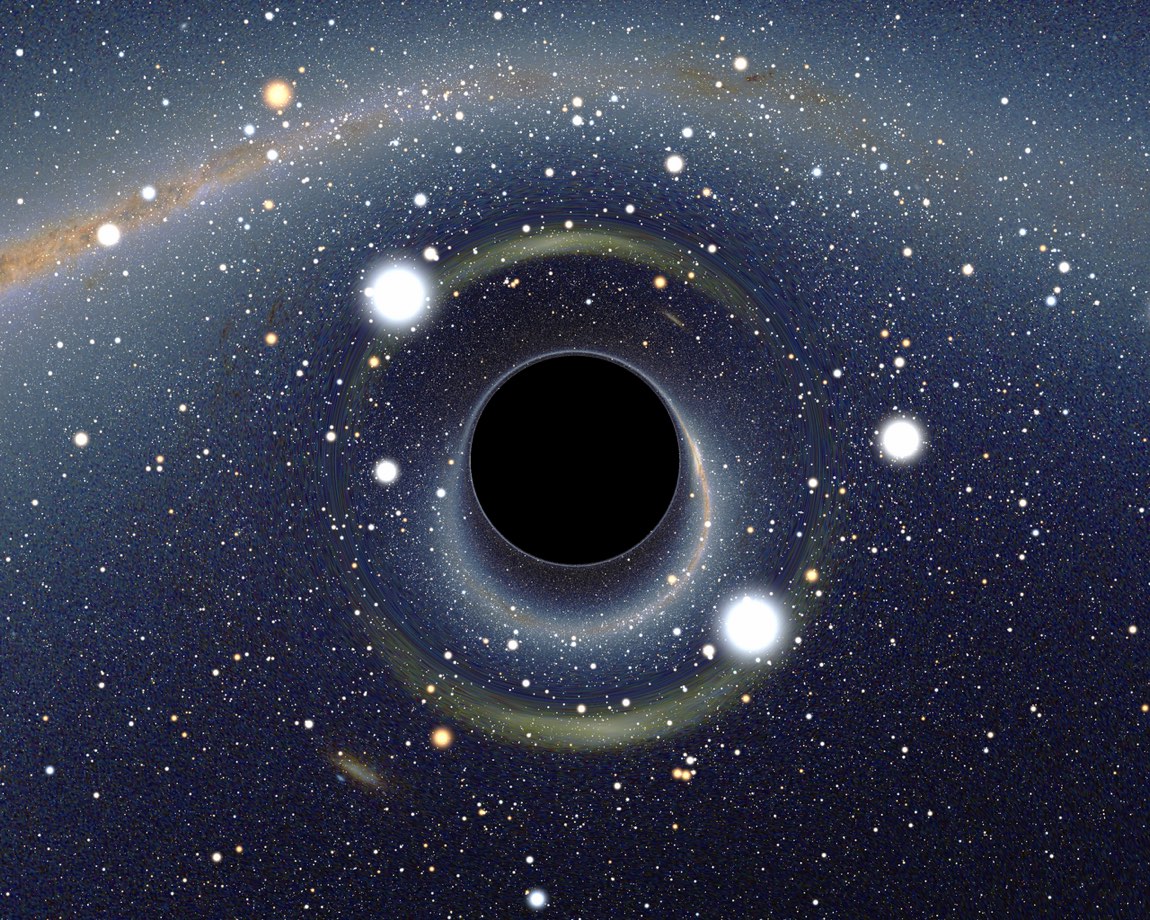
Galaxies are gravity's cities: hundreds of billions of stars, plus gas, dust and a dominant halo of dark matter, all orbiting a shared center — usually with a supermassive black hole downtown. They come in spirals (young, star-forming disks), ellipticals (old merger remnants), and irregulars; they grow by devouring neighbors, and ours is mid-meal on several dwarfs right now.
Go deeper Advanced
Galaxy and black-hole masses correlate tightly (M–σ relation) — co-evolution via feedback: quasar winds and jets can quench star formation. Morphology follows merger history and gas supply. JWST's early massive galaxies press on formation models. On the largest scales galaxies trace the cosmic web; in clusters, ram-pressure stripping and harassment reshape them — environment is destiny.
The deep dive
Researched for the Atlas from Wikipedia — Galaxy (50,924 characters read) · updated Sep 20, 2026
01 From 'island universes' to galaxies: the naming fight
Before the word 'galaxy' settled into everyday astronomical use, these vast systems went by a surprisingly contentious collection of names. Eighteenth- and nineteenth-century astronomers called them 'spiral nebulae,' and many assumed they were simply unresolved star clusters sitting inside the Milky Way. The popular term 'island universes' captured the grander idea that each was a separate cosmos, but it carried philosophical baggage — implying there were many universes rather than many galaxies within one. Harlow Shapley campaigned hard for 'galaxy' and against both 'nebulae' and 'universes,' but the deeply influential Edwin Hubble stubbornly kept calling them nebulae in his own work. Because Hubble's authority was enormous, the terminology didn't fully shift until after his death in 1953. Even the capitalisation matters: astronomers today write 'Galaxy' with a capital G specifically to mean our own Milky Way, distinguishing it from the billions of others.
02 The Great Debate and how it was settled
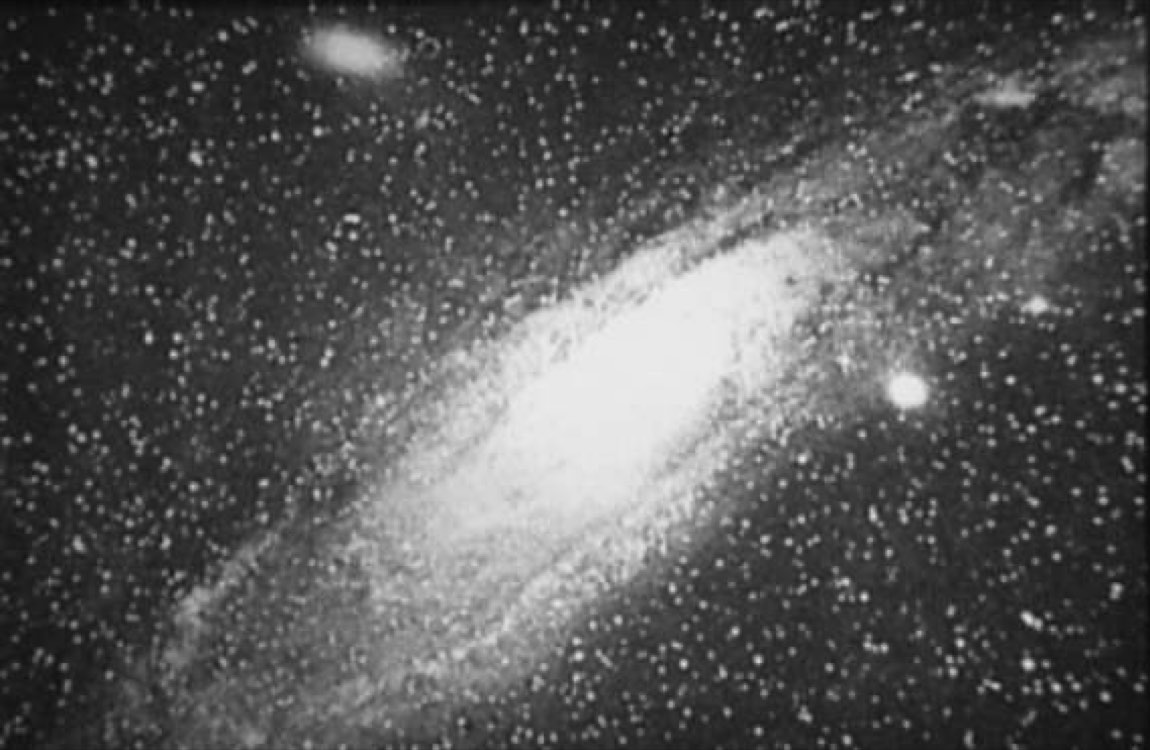
In 1920, Harlow Shapley and Heber Curtis faced each other in what became known as the Great Debate, arguing over whether spiral nebulae were objects inside the Milky Way or entirely separate star systems far beyond it. Curtis had strong evidence: in 1917 he had noticed nova S Andromedae in the 'Great Andromeda Nebula' and, searching photographic records, found 11 more novae. These were on average 10 magnitudes fainter than novae elsewhere, which led him to a distance estimate of 150,000 parsecs — placing Andromeda well outside the Milky Way. He also pointed to dark dust lanes resembling those in our own Galaxy, and significant Doppler shifts. In 1922, Estonian astronomer Ernst Öpik independently provided a distance determination supporting the extragalactic interpretation. Final confirmation came when Edwin Hubble used the new 100-inch Mount Wilson telescope to resolve individual Cepheid variable stars in Andromeda's outer regions, placing it unambiguously beyond the Milky Way and ending the debate.
03 How astronomers mapped our own Galaxy's shape Deeper
Mapping the Milky Way from inside it is like trying to sketch a forest while standing among the trees. William Herschel made the first systematic attempt in 1785 by counting stars in different patches of sky, producing a diagram that placed the Solar System near the center of a disk-shaped system. Jacobus Kapteyn refined this approach by 1920, arriving at a small ellipsoid galaxy roughly 15 kiloparsecs in diameter, again with the Sun near the center. Harlow Shapley attacked the problem differently, cataloguing the positions of globular clusters, and found a dramatically larger picture: a flat disk about 70 kiloparsecs across, with the Sun far from the center. Both analyses turned out to be compromised by the same blind spot — they ignored how interstellar dust absorbs starlight along the galactic plane, making distant stars appear far fainter than they truly are. Robert Julius Trumpler quantified this dust absorption effect in 1930 by studying open clusters, and only after his correction did a reliable picture of the Milky Way's structure begin to emerge.
 ⤢
⤢
04 The 21-centimetre line: seeing through dust Deeper
Optical telescopes are stymied by the dust that fills the galactic plane, but radio waves pass through it almost unimpeded. In 1944, Hendrik van de Hulst predicted that interstellar neutral hydrogen gas would emit microwave radiation at a wavelength of exactly 21 centimetres, and by 1951 this radiation had been detected. Because it is unaffected by dust absorption, astronomers could measure its Doppler shift across the whole Galaxy and map how gas is actually moving. These radio observations led directly to the hypothesis that the Milky Way has a rotating bar structure at its centre — something impossible to confirm through optical means alone. As radio telescope technology improved, the same 21-centimetre technique was extended to other galaxies, revealing their hydrogen distributions and rotation patterns in detail. This tool remains one of the most powerful in extragalactic astronomy, precisely because it ignores the dust that blinds every optical instrument.
05 Vera Rubin and the galaxy rotation problem
In the 1970s, astronomer Vera Rubin uncovered one of the most consequential discrepancies in modern astrophysics. When she measured how fast stars at different distances from a galaxy's centre were orbiting, she found something deeply wrong: the outer stars were moving far too quickly. According to the gravity of all the visible stars and gas, they should have been orbiting much more slowly — the way the outer planets of the Solar System move slower than the inner ones. Instead, the rotation curves were nearly flat, meaning stars at the galaxy's edge were moving at roughly the same speed as those much closer to the centre. The only plausible explanation was that a vast, unseen mass must be distributed in a roughly spherical halo extending far beyond the visible disk, providing extra gravitational pull. Today this is understood as dark matter, which constitutes most of the mass in a typical galaxy — the stars and nebulae that we actually see represent only a few percent of the total.
06 Shell galaxies: ripples left by ancient collisions
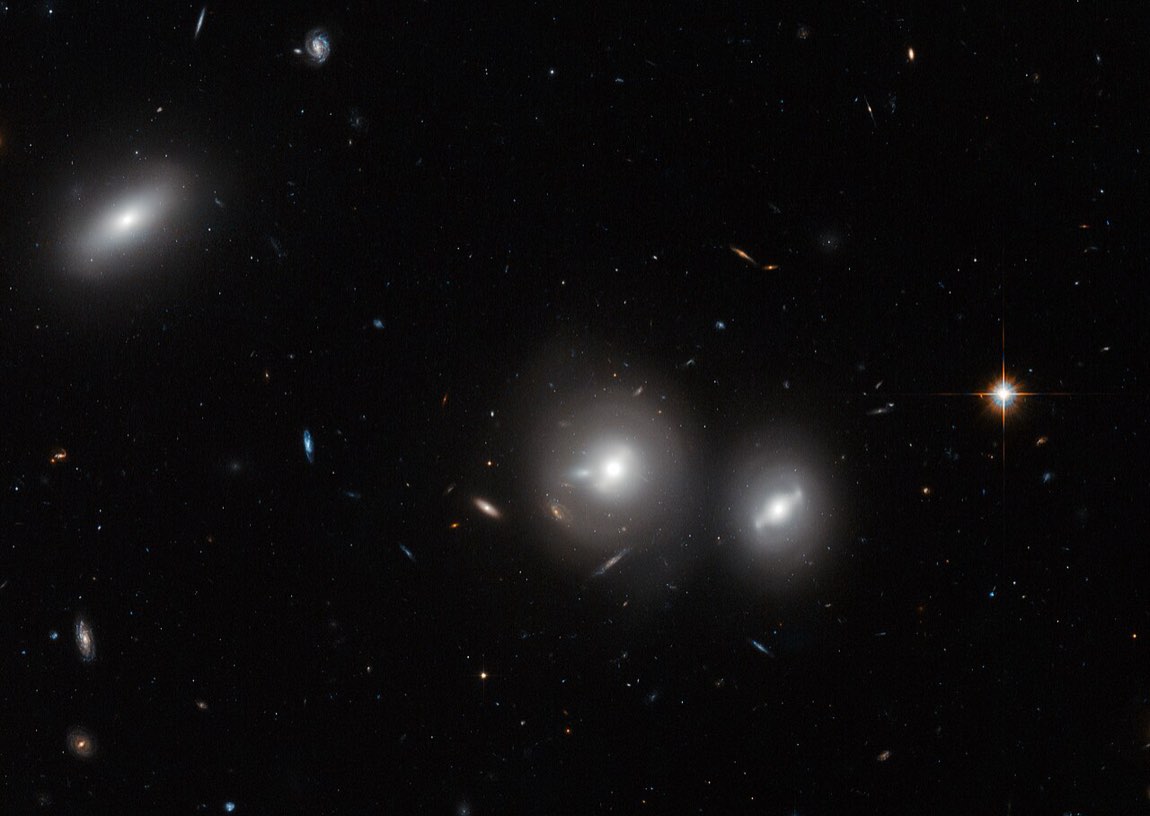
Some elliptical galaxies display one of astronomy's most striking visual surprises: their stellar halos are arranged in concentric shells, like the layers of an onion, rather than in a smooth continuous glow. About one-tenth of all elliptical galaxies show this shell-like structure, and it has never been observed in spiral galaxies. The leading explanation is that shells form when a larger galaxy absorbs a smaller companion. As the two galactic centres approach and then oscillate around a common point, the oscillation sends gravitational ripples outward, sweeping stars into the concentric shell pattern — similar to ripples spreading across the surface of water after a stone is dropped in. The galaxy NGC 3923 is a particularly striking example, displaying over 20 distinct shells. These structures are therefore preserved evidence of past cannibalism events, offering astronomers a fossil record of galactic mergers written in starlight.
 ⤢
⤢
07 Starburst galaxies: brief but furious episodes
Most galaxies form stars at a steady, restrained pace, but some undergo periods of frantic stellar birth called starbursts. During a starburst, a galaxy produces stars at such a prodigious rate that, if it continued, the entire reserve of cold gas would be consumed in a time shorter than the galaxy's total lifespan. As a result, starburst activity typically lasts only about ten million years — a brief episode in a cosmic history measured in billions. The process is self-sustaining for a while: massive newly formed stars ionise surrounding gas into H II regions, then detonate as supernovae whose expanding remnants compress neighbouring gas clouds, triggering yet more star formation. Starburst galaxies were far more common when the universe was young, but even today they contribute an estimated 15% of total star production. The galaxy M82 is the textbook example of a starburst triggered by a close gravitational encounter with its larger neighbour M81.
08 Giant radio galaxies and the record holder Alcyoneus Deeper
Some galaxies grow radio-emitting lobes of plasma so enormous that they dwarf the galaxies themselves. These giant radio galaxies (GRGs) produce their lobes through relativistic jets — beams of particles fired from the supermassive black hole at the galaxy's core at velocities approaching the speed of light. While most galaxies measure thousands of parsecs across, GRG radio lobes can reach scales of several megaparsecs. The current record holder is Alcyoneus, an FR II class low-excitation radio galaxy whose lobed structures span 5 megaparsecs, which translates to roughly 16 million light-years — an almost incomprehensible extent compared to the Milky Way's diameter of about 87,400 light-years. For context, another impressively large giant radio galaxy, 3C 236, has lobes 15 million light-years across. Radio galaxies are classified using the Fanaroff–Riley system: FR I galaxies have lower radio luminosity and more elongated structures, while FR II galaxies have higher radio luminosity.
09 Magnetic fields woven through every spiral galaxy Deeper
Every spiral galaxy carries its own magnetic field, and these fields are far from passive decorations — they actively shape the galaxy's structure. Magnetic fields influence the formation of spiral arms and are crucial for transporting angular momentum within gas clouds, a necessary condition for those clouds to collapse under gravity and form stars. The typical average equipartition magnetic field strength in a spiral galaxy is about 10 microgauss (or 1 nanotesla). For comparison, Earth's own magnetic field averages around 0.3 Gauss — roughly 30,000 times stronger. Quieter galaxies like M31 and M33 have weaker fields of about 5 microgauss, while gas-rich, actively star-forming galaxies such as M51, M83, and NGC 6946 average around 15 microgauss. Inside prominent spiral arms, where cold gas and dust concentrate, field strengths can reach 25 microgauss. The strongest fields of all — between 50 and 100 microgauss — appear in starburst galaxies like M82, and in the nuclear starburst regions of barred galaxies such as NGC 1097.
 ⤢
⤢
10 The cosmic web: filaments, voids, and the largest known structure
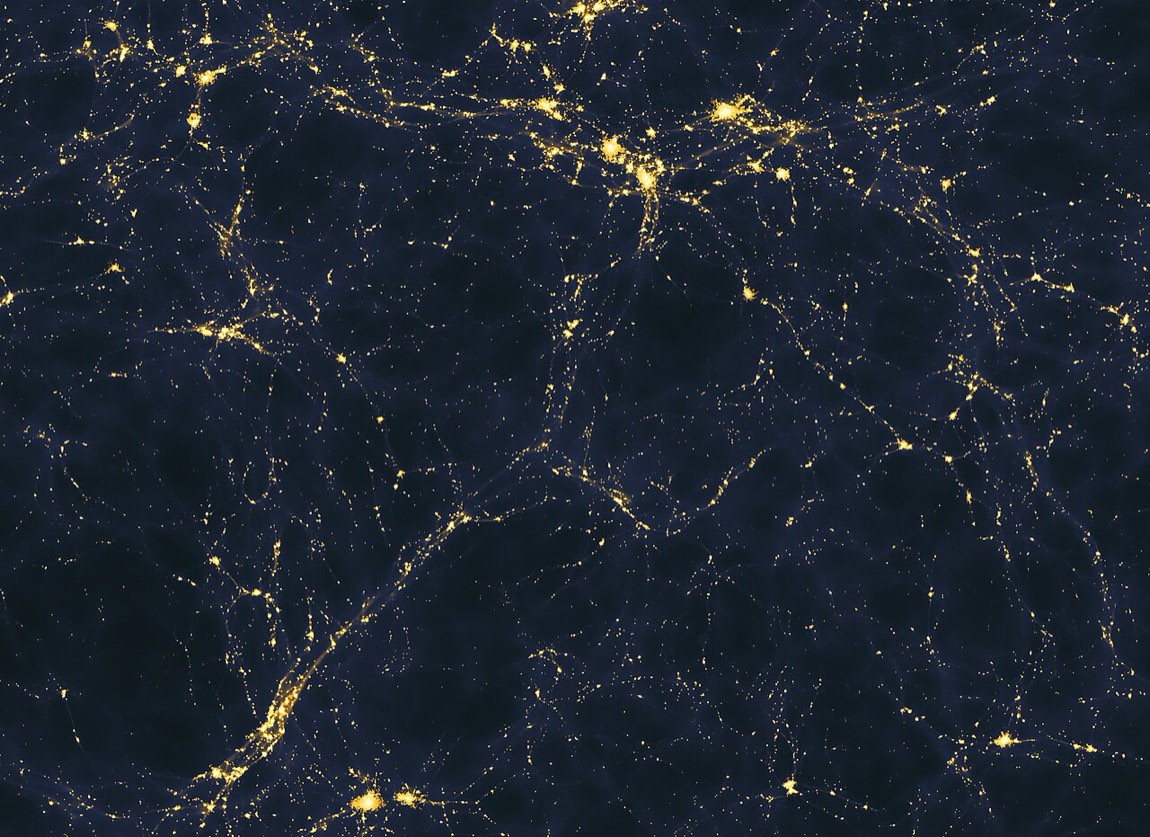
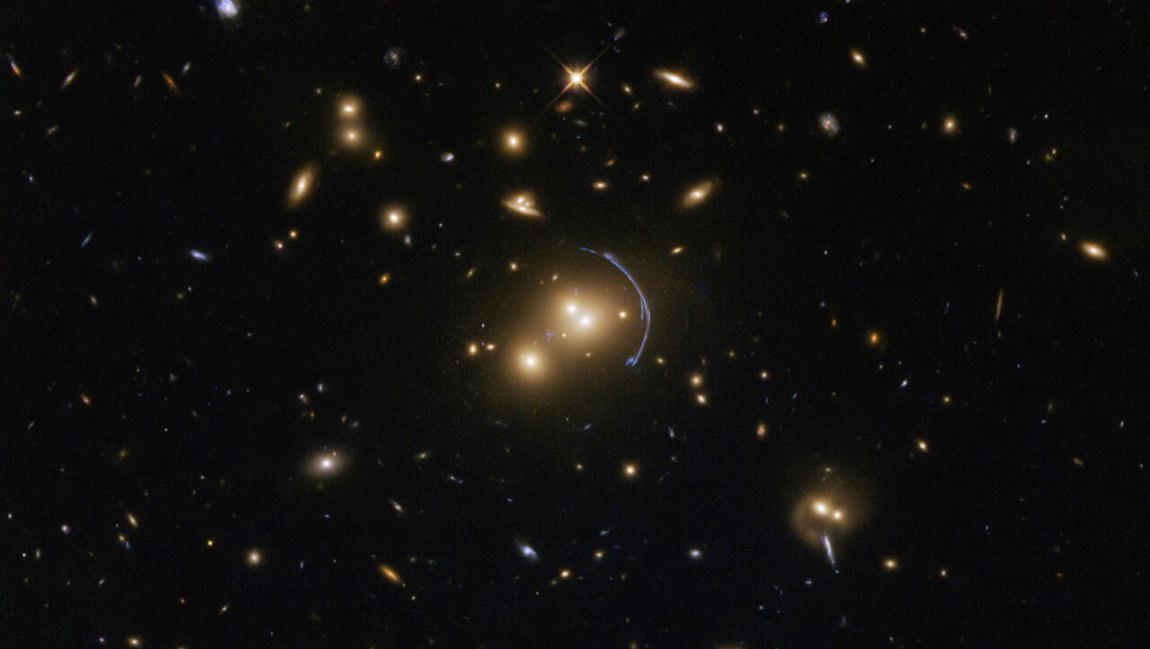
Zoom out far enough and individual galaxies become almost irrelevant; what matters is the vast architecture they trace. Galaxies gather into groups, groups into clusters of hundreds to thousands of members, and clusters into superclusters containing tens of thousands of galaxies. At the supercluster scale, galaxies and their clusters are arranged into thin sheets and long filaments that surround immense empty regions called voids. This web-like pattern was shaped in the universe's early history when clumps of dark matter gravitationally pulled ordinary matter together, and nearby groups later merged into larger clusters. The gas caught between galaxies in a cluster gets heated to extraordinary temperatures of 30 to 100 megakelvins by the ongoing merging process. Dark matter dominates these structures: roughly 70 to 80 percent of a cluster's total mass is dark matter, with 10 to 30 percent in the form of hot intergalactic gas and only a few percent in actual galaxies. The largest known structure in the universe, the Hercules–Corona Borealis Great Wall, stretches 10 billion light-years in length.
11 Ultra diffuse galaxies: nearly invisible but full of dark matter
At the extreme low end of the galactic size scale sit objects so faint they were barely recognised as galaxies at all. A 'dark' or 'ultra diffuse' galaxy can span a volume comparable to the Milky Way in physical extent, yet contain visible stars amounting to only one percent of the Milky Way's stellar population. Their surface brightness is so low that they barely stand out against the background sky. Multiple formation mechanisms have been proposed, and astronomers suspect different ultra diffuse galaxies may have formed by different processes — so there may not be a single explanation. One leading idea is that these galaxies lost their star-forming gas at an early stage, leaving behind only old stellar populations and yielding almost no new star formation since. Dwarf galaxies in general show a revealing pattern: a study of 27 Milky Way neighbours found that the central mass in all of them is approximately 10 million solar masses, regardless of how few or how many stars they contain, suggesting that dark matter — not stars — fundamentally determines their structure.
12 How the observable galaxy count keeps changing
The number of galaxies in the observable universe has been a moving target as technology improves. The Hubble Deep Field — an extremely long exposure of a seemingly empty patch of sky — provided evidence suggesting about 125 billion galaxies exist in the observable universe. A 2016 study led by Christopher Conselice of the University of Nottingham, published in The Astrophysical Journal, pushed that estimate dramatically higher: analysing multiple data sources across the observable universe out to a redshift of z=8, the team concluded there are at least two trillion galaxies — a factor of ten more than are directly visible in Hubble images. The reasoning is that most early galaxies were too small and faint to be detected directly. However, subsequent observations with the New Horizons space probe, made from beyond the zodiacal light, measured less cosmic optical background light than Conselice's estimate, while still supporting the idea that direct observations miss a large fraction of galaxies. The true count remains an open and actively debated question.
13 The Milky Way's own violent past and future
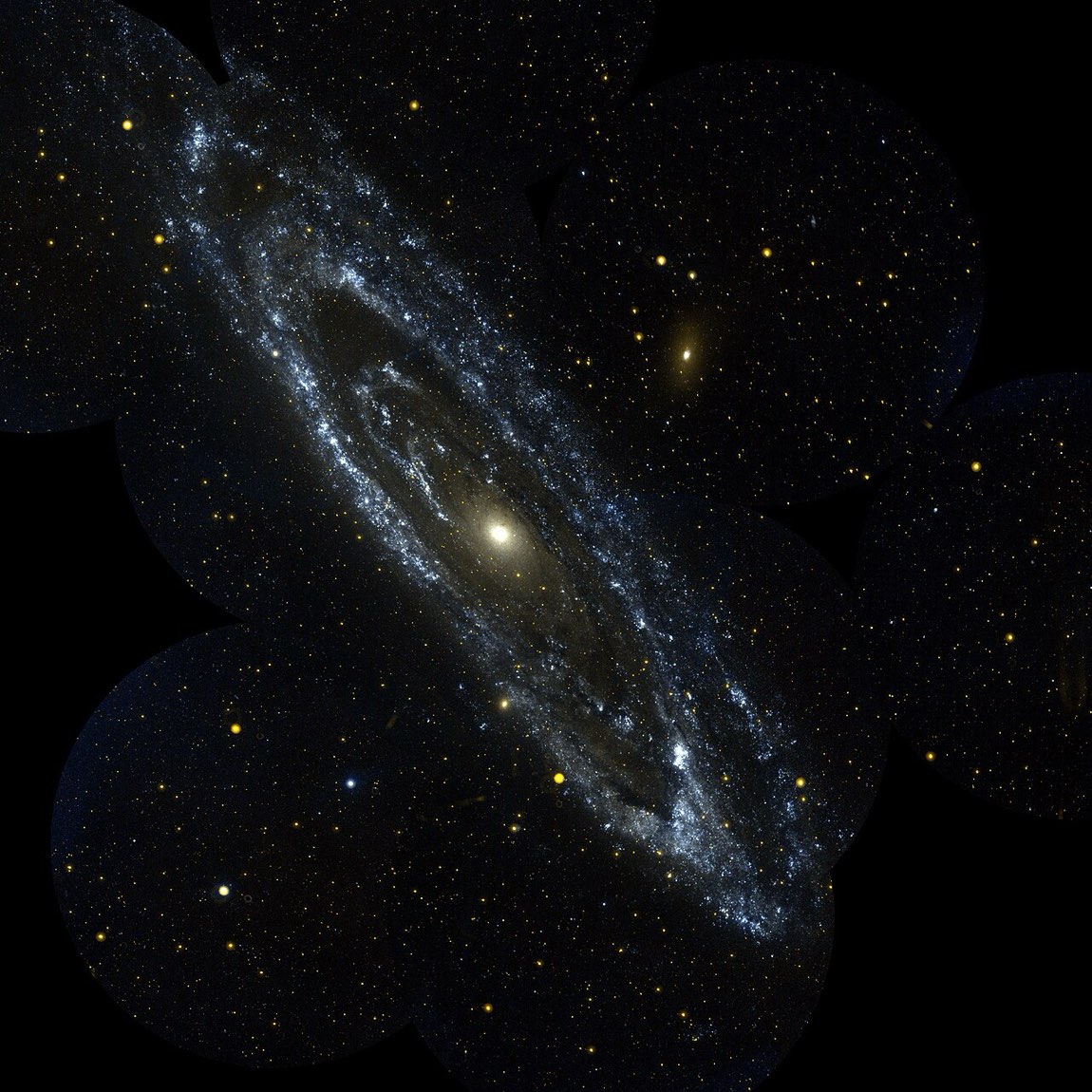
The Milky Way presents itself as a stately barred-spiral galaxy roughly 30 kiloparsecs in diameter and a kiloparsec thick, containing about 200 billion stars and a total mass of about 600 billion solar masses. Yet its history is anything but calm. It is currently cannibalising two smaller neighbours — the Sagittarius Dwarf Elliptical Galaxy and the Canis Major Dwarf Galaxy — pulling them apart and absorbing their stars. Cosmological simulations suggest that around 11 billion years ago the Milky Way merged with a particularly large galaxy now labelled the Kraken, a collision that fundamentally shaped its structure. The future holds an even more dramatic encounter: the Andromeda Galaxy is approaching at about 130 km/s, and depending on lateral velocities, the two may collide in roughly five to six billion years. Meanwhile, star formation will continue for up to 100 billion years before the supply of dense molecular hydrogen runs out, after which galaxies will slowly fade as their smallest, longest-lived red dwarf stars spend trillions of years burning down to darkness.