Cosmology
The Cosmic Web
ConfirmedThe idea
Zoom all the way out and the universe has a shape: galaxies are not scattered randomly but strung along vast glowing filaments surrounding immense dark voids — a three-dimensional spiderweb billions of light-years across. Galaxy clusters sit where filaments meet. It is the largest structure there is, and gravity built it from almost nothing.
Go deeper Advanced
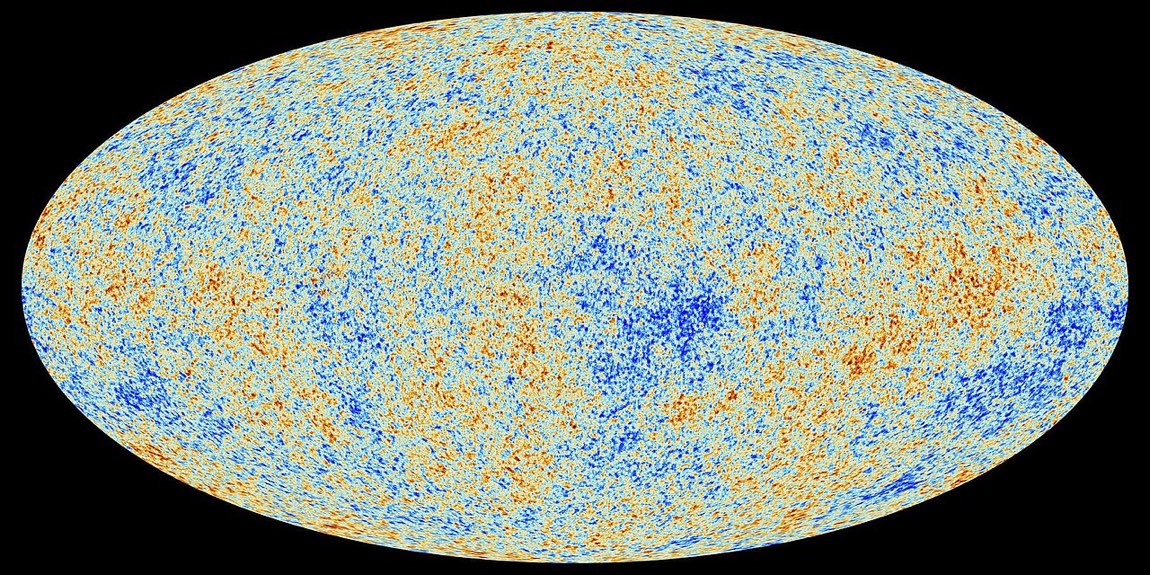
The web grew from the CMB's 1-in-100,000 ripples: overdense regions won gravity's compound interest for 13.8 billion years. Redshift surveys (SDSS, DESI: 40+ million galaxies) map it directly; simulations from ΛCDM initial conditions reproduce it strikingly. Dark-matter filaments are now imaged via weak lensing, and half the universe's 'missing' ordinary matter was recently located as hot filament gas.
The deep dive
Researched for the Atlas from Wikipedia — Galaxy filament (3,455 characters read) · updated Sep 20, 2026
01 What galaxy filaments actually are
Galaxy filaments are not simply lines of galaxies strung together like beads — they are massive, thread-like walls built from entire galactic superclusters. The distinction matters: a supercluster is itself already an almost incomprehensibly large collection of galaxy clusters, and filaments are the structures that connect and bound those superclusters. They trace the skeleton of the observable universe, separating vast, nearly empty regions called voids. Two geometric subtypes exist. True filaments have roughly similar major and minor axes in cross-section — they are more or less cylindrical along their length. Galaxy walls, by contrast, have a significantly greater major axis than minor axis, making them flatter, sheet-like formations. Both subtypes form what cosmologists call the cosmic web, the grand scaffolding that defines the overall architecture of the observable universe as we can see it today.
02 How discovery unfolded decade by decade
The history of finding structures larger than superclusters is surprisingly recent. It began in earnest in 1987, when astronomer R. Brent Tully of the University of Hawaii's Institute of Astronomy identified a formation he named the Pisces–Cetus Supercluster Complex — a hint that something grander than individual superclusters was lurking in the data. Just two years later, in 1989, the CfA2 Great Wall was discovered, offering the first clear evidence of a genuine large-scale wall-type structure. Progress then paused before the Sloan Great Wall was found in 2003 using data from the Sloan Digital Sky Survey. The pace accelerated again in 2013: in January, Roger Clowes of the University of Central Lancashire and colleagues announced the Huge-LQG, a large quasar group that dwarfed previously known filaments. Then in November of the same year, using gamma-ray bursts as cosmic reference points, astronomers identified the Hercules–Corona Borealis Great Wall, measuring more than 10 billion light-years across.
03 The staggering size range of known filaments
Typical galaxy filaments commonly reach 50 to 80 megaparsecs in length — equivalent to roughly 160 to 260 megalight-years. To put that in perspective, the entire Milky Way galaxy is only about 0.03 megaparsecs across, so even the shortest common filaments span thousands of times the diameter of our home galaxy. At the upper end, the largest confirmed filament found to date is Quipu, stretching 400 megaparsecs. But the record may belong to a still-unconfirmed structure: the Hercules–Corona Borealis Great Wall, estimated at around 3 gigaparsecs — approximately 9.8 billion light-years — in length. Because the observable universe itself is only about 28 gigaparsecs in diameter, a single filament at 3 gigaparsecs would span more than ten percent of everything we can see, which is precisely why some researchers remain cautious about confirming it as a coherent, physically connected structure.
04 Galaxy walls: flatter cousins of true filaments Deeper
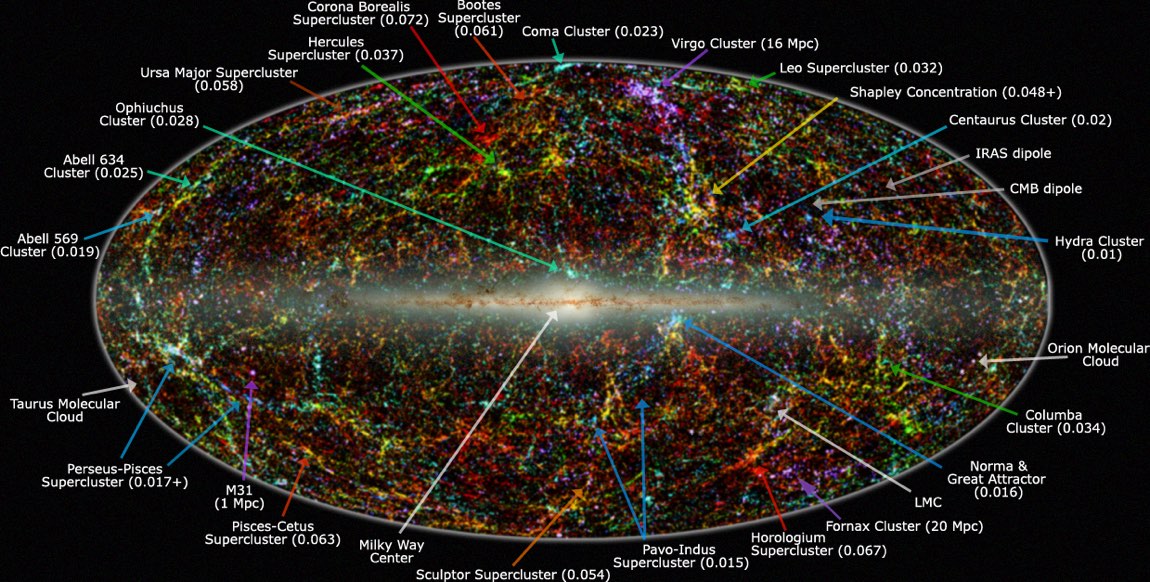
While cylindrical filaments draw most of the headlines, galaxy walls are an equally important subtype and may be even more visually striking in large-scale maps. Their defining characteristic is a cross-section where the major axis greatly exceeds the minor axis, giving them a flat, sheet-like geometry rather than a rope-like one. Several walls have been proposed in our cosmic neighborhood. A structure sometimes called the Centaurus Great Wall — also referred to as the Fornax Great Wall or Virgo Great Wall — has been proposed to include the Fornax Wall, the Centaurus Supercluster, and the Virgo Supercluster, which is also known as the Local Supercluster and contains our own Milky Way. If confirmed as a single coherent wall, the Milky Way itself would lie embedded within it. Researchers have also proposed walls at significant cosmological distances: one was suggested in 2000 at a redshift of z=1.47 near radio galaxy B3 0003+387, and another at z=0.559 in the northern Hubble Deep Field.
 ⤢
⤢
05 The Great Attractor and a wall behind it Deeper
For decades, cosmologists puzzled over the Great Attractor — a gravitational anomaly pulling the Milky Way and millions of neighboring galaxies toward a point in the direction of the Centaurus constellation. One proposed explanation was structural: a galaxy wall was suggested to be the physical embodiment of the Great Attractor, with the Norma Cluster forming part of it. This idea gave rise to the names Great Attractor Wall and Norma Wall. However, the wall interpretation was eventually superseded by a grander proposal: the supercluster Laniakea, a vast basin of gravitational attraction that would encompass the Great Attractor, the Virgo Supercluster, and the Hydra–Centaurus Superclusters all within a single, loosely bound superstructure. The shift from a wall model to a supercluster model illustrates how interpretations of large-scale structure continue to evolve as mapping techniques improve and data sets grow richer.
06 Large quasar groups: filaments in the making Deeper
Large quasar groups, or LQGs, occupy a fascinating theoretical niche in the story of cosmic structure. Quasars — the intensely luminous cores of young, active galaxies powered by supermassive black holes — were far more common in the early universe, and they tend to cluster together in groups that can reach enormous scales. The Huge-LQG announced by Roger Clowes and colleagues in January 2013 was notable precisely because it dwarfed previously discovered galaxy filaments in size, challenging assumptions about the upper limit of cosmic structures. Theorists believe LQGs are not mature filaments but rather their precursors: proto-hypercluster complexes, or proto-supercluster-complexes, that represent an earlier evolutionary stage before gravity has fully assembled the web. In this view, observing large quasar groups at high redshift is essentially watching the cosmic web being constructed in the deep past, before the filaments we see locally had fully formed.
07 A filament almost in our backyard
Most discussion of galaxy filaments involves structures billions of light-years away, but a short filament has been proposed much closer to home — in the neighborhood of the Milky Way and the Local Group. This candidate filament was identified by Adi Zitrin and Noah Brosch through the detection of a spatial alignment of star-forming galaxies. A similar but even shorter filament was proposed alongside it. Both proposals emerged from a 2014 study by McQuinn and colleagues that used distance measurements obtained via the Tip of the Red Giant Branch method, known as the TRGB method. The TRGB technique exploits the fact that the brightest red giant stars at the tip of the red giant branch all reach nearly the same intrinsic luminosity, making them reliable standard candles for measuring cosmic distances. Finding a filament so close to the Milky Way suggests that the cosmic web's structure extends all the way down to our immediate cosmic environment.
08 Gamma-ray bursts as cosmic tape measures Deeper
The discovery of the Hercules–Corona Borealis Great Wall in November 2013 introduced a clever observational technique to the study of large-scale structure. Rather than mapping the positions of ordinary galaxies or quasars, the astronomers used gamma-ray bursts as reference points. Gamma-ray bursts are the most energetic explosions in the known universe, detectable across vast cosmological distances, which makes them useful tracers of where matter — and by extension, structure — exists in the distant universe. By plotting the spatial distribution of gamma-ray bursts and finding a statistically significant clustering at certain distances, the research team was able to infer the presence of a filament or wall more than 10 billion light-years across. This approach complements traditional galaxy redshift surveys by probing regions too distant or obscured for conventional galaxy mapping, opening a new window on the largest scales of cosmic architecture.
 ⤢
⤢
09 Why filaments are doomed to dissolve
Galaxy filaments exist in a universe that is not only expanding but accelerating in its expansion, driven by dark energy. The individual clusters of gravitationally bound galaxies that make up a filament are, on local scales, held together by their own mutual gravity. But on the largest scales, the accelerating expansion of the universe is steadily pulling those clusters away from one another at an ever-increasing rate. Gravity can resist this pull within a bound cluster, but it cannot prevent the wider filament from being stretched apart over cosmic timescales. The consequence, as described in the cosmological picture, is that in the far future these magnificent structures will dissolve. The cosmic web we see today — this intricate network of filaments, walls, and voids — is not a permanent feature of the universe but a snapshot of a particular epoch, one in which gravity has had time to build large structures but dark energy has not yet had time to fully unravel them.
10 The Pisces–Cetus Complex and supercluster complexes
Before the term cosmic web became standard, astronomers were already searching for structures that transcended individual superclusters. The Pisces–Cetus Supercluster Complex, identified in 1987 by R. Brent Tully of the University of Hawaii's Institute of Astronomy, was a landmark recognition that superclusters themselves could be grouped into even larger assemblages. Tully's identification of this complex predated the formal discovery of the CfA2 Great Wall by two years and set the conceptual stage for understanding supercluster complexes as a distinct class of structure. In the taxonomy of large-scale structure, supercluster complexes occupy the tier above individual superclusters and may correspond to, or overlap with, what others call galaxy filaments or walls. The Pisces–Cetus Supercluster Complex remains a canonical example of this category, representing the point at which astronomers first began to grapple seriously with structure at the scale of hundreds of megaparsecs.
11 The Zone of Avoidance complicates the map Deeper
One recurring challenge in mapping galaxy walls near the Milky Way is an observational obstacle called the Zone of Avoidance — the region of sky obscured by the dust and stars of our own galaxy's disk, which blocks the light from galaxies lying behind it. The proposed Centaurus Great Wall illustrates this complication directly: the Fornax Wall, which is thought to be a portion of the larger Centaurus Great Wall, is described as being visually created by the Zone of Avoidance. In other words, what appears in sky maps as a distinct wall-like structure partly owes its apparent shape to the fact that we simply cannot see the galaxies hidden behind the Milky Way's disk. Untangling true large-scale structure from the artifacts of our own obscured sightlines requires techniques such as radio surveys, infrared observations, and reconstructions of galaxy velocities — methods that can, at least partially, peer through the obscuring veil and reveal what lies behind it.
12 Open questions: do the biggest structures even count? Deeper
The existence of the very largest claimed structures raises a genuine scientific debate that remains unresolved. The Hercules–Corona Borealis Great Wall, at roughly 3 gigaparsecs, and the Huge-LQG are described in the article as either unconfirmed or as dwarfing all other known filaments — and their sheer scale creates a conceptual problem. The standard cosmological model predicts that the universe should appear statistically uniform — homogeneous and isotropic — on scales larger than a few hundred megaparsecs, a principle called the cosmological principle. Structures as large as the Hercules–Corona Borealis Great Wall, if real and physically coherent, would challenge this foundational assumption. Critics question whether the clusterings of gamma-ray bursts or quasars used to infer these giants truly represent gravitationally connected structures, or whether they are statistical fluctuations. Resolving this debate requires better data, more sophisticated statistical tests, and continued refinement of what it even means for a collection of objects to constitute a single cosmic structure.