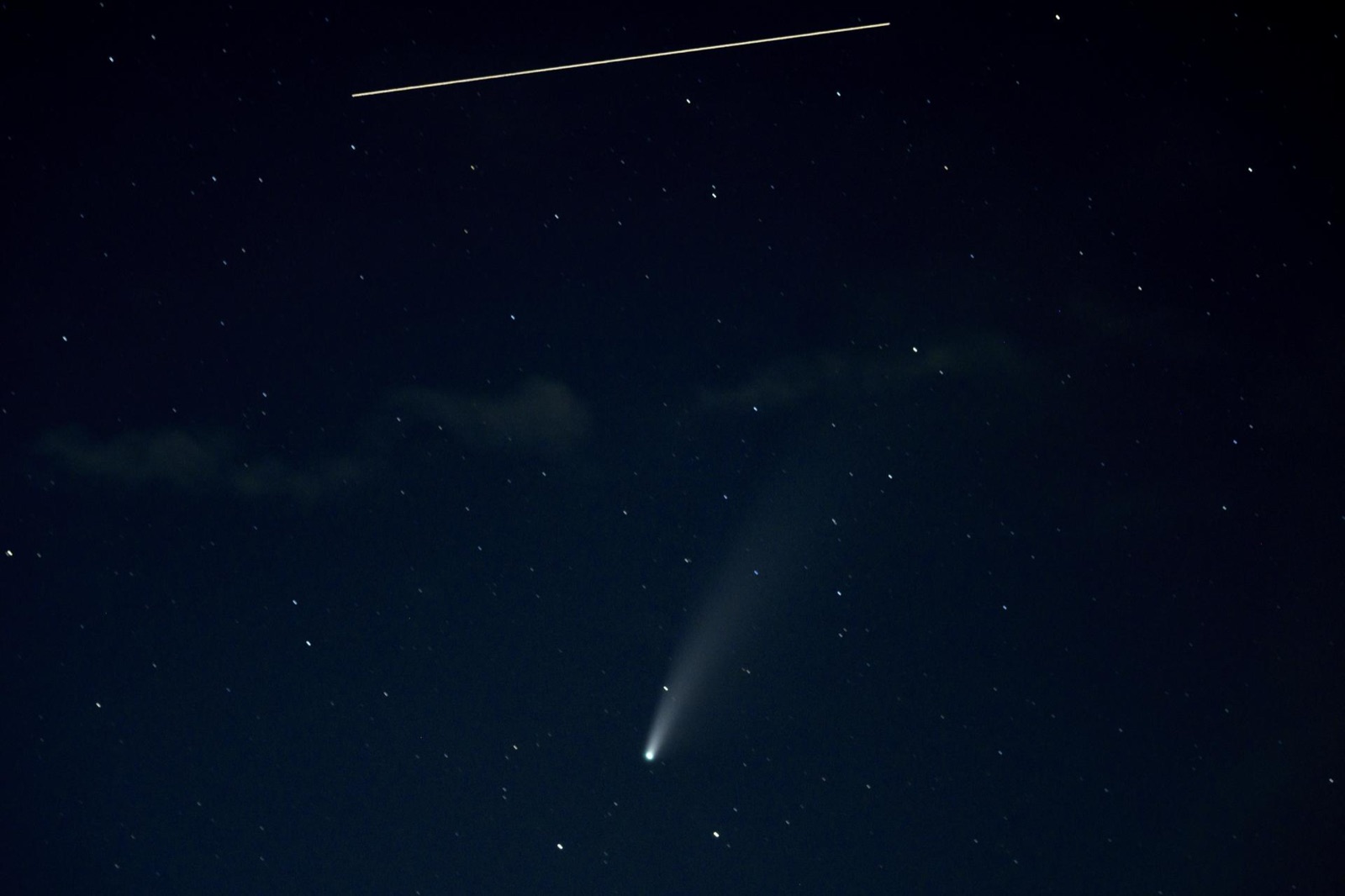
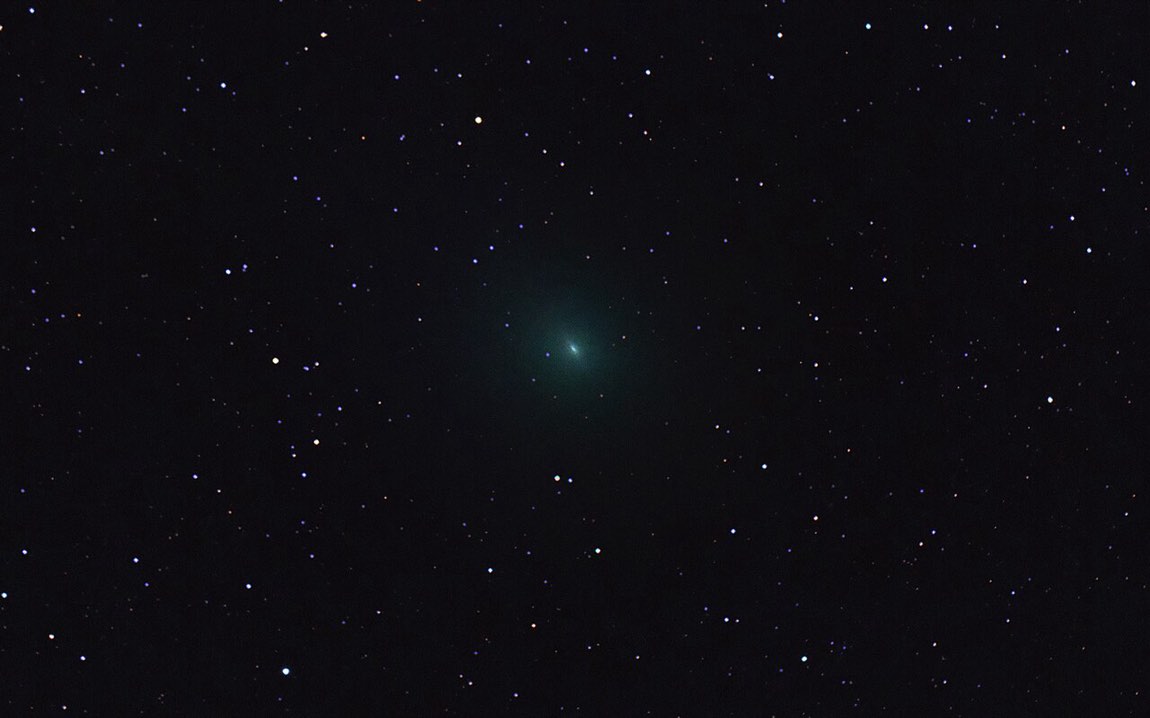
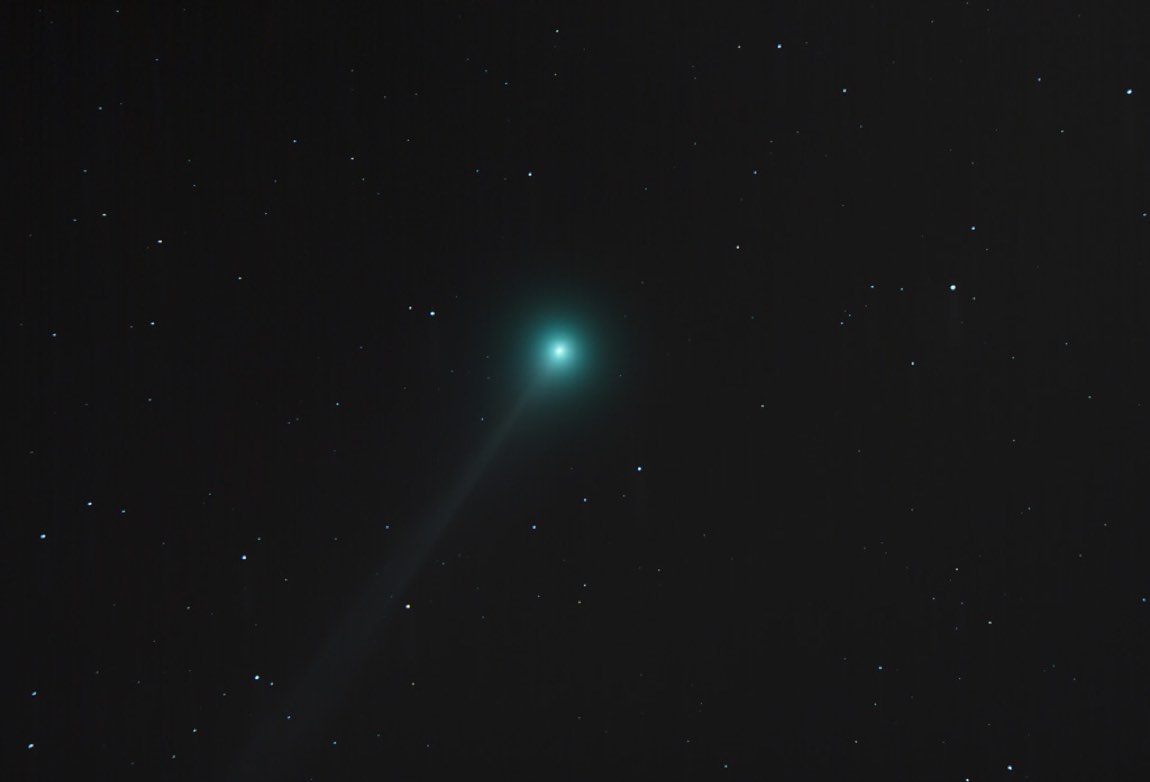
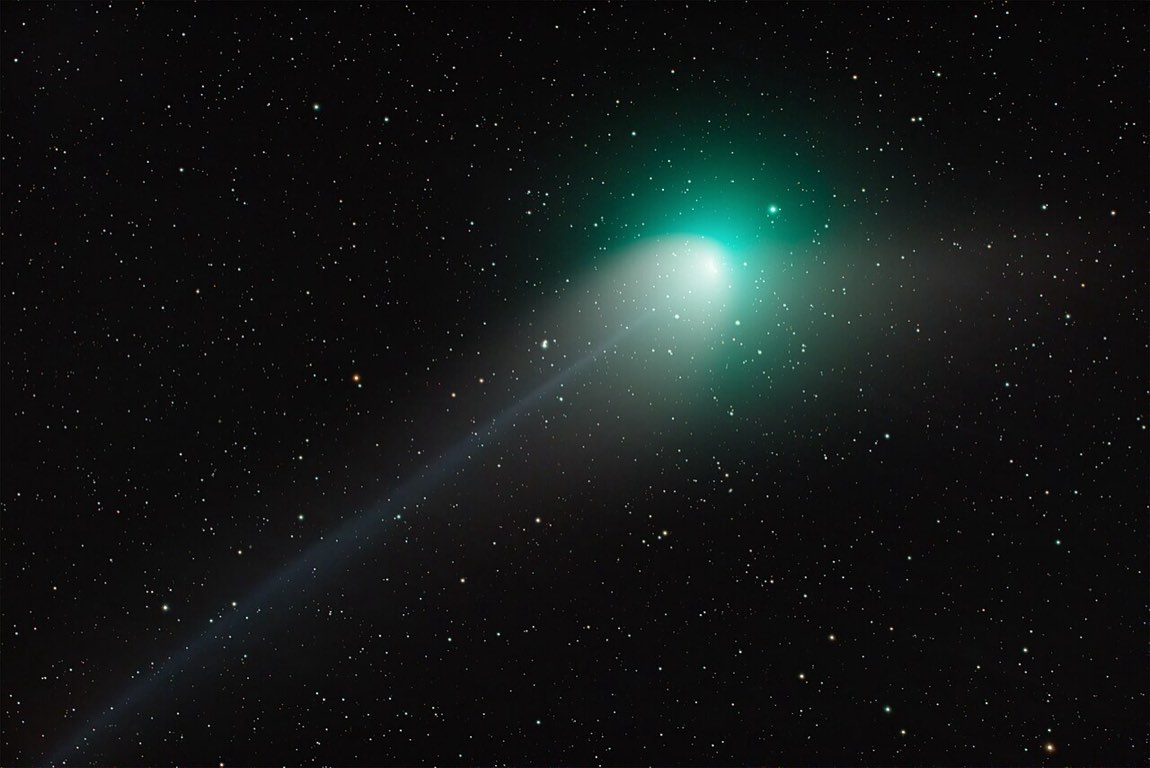
 Photograph · Edu INAF , photographer: Alessandro Bianconi · CC BY-SA 2.0
Comet · Deep guide
Comet ZTF (C/2022 E3)
Also called: C/2022 E3 · Green comet
The 'green comet' of early 2023, faintly visible to the naked eye from dark skies.
What is it?
C/2022 E3 (ZTF) was discovered by the Zwicky Transient Facility survey on 2 March 2022. It came from the Oort cloud, reached perihelion on 12 January 2023 and passed about 0.28 AU from Earth on 1 February 2023. Sunlight acting on diatomic carbon and cyanogen gave its head a green glow. It reached about magnitude 5, and in January 2023 observers also saw a thin anti-tail.
The deep dive
Researched for the Atlas from Wikipedia — C/2022 E3 (ZTF) (7,409 characters read) · updated Nov 14, 2026
01 How the ZTF Survey Caught It First
Comet ZTF was discovered on 2 March 2022 by astronomers Bryce Bolin and Frank Masci using the Zwicky Transient Facility, a wide-field survey instrument built around a 1.2-metre f/2.4 Schmidt telescope at Palomar Observatory in California. The ZTF is designed to sweep large swaths of sky repeatedly, hunting for things that change — supernovae, variable stars, and, as it turned out, comets. When first spotted, the object had an apparent magnitude of 17.3, roughly 100,000 times too faint for the naked eye, and lay about 4.3 AU from the Sun — farther out than Mars. It was initially logged as an asteroid. Only follow-up observations revealed a telltale condensed coma, the fuzzy envelope of gas and dust that marks a comet. Citizen and professional observers then dug through archival images and found the comet had actually been photographed by Pan-STARRS 1 at Haleakalā Observatory, Hawai'i, as early as 10 July 2021, when it glowed at magnitude 23, and by ZTF itself in October and November 2021 — without anyone noticing at the time.
02 The AI That Flags Fuzzy Strangers Deeper
One of the quieter heroes of this discovery is a neural network called Tails. When ZTF images are processed, Tails compares each detected source against nearby point-like stars; if a source appears extended rather than sharp, the system flags it as a candidate comet. That algorithmic nudge helped confirm C/2022 E3 as cometary even before human observers had a chance to study it carefully. Early coma measurements from independent observers illustrated just how uncertain initial cometary characterisation can be: H. Sato, observing remotely from Mayhill, New Mexico, measured the coma at 8 arcseconds across in stacked images, while K. Yoshimoto reported 15 arcseconds and even spotted a small tail 25 arcseconds long. Those differing numbers reflect genuine variations in image depth, stacking technique, and sky conditions — a reminder that comets present a notoriously slippery edge to measure. The designation "2022 E3" encodes the discovery timeline precisely: it was the third comet found in the first half of March 2022.
03 Why the Coma Glows Green
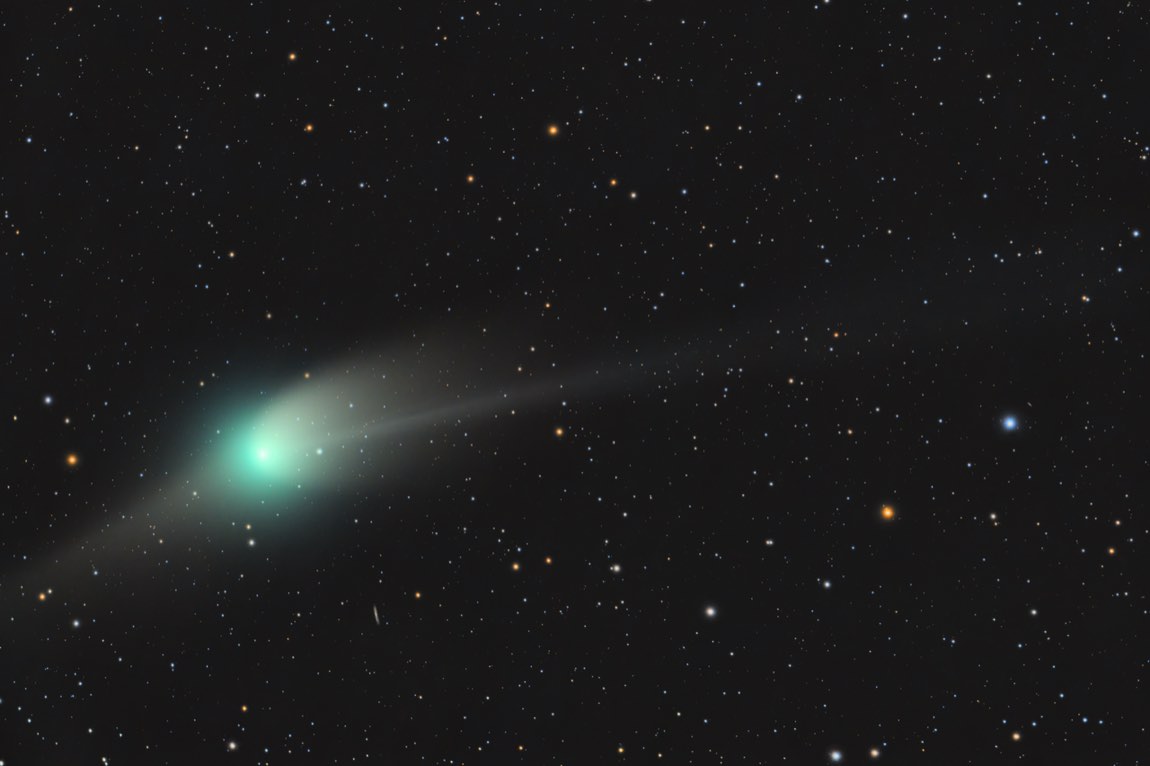
The vivid green glow that made Comet ZTF so photogenic traces back to a simple molecule: diatomic carbon, C₂. Organic materials evaporate off the warm nucleus as the comet nears the Sun, and solar ultraviolet radiation breaks those molecules apart — a process called photolysis — producing C₂. When solar UV excites C₂ into a particular triplet electronic state, the molecule radiates at 518 nanometres, squarely in the green part of the visible spectrum. The molecule is fragile, however: it undergoes further photolysis with a lifetime of roughly two days, which is why the green glow is confined to the comet's head rather than trailing down the tail. Cyanogen is also cited as a contributor to the colour. Comet researcher Matthew Knight noted that this greenish tint is not unusual for comets with high gas content, but such comets only rarely pass close enough to Earth for the colour to be so obvious. A similar hue had been seen earlier in comet C/2021 A1 (Leonard).
04 Three Tails and a Solar Disconnection
Most comets display two tails — one of ionised gas pushed straight back by the solar wind, one of dust curving gently along the orbital path — but Comet ZTF briefly showed three. By 19 December 2022 observers could see a greenish coma, a short broad dust tail, and a long faint ion tail stretching across a 2.5-degree field of view. Then, on 22 January 2023, an anti-tail appeared: a spike seeming to point toward the Sun, in the opposite direction from the other tails. This striking illusion arises because large, slow-moving dust particles spread along the comet's orbital plane; when Earth crosses that plane, the perspective makes this sheet of debris look like a tail pointing sunward. Around the same time, on 17 January, a coronal mass ejection from the Sun sent a surge of fast solar wind into the comet's ion tail, causing a disconnection event — the ion tail appeared to snap off and re-form, a phenomenon that has been observed in other comets but that is dramatic every time it happens.
 ⤢
05 A Nucleus Spinning Every 8.6 Hours Deeper
The solid nucleus at the heart of Comet ZTF was estimated to have a radius of roughly 0.81 to 2.79 kilometres — a wide range that reflects genuine difficulty in measuring an object so small and so wrapped in bright coma. For perspective, the larger end of that estimate is comparable to the length of about 25 football fields. The nucleus rotates once every 8.5 to 8.7 hours, a figure derived from periodic variations in the comet's brightness as different active regions on the surface alternately face the Sun. Dust production measured as the comet closed on the Sun rose from 241 ± 3 kilograms per second in July 2022 to 476 ± 9 kilograms per second by October 2022 — roughly doubling in three months as increasing solar heat drove more material off the surface. By 31 January 2023, the comet's coma had swelled to about 20 arcminutes across, and the central condensed region spanned roughly 4 arcminutes, corresponding to a physical diameter of 50,000 kilometres — slightly larger than four Earths side by side.
06 Molecules Found Inside the Coma Deeper
Spectroscopic analysis of Comet ZTF revealed a remarkably rich chemical inventory. Emission lines of NH₂, diatomic carbon (C₂), and atomic oxygen ([OI]) appeared in wavelengths between 5000 and 7000 ångströms. A spectrum taken on 10 March 2023 identified CN, diatomic and triatomic carbon, and possibly OI. The ratio of C₂ to CN was measured at about 0.6 — lower than in most Solar System comets but not low enough to place it in the formally "depleted" category. Radio and millimetre-wave observations pushed the inventory further, detecting hydrocyanic acid, hydrogen isocyanide, CH₃CN, isocyanic acid, formamide, methanol, formaldehyde, formic acid, acetaldehyde, H₂S, carbon monosulfide, carbonyl sulfide, ethanol, and CH₂OH₂. The comet was notably depleted in hypervolatiles, showing low abundances of carbon monoxide and H₂S relative to water. Its methanol abundance relative to water was measured at 1.8 percent, below the mean for other comets. These chemical fingerprints help scientists categorise where in the early solar nebula the comet's material condensed.
07 Watching It Brighten Month by Month
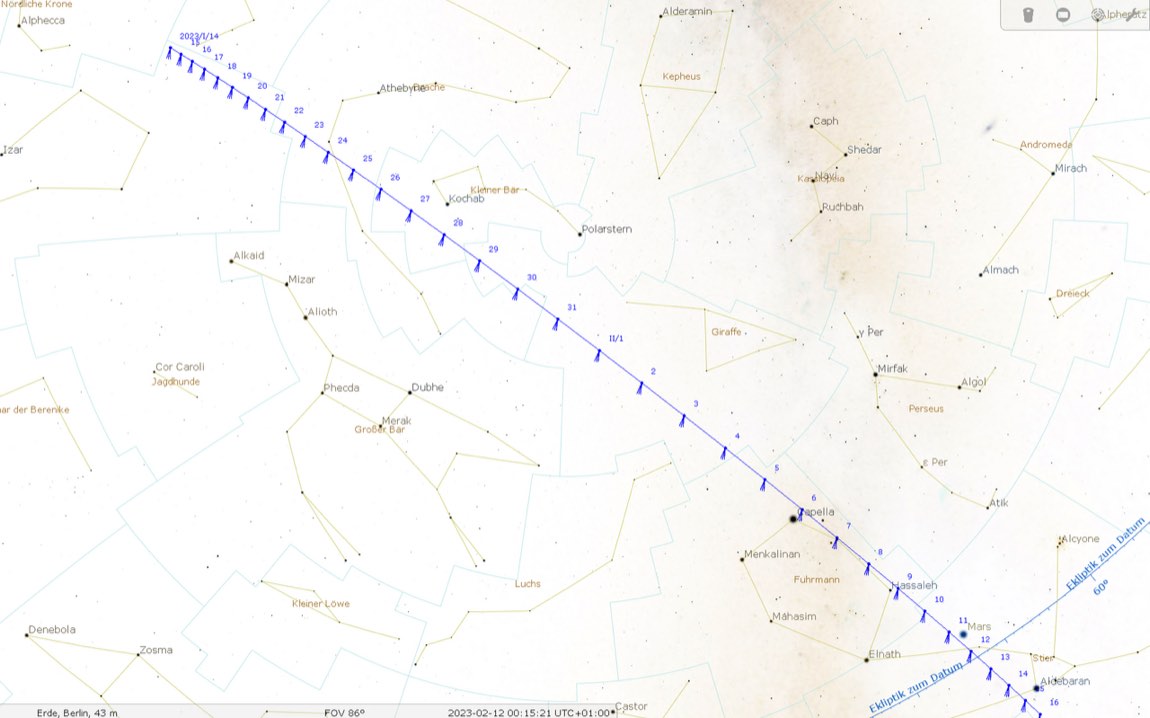
The comet's brightening arc from discovery to naked-eye visibility took nearly a year. At discovery in March 2022, it shone at magnitude 17.3 — invisible without a large telescope. By early November 2022 it had climbed to magnitude 10, reachable with binoculars, and was drifting slowly through the constellations Corona Borealis and Serpens while moving almost parallel to Earth. The comet reached perihelion — its closest point to the Sun, at 1.11 AU or 166 million kilometres — on 12 January 2023. The first naked-eye sightings were logged on 16 and 17 January, at estimated magnitudes of 5.4 and 6.0 respectively. By 31 January it had brightened to about magnitude 5. The XMM-Newton X-ray space telescope observed it on 23 January but detected it only faintly. After closest Earth approach on 1 February, the comet crossed near Capella on 5 February, made a visual conjunction with comet C/2022 U2 (ATLAS) on 6 February, passed 1.5 degrees from Mars on 10–11 February, and drifted in front of the Hyades star cluster on 13–15 February.
08 Its Path Across the Winter Sky
As Comet ZTF brightened through late 2022 and early 2023, it traced a memorable route across the northern sky that sky-watchers could follow night by night. After appearing in the evening sky in November, it shifted to morning visibility and marched northward through Boötes, Draco, and Ursa Minor, passing within about 10 degrees of Polaris — the North Star — by the end of January. At closest approach to Earth on 1 February 2023, the comet sat near the north celestial pole inside the faint constellation Camelopardalis. Unfortunately for casual observers, the Moon was in its waxing gibbous phase at exactly that moment, washing out the sky and hampering naked-eye viewing. The solar elongation at discovery had been only 44 degrees, meaning the comet was relatively close to the Sun in the sky, but it widened steadily as the comet moved into better viewing geometry. By passing into circumpolar territory for mid-latitude northern observers, the comet became accessible throughout the night — a rare convenience for comet hunters.
 ⤢
09 Will It Ever Return? Deeper
The long-term fate of Comet ZTF sits at a genuinely uncertain knife-edge. Before perihelion, JPL Horizons modelling suggested the outbound orbit was technically bound to the Sun-Jupiter system when projected to an epoch around 2050, but with an absurdly large maximum distance of 270,000 AU — 4.3 light-years — which extends well beyond the Oort cloud and is considered unrealistic. After perihelion, the picture shifts: using a heliocentric orbit anchored to the epoch 2495 and accounting only for the Sun's gravity, the comet appears unbound to the Solar System. The numbers are razor-thin: the Sun's escape velocity at 200 AU is 2.98 km/s, and the comet is calculated to be moving at 2.97 km/s at that distance. Whether it lingers in the Solar System for millions of years or escapes entirely depends on small perturbations — outgassing forces (non-gravitational accelerations from jets of evaporating gas), the gravitational nudges of the galactic tide, and encounters with passing stars while in the Oort cloud. It is a genuinely open question.
10 An Oort Cloud Visitor's Credentials
The designation C/2022 E3 carries real scientific meaning. The leading "C" indicates that this is a non-periodic comet — one that either takes far longer than 200 years to orbit or, in this case, may not orbit at all in any practical human sense. The comet is classified as an Oort cloud object, meaning it spent most of its existence in the vast spherical reservoir of icy bodies that surrounds the Solar System at distances of thousands to tens of thousands of AU. Gravitational disturbances — perhaps from a passing star or the gentle tidal pull of the Milky Way's disk — nudged it onto a path that brought it sailing inward past all the planets. When it was still 4.3 AU from the Sun at discovery, it was already shedding gas and dust, suggesting a composition rich in volatile ices preserved since the early Solar System. That chemical pristineness is precisely why astronomers study Oort cloud comets so keenly: they offer a relatively unaltered sample of the material that existed when the planets were still forming, roughly 4.6 billion years ago.
11 X-rays from a Comet and What They Tell Us Deeper
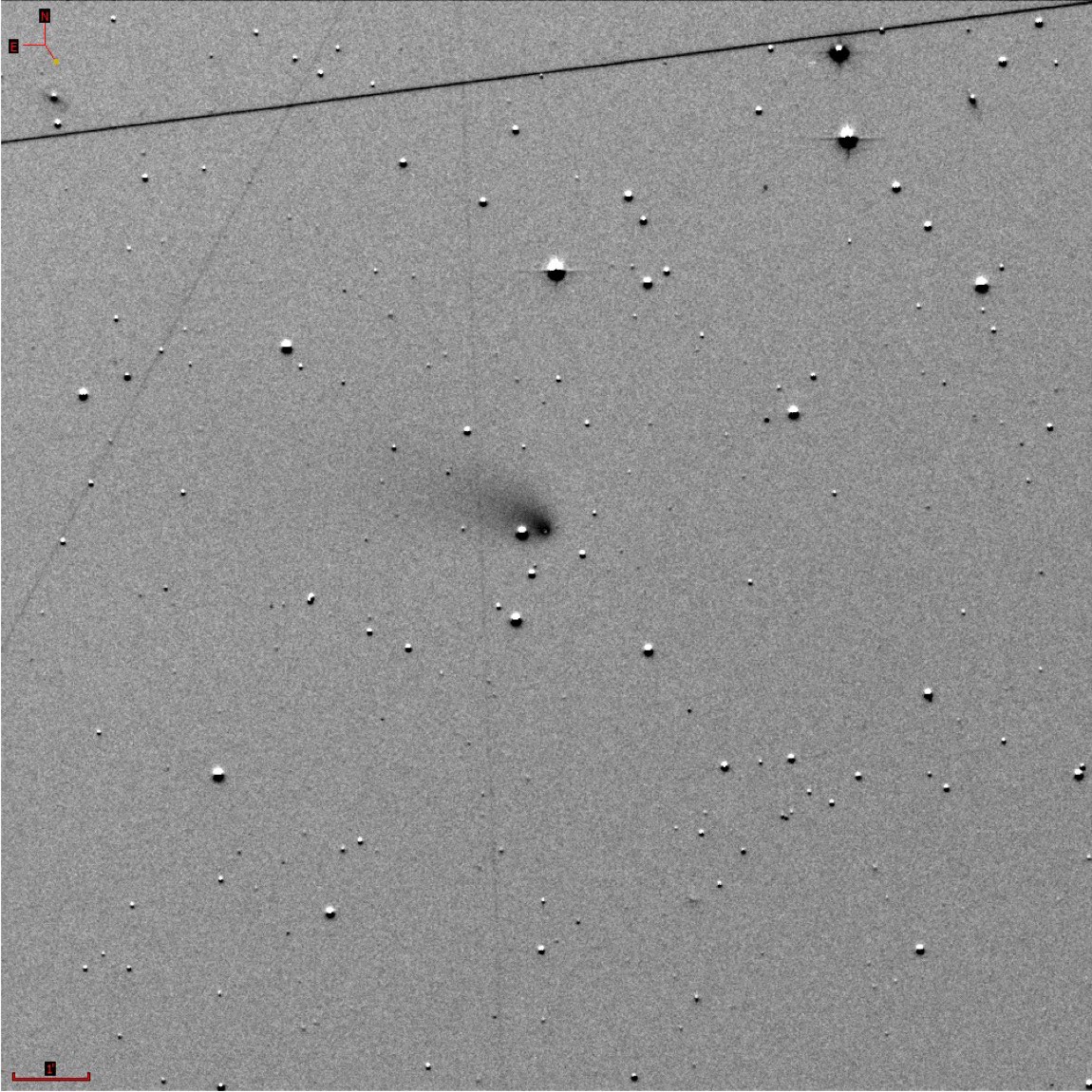
On 23 January 2023, the European Space Agency's XMM-Newton X-ray space observatory trained its mirror on Comet ZTF and detected a faint X-ray signal from the comet. X-ray emission from comets was first observed in the 1990s and was initially surprising — comets are cold, icy objects, not obvious X-ray sources. The mechanism is now understood to be charge-exchange: highly ionised atoms in the solar wind collide with neutral gas molecules in the comet's coma, capturing electrons and releasing X-ray photons in the process. The fact that XMM-Newton detected ZTF only faintly is itself informative, suggesting the comet's coma was not extremely dense in heavy solar-wind ions at that moment, or that observing geometry limited the signal. Such X-ray observations, when combined with optical and radio data, allow scientists to probe the solar wind environment local to the comet and cross-check coma outgassing rates independently of visible-light estimates.
 ⤢