 Photograph · CajunAstro · CC BY 2.0
Comet · Deep guide
Comet Honda–Mrkos–Pajdušáková (45P)
Also called: 45P/Honda–Mrkos–Pajdušáková · 45P
A small green comet that has been bounced off by radar from Earth.
What is it?
45P/Honda–Mrkos–Pajdušáková was discovered by Japanese astronomer Minoru Honda in December 1948 and is also named for Antonín Mrkos and Ľudmila Pajdušáková. It is a short-period comet with a nucleus about 1.3 km across. In August 2011 it became the fifteenth comet detected by ground-based radar. Its coma glows green because of diatomic carbon gas, and its next perihelion is in August 2027.
The deep dive
Researched for the Atlas from Wikipedia — 45P/Honda–Mrkos–Pajdušáková (2,548 characters read) · updated Nov 14, 2026
01 Three Discoverers, One Comet
The comet carries three names because three astronomers independently spotted it in quick succession after Minoru Honda first detected it on December 3, 1948. Antonín Mrkos and Ľudmila Pajdušáková each confirmed independent observations close enough in time that convention honored all three with a shared credit. This kind of multi-discoverer naming was common in the mid-twentieth century, when professional and dedicated amateur astronomers around the world were systematically sweeping the sky with modest telescopes, and word of a new object could not travel instantly. Honda was a prolific Japanese comet hunter who would go on to discover several comets; Mrkos was a Czech astronomer known for comet and minor-planet work; and Pajdušáková was a Slovak astronomer and one of the few women of her era to have a comet named in her honor. Together their names form one of the longer and more tongue-twisting designations in the catalog of periodic comets, often shortened simply to 45P.
02 An Orbit That Keeps Coming Back
45P follows an elliptical path around the Sun with a period of 5.25 years, placing it firmly in the class of Jupiter-family short-period comets whose orbits are sculpted by gravitational nudges from Jupiter. Because the period is relatively short, observers on Earth get repeated opportunities to study the same object across multiple returns, watching how its activity level and structure evolve over time. The comet reached perihelion on December 31, 2016, making New Year's Eve 2016 its closest approach to the Sun during that apparition. Looking ahead, perihelion is expected again on August 30, 2027. The comet's repeated close passages of Earth — 0.0600 AU in August 2011 and 0.08318 AU in February 2017 — mean it qualifies as a notable near-Earth comet, and future close approaches such as the anticipated October 2032 passage continue to attract planning attention from both amateur and professional observers.
03 Why the Coma Glows Green
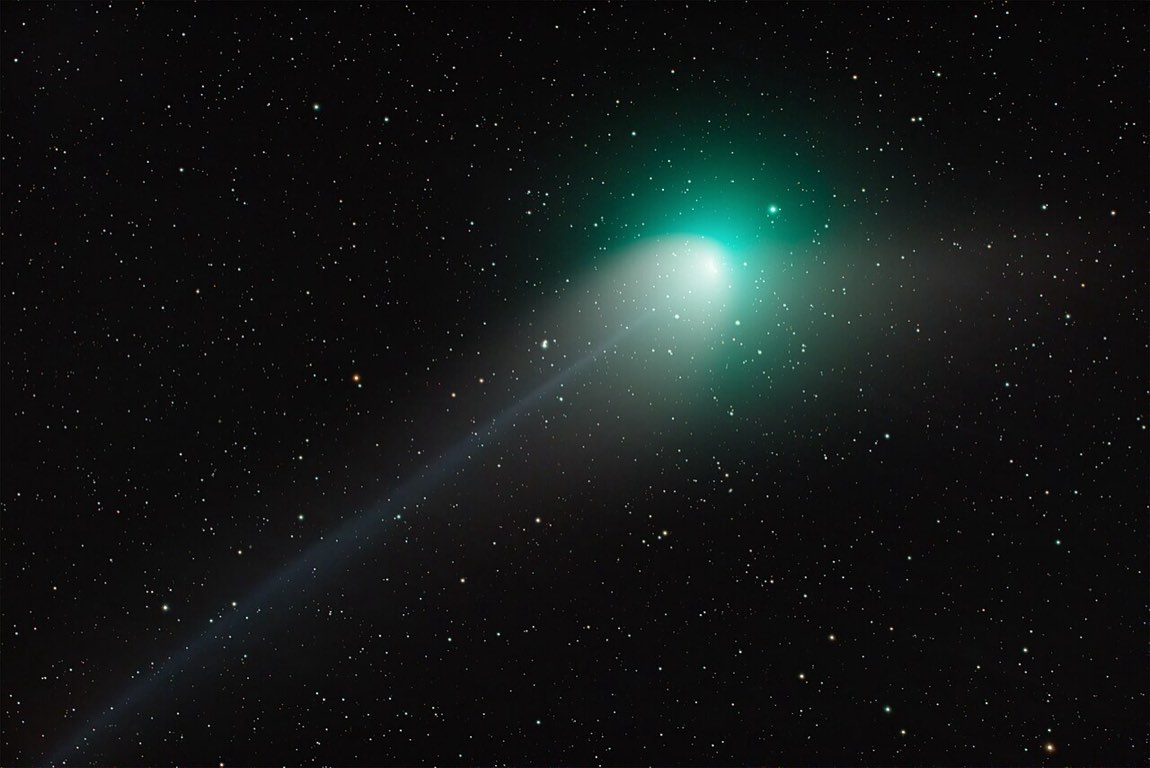
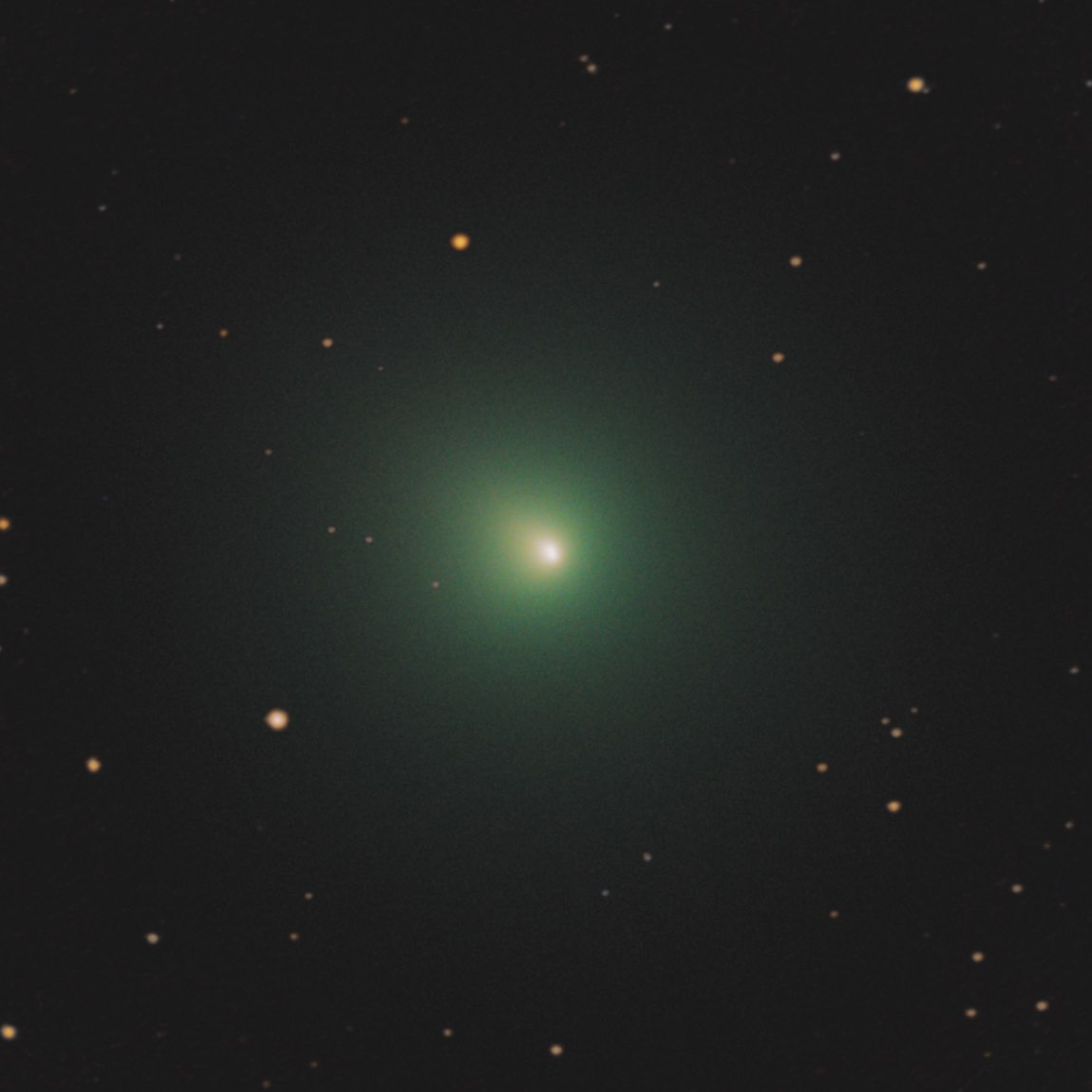
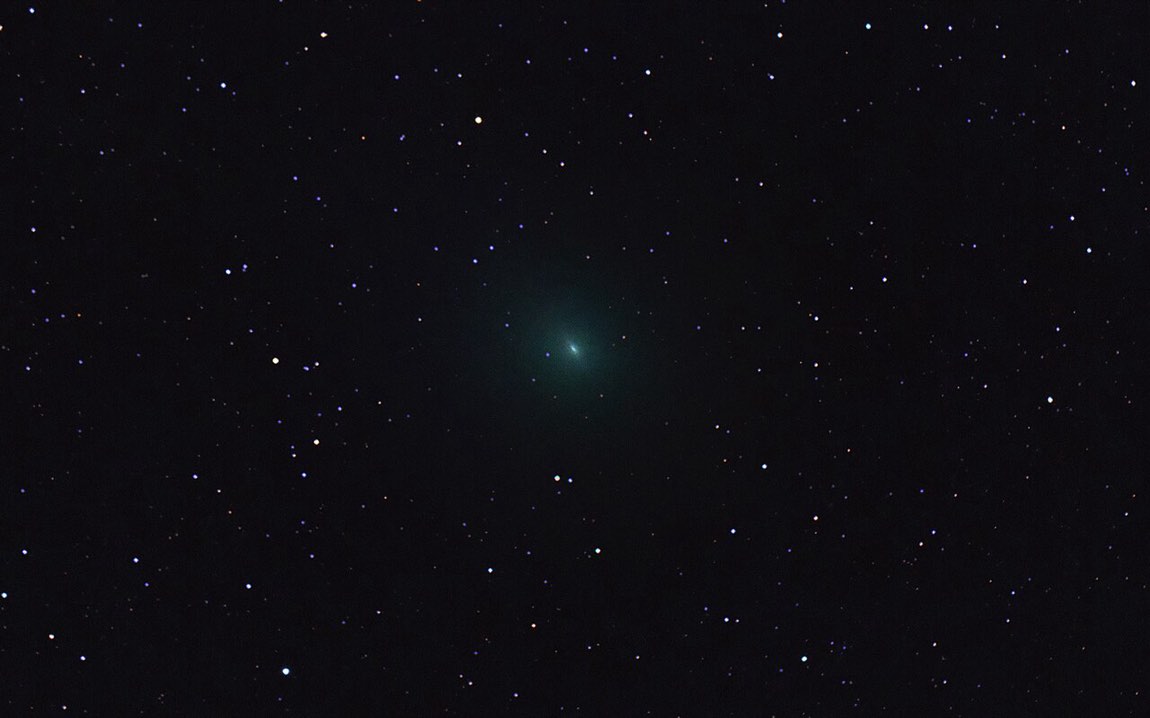
One of the most visually striking facts about 45P is its vivid green color, and the explanation is rooted in chemistry rather than illusion. The comet emits diatomic carbon — molecules made of two carbon atoms bonded together — which fluoresces green when energized by sunlight in the near vacuum of space. This emission is a well-known spectroscopic signature of cometary comae and is responsible for the eerie green glow seen in photographs of many active comets. The process works because solar ultraviolet photons excite the diatomic carbon molecules to higher energy states; as the molecules relax back down, they release photons at characteristic green wavelengths. During the 2017 passage, the coma — the extended cloud of gas and dust surrounding the nucleus — measured approximately 100,000 km across by February 4, 2017, a span roughly eight times the diameter of Earth, all rendered in that characteristic green hue when imaged through appropriate filters.
 ⤢
04 Radar Echoes From a Tiny Nucleus Deeper
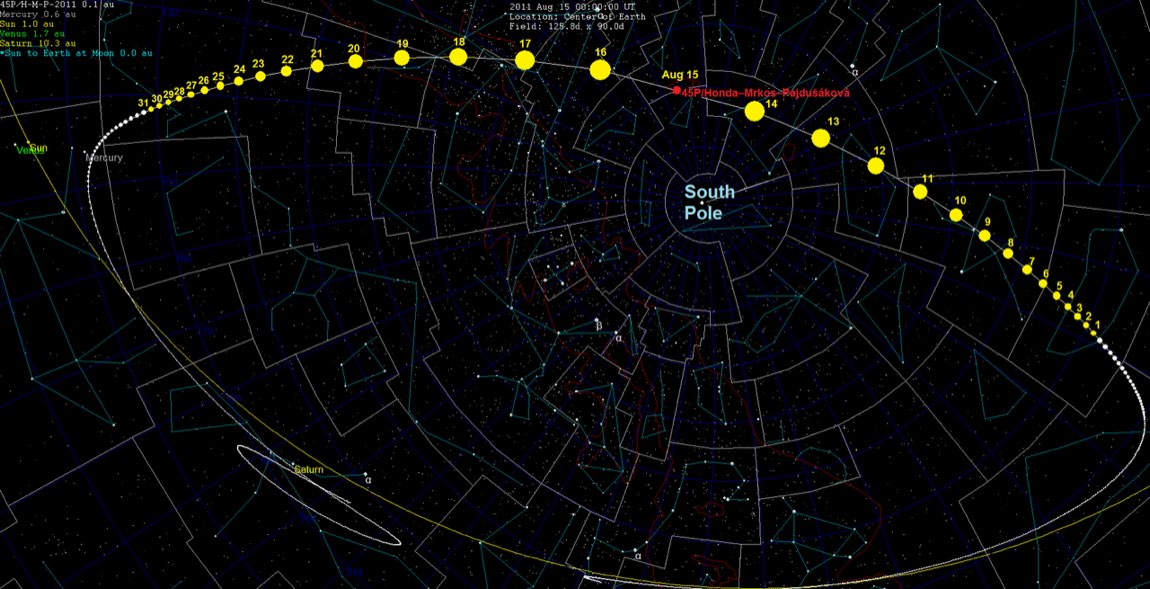
On August 19 and 20, 2011, ground-based radar telescopes succeeded in bouncing radio signals off comet 45P, making it the fifteenth comet ever detected by radar. The observations were conducted with the Goldstone Deep Space Network following a close approach of just 0.0600 AU — about 8,980,000 km — from Earth on August 15, 2011. Radar astronomy is a powerful technique for comets because it can resolve information about the nucleus that optical telescopes cannot easily access through the surrounding coma. In this case, the radar detected echoes from both the nucleus and the coma separately, providing physical constraints on the object's solid core. The nucleus is now known to be 1.3 kilometers in diameter — roughly the length of thirteen football fields end to end — which is small even by cometary standards and helps explain why the comet must approach Earth relatively closely before it becomes bright enough for naked-eye or easy binocular viewing.
05 How Bright Does It Get?
The brightness of 45P varies considerably depending on how close it comes to both the Sun and Earth during any given apparition. During its 2011 passage, the comet was recovered in June at a faint magnitude 21 — far beyond any unaided eye or even casual telescope — and brightened through magnitude 18 and 16 as it approached perihelion, ultimately expected to peak near magnitude 7.3. During the 2017 passage, it reached around magnitude 7 by early February, requiring binoculars because of its low surface brightness. The 1996 observation by the Solar and Heliospheric Observatory caught the comet at approximately magnitude 7 when it was only 4.3 degrees from the Sun. For the upcoming 2027 apparition, predictions suggest the comet will be around magnitude 14 by May of that year, then brighten to somewhere between magnitude 5 and 8 at perihelion on August 30, 2027 — potentially within naked-eye or easy binocular range under dark skies, though cometary brightness predictions always carry uncertainty.
06 Watched by a Sun-Staring Spacecraft Deeper
During the 1995 perihelion passage, comet 45P appeared in the field of view of the Solar and Heliospheric Observatory, known as SOHO, on January 16, 1996. At that moment the comet was at an apparent magnitude of about 7 and positioned only 4.3 degrees from the Sun — an angular separation so small that ground-based observers would have faced nearly impossible conditions trying to observe it against the bright twilight sky. SOHO, which orbits the Sun–Earth L1 Lagrange point and uses a coronagraph to block the solar disk, is ideally suited to catching comets that swing through the inner solar system in configurations inaccessible from the ground. This observation demonstrates that 45P's orbit brings it into the Sun's neighborhood closely enough that space-based solar observatories, originally built for heliophysics research rather than comet hunting, become important instruments for tracking the comet's behavior near its closest solar approach.
 ⤢
07 The August Delta Capricornids: A New Shower Deeper
On August 16, 2022, the global CAMS and Sonotaco meteor-camera networks detected a modest outburst of meteors whose orbital characteristics closely matched comet 45P. The shower was given the temporary designation M2022-Q1 before being permanently named the August Delta Capricornids. Investigators traced the meteors to the 1980 meteoroid stream of 45P — debris shed by the comet during a pass more than four decades earlier that had spread along its orbit and finally intersected Earth's path. In total, 137 meteors were triangulated by the global CAMS network. The meteors entered the atmosphere at 24.4 km/s and appeared to radiate from the border of Aquarius and Capricornus, at a right ascension of 21 hours 40 minutes and a declination of –11.9 degrees. This detection marked the first confirmed encounter between Earth and a dust trail definitively linked to 45P, connecting a named meteor shower to its parent comet and adding 45P to the growing list of comets with identified meteor shower progeny.
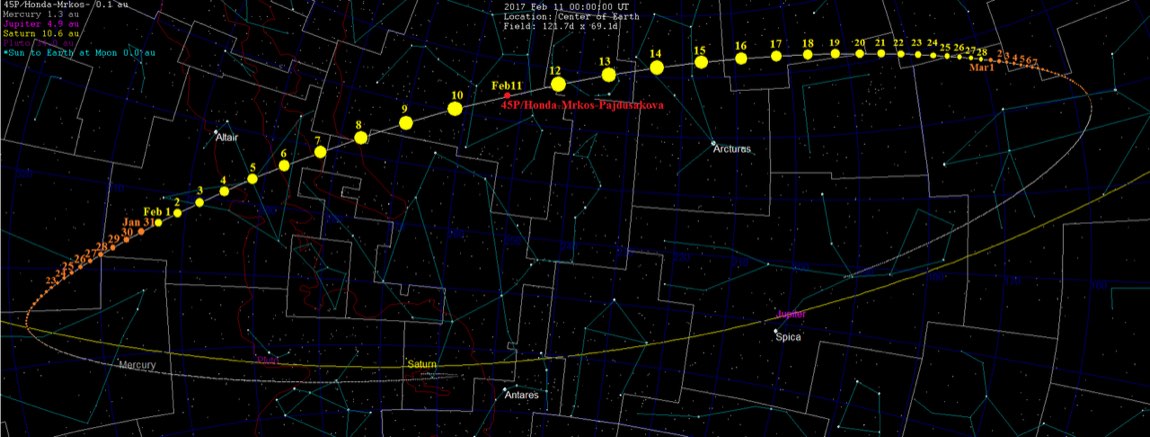
08 The 2017 Close Pass: Timing and Coincidence
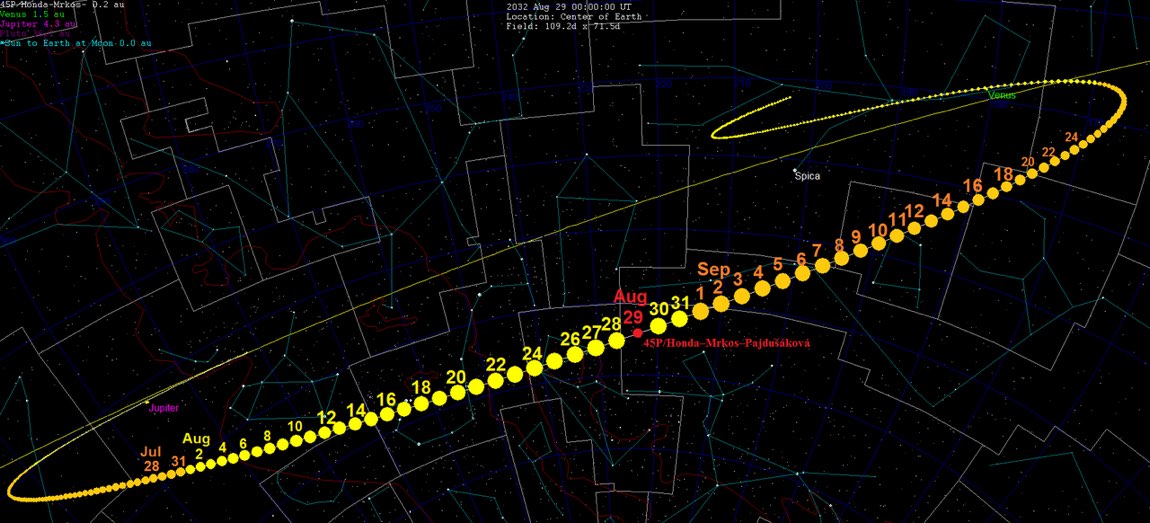
The 2017 apparition of 45P offered an unusually photogenic set of circumstances for skywatchers. The comet reached perihelion on December 31, 2016 — the final hours of the year — and then swept toward Earth, passing just 0.08318 AU (about 12,444,000 km) from our planet on February 11, 2017. That same evening, a lunar eclipse was underway, giving observers who stepped outside to watch the Moon darken over Earth's shadow the bonus spectacle of a green-glowing comet elsewhere in the sky. By that date the comet's coma had swelled to about 100,000 km in diameter. Despite the comet's relative proximity, its low surface brightness meant it did not simply pop into view: binoculars were required to see it, a reminder that apparent brightness depends on how spread out a coma is across the sky, not just on total light output. The next similarly notable close approach is expected in October 2032, when the comet may again reach approximately magnitude 7.
09 How to Observe 45P at Its Next Return
The 2027 perihelion passage on August 30 offers the next well-documented opportunity to follow 45P. Predictions indicate the comet will be detectable at around magnitude 14 by May 2027, within the reach of moderate amateur telescopes under dark skies. As perihelion approaches, brightness is expected to climb to somewhere between magnitude 5 and 8, a range that spans the boundary between easy binocular targets and potentially naked-eye visibility — though the wide uncertainty in that range reflects the inherent unpredictability of cometary outgassing. Past experience with 45P shows it tends to have a low surface brightness even when nominally bright, because its light is spread across an extended coma rather than concentrated in a star-like point. Observers using binoculars or wide-field eyepieces on telescopes will have better luck than those hunting with high magnification. The October 2032 close approach is also flagged as a potential magnitude-7 event worth marking on long-range planning calendars.
 ⤢