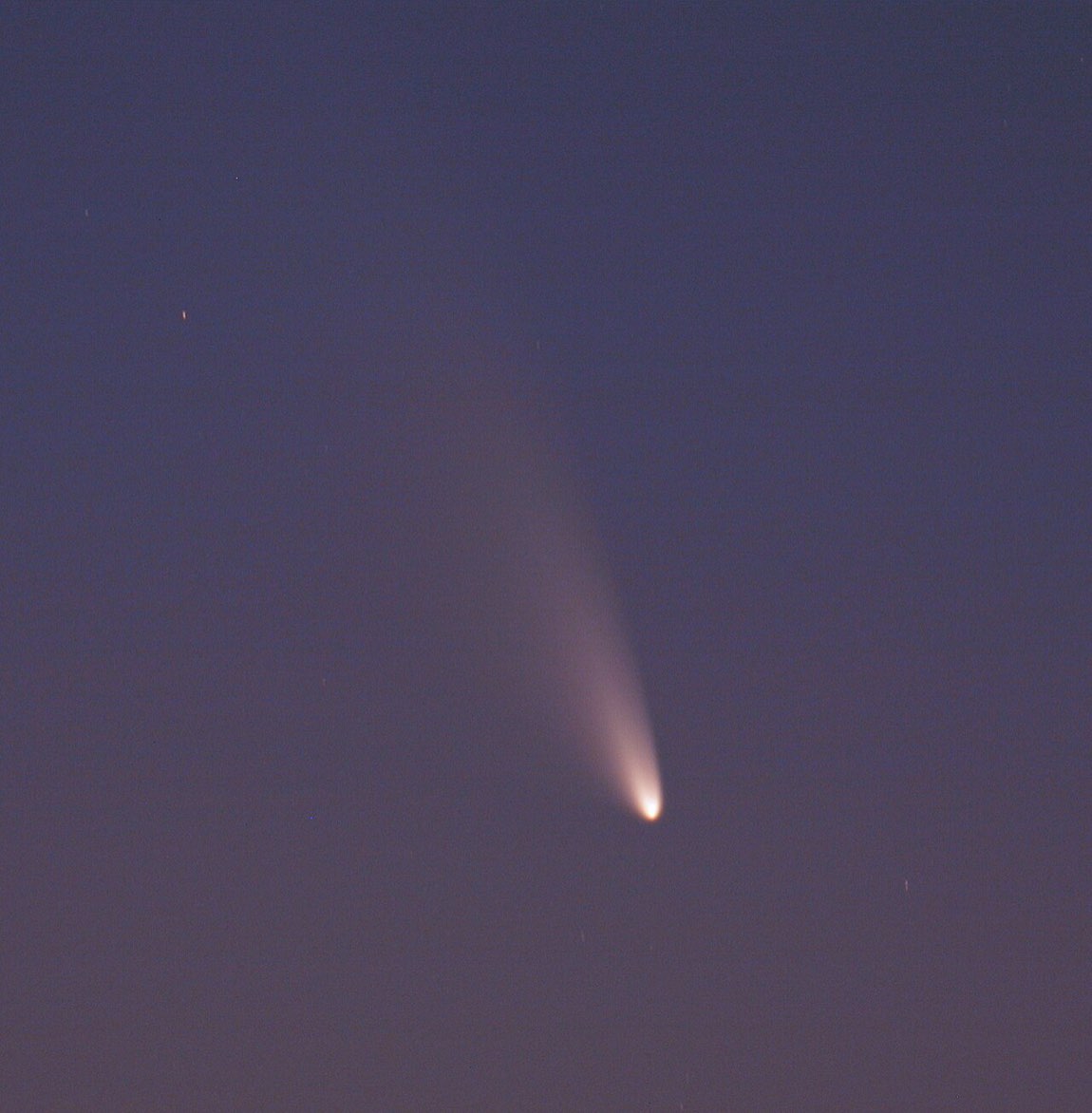
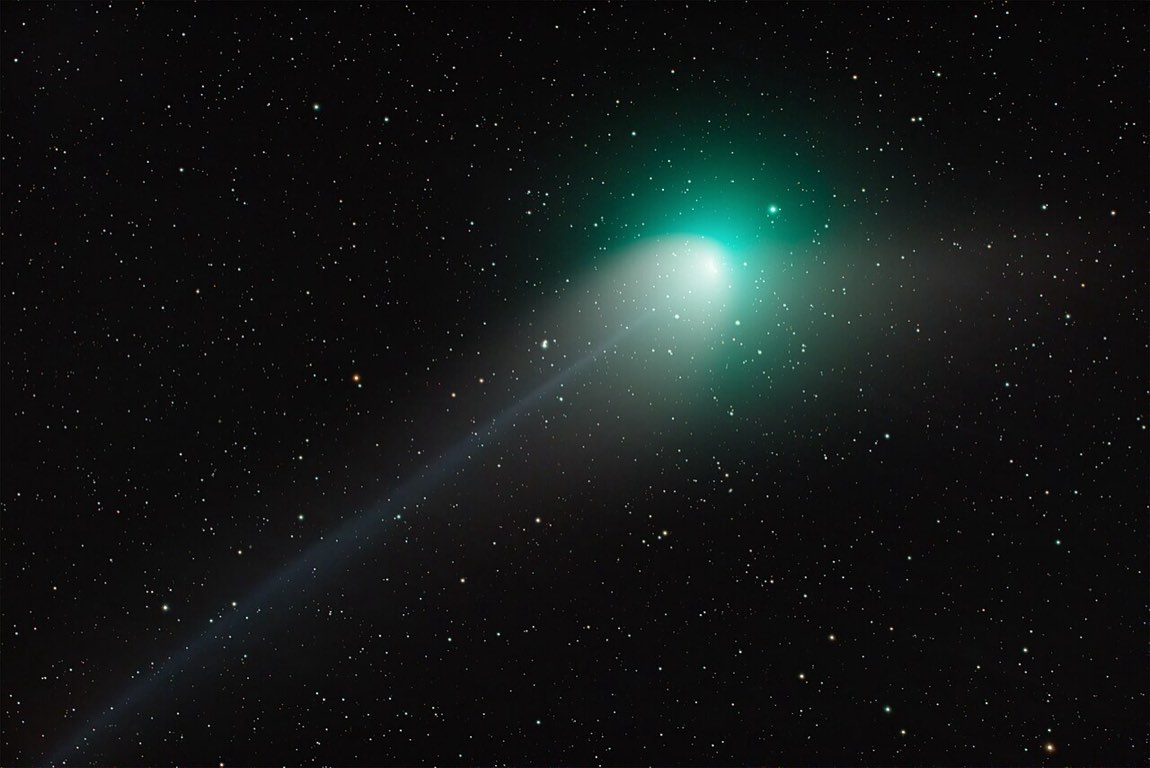
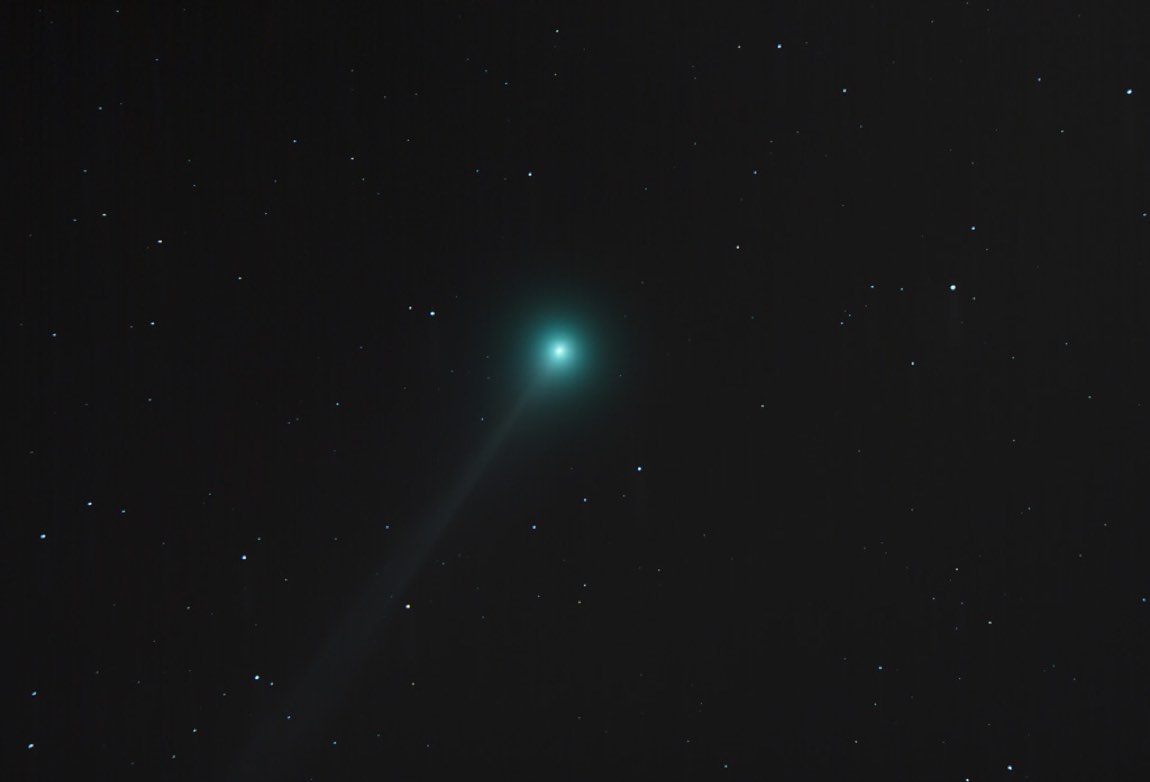
 Photograph · Massimozanardi · CC BY-SA 3.0
Comet · Deep guide
Comet Lemmon (C/2012 F6)
Also called: C/2012 F6
A naked-eye-limit comet that graced southern skies in early 2013.
What is it?
Comet Lemmon was discovered in March 2012 by Alex R. Gibbs of the Mount Lemmon Survey in Arizona; at first it was thought to be an asteroid. It brightened slowly through 2012 and peaked around magnitude 5 in late March 2013, best seen from the Southern Hemisphere, at about the same time as Comet PANSTARRS. Its long, stretched orbit takes it out to nearly 1,000 AU, and it will not return for roughly 8,000 years.
The deep dive
Researched for the Atlas from Wikipedia — C/2012 F6 (Lemmon) (3,998 characters read) · updated Nov 14, 2026
01 A Cosmic Wanderer Found by Machine
Comet Lemmon's story begins not with a human eye at an eyepiece but with a robotic sky survey doing patient, methodical work. On 23 March 2012, the Mount Lemmon Survey's 1.5-metre reflecting telescope, perched at the summit of Mount Lemmon in the Santa Catalina Mountains north of Tucson, Arizona, swept across the constellation Leo and captured the comet's faint light. Astronomer Alex R. Gibbs reviewed the images but initially saw nothing obviously cometary — the object looked asteroidal, and it was duly reported to the Minor Planet Center's Near-Earth Object Confirmation Page as an asteroid. Only subsequent observations revealed the fuzzy, extended appearance that is a comet's telltale signature. This mix-up is surprisingly common in modern surveys: automated telescopes collect far more data than humans can manually inspect in real time, so borderline objects often get a provisional asteroidal label before follow-up settles the question.
02 Amateur Eyes Confirm a Comet
Within days of the initial discovery report, amateur astronomer Peter Birtwhistle at Great Shefford, England, turned his 40-centimetre refracting telescope toward the suspect object and took CCD images. His estimate of an apparent magnitude of +20.1 and a measured angular diameter of 5 arc seconds across were enough to confirm the cometary nature that the original detection had missed. That is impressively faint — roughly 250,000 times dimmer than the faintest stars visible to the naked eye — yet the small but measurable fuzziness Birtwhistle recorded was the decisive clue. His independent confirmation illustrates the continuing partnership between professional survey programs and dedicated amateurs who possess serious equipment and the willingness to follow up on candidate objects quickly. Without that rapid second look, Comet Lemmon might have remained catalogued as a mundane near-Earth asteroid for far longer.
03 Eighteen Months of Brightening
From discovery in March 2012 through perihelion in March 2013, Comet Lemmon underwent one of the more dramatic brightness progressions of a modern naked-eye comet. At discovery it sat near apparent magnitude +20.6 to +20.8 — detectable only by the survey telescope. By 14 June 2012 it had climbed to +19.0 before vanishing into the Sun's glare as it passed apparently just 0.7 degrees from the Sun on 25 August. When the Remote Astronomical Society Observatory in Mayhill, New Mexico, recovered it on 14 October, it had brightened sharply to +15.3. By late November the comet crossed the threshold where it could be seen without CCD assistance: Juan José González Suárez in Cantabria, Spain, became the first person confirmed to have spotted it visually, using a 20-centimetre reflector. By year's end the coma had grown to 5–7 arc minutes across and the magnitude stood at +9, well within telescopic range.
04 Peak Brilliance and Southern Skies
Comet Lemmon saved its best performance for the Southern Hemisphere. Through January and February 2013 it swept across the southern constellations Centaurus, Crux, and Chamaeleon, eventually becoming circumpolar — never setting below the horizon — when viewed from high southern latitudes while it lingered in Octans. By late February it was sitting in the constellation Phoenix in the early evening sky. The comet reached perihelion on 24 March 2013, its closest approach to the Sun at 0.73 astronomical units, and near that same date it peaked at an apparent magnitude of +5, right at the edge of naked-eye visibility under good conditions. Observers in Australia, South Africa, and South America had a front-row seat; northern observers largely missed the peak. After perihelion the comet began to fade, and when it crossed the celestial equator on 20 April 2013 and became a northern-sky object, it was already significantly dimmer than it had been at its best.
05 An Extreme Orbit: Close and Far Deeper
Comet Lemmon's orbital path is shaped by an extraordinary eccentricity that swings it between two very different regimes of the solar system. At perihelion it comes to within 0.73 astronomical units of the Sun — closer than Venus orbits — bathing the nucleus in intense solar heat and triggering the outgassing that creates the visible coma and tail. At aphelion, the far end of the orbit, the comet retreats to roughly 973 astronomical units from the Sun. To put that in perspective, Pluto averages about 39 AU from the Sun, so Comet Lemmon's aphelion lies roughly 25 times farther out than Pluto, deep in the outer reaches of the solar system where sunlight is so faint it barely warms anything. The orbital period derived from the epoch 2050 calculation is approximately 8,000 years, meaning the last time this comet swung through the inner solar system, human civilization was just beginning to develop writing and agriculture.
06 STEREO Catches a Fading Traveler Deeper
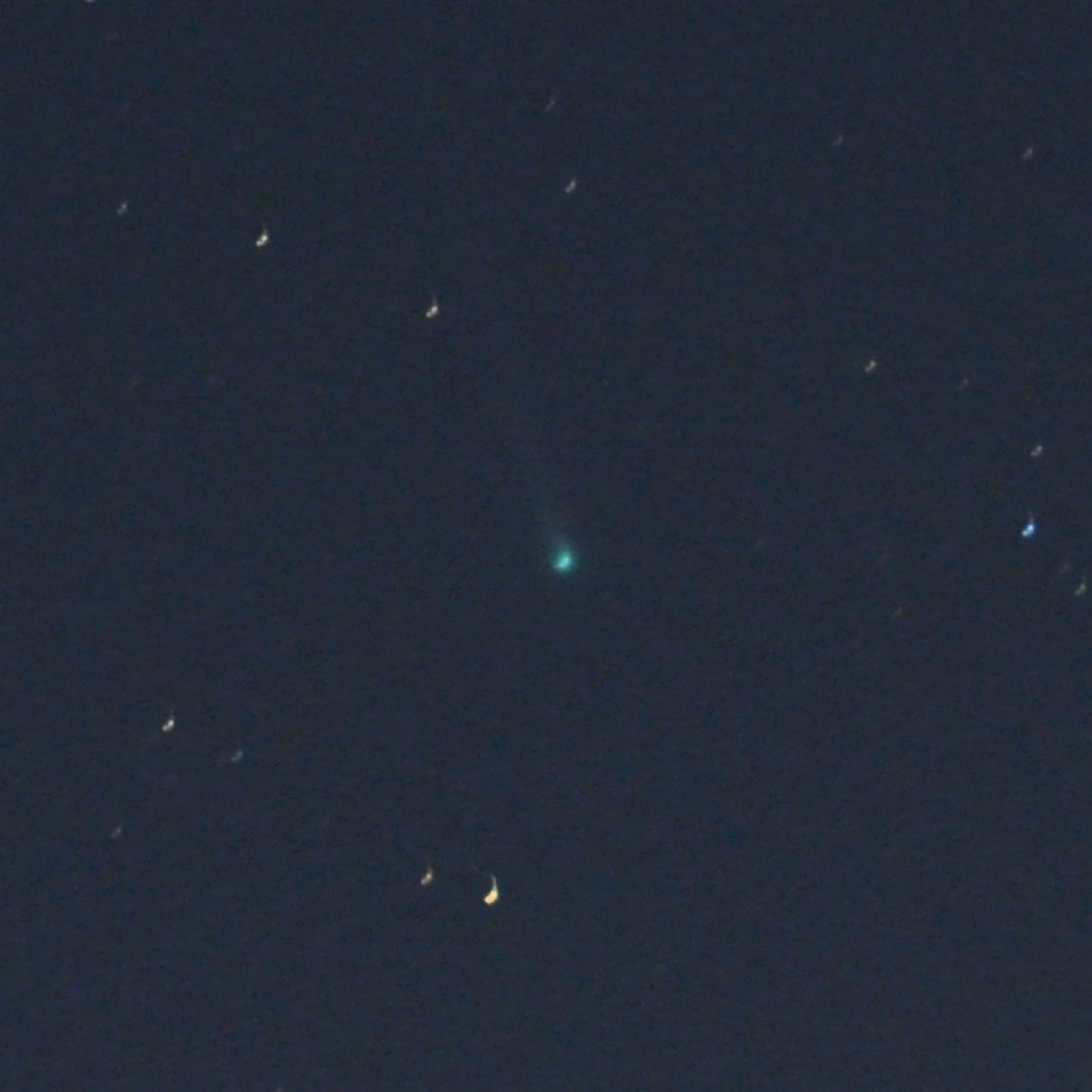
As Comet Lemmon moved away from perihelion and began its long journey back to the outer solar system, it briefly entered the field of view of a space-based observer. Starting on 17 April 2013, NASA's STEREO spacecraft — specifically the heliospheric imager instrument HI-2A — detected the comet. The STEREO mission was designed to track solar wind structures and coronal mass ejections, but its wide-field imagers regularly capture comets passing through the inner solar system. Catching Lemmon in the HI-2A field placed the comet at a well-defined position in the sky at a precisely known time, contributing to refining the orbital solution. This kind of serendipitous observation by instruments not primarily built for comet science is increasingly common and highlights how continuously operating space-based observatories serve as an always-on network that misses very little crossing the inner solar system.
 ⤢
07 ALMA Probes the Chemistry of Its Coma Deeper
The most scientifically significant result tied to Comet Lemmon came more than a year after perihelion. On 11 August 2014, astronomers published studies based on observations made with the Atacama Large Millimeter/Submillimeter Array — ALMA — marking the first time that observatory had been used to study the internal distribution of molecules inside cometary comae. Using ALMA's exceptional angular resolution at millimetre and submillimetre wavelengths, researchers mapped the spatial distribution of four distinct species inside Lemmon's coma: hydrogen cyanide (HCN), hydrogen isocyanide (HNC), formaldehyde (H₂CO), and dust. These molecules are organic compounds of direct interest to astrochemistry and the question of how carbon-bearing material is distributed in the early solar system. Lemmon was studied alongside Comet ISON (C/2012 S1) in the same research program, allowing a comparative look at two comets with different dynamical histories during the same observational campaign.
08 Why HCN, HNC, and Formaldehyde Matter Deeper
The specific molecules ALMA detected in Comet Lemmon's coma are not chosen at random — each one carries scientific meaning. Hydrogen cyanide (HCN) is one of the most commonly detected molecules in comets and is used as a proxy for the total production rate of gas from the nucleus. The ratio of HNC to HCN is particularly telling: HNC is a less stable isomer that theoretically should not survive long in the coma unless it is being produced by chemical reactions occurring as gas streams away from the nucleus, or by photo-driven processes driven by solar ultraviolet radiation. Measuring where HNC peaks relative to HCN spatially — which ALMA's maps could reveal — helps distinguish between these competing production mechanisms. Formaldehyde (H₂CO) similarly provides information about where complex organic molecules are breaking apart within the coma. Together, these detections inform models of how cometary ices sublimate and chemically evolve as they travel from the nucleus outward.
09 How to Place This Comet in Its Class
Comets are broadly divided by their orbital periods into short-period comets (which complete an orbit in under 200 years and are associated with the Kuiper Belt and scattered disk) and long-period comets, which take longer — sometimes enormously longer — to complete a single orbit. With an orbital period of approximately 8,000 years, Comet Lemmon falls firmly into the long-period category. Comets with periods this long are thought to originate in the Oort Cloud, a vast spherical reservoir of icy bodies extending from roughly 2,000 to perhaps 100,000 AU from the Sun. Gravitational nudges from passing stars, giant molecular clouds, or the tidal pull of the Milky Way's disk gradually perturb Oort Cloud objects onto trajectories that bring them sunward. Because each visit to the inner solar system strips away volatile material, long-period comets like Lemmon arriving on roughly 8,000-year orbits may be relatively pristine compared with short-period comets that have baked near the Sun many times.
10 The Survey That Gave the Comet Its Name
Comets are traditionally named after their discoverers, and in Comet Lemmon's case the discoverer is not a person but a place: the Mount Lemmon Survey. Mount Lemmon itself is the highest peak in the Santa Catalina mountain range, rising north of Tucson, Arizona. The survey operates as part of the Catalina Sky Survey, one of the most productive programs in the world for discovering near-Earth objects and other solar system bodies. The 1.5-metre reflecting telescope used in the discovery is a mid-sized instrument by professional standards — roughly the size of telescopes that were considered major research instruments in the mid-twentieth century — but paired with modern CCD detectors and automated scheduling software, it can survey large swaths of sky to very faint limiting magnitudes night after night. The survey's primary mission is planetary defense: finding asteroids and comets that might pose an impact risk to Earth. Comet Lemmon is a secondary product of that work, a long-period visitor incidentally swept up during routine patrol operations.
11 Observing Windows Then and Now
For observers who experienced Comet Lemmon in real time, the viewing story was one of geography and patience. Through most of 2012 the comet was a CCD-only object, invisible without electronic assistance. In late November 2012 it crossed into telescopic visual range, and by the end of that year a small telescope under dark skies would have shown a fuzzy ball roughly 5 to 7 arc minutes wide — comparable in apparent size to the Orion Nebula's core. The best show came in early 2013 and was reserved almost entirely for southern observers who could follow the comet through Centaurus, Crux, and Chamaeleon. Northern observers got a consolation prize: by 9 May 2013, with the comet near the star Gamma Pegasi, it was still visible in binoculars before sunrise from a dark site, though well past its prime. With an 8,000-year orbital period, no one alive today — or for many generations — will get a second chance.
 ⤢