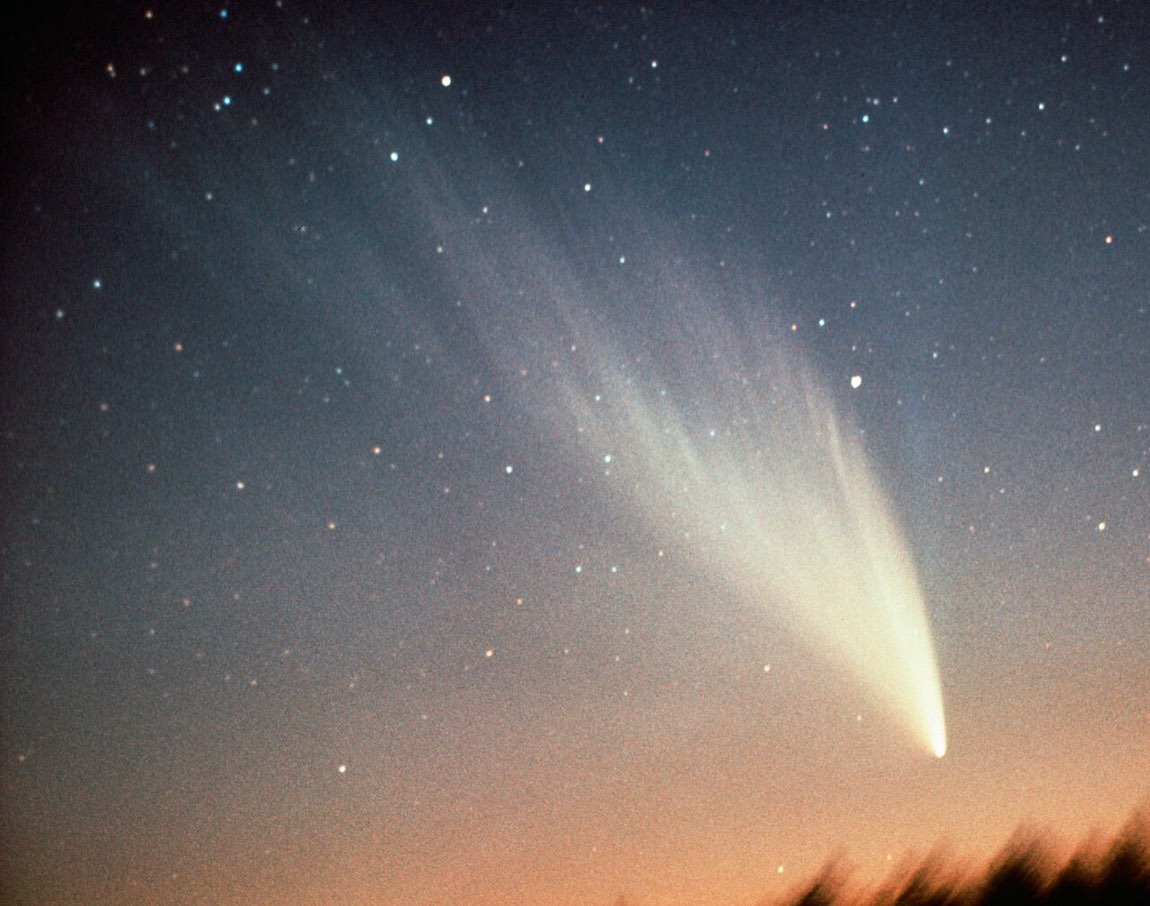
 Photograph · J. Linder/ESO · CC BY 4.0
Comet · Deep guide
Comet West (Great Comet of 1976)
Also called: C/1975 V1 · Great Comet of 1976
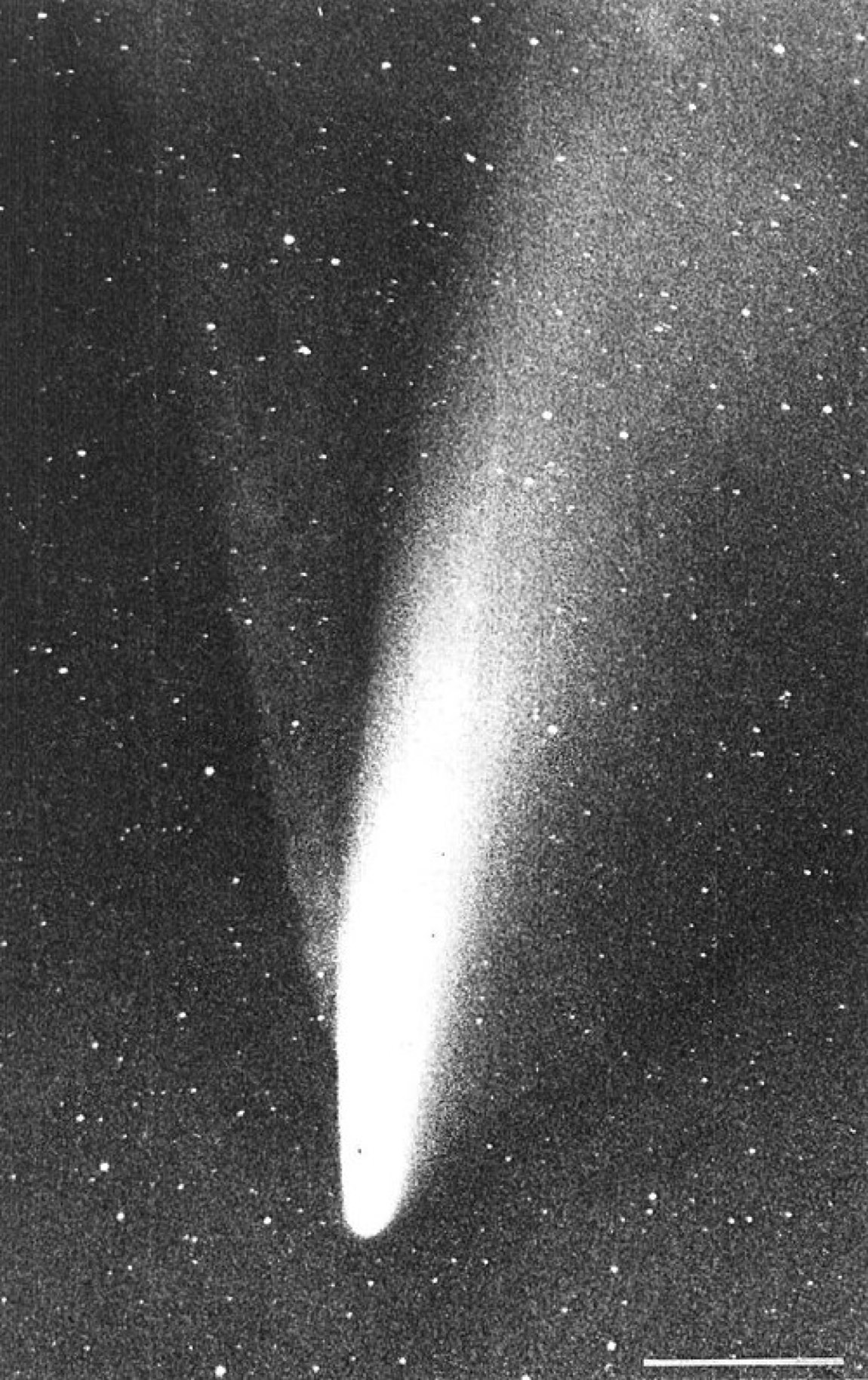
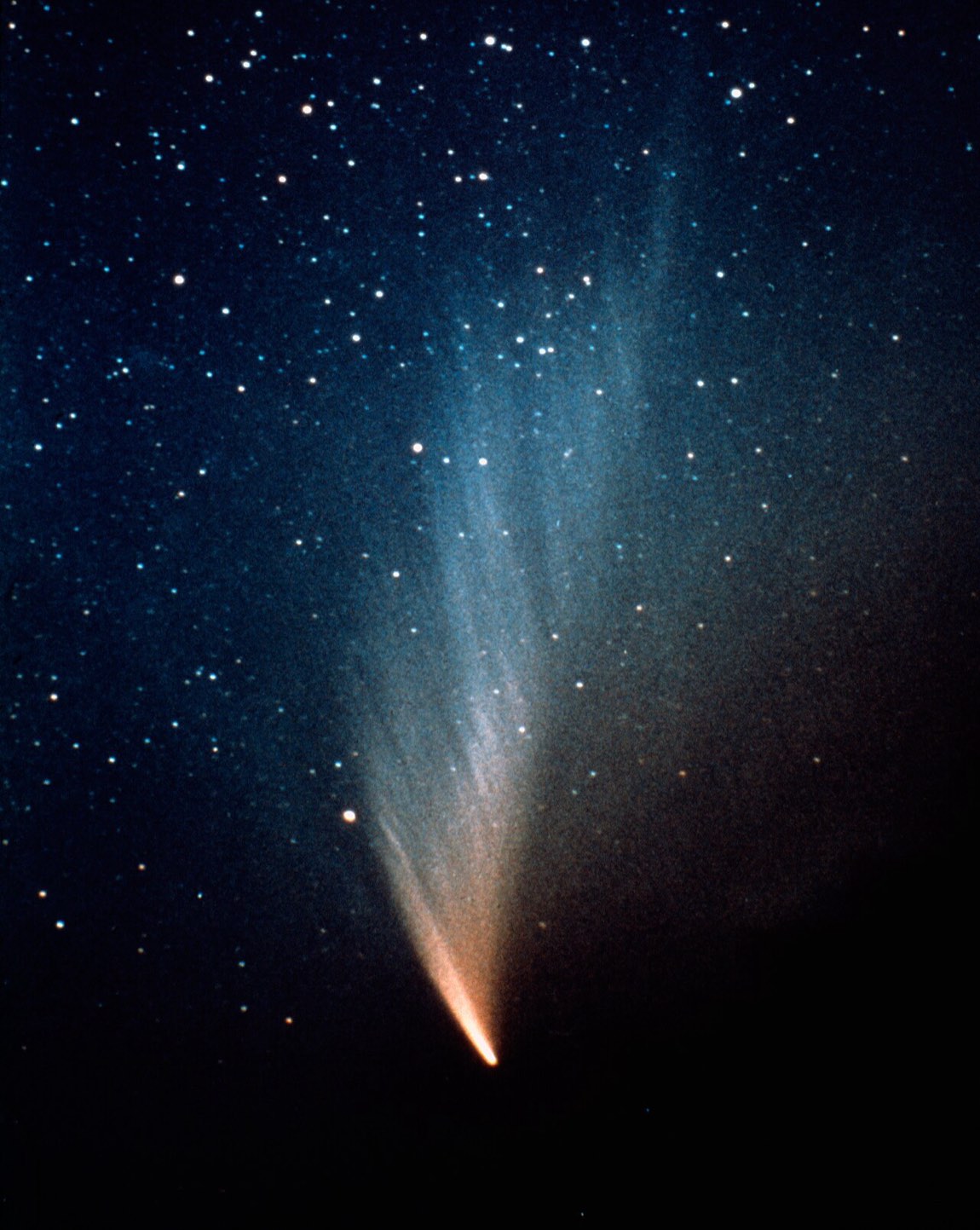
Its nucleus broke into four pieces as it rounded the Sun, while a broad dust fan lit the dawn sky.
What is it?
Comet West was found by astronomer Richard M. West on photographic plates at the European Southern Observatory in 1975. After perihelion in late February 1976 it became one of the brightest comets of the century, reportedly visible in daylight. In March 1976 astronomers watched its nucleus split, first into two and then into four fragments, one of the few comet breakups observed at that time.
The deep dive
Researched for the Atlas from Wikipedia — C/1975 V1 (West) (4,013 characters read) · updated Nov 14, 2026
01 How Richard West Found It on Film
Comet West was not spotted through an eyepiece on a clear night — it was discovered photographically by Richard M. West of the European Southern Observatory on 10 August 1975. That means West found it by examining photographic plates or images rather than by direct visual observation, a method that had become standard for detecting faint, distant objects before they brightened enough to see with the naked eye. The comet was given three formal designations over its lifetime: C/1975 V1, 1976 VI, and 1975n, reflecting the naming conventions that shifted between its discovery and later cataloguing. The modern designation C/1975 V1 uses the letter V to indicate the half-month of discovery and the number 1 to mark it as the first comet found in that interval — easily confused with the older label 1976 VI, where VI is the Roman numeral six, not the letter V at all. West had more than six months of advance notice before the comet swung past the Sun, giving astronomers time to prepare observations.
02 Why the Media Mostly Stayed Silent
Despite reaching a peak apparent magnitude of −3 — bright enough to observe in full daylight — Comet West was largely ignored by popular media. The reason traces directly back to Comet Kohoutek in 1973. Kohoutek had been widely and enthusiastically predicted to become an extraordinarily prominent spectacle, and it disappointed. Scientists burned by that experience were deliberately cautious about Comet West, wary of making bold public predictions that could again raise and then dash expectations. The New York Times was a notable exception, reporting on 2 March 1976 that the comet was expected to reach maximum visibility in the eastern sky before sunrise and that astronomer Dr. Marsden believed it would be far enough from the Sun by Wednesday to be visible to the unaided eye. The episode became a case study in how a previous public-relations failure can suppress coverage of a genuinely remarkable astronomical event, leaving Comet West far less celebrated than its brightness deserved.
03 Six Degrees From the Sun: The Perihelion Deeper
Comet West reached perihelion — its closest point to the Sun — on 25 February 1976, passing within 30 million kilometres of our star. At that moment it had a minimum solar elongation of only 6.4 degrees, meaning it hugged the Sun's apparent position in the sky to within roughly the width of your fist held at arm's length. Such a tight angular separation would normally render any object completely lost in solar glare. What saved West's visibility was a phenomenon called forward scattering: when sunlight passes through a comet's dust-laden coma at certain geometries, the particles scatter light preferentially toward the observer, dramatically amplifying apparent brightness. The result was a peak apparent magnitude of −3, comparable to a brilliant planet. From 25 to 27 February, observers reported the comet was bright enough to study in full daylight — a rare and striking achievement. Only a handful of comets in recorded history have been unambiguously daylight-visible, and Comet West earned a firm place among them.
04 A Nucleus That Came Apart in Four Pieces
One of Comet West's most dramatic acts was tearing itself apart. As it passed within 30 million kilometres of the Sun, the intense tidal and thermal stresses fractured the nucleus into four distinct fragments. The first report of the split arrived around 7 March 1976 at 12:30 UTC, when observers announced the comet had broken into two pieces. Less than two weeks later, on the morning of 18 March, astronomer Steven O'Meara — working with the 9-inch Harvard Refractor — reported that two additional fragments had formed, bringing the total to four. At the time, this was one of very few comet breakups ever witnessed. Astronomers drew comparisons to the Great Comet of 1882, a member of the Kreutz Sungrazing family, which had been one of the most notable earlier examples of a comet splitting. The rarity of such events made Comet West scientifically significant well beyond its visual spectacle, and it helped establish a framework for understanding why some cometary nuclei cannot survive a close solar passage.
05 An Orbit Measured in Hundreds of Millennia Deeper
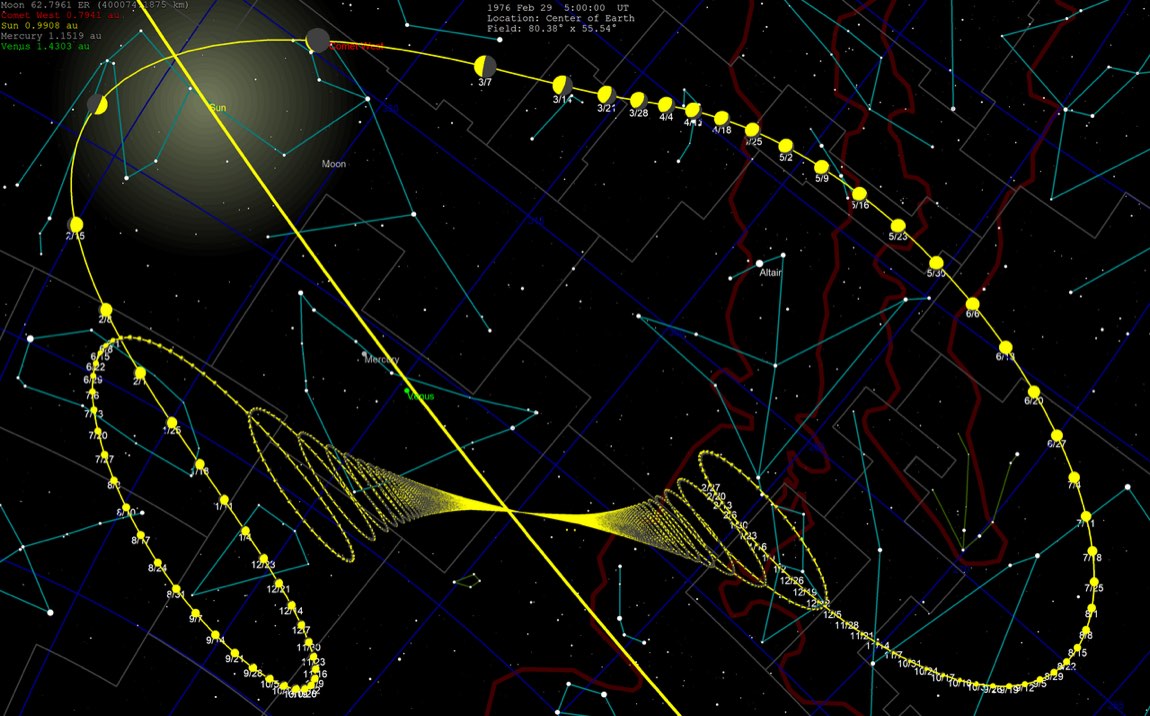
Before perihelion, using 28 positional measurements obtained between 10 August 1975 and 27 January 1976, Comet West's orbital period was estimated at roughly 254,000 years. That is about 1,000 times longer than all of recorded human history. After the breakup, however, refining that number became genuinely difficult. Because the nucleus shattered, the fragments may have experienced non-gravitational perturbations — subtle pushes from jets of outgassing material — that altered their paths in ways hard to disentangle from pure gravitational dynamics. As a result, estimates for the orbital period range widely, from 254,000 to 558,000 years. The 2008 SAO Catalog of Cometary Orbits lists 195 observations for the primary fragment C/1975 V1 and 135 for fragment C/1975 V1-A, a combined total of 330, though only 218 of those were ultimately used in computing the best-fit orbit. By 2003 the comet had already travelled more than 50 AU — 7.5 billion kilometres — from the Sun, well past the orbit of Neptune.
 ⤢
06 What the Comet Was Actually Made Of Deeper
A 2014 reanalysis of photometric observations taken during the 1976 perihelion shed new light on what Comet West was carrying inside it. The dust particles emitted from its coma turned out to be a mixture of weakly refractive and highly refractive material, a combination pointing specifically to magnesium-rich silicates and amorphous carbon. These are minerals and carbonaceous compounds also found in other well-studied comets; in fact, the observed morphology of agglomerated debris from West was described as consistent with those found in 1P/Halley and Hale–Bopp. The gas phase was equally informative: emission lines of C2, CN, C3, CH, and NH2 were all detected. These molecules are standard tracers of cometary activity, but Comet West offered an unusual bonus. Because it split into fragments, astronomers could examine each piece separately, and photometric observations taken about two months after the breakup revealed an uneven distribution of these compounds across the fragments — clear evidence that the original nucleus was heterogeneous, with significant compositional variations from one region to another.
07 A Heterogeneous Nucleus: What the Fragments Revealed Deeper
The splitting of Comet West was not merely a dramatic visual event — it turned the comet into an accidental laboratory. When a nucleus breaks apart and the pieces drift separately through space, each fragment carries a sample of a different region of the original body. Photometric observations of West's four fragments, made roughly two months after the split, showed an uneven distribution of the chemical species C2, CN, C3, CH, and NH2 among the pieces. Had the nucleus been compositionally uniform throughout, each fragment would have been expected to outgas these molecules in roughly similar proportions. The fact that they did not implied that different zones of the nucleus had genuinely different compositions — in other words, the original comet was heterogeneous with significant composition variations in some areas. This finding supported emerging ideas that cometary nuclei are not simple homogeneous snowballs but rather complex, layered or patchwork bodies, possibly assembled from distinct components during the early Solar System.
08 Comet West and Its Historical Comparisons
When Comet West's nucleus split, astronomers reached for historical precedents and found relatively few. The most notable prior example cited at the time was the Great Comet of 1882, a member of the Kreutz Sungrazing family — a group of comets that follow similar orbits plunging extremely close to the Sun and are thought to be fragments of a single ancient progenitor. The comparison highlighted how unusual nucleus fragmentation was considered to be in the mid-1970s. In the decades since, the catalogue of splitting comets has grown: comet Schwassmann–Wachmann-3 (also designated 73P), C/1999 S4 LINEAR, and 57P/du Toit-Neujmin-Delporte have all been observed to split or disintegrate during close solar passages. Each new case has helped astronomers refine their understanding of the structural weaknesses and internal stresses that can destroy a cometary nucleus, with Comet West serving as one of the foundational events in that growing record.
09 How the Naming System Changed Around It
Comet West carries three official designations, and the differences between them are a small window into how cometary nomenclature evolved over the twentieth century. When it was discovered in 1975, it received the provisional label 1975n, using a letter suffix to mark its order among comets found that year. After its perihelion passage in 1976, it was assigned the roman-numeral designation 1976 VI, indicating it was the sixth comet to pass perihelion in 1976. Under the modern system adopted later, it became C/1975 V1 — where C marks it as a non-periodic comet, 1975 is the discovery year, V indicates the second half of November (the half-month of discovery), and 1 means it was the first comet found in that interval. The potential for confusion is real: 1976 VI contains the Roman numeral six, while C/1975 V1 contains the letter V followed by the digit one, and the two look deceptively similar in print. The comet's fragment, designated C/1975 V1-A, follows the same modern convention with an appended letter to distinguish the secondary piece.
10 Observing a Comet in Broad Daylight
The window during which Comet West could be seen in daylight was narrow but real. From 25 to 27 February 1976, observers reported that the comet was bright enough to study under full sunlight — a consequence of its peak apparent magnitude of −3, achieved largely through forward scattering of sunlight by its dust-rich coma. After those three extraordinary days, the comet moved far enough from the Sun to become a pre-dawn object visible to the unaided eye. The New York Times reported on 2 March 1976 that from the following day until Sunday, the comet was expected to reach maximum visibility in the eastern sky before sunrise. Dr. Marsden was quoted as believing that by Wednesday it would be far enough from the Sun to be seen without optical aid. For anyone who was awake before sunrise in early March 1976 and knew where to look, Comet West would have been an unmistakable, brilliant streak in the eastern predawn sky — a once-in-many-lifetimes sight that most of the public never knew was happening.
 ⤢