 Photograph · NASA · Public domain
Comet · Deep guide
Comet Kohoutek
Also called: C/1973 E1
Hyped as the 'comet of the century' in 1973, it fizzled for skywatchers but taught scientists a lot.
What is it?
Czech astronomer Luboš Kohoutek found this comet in March 1973 while searching photographic plates at Hamburg Observatory, farther from the Sun than any comet discovered before. Early forecasts predicted a dazzling show near magnitude −10, but it peaked around −3 near the Sun and only about magnitude 0 for people on the ground. Even so, Skylab astronauts and many observatories studied it closely, detecting complex molecules and supporting the 'dirty snowball' picture of comets.
The deep dive
Researched for the Atlas from Wikipedia — C/1973 E1 (Kohoutek) (45,316 characters read) · updated Nov 14, 2026
01 A Serendipitous Find on the Wrong Plate
Luboš Kohoutek was not hunting for a new comet when he made his celebrated discovery. Since 1971, he had been methodically searching for Biela's Comet, lost to observers since 1852, using the Hamburg Observatory's 80 cm aperture Schmidt camera in Bergedorf. During that search, the October–November 1971 survey alone netted 52 minor planets across roughly 180 square degrees of sky, and 15 of those objects were scheduled for follow-up observations between January and April 1973. On 7 March 1973, Kohoutek exposed a photographic plate targeting main-belt asteroid (8606) 1971 UG — and captured something else entirely. Comparing two plates taken on 7 and 9 March, he noticed a diffuse object with central condensation that had shifted slightly toward the west-northwest, unambiguously moving against the background stars. He reported the find to the Central Bureau for Astronomical Telegrams on 19 March; IAU circular 2511 announced the discovery the next day. The comet was the sixth found in 1973 and received the designation 1973f. A precovery image taken on 28 January — also aimed at the same asteroid — later confirmed the comet at a heliocentric distance of 5.2 AU (780 million km).
02 Discovered Farther Out Than Any Comet Before
What made Kohoutek's discovery historically unprecedented was sheer distance. When Kohoutek spotted it, the comet lay 4.7 AU (700 million km) from the Sun — near the orbit of Jupiter — and 4.0 AU (600 million km) from Earth. At the time, comets were rarely detected so far from the Sun because most were simply too faint. Kohoutek's apparent magnitude at discovery was between 15.5 and 16, far below naked-eye visibility, detectable only on photographic plates. Its slow westward drift of about 0.2° per day across the constellation Hydra betrayed its identity. Because orbital calculations placed perihelion roughly seven months away — on 28 December 1973 — astronomers had an extraordinary preparation window. The calculated orbit was nearly parabolic, with an eccentricity between 0.9999 and 1 and an inclination of only 14.3° to the ecliptic, meaning the comet would swing to within 0.14 AU (21 million km) of the Sun. No comet had previously been discovered so early and at such distance before its closest solar approach, which is precisely why the discovery generated such intense scientific excitement alongside the eventual public frenzy.
03 An Orbit That May Span Four Million Years Deeper
The orbital history of Kohoutek is as dramatic as its passage. British astronomer Brian G. Marsden calculated an initial semi-major axis of 50,000 AU (0.79 light-years), suggesting the comet may have spent millions of years in the deep Solar System or even arrived from another planetary system. Marsden's figures allowed for the possibility that the 1973 apparition was the comet's very first plunge into the inner Solar System. Stephen P. Maran, who headed NASA's Kohoutek observing effort, proposed a specific gravitational narrative: the comet originally had a perihelion beyond Jupiter's orbit until a passing star perturbed it inward, reducing its perihelion to within Mercury's orbit and setting its period at 4–5 million years; subsequent planetary interactions then shortened that period further to about 75,000 years. Both the Minor Planet Center and the JPL Small-Body Database record Kohoutek as having had a hyperbolic trajectory near perihelion, though its orbit became gravitationally bound to the Sun by 1978. The comet is not expected to return for approximately 75,000 years. As of 2022 it sits about 74 AU (11.1 billion km) from the Sun in Gemini, receding at 4.8 km/s.
04 A Tail Longer Than Earth Orbits the Sun
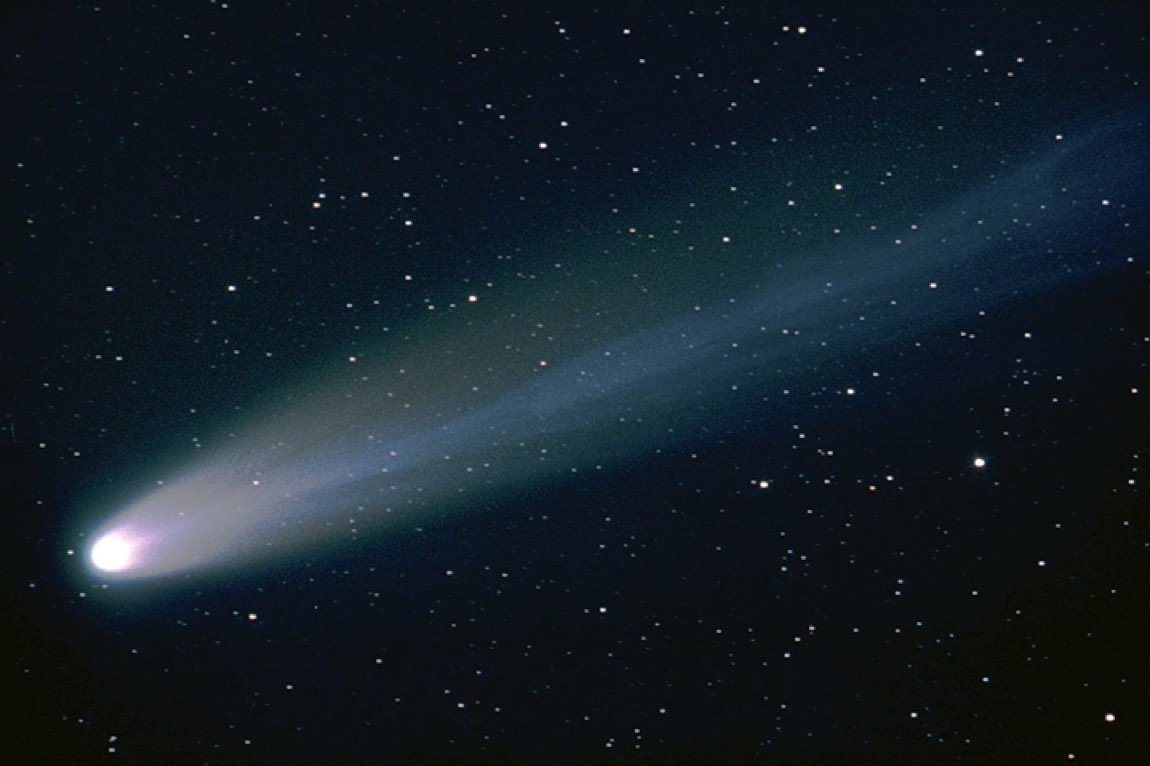
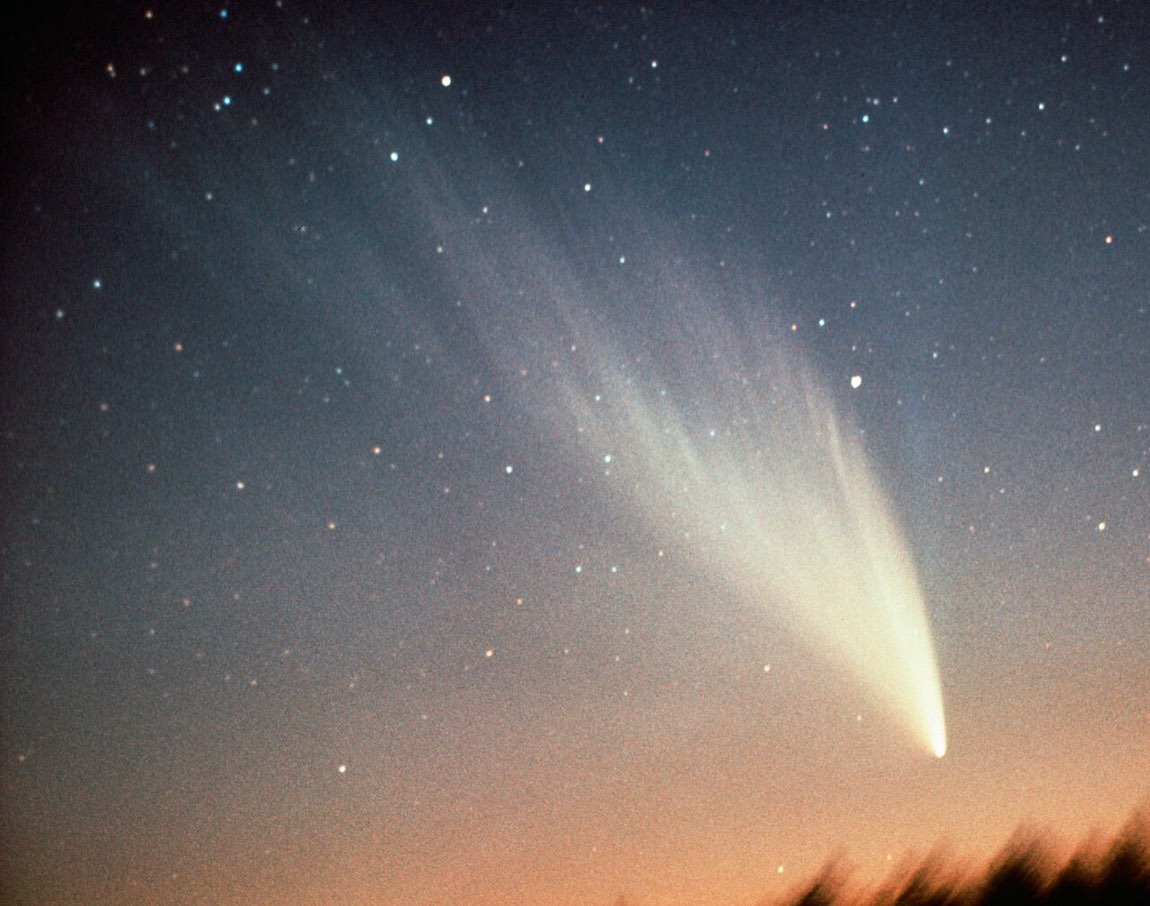
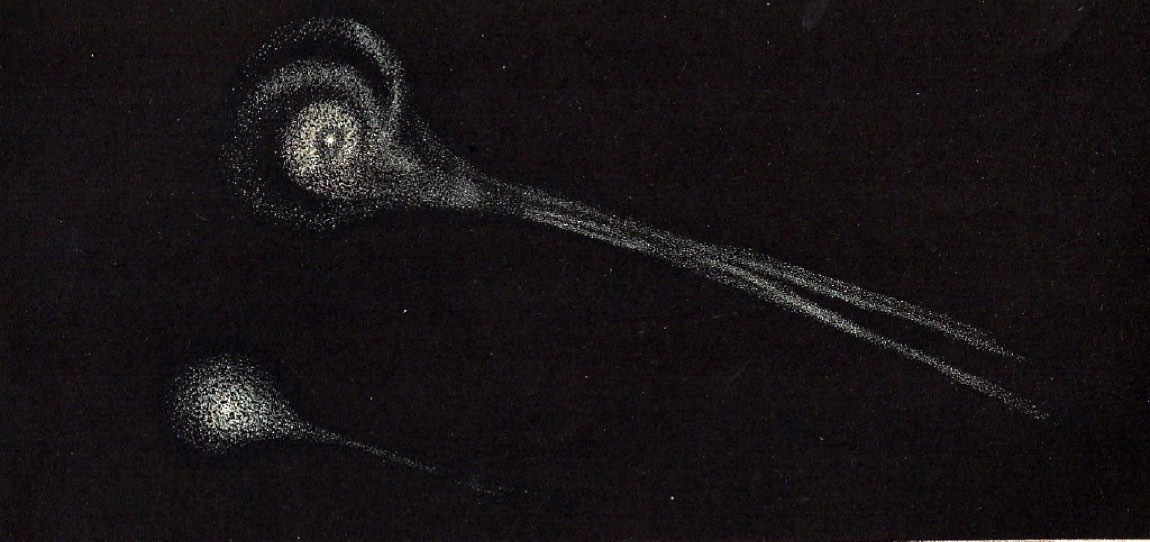
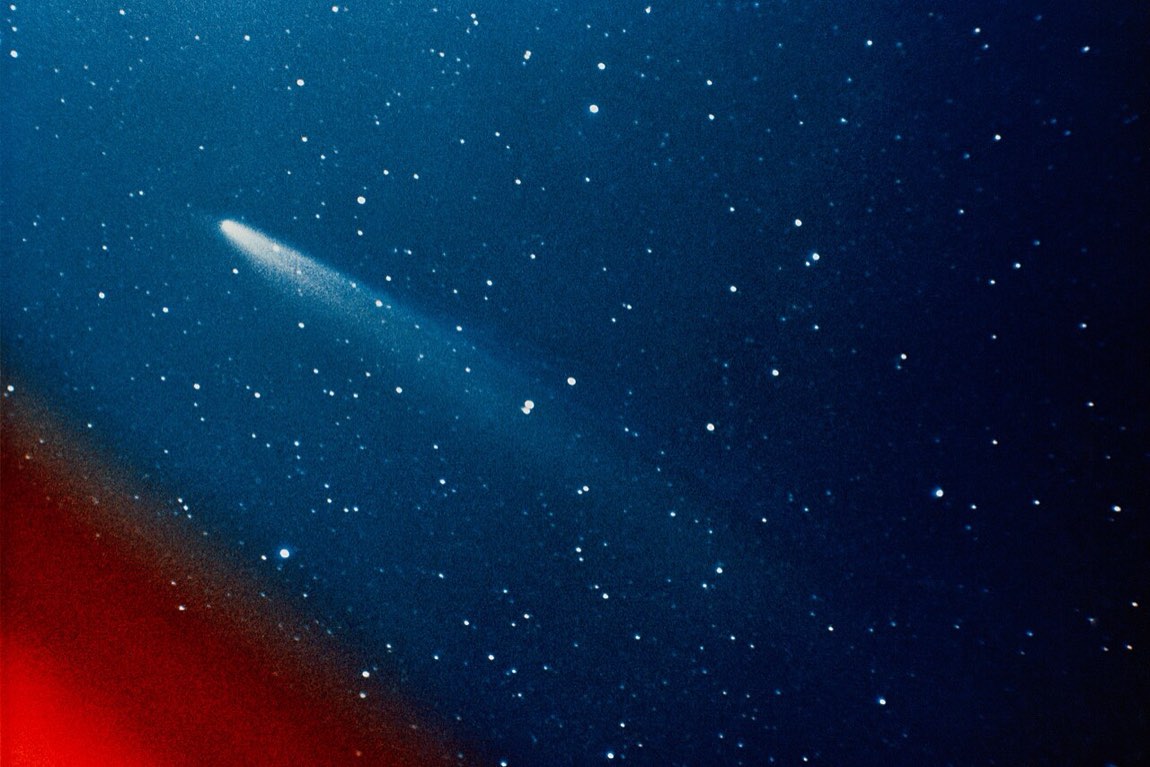
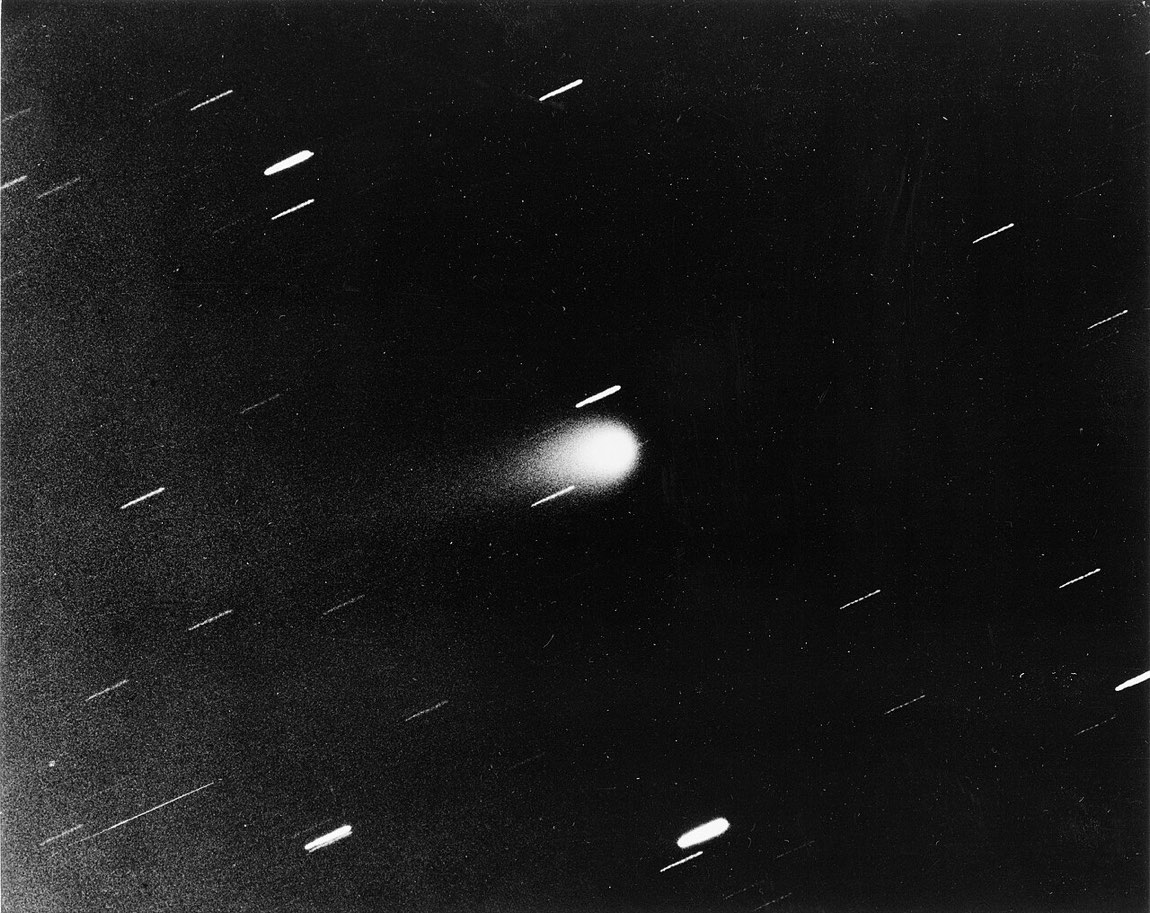
Kohoutek's tail was a structure of almost incomprehensible scale. Detection of positive carbon monoxide ions showed the tail stretched at least 20 million km (12 million mi) in length — roughly 13 times the distance from Earth to the Moon. Its width ranged from about 30,000 km (19,000 mi) near the coma to 300,000 km (190,000 mi) farther out. Observations from the Joint Observatory for Cometary Research in Socorro, New Mexico, traced the blue ion tail to 0.333 AU (49.8 million km) from the nucleus. Ion density within the tail several million miles from the nucleus measured about 10 cm⁻³, while maximum electron density reached around 20,000 cm⁻³. At its greatest visual extent the tail spanned 25° across the sky — fifty times the width of the full Moon. In January 1974 the tail displayed both a helical structure and a more irregular cloud-like feature about 0.1 AU (15 million km) from the nucleus. A separate antitail — composed of larger particles ejected sunward — stretched as far as 5–7° during Kohoutek's perihelion passage, as seen from Skylab, and up to 3° as seen from the ground, though it became more diffuse and dim after perihelion.
 ⤢
05 Firsts in Cometary Chemistry Deeper
Kohoutek transformed cometary chemistry. Before its apparition, no molecule with more than three atoms had ever been detected in any comet. Radio and microwave observations identified methyl cyanide — its spectrographic signature at a wavelength of 2.7 mm — directly in the nucleus, the first detection of a complex molecule in a comet and the first evidence that nuclei harbor stable "parent molecules" that sublimate or dissociate into the simpler radicals long seen in cometary spectra. Hydrogen cyanide was identified for the first time in a comet, supporting the idea that it could be a parent molecule of the cyano radical. Infrared spectra provided the first direct evidence of silicon in any comet. The prominent water signature in Kohoutek's tail was the first conclusive proof that comets contain water — previously only inferred from hydroxide and hydrogen detections. Radio observations also found ethyl alcohol, methylidyne radicals, and hydroxide. Cyanide was first spotted in the coma on 15 October 1973 at a heliocentric distance of 1.8 AU (270 million km). The water cation H₂O⁺ was identified in the tail, most likely produced by photoionization of neutral water near the nucleus. Acetone, ammonia, and helium were searched for but not detected.
06 The Hydrogen Cloud Wider Than the Sun Deeper
One of the more astonishing physical features of Kohoutek was its hydrogen halo. The nucleus outgassed hydrogen at rates of up to approximately 4.5×10²⁹ atoms per second at speeds of around 7.8±0.2 km/s. Because hydrogen atoms are so light and Kohoutek's gravity is negligible, they dispersed into an enormous cloud extending over 30 million km (19 million mi) across — wider than the disk of the Sun itself, which measures about 1.4 million km in diameter. Within the cloud, the ratio of deuterium to atomic hydrogen was at most 1.0%. The atomic hydrogen was later understood to be the product of photodissociation of water ice in the nucleus. Separately, analyses of the coma and tail in the near-ultraviolet found roughly equal amounts of hydrogen and hydroxide, consistent with both being dissociation products of water. Lyman-alpha line observations of this hydrogen envelope also validated earlier theoretical predictions that comets accumulate extensive hydrogen coronae. The sheer spatial scale of the hydrogen cloud underscored how dramatically cometary outgassing can restructure material around even a relatively small nucleus like Kohoutek's, estimated at only about 2.1 km (1.3 mi) in radius.
07 Dust, Gas, and a Shifting Balance Deeper
Whether Kohoutek was dust-rich or gas-rich has been genuinely debated, with different analyses reaching different conclusions. What is clear is that the balance shifted dramatically across its perihelion. On 2 December 1973 the nucleus was expelling about 900 billion dust molecules per second; by 31 January 1974 that rate had dropped to around 30 billion per second. Between 16 and 29 January 1974, the nucleus shed roughly 1,675 kg (3,693 lb) of gas and 16,000 kg (35,000 lb) of dust per second on average. After perihelion the gas-to-dust ratio rose by at least a factor of 2, and later photometric analyses concluded that Kohoutek was ultimately a gassy, volatile-rich comet — characteristic of a body entering the inner Solar System for the first time. The uneven outgassing of water and other volatiles implies a heterogeneous nucleus on scales of around 10 m (33 ft). Silicates were detected in both the tail and the antitail via infrared astronomy. The ejection of meteoroids during Kohoutek's solar passage added approximately 1.0 billion kg (2.2 billion lb) of mass to the zodiacal cloud, and micrometeoroids ranging between 10⁻¹³ and 10⁻¹¹ g were detected by the HEOS 2 satellite over roughly 60 days when it crossed the comet's orbital plane around 9 June 1974.
08 Operation Kohoutek and Its Instrument Fleet
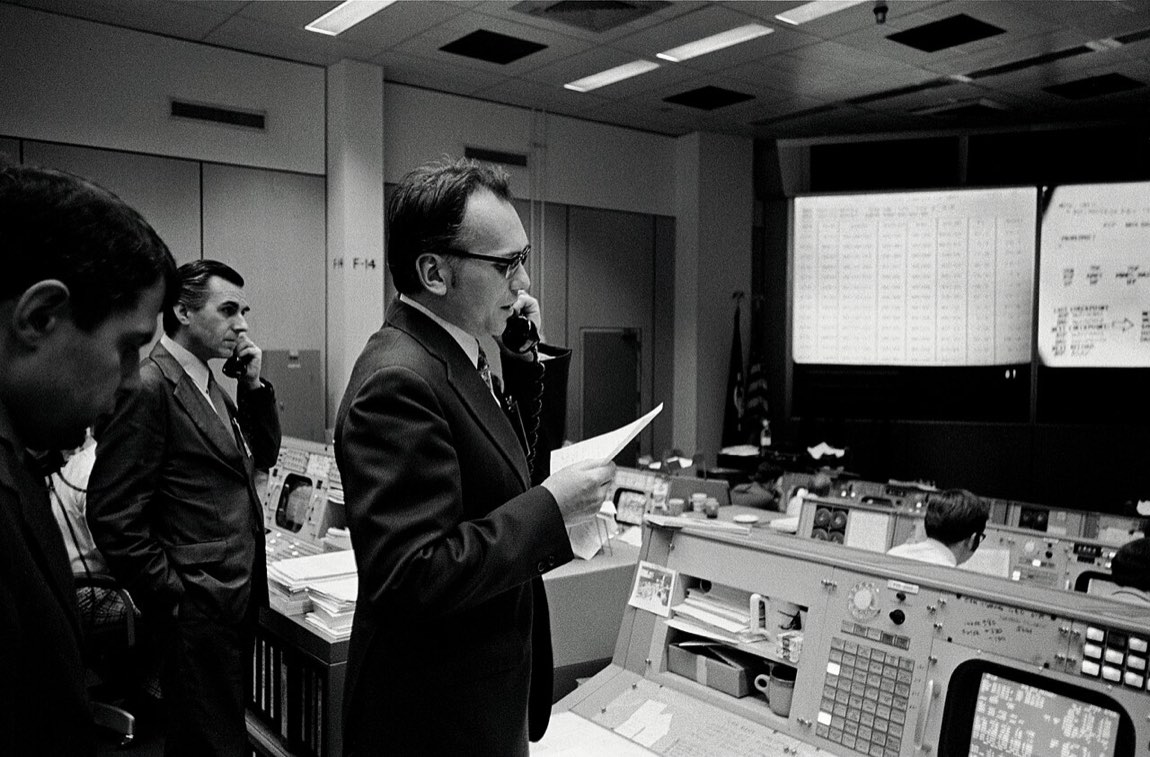
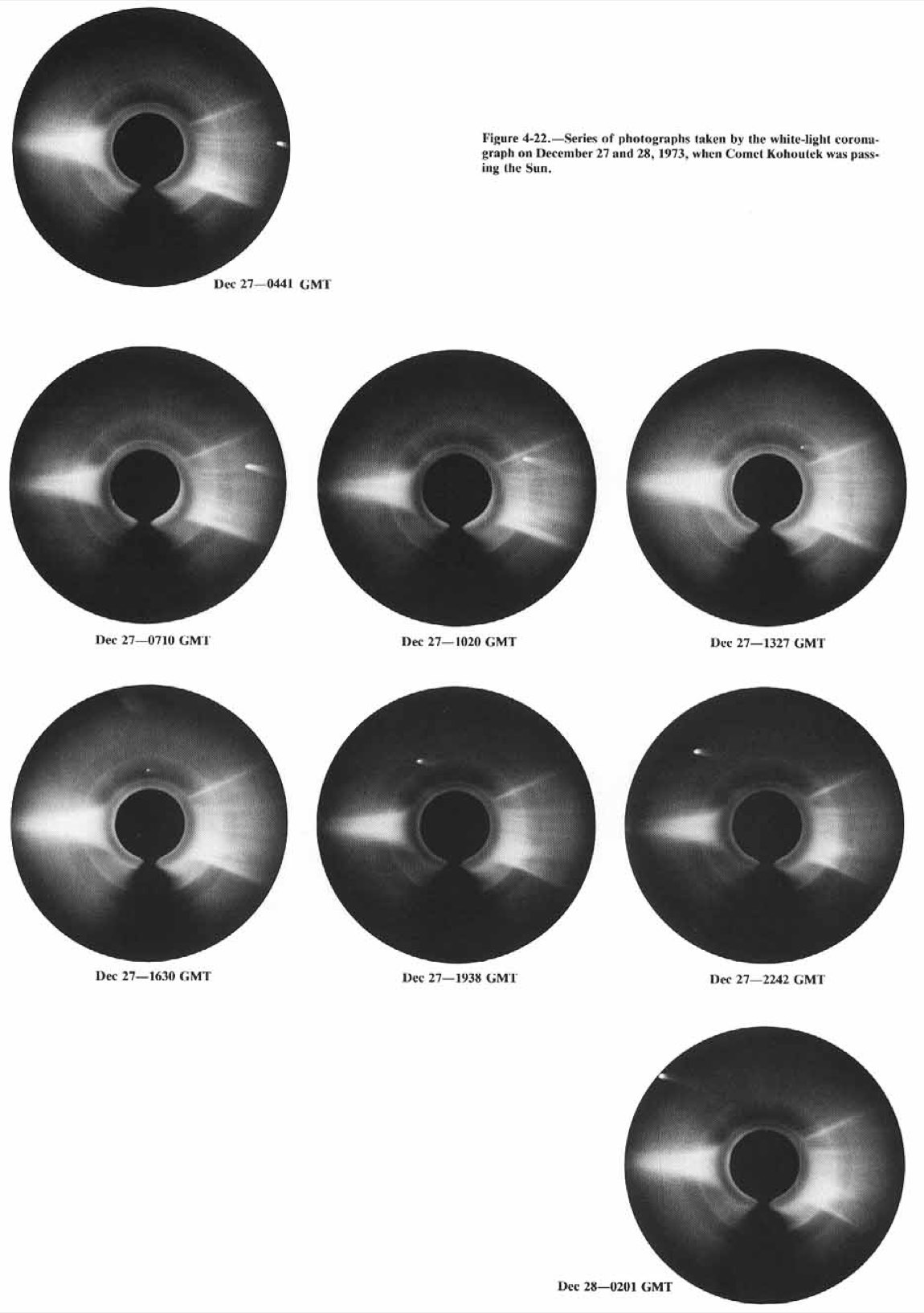
The early detection of Kohoutek allowed an unprecedented mobilization of scientific resources. NASA coordinated Operation Kohoutek, assembling Skylab, the Orbiting Astronomical Observatory, the Orbiting Solar Observatory, ground-based observatories, and sounding rockets into a single observing campaign. It was the first time radio astronomy techniques had been applied to studying a comet. The newly constructed Joint Observatory for Cometary Research near Socorro, New Mexico, was rushed into operation specifically to observe Kohoutek. In June 1973, NASA briefly considered launching a dedicated intercept spacecraft via either a Thor-Delta or Atlas-Centaur rocket but abandoned the idea due to insufficient preparation time. Skylab 4's launch date was actually selected partly to coincide with the comet's perihelion; on 27 December 1973, Skylab instruments tracked Kohoutek almost continuously across 21 consecutive orbits, though the comet could only be observed for at most 26 minutes per orbit due to Skylab's path around Earth. Mariner 10, en route to Venus, made ultraviolet measurements of Kohoutek at around 0.7 AU (100 million km) in January 1974 — making Kohoutek the first comet ever observed by an interplanetary spacecraft, even though unexpected faintness prevented usable television images. Pioneer 6 and Pioneer 8 recorded data from within the comet's tail in 1974. Results from Operation Kohoutek were formally presented in June 1974 at a workshop at the Marshall Space Flight Center.
 ⤢
09 Why the Brightness Predictions Went So Wrong Deeper
The prediction catastrophe had a specific, traceable cause. Conventional practice held that a comet's brightness scaled with the inverse fourth power of its distance from the Sun — written as n = 4. Applied to a comet discovered as far out as Kohoutek, this formula implied a million-fold increase in intrinsic brightness, producing early estimates of apparent magnitude as bright as −10 and later −12, comparable to the full Moon. A more careful early analysis could have yielded a peak around magnitude −2.3, but the most optimistic figures dominated press coverage. In reality, Kohoutek's light curve from 24 November 1973 to perihelion best fit n = 2.2, while its post-perihelion curve best fit n = 3.3 or 3.8. Using n = 6 — the high end that some forecasters applied — overestimated perihelion brightness by as much as a factor of 2,800. The likely explanation is that early outgassing of highly volatile surface ices briefly inflated the comet's brightness at large heliocentric distances, mimicking a steeper brightening trend, before the nucleus settled into slower brightening more typical of its orbital class. A 1995 study confirmed that comets with initial semi-major axes greater than 10,000 AU (0.16 ly) systematically brighten more slowly and less dramatically before perihelion than shorter-period comets — behavior now recognized as typical for Kohoutek's orbital type.
10 Perihelion Through Astronaut Eyes
While most of humanity was locked out by the Sun's glare during perihelion, the astronauts aboard Skylab 4 and the Soviet Soyuz 13 had a ringside view. Skylab crews noted that Kohoutek at its brightest was distinctly yellow — a color attributed to light scattering by sodium released from the nucleus — and estimated its peak brightness as comparable to Jupiter at magnitude −1.6. The separate gas and dust tails visible at other times merged into a uniform yellow texture that transitioned to white and then to a mottled violet. An astronaut relaying real-time observations described the coma growing "quite large and bright" and the tail fanning out into a broad shape showing "reds and yellows." The separate antitail stretched as far as 5–7° from the comet toward the Sun. At closest approach the comet was separated from the center of the Sun by only about 0.75°. Meanwhile, the comet was actually far brighter in the infrared than in visible light, reaching magnitudes of at least −4.75 and −5.70 at wavelengths of 10 and 20 μm respectively — data unavailable to ordinary observers. For ground observers who had to wait until 27 December 1973 for Kohoutek to re-emerge from the Sun's glare, the comet was at most a 0th- or 1st-magnitude object.
11 Kohoutek's Colossal Cultural Footprint
Few comets have embedded themselves so deeply in popular culture, and in such contradictory ways. Telescope sales soared: Edmund Scientific Corporation reported a 200% increase in 1973 versus 1972, and sales at Macy's quadrupled after a seven-column New York Times advertisement. Pinnacle Books sold 750,000 copies of astrologer Joseph Goodavage's book calling the comet a "harbinger of God." The ocean liner Queen Elizabeth 2 sailed a sold-out comet-watching cruise from 9–12 December 1973 with Luboš Kohoutek himself as guest of honor, joined by Isaac Asimov and astronomer Kenneth Franklin; overcast skies foiled the view. Caribbean cruises in January 1974 brought Buzz Aldrin, Carl Sagan, and Burl Ives aboard for better-weather attempts. Musically, Journey performed "Kohoutek" publicly for the first time on New Year's Eve 1973; Sun Ra dedicated a concert at The Town Hall in New York to the comet on 22 December 1973; and works by Kraftwerk, Pink Floyd, Argent, R.E.M., and Weather Report all bore the comet's influence. The Kohoutek Celebration of Consciousness was held at the Bill Graham Civic Auditorium in San Francisco in January 1974. Meanwhile, David Berg of the Children of God had predicted a colossal doomsday event for America by the end of January 1974 because of the comet. When none of it materialized, Russell Baker called Kohoutek "the Edsel of the firmament."
12 The "Dirty Snowball" Debate and What Kohoutek Settled Deeper
By 1973 most scientists accepted Fred Whipple's "dirty snowball" model of comet nuclei — primarily icy bodies laced with dust and organic material. But British astronomer Raymond A. Lyttleton championed a competing "sand bank" model in which nuclei were loose aggregates of dust with negligible ice. Kohoutek's abundant gas production, its rich chemical inventory, and the behavior of its coma and tail provided strong empirical support for Whipple's model, effectively sidelining Lyttleton's alternative. The low abundance of methane in Kohoutek and what Whipple called "chemically ill-mated carbon molecules" further suggested that cometary material formed by aggregation of compounds at low temperatures rather than by cooling of hot gases — implying a significant role for interstellar medium chemistry in building comet nuclei. The cyano radicals and diatomic carbon in Kohoutek's inner coma were strikingly different from earlier comets: rather than being distributed spherically, they were elongated significantly away from the Sun to distances of up to 10 million km (6.2 million mi). These findings prompted development of more nuanced nuclear models, including one proposing that some comets possess a non-volatile dust mantle surrounding a volatile icy core. Whipple himself declared that Kohoutek had ushered in a "renaissance" of cometary research.
 ⤢
13 Faint Meteors and a Radio Occultation Bonus Deeper
Kohoutek left behind more than memories. Meteoroids ejected during the comet's solar approach were large enough — no smaller than 0.2 mm (0.0079 in) in diameter — to be placed into stable orbits around the Sun, contributing roughly 1.0 billion kg (2.2 billion lb) to the zodiacal cloud. A faint meteor shower observed on 1–3 March 1974, coinciding with Earth's closest pass through Kohoutek's orbital plane, may be directly linked to those ejected particles, though the association was not definitively confirmed. Smaller micrometeoroids with masses between 10⁻¹³ and 10⁻¹¹ g were detected by the HEOS 2 satellite over approximately 60 days centered on its orbital plane crossing around 9 June 1974. The comet also provided an unexpected bonus for solar wind research: when Kohoutek's tail occulted the radio source PKS 2025–15 on 5 January 1974, scientists used the event to study interplanetary scintillation. At a heliocentric distance of about 0.5 AU (75 million km), the plasma outflow in the tail generated a weak magnetic field with a strength comparable to the interplanetary magnetic field — a subtle but measurable imprint of a small icy nucleus on the space environment tens of millions of kilometers away.