Comet · Deep guide
Comet Tuttle–Giacobini–Kresák (41P)
Also called: 41P/Tuttle–Giacobini–Kresák · Comet Tuttle-Giacobini-Kresak
A small Jupiter-family comet discovered three times by three different astronomers.
What is it?
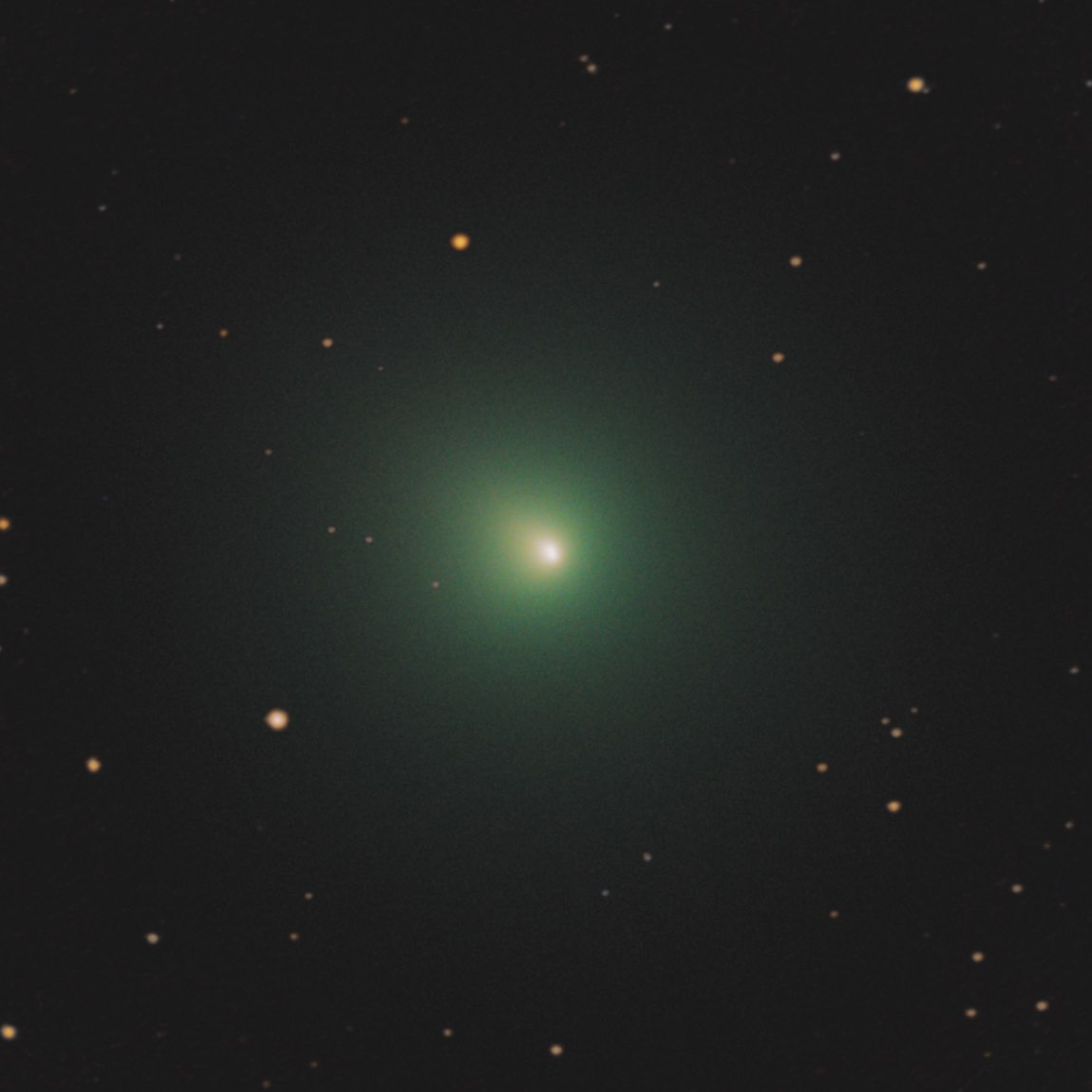
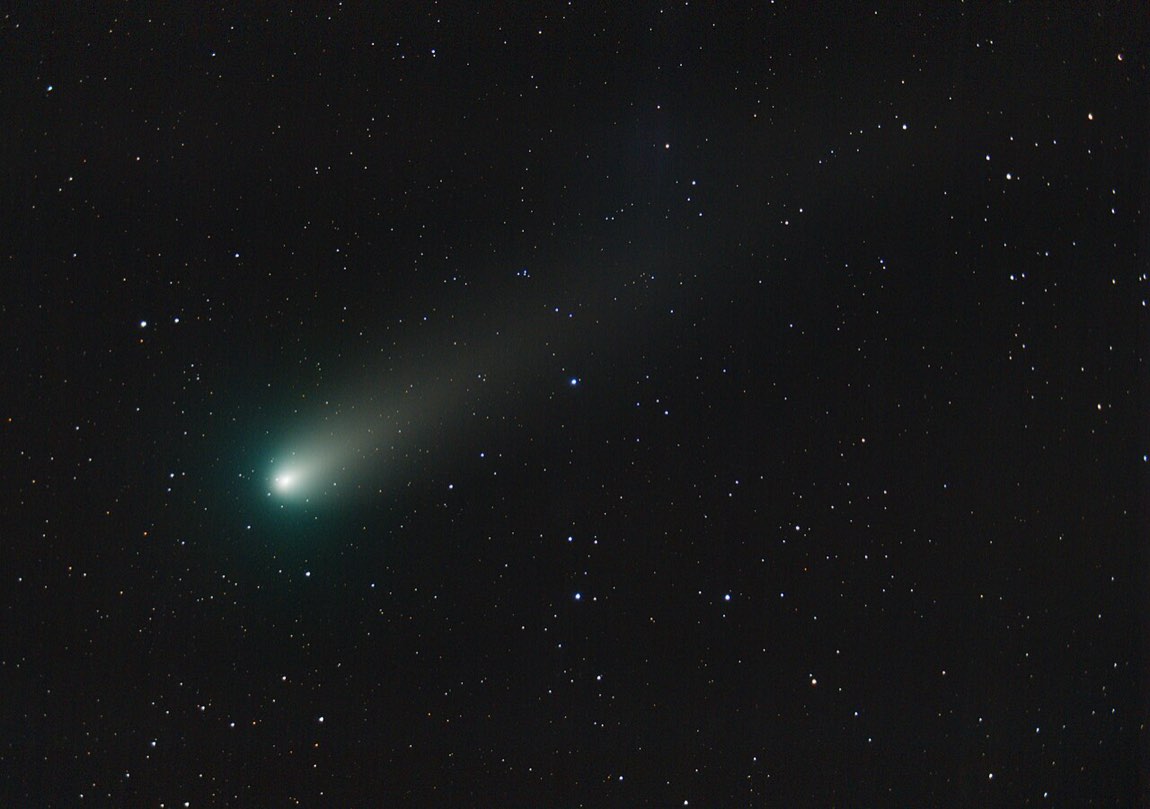
41P/Tuttle–Giacobini–Kresák is named after Horace Tuttle, who saw it in 1858, Michel Giacobini, who found it again in 1907, and Ľubor Kresák, who recovered it in 1951. It orbits the Sun every five and a half years. Hubble Space Telescope observations suggest its nucleus is only about a kilometre across, smaller than earlier estimates. Its next perihelion is in February 2028.
The deep dive
Researched for the Atlas from Wikipedia — 41P/Tuttle–Giacobini–Kresák (3,068 characters read) · updated Nov 14, 2026
01 Three Discoverers, Nearly a Century Apart
The comet carries three names because it was independently found three separate times before anyone connected the sightings. Horace Parnell Tuttle spotted it first on May 3, 1858. Then Michel Giacobini rediscovered it in 1907, nearly fifty years later. Ľubor Kresák completed the trio in 1951, another forty-four years on. Each observer had no way of knowing they were looking at a returning traveler already seen by their predecessors. Only afterward, when orbital calculations showed all three sightings traced the same path around the Sun, did astronomers link them into a single object and honor all three discoverers in the name. This pattern of independent rediscovery was common with periodic comets before systematic sky surveys existed, but a gap of nearly a century between first and third sighting is a striking illustration of how a faint, unremarkable comet can slip past observers for decades and then reveal itself again to patient eyes pointed at the right patch of sky.
02 What It Means to Be a Jupiter-Family Comet
41P belongs to a class called Jupiter-family comets, a designation that tells you something fundamental about where this object has been and what controls its fate. Jupiter-family comets have orbital periods shorter than roughly twenty years and owe their current trajectories to close gravitational encounters with Jupiter. The giant planet's enormous gravity can capture comets from the outer solar system and pull their orbits inward, delivering fresh icy material into the inner solar system. For 41P, that reshaping produced a 5.43-year orbit — short enough that the comet swings past the Sun and returns before a child starting school has reached secondary school. The flip side of Jupiter's influence is instability: the same gravitational tugs that brought 41P close can eject it or perturb it further. Dynamical modeling estimates the comet's remaining dynamical lifetime at roughly 1,000 years, a blink of an eye on solar-system timescales, suggesting 41P is a temporary resident of its current orbit rather than a permanent fixture.
03 The 1973 Double Outburst: From Faint to Naked Eye
The event that made 41P famous among comet watchers happened in 1973, when the comet staged not one but two dramatic outbursts in the same apparition. In May and again in July of that year, the comet jumped from magnitude 14 — well beyond unaided vision — all the way to apparent magnitude 4, comfortably visible to the naked eye from a dark site. That is a brightness increase of roughly 10,000 times in each episode. For context, magnitude 4 objects are comparable to moderately bright stars in a city-suburban sky. The cause of such outbursts is not fully understood for any comet, but they are generally attributed to sudden releases of trapped gas and dust, perhaps triggered by the collapse of a surface crust, the exposure of a fresh volatile-rich layer, or the fracturing of part of the nucleus. The fact that 41P produced two such events in a single apparition made it exceptional and ensured it would be watched closely in every subsequent return.
04 A Nucleus Smaller Than You Might Expect Deeper
Ground-based telescopes initially suggested a larger nucleus, but high-resolution Hubble Space Telescope observations revised the picture downward. After carefully correcting the photometry for contamination by the surrounding coma — the cloud of gas and dust that makes comets look far bigger than their solid cores — and combining that with estimates derived from non-gravitational accelerations, researchers arrived at an effective nucleus radius of 440 to 560 meters, implying a diameter of roughly 0.88 to 1.12 kilometers. To picture that, the entire solid nucleus could sit comfortably within a mid-sized city's downtown core. The nucleus is also not a simple sphere. Photometric lightcurve observations show a brightness variation of about 0.4 magnitudes as the nucleus rotates, which implies an elongated shape with an axis ratio of at least 1.4 to 1 — meaning the longest dimension is at least forty percent greater than the shortest. This kind of irregular, stretched shape is typical of small cometary nuclei and probably reflects the original accretion of material or subsequent reshaping by outgassing and mass loss.
05 Spinning Down: A Rotation Rate in Freefall Deeper
One of the most surprising findings from the 2017 apparition was that 41P's nucleus was visibly slowing its rotation in real time. Period analysis of the lightcurve gives a likely double-peaked rotation period of 0.599 days, equivalent to 14.4 hours. Near perihelion in 2017, the nucleus exhibited rapid rotational deceleration attributed to asymmetric outgassing torques — essentially, jets of gas escaping unevenly from the sunlit surface were acting like tiny rocket engines, braking the spin. This kind of torque is well understood in principle but rarely caught in such obvious action. The implications are significant: modeling suggests that if these torques continue across future apparitions, the nucleus could reach a state of rotational instability on timescales of decades. That is potentially far shorter than the comet's estimated dynamical lifetime of around 1,000 years, raising the real possibility that 41P could spin up or spin down to the point of structural failure and break apart well before its orbit brings it to a natural end.
06 How the 2017 Close Approach Revealed New Science
The 2017 apparition was the best observing opportunity in recent memory for 41P. Pan-STARRS recovered the comet on November 10, 2016, at a faint apparent magnitude of 21 — roughly one hundred million times dimmer than the naked-eye limit — giving astronomers months of lead time to prepare. On April 1, 2017, the comet passed just 0.142 AU from Earth, equal to about 21.2 million kilometers or 13.2 million miles, close enough that it was expected to brighten to around magnitude 7 and be visible in binoculars. That proximity allowed the kind of detailed nucleus photometry, coma morphology studies, and rotation period measurements that simply are not possible at greater distances. The rotational deceleration discovered during this apparition would likely have gone undetected had the geometry been less favorable. Close approaches by short-period comets therefore represent rare scientific windfalls, and astronomers planned observations well in advance to squeeze every possible measurement out of the geometry.
07 Planning for the 2028 Return
41P's next well-placed apparition centers on a perihelion passage on February 15, 2028. By January of that year, the comet should have brightened to around apparent magnitude 13, within reach of modest amateur telescopes. At perihelion itself the solar elongation will be 65 degrees — a reasonable angular separation from the Sun — and the magnitude should reach approximately 11, still comfortably observable with small telescopes. This is notably less dramatic than 1973's naked-eye spectacle, but 1973 involved extraordinary outbursts that boosted brightness by factors of thousands; a typical return for 41P lands in the range accessible to backyard observers rather than casual naked-eye stargazers. The 2028 apparition gives researchers another chance to monitor whether the rotational deceleration observed in 2017 continued during the intermediate 2022 return and to track any further evolution in the nucleus spin state, which remains one of the comet's most scientifically active open questions.
08 The Space Mission That Never Flew
In the 1960s, the European Space Research Organisation — ESRO, the predecessor body to what would become the European Space Agency — seriously investigated sending a spacecraft to 41P with the goal of arriving in time for the 1973 apparition. The proposal reached enough of a planning stage to be formally evaluated before it was ultimately rejected. Had it succeeded, 41P would have been among the earliest comets ever visited by a dedicated spacecraft, years before missions like the later landmark encounters with other comets. The rejection left the 1973 double outburst as an entirely ground-based discovery, observed only remotely rather than up close. It is a reminder that the history of planetary science is littered with missions that came close to approval and would have changed what we know. For 41P specifically, an in-situ visit during one of its dramatic outbursts would have provided data on cometary eruptions that researchers are still working to explain from afar more than half a century later.
09 What Rotational Breakup Would Actually Mean Deeper
The possibility that 41P could spin itself apart is not just a dramatic headline — it has concrete scientific and observational implications. If asymmetric outgassing continues to decelerate the nucleus, or in some configurations accelerate it past a critical threshold, centrifugal or structural forces could overcome the weak self-gravity holding the loose, porous body together. Cometary nuclei are thought to have very low bulk densities and limited tensile strength, making them surprisingly fragile. A breakup would not necessarily be a single violent explosion; it might be a gradual splitting into two or more fragments, as has been observed in other comets. The result would be a trail of debris on a similar orbit, potentially enriching future meteor activity along Earth's path if the geometry aligned. Modeling places this risk on a timescale of decades, meaning it is something that could plausibly be observed within a human lifetime if monitoring continues. The 2017 findings therefore turned 41P from a quirky outbursting comet into an object with a genuinely uncertain physical future.
10 The Unfavorable Apparition Problem
Not every return of 41P offers a useful viewing window. The 2011 apparition illustrates the worst-case scenario: perihelion passage occurred when the comet was on the far side of the Sun as seen from Earth, making observation essentially impossible. The geometry of a comet's orbit relative to Earth's position at the moment of perihelion is largely a matter of celestial timing, and for short-period comets like 41P that return every 5.43 years, some apparitions simply align badly. When the comet is near its closest approach to the Sun but hidden behind it, brightness and proximity to Earth cannot compensate for the overwhelming glare. This kind of lost opportunity underscores why astronomers prioritize well-placed apparitions — like 2017 and the upcoming 2028 return — with intense observing campaigns. Data gathered during favorable windows must carry the scientific weight for multiple orbital periods at a time.
11 Naming Conventions and What They Record
The naming of 41P follows a convention that preserves the historical record of independent discovery directly in the comet's title. Tuttle, Giacobini, and Kresák are listed in order of their separate first sightings in 1858, 1907, and 1951 respectively. The numerical prefix 41P indicates it was the forty-first periodic comet confirmed in the catalog, while the P distinguishes it as a periodic comet with a known, repeating orbit. This system means that reading a comet's full designation tells you something real about its scientific history: who found it, in what sequence, and what category of object it is. Horace Parnell Tuttle was a prolific comet discoverer at the Harvard College Observatory in the nineteenth century. Michel Giacobini was a French astronomer also associated with another Jupiter-family comet that bears his name. Ľubor Kresák was a Slovak astronomer whose later work on cometary outbursts gave him a particular professional connection to this object well beyond the discovery credit.
 ⤢