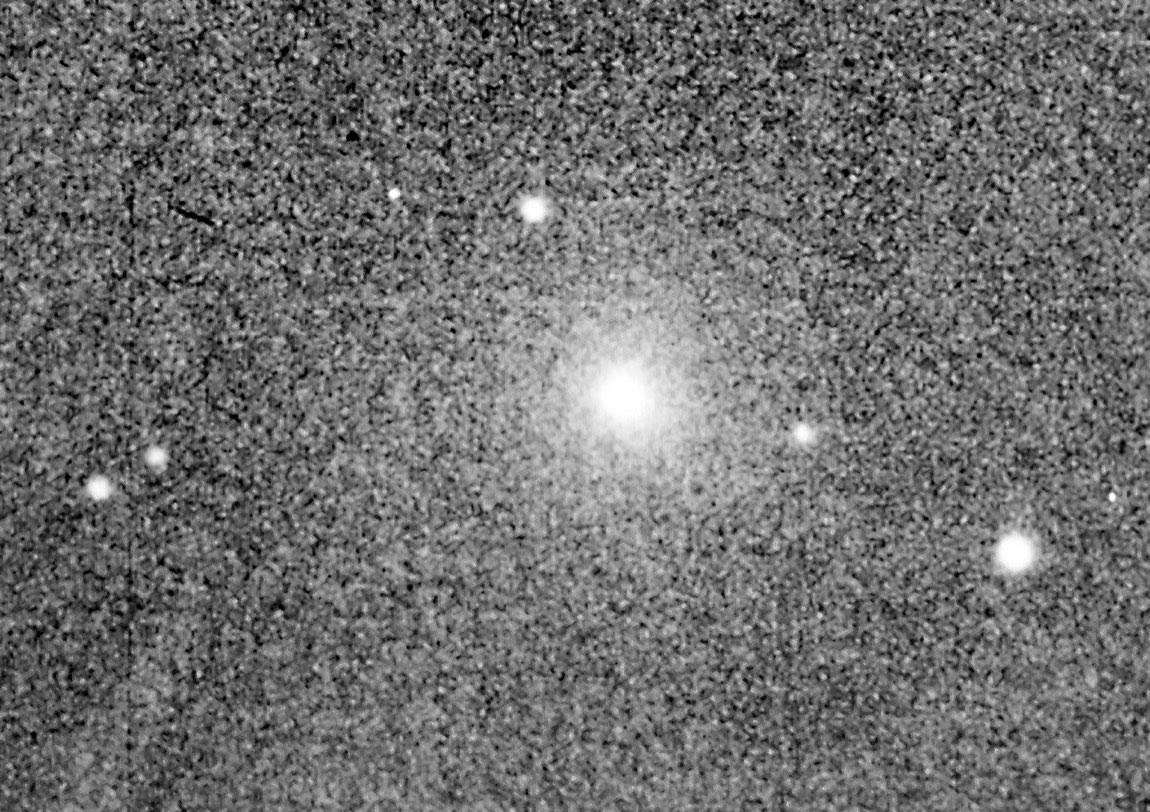
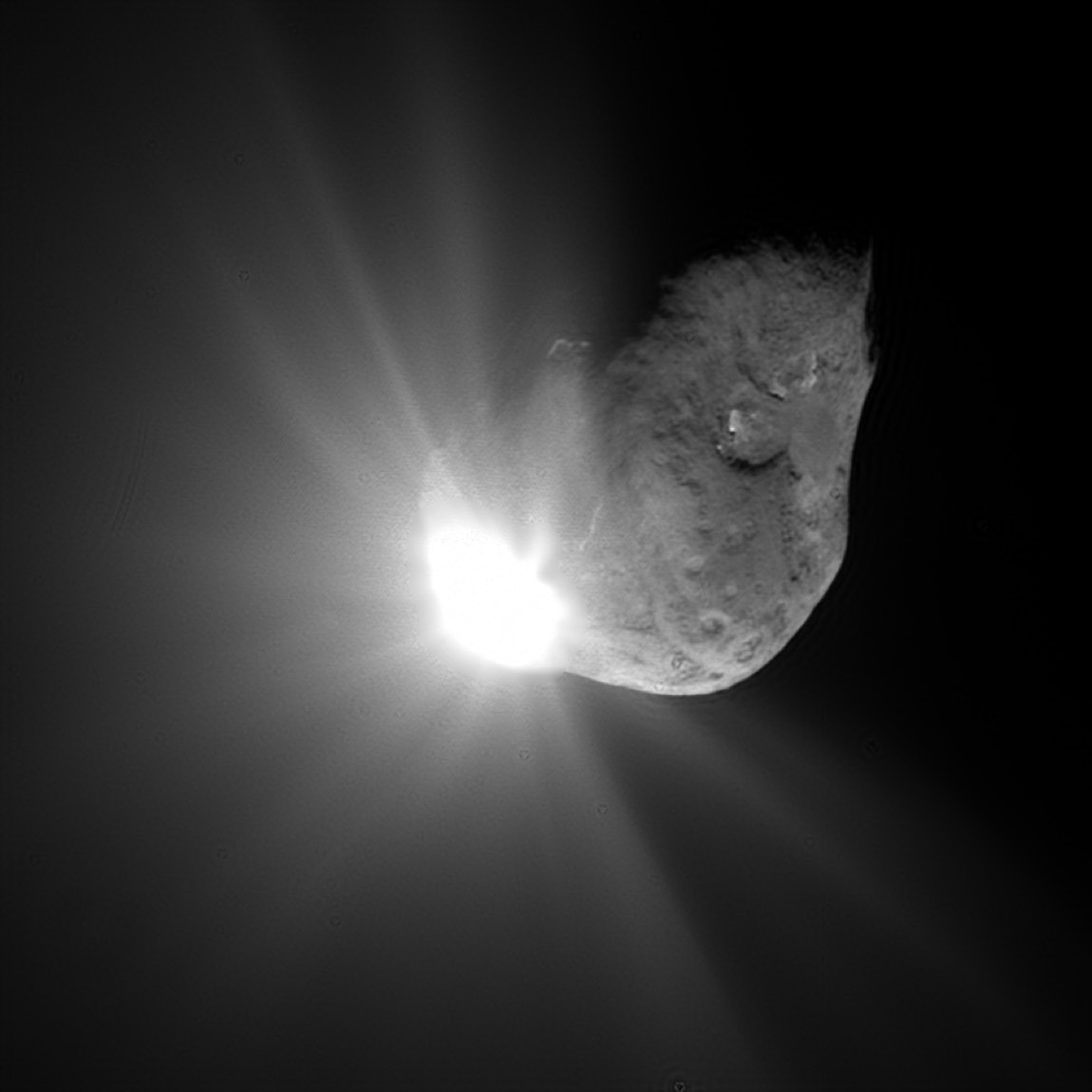
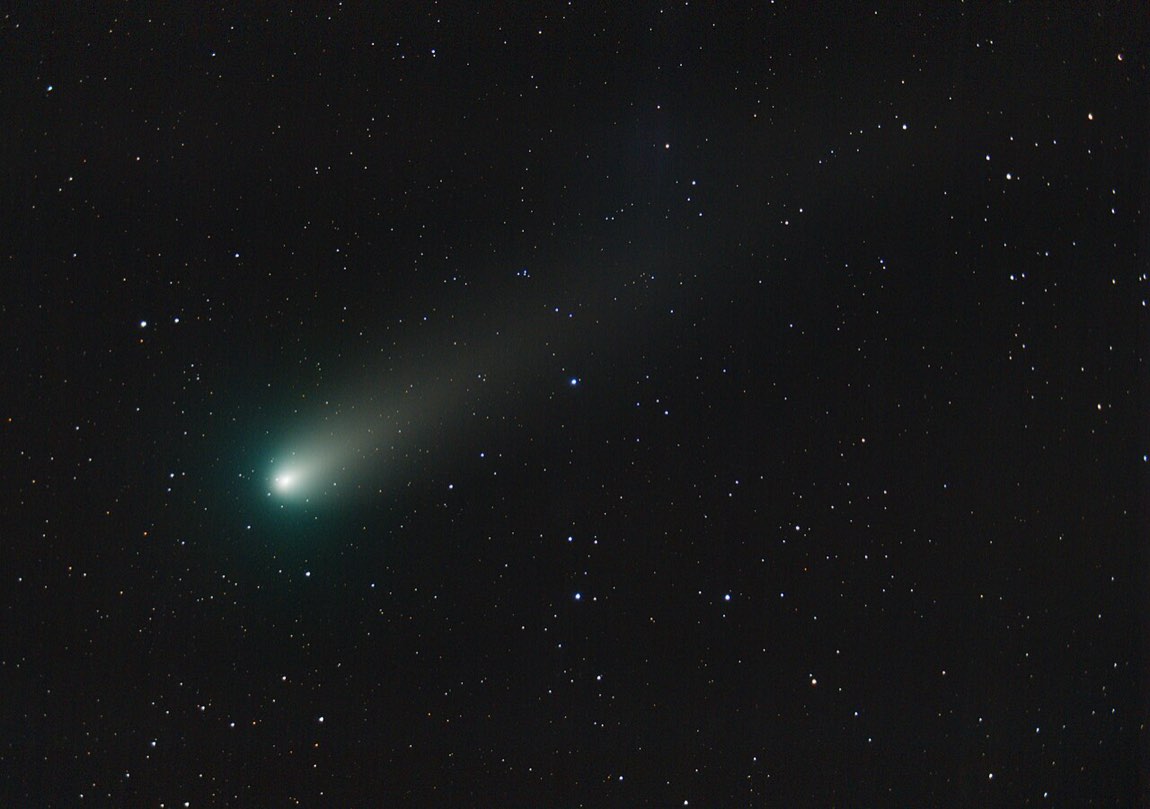
 Photograph · Alexander Vasenin · CC BY-SA 4.0
Comet · Deep guide
Comet Giacobini–Zinner (21P)
Also called: 21P/Giacobini–Zinner · Comet Giacobini-Zinner
The first comet ever visited by a spacecraft, and the source of the October Draconid meteors.
What is it?
Giacobini–Zinner is a Jupiter-family comet that circles the Sun every six and a half years. Michel Giacobini spotted it in 1900 and Ernst Zinner found it again in 1913. On 11 September 1985 NASA's International Cometary Explorer flew through its plasma tail about 7,800 km from the nucleus, the first time any spacecraft had visited a comet. Dust shed along its orbit produces the Draconid (Giacobinid) meteor shower in early October.
The deep dive
Researched for the Atlas from Wikipedia — 21P/Giacobini–Zinner (2,070 characters read) · updated Nov 14, 2026
01 A Tale of Two Discoverers
The comet carries two names because it was found, lost, and found again by different astronomers more than a decade apart. Michel Giacobini first spotted it on 20 December 1900, tracing a faint smudge in the constellation Aquarius. At the time, confirming a new comet required follow-up observations, and 21P slipped from view before its orbit could be firmly pinned down. It took until 23 October 1913 — two full orbits later — for German astronomer Ernst Zinner to stumble upon it again, quite by accident, while he was monitoring variable stars near Beta Scuti. Only after comparing observations did astronomers realize Zinner had rediscovered Giacobini's comet. This kind of independent recovery was common in the era before computerized sky surveys, and international convention rewards the effort by hyphenating both surnames into the official name. The gap of roughly thirteen years between the two sightings is itself a clue to the comet's orbital rhythm: two laps of its 6.53-year orbit bring it back almost exactly to the same region of the inner Solar System where Giacobini first noticed it.
02 Member of Jupiter's Comet Family
Giacobini–Zinner belongs to a class called Jupiter-family comets, a designation that reflects more than just orbital bookkeeping. These are short-period comets whose paths have been gravitationally sculpted by Jupiter's immense pull until their orbital periods cluster near or below about twenty years. With a period of 6.53 years, 21P completes roughly three laps around the Sun for every one Jupiter makes, keeping the two bodies in a loose but persistent gravitational conversation. That relationship is not static. On 14 February 2029, the comet will swing within 0.364 AU — about 54.5 million km — of Jupiter, a close enough passage to nudge its trajectory measurably. The subsequent perihelion, on 30 August 2031, will place the comet only 1.07 AU from the Sun, barely outside Earth's own orbit. Jupiter-family membership also means the comet's nucleus has probably experienced far fewer total orbits around the Sun than a long-period comet would have, which affects how much primordial material may remain intact beneath its darkened surface crust.
03 The Nucleus: Small, Dark, and Erratic Deeper
The solid heart of Giacobini–Zinner — its nucleus — is estimated at just 2.0 km in diameter, roughly the length of twenty city blocks. For context, that makes it smaller than many of the asteroids that cross Earth's path. Despite its modest size, the nucleus can drive spectacular displays. Under normal conditions, outgassing from sunlit surface ices pushes the comet to around 7th or 8th magnitude during its apparitions, putting it just at the edge of naked-eye visibility. But in 1946 the comet staged a remarkable performance, undergoing a series of outbursts that briefly pushed it to 5th magnitude — bright enough to see without optical aid under dark skies. Such outbursts are thought to occur when fresh, volatile-rich material is suddenly exposed, perhaps by a surface collapse or the opening of a new active pit, releasing a sudden surge of gas and dust. The 1946 behavior remains one of the more dramatic documented outburst sequences for this comet, and its cause is not definitively explained, illustrating how even a well-studied body can still surprise observers.
04 Chemistry Clues to a Warm Birthplace Deeper
Comets are often called frozen time capsules, but not all capsules contain the same ingredients. During the 2018 apparition, astronomers obtained optical spectra of Giacobini–Zinner and found something telling: the comet is depleted in carbon-chain molecules and carbon dioxide relative to what is typical for comets. These two chemical families tend to condense and be trapped in icy material that forms at very cold temperatures, far from the young Sun. Their absence — or reduced abundance — in 21P's spectrum suggests the comet did not originate in the coldest, most distant reaches of the early Solar System. Instead, the evidence points toward formation in a relatively warm portion of the solar nebula, closer to where temperatures were high enough to prevent large amounts of carbon-chain species and CO₂ from being locked into the growing body. This makes Giacobini–Zinner compositionally unusual among Jupiter-family comets and raises questions about how much migration and gravitational scattering shaped its journey to its current orbit. The 2018 spectral work adds an important chemical fingerprint to the comet's identity.
05 First Comet Ever Visited by a Spacecraft
Before September 1985, no spacecraft had ever flown through or past a comet. Giacobini–Zinner changed that. The International Cometary Explorer — ICE — threaded through the comet's plasma tail on 11 September 1985, passing at a closest distance of 7,800 km from the nucleus. That is roughly the distance between London and New York, traversed in minutes at spacecraft speeds. ICE had not been built as a comet mission; it was originally the International Sun–Earth Explorer 3, studying the solar wind. Mission planners realized they could retask it using gravitational slingshots around the Moon, redirecting it toward 21P without a new rocket launch. The plasma tail — the ion tail blown straight back from the comet by the solar wind — was the accessible target, and ICE sampled its charged-particle environment, magnetic field, and plasma waves. The visit established a historic milestone in planetary science, arriving months before the more famous fleet of spacecraft that would encounter Halley's Comet in 1986. That same month, in an independent observation, Pioneer Venus Orbiter also turned its instruments toward Giacobini–Zinner from its perch in orbit around Venus.
06 The Probe That Almost Got a Second Mission Deeper
The story of spacecraft encounters with Giacobini–Zinner has a tantalizing footnote. Japanese space officials seriously considered redirecting the Sakigake interplanetary probe for a 1998 flyby of the comet. Sakigake had been launched as part of Japan's contribution to the Halley armada in 1985 and, like ICE, had demonstrated that existing hardware could sometimes be repurposed for new targets. The engineering study for a Giacobini–Zinner encounter was real and earnest. Unfortunately, the analysis concluded that Sakigake simply did not carry enough propellant to execute the required trajectory changes, and the project was abandoned. Had it succeeded, it would have provided a second in-situ look at 21P's environment with instruments more modern than those on ICE. The failed redirect is a reminder that extending spacecraft missions always depends on the hard arithmetic of fuel reserves, and that many scientifically compelling encounters remain out of reach for exactly that reason. It also underscores how often planetary scientists look at existing assets and ask whether they can be stretched just a little further before fuel runs out.
07 The Draconid Meteor Showers It Feeds
Every time Giacobini–Zinner rounds the Sun, heat vaporizes surface ices and lifts dust and grit off the nucleus, scattering debris along the comet's orbital path. Earth intersects that stream of particles each October, producing the annual Draconid meteor shower — also formally called the Giacobinids, after the comet. The radiant, the sky point from which meteors appear to diverge, sits in the constellation Draco, giving the shower its more popular name. In most years the Draconids are a modest display, but when Earth passes through a particularly dense filament of freshly deposited material, the shower can surge dramatically. The comet's current minimum orbit intersection distance with Earth is 0.035 AU, or about 5.2 million km — close enough that the debris streams can deliver notable showers. The Draconids are notable for being an evening shower, with the radiant high in the northern sky shortly after dark rather than in the pre-dawn hours typical of many other annual showers, making them accessible to casual observers willing to step outside after dinner.
08 How Close Does It Actually Get to Earth?
Giacobini–Zinner does not pass dramatically close to Earth at every return. The geometry of each apparition varies considerably depending on where Earth and the comet happen to be in their respective orbits when the comet reaches perihelion. The 2025 perihelion on 25 March illustrates the range of possibilities: closest Earth approach actually occurred four days earlier, on 21 March 2025, but the comet was on the opposite side of the Sun at an unfavorable distance of 2.0 AU — roughly 300 million km. At that distance, with solar interference added, the comet only brightened to around magnitude 11, far beyond naked-eye reach and even challenging for small telescopes. By contrast, the upcoming 2031 apparition looks far more promising. After its close Jupiter encounter in February 2029 reshapes its path, the comet will pass within 0.554 AU — 82.9 million km — of Earth on 3 September 2031, just four days after perihelion. That favorable geometry, combined with a perihelion near 1.07 AU, could make 2031 one of the better viewing opportunities for this comet in recent memory.
09 Reading the Brightness Record Over Time Deeper
Tracking how bright a comet becomes across multiple apparitions is one of the primary ways astronomers monitor the long-term health of its nucleus. For Giacobini–Zinner, the typical brightness at perihelion hovers around 7th to 8th magnitude — just below what an unaided human eye can detect under ideal dark-sky conditions, but accessible through binoculars. The 1946 outburst series pushed the comet anomalously to 5th magnitude, a leap of roughly two to three magnitudes that corresponds to a sixfold to sixteenfold increase in apparent brightness. Such outbursts complicate any simple model of steady, predictable fading over successive orbits. A comet that is slowly exhausting its volatile inventory should grow fainter apparition by apparition, but outbursts can temporarily reverse that trend. The 2025 return, reaching only about magnitude 11, is consistent with a relatively unfavorable geometry rather than necessarily indicating a decline in intrinsic activity. Separating geometric effects from genuine changes in the nucleus's output requires careful photometric records across many returns — exactly the kind of patient observational work that professional and advanced amateur astronomers continue to compile.
10 Open Questions About 21P's Future Deeper
The 2029 Jupiter encounter introduces genuine uncertainty into Giacobini–Zinner's long-term future. When the comet passes within 0.364 AU — about 54.5 million km — of Jupiter on 14 February 2029, the giant planet's gravity will adjust the comet's orbit in ways that depend sensitively on the exact geometry of the encounter. Small differences in the actual trajectory can lead to notably different post-encounter orbits: a slightly closer pass could shorten or lengthen the period, change perihelion distance, or even set the comet on a path toward eventual ejection from the inner Solar System. The 2031 perihelion distance of 1.07 AU reflects current best calculations, but that value will be refined as the comet's position is tracked more precisely through the late 2020s. Beyond dynamics, the chemical depletion in carbon-chain molecules and CO₂ raises unresolved questions about where in the young Solar System the nucleus formed and what pathway brought it to its current Jupiter-family orbit. These questions sit at the intersection of cometary science, planet formation theory, and solar system dynamics — and 21P remains a productive object for probing all three.
11 Observing 21P: Timing and Tips
Planning to observe Giacobini–Zinner requires paying close attention to apparition geometry, because the difference between a rewarding view and a frustrating non-event can be enormous from one return to the next. The 2025 perihelion was a poor opportunity, with the comet deep in solar glare at 2.0 AU from Earth and only reaching around magnitude 11. The 2031 apparition, however, offers a genuinely favorable window: closest Earth approach on 3 September 2031 at 0.554 AU, with perihelion just four days earlier. Under those conditions, with perihelion at 1.07 AU from the Sun, the comet may become bright enough to observe comfortably with binoculars or a small telescope, and experienced observers will monitor it for any outburst activity recalling 1946. When observing, the comet will appear as a fuzzy, non-stellar object — a coma of gas and dust surrounding the unresolved nucleus. Under favorable conditions a tail may be visible, extending away from the Sun. The comet's minimum orbital intersection distance of 0.035 AU means Earth passes near its debris trail each October, so watching the Draconid shower is another way to connect with 21P without a telescope.