 Photograph · Arecibo Radiotelescope · Public domain
Comet · Deep guide
Comet Tuttle (8P/Tuttle)
Also called: 8P/Tuttle · Tuttle's Comet
The source of the Ursid meteors that fall just before Christmas.
What is it?
Comet 8P/Tuttle was discovered by Horace Parnell Tuttle in January 1858 and turned out to have been seen already in 1790. It orbits the Sun every 13.6 years on a fairly tilted path. Dust left along its orbit produces the Ursid meteor shower, in late December. Its last perihelion in August 2021 was poorly placed for viewing, and it is next due in 2035.
The deep dive
Researched for the Atlas from Wikipedia — 8P/Tuttle (1,796 characters read) · updated Nov 14, 2026
01 A comet caught between two definitions
Comet 8P/Tuttle sits in an awkward classification gap that reveals how messy the real solar system can be compared to our tidy categories. Its orbital period of 13.6 years places it comfortably within the classical definition of a Jupiter-family comet, which simply requires a period shorter than 20 years. But the modern definition adds a stricter dynamical test: the Tisserand parameter with respect to Jupiter must fall between 2 and 3. Comet Tuttle fails that second test, leaving astronomers with a comet that looks like a Jupiter-family member by one measure and doesn't by another. This is not a trivial bookkeeping dispute. The Tisserand parameter reflects how strongly Jupiter's gravity has sculpted a comet's orbit, so the disagreement hints that Tuttle's orbital history may differ meaningfully from the typical short-period comets that Jupiter has firmly corralled. It is a reminder that classification systems are tools, not truths, and that individual objects sometimes demand that we examine our assumptions.
02 The radar reveal: a double-lobed world Deeper
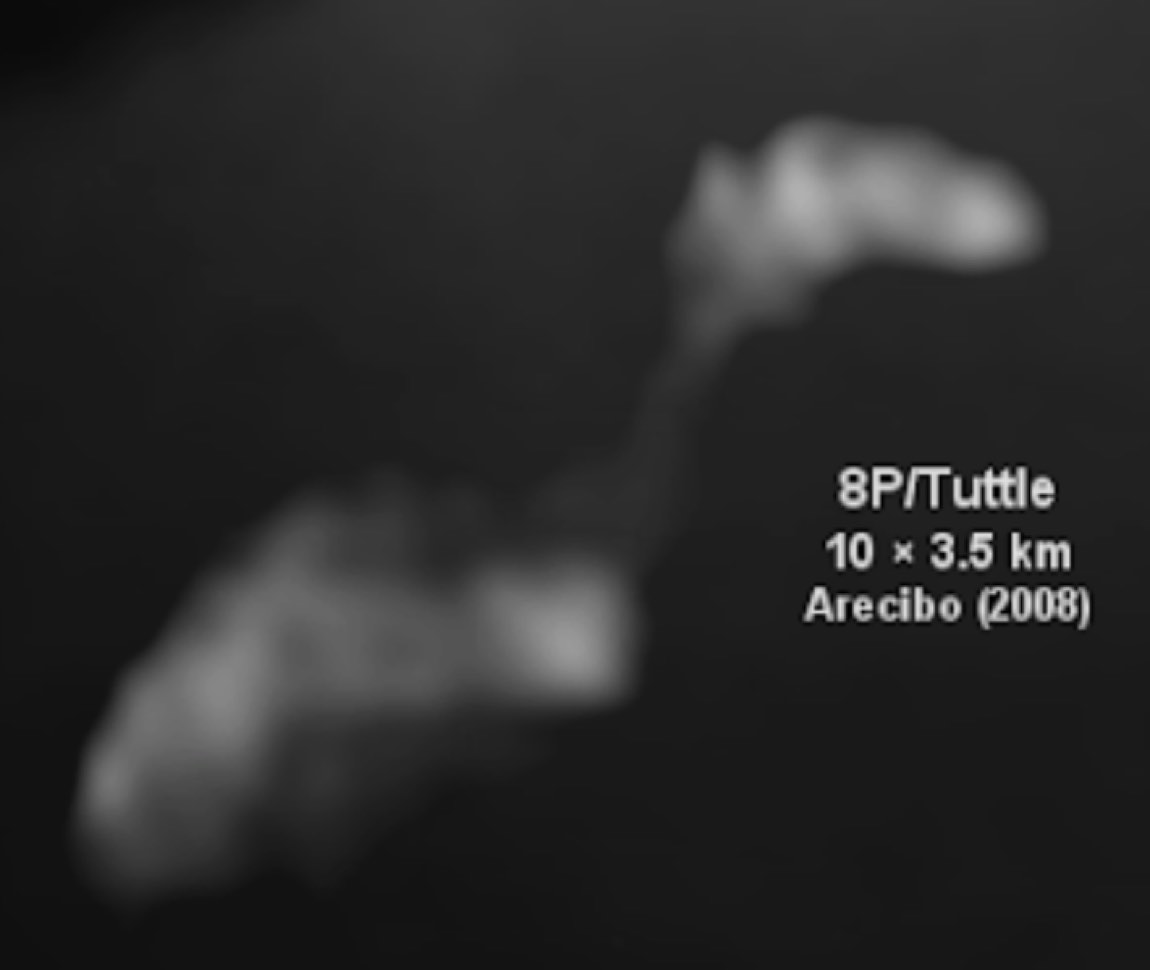
One of the most striking discoveries about Comet 8P/Tuttle came not from an optical telescope but from radar. In January 2008, scientists used the Arecibo Observatory to bounce radio waves off the comet's nucleus and analyze the returning echoes. What they found was that the nucleus is a contact binary — two distinct lobes pressed together into a single body rather than one smoothly unified chunk of ice and rock. The overall nucleus is estimated at 4.5 km in diameter, a figure derived as the equivalent diameter of a sphere whose volume equals the combined volume of the two lobes, which are themselves modeled as a 3 km by 4 km sphere. To put that scale in perspective, 4.5 km is roughly the length of about 45 football fields end to end. Contact binaries are now known among other small solar system bodies, including some asteroids and the Kuiper Belt object Arrokoth visited by New Horizons, suggesting that gentle mergers of two objects may be a common chapter in the life story of primordial bodies. For Tuttle, the contact binary structure raises questions about how the two lobes interact as the comet heats up and outgasses near perihelion.
03 How the 2008 close approach unfolded
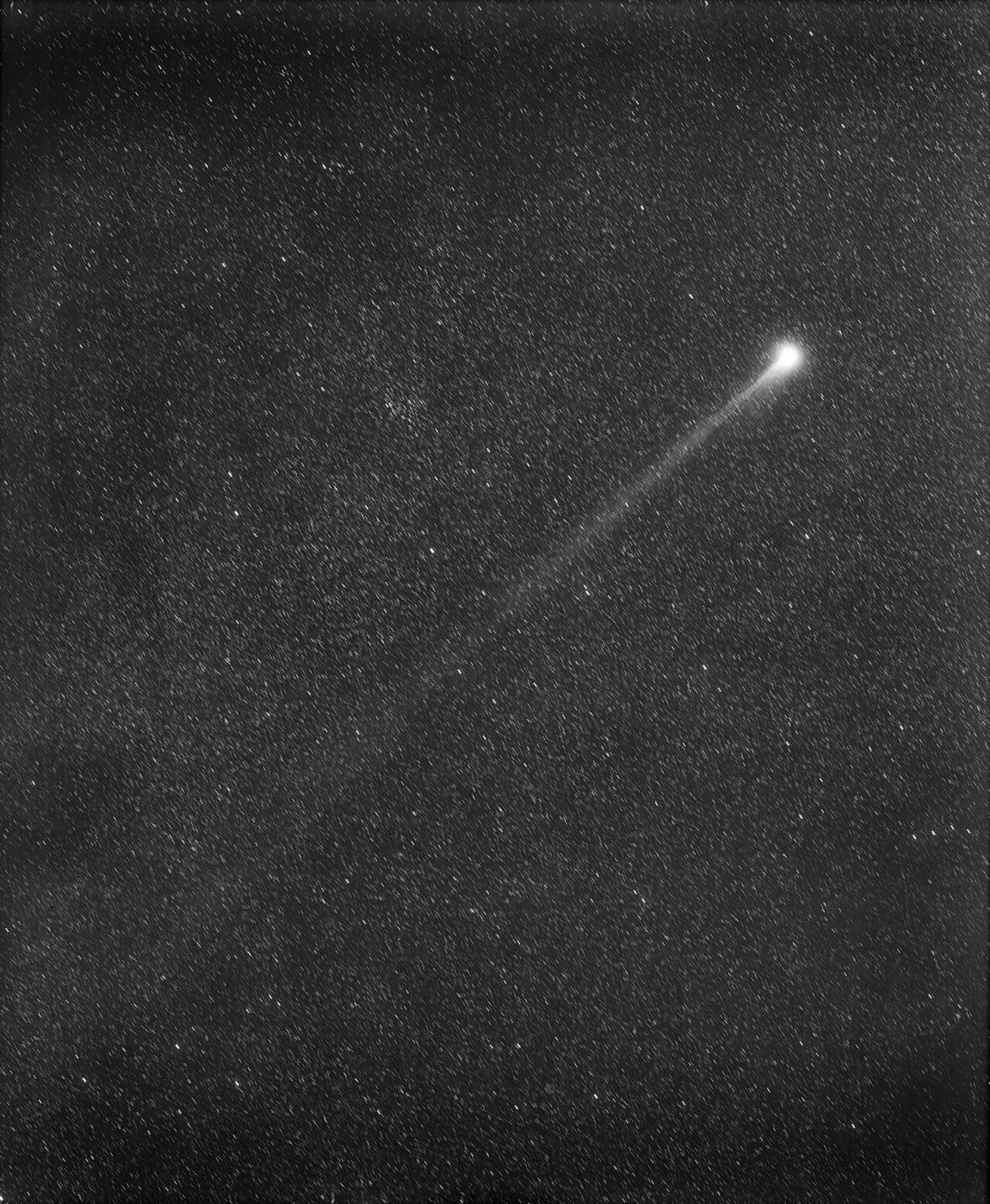
The 2008 perihelion passage gave observers a rare chance to see Comet Tuttle with their own eyes. Under dark skies, it reached naked-eye brightness, a threshold most periodic comets never achieve. On December 30, 2007, it produced a memorable visual event when it passed into close conjunction with the Triangulum Galaxy, placing a fuzzy comet alongside a fuzzy galaxy in the same telescopic field of view — a pairing that generated a wave of amateur astrophotography. Just two days into the new year, on January 1, 2008, the comet reached its closest point to Earth at a distance of 0.25282 AU, equivalent to about 37.821 million km. After that it faded and retreated, eventually becoming visible only through telescopes. Southern Hemisphere observers tracked it into February 2008, watching it drift through the constellation Eridanus as it moved away from the inner solar system. The whole arc — from naked-eye spectacle to telescopic target — played out over just a few weeks, illustrating how quickly a comet's character can shift as orbital geometry changes.
04 The 2021 return: a less favorable geometry
Not every perihelion passage is created equal, and the 2021 return of Comet 8P/Tuttle demonstrated that clearly. The comet reached perihelion on August 27, 2021, but its solar elongation at that moment was only 26 degrees — meaning it sat uncomfortably close to the Sun in the sky, making observation difficult and dangerous for anyone attempting it without special equipment. Its apparent magnitude was approximately 9, which is well below naked-eye visibility and requires at least binoculars or a small telescope under good conditions. Two weeks after perihelion, on September 12, 2021, the comet was about 1.8 AU from Earth, which is roughly 270 million km. The article notes that this distance represents approximately as far from Earth as the comet can get when it is near perihelion — a consequence of the particular geometry of Tuttle's orbit relative to Earth's. Comparing 2021 to 2008 makes plain how dramatically the viewing conditions for a periodic comet can swing from one apparition to the next.
05 Ursids: a meteor shower traced to Tuttle
Every time Comet 8P/Tuttle swings through the inner solar system, it sheds dust and debris along its orbital path. Earth crosses that debris trail every year in late December, sweeping up the particles and producing the Ursid meteor shower. The shower takes its name from the constellation Ursa Minor, where its radiant — the point in the sky from which meteors appear to diverge — is located. Because the Ursids peak around December 22, they often go unappreciated, buried under the noise of holiday activity and sometimes washed out by a bright Moon. When the 2007 Ursid shower arrived, predictions suggested it might be stronger than usual because the parent comet was itself returning to the inner solar system, potentially seeding the debris field with fresh material. In the end, those hopes did not materialize: observed counts fell within the normal distribution, suggesting that the comet's proximity did not translate into a noticeably denser stream of particles encountering Earth that year.
06 Comet Interceptor: Tuttle as a backup prize Deeper
The European Space Agency's Comet Interceptor mission represents a new philosophy in comet exploration: launch the spacecraft first and select the target later, waiting for an ideal comet — possibly a dynamically new visitor from the outer solar system — to reveal itself. In 2019, 8P/Tuttle was identified as one of ten backup targets for the mission, meaning that if no sufficiently compelling primary target materializes, mission planners have a list of well-characterized periodic comets ready to substitute. The spacecraft is scheduled for launch in 2029, and if 8P/Tuttle is ultimately selected, the planned flyby date is March 26, 2035. A flyby of Tuttle would be scientifically valuable partly because of its contact binary nucleus — spacecraft imaging could resolve the two lobes directly and reveal how their surfaces and activity patterns differ. The radar data from Arecibo provided shape information, but only a close spacecraft encounter could deliver surface geology, composition maps, and direct measurements of the gas and dust environment surrounding this double-lobed nucleus.
07 Orbital period and what 13.6 years means
A period of 13.6 years means that Comet 8P/Tuttle completes one full trip around the Sun in roughly the time it takes a child born at one perihelion to become a teenager by the next. This is long enough that most people will witness only a handful of its returns in a lifetime, yet short enough that planetary scientists can build up a multi-apparition record of the comet's behavior spanning decades. The 13.6-year cadence also determines the rhythm of the Ursid meteor shower's intensity: every time Tuttle returns, it refreshes a portion of the debris trail that Earth intersects each December. Between apparitions, the comet spends most of its time in the cold outer solar system, where solar heating is too weak to drive significant outgassing, essentially putting the comet into a dormant state until it swings back inward. The varying geometry of each return — how close the comet comes to Earth, how far it sits from the Sun in Earth's sky — means that some apparitions, like 2008, are spectacular, while others, like 2021, are frustratingly difficult to observe.
08 Why Arecibo was the right tool for this job Deeper
Optical telescopes, however large, see a comet's nucleus only as an unresolved point lost inside its own bright coma of gas and dust. Radar astronomy sidesteps this problem entirely. The Arecibo Observatory in Puerto Rico, before its collapse in 2020, operated a powerful radar transmitter that could beam microwave pulses at solar system bodies and detect the returning echoes with its enormous 305-meter dish. Because radar wavelengths penetrate the coma and bounce off solid surfaces, the technique can reveal the actual shape and rotation of a nucleus that would otherwise be invisible. For Comet Tuttle in January 2008, the Arecibo radar observations delivered a clear picture of a contact binary structure — two lobes in contact — along with enough geometric information to estimate the size of each component. This kind of radar characterization had previously been applied to near-Earth asteroids, and Tuttle's 2008 apparition, bringing it to within 0.25282 AU of Earth, placed the comet close enough that the radar echoes were strong enough to be scientifically useful. The result was one of the most detailed structural portraits ever made of a cometary nucleus from the ground.
09 Observing Tuttle: past, present, and future windows
The history of Comet 8P/Tuttle's apparitions illustrates how much viewing conditions vary. The 2008 return was exceptional: the comet reached naked-eye brightness, passed just 0.25282 AU from Earth on January 1, 2008, and treated observers to a memorable conjunction with the Triangulum Galaxy on December 30, 2007. Southern Hemisphere observers enjoyed an extended window through February 2008 as the comet traversed Eridanus. By contrast, the 2021 return was hobbled from the start by a solar elongation of only 26 degrees at perihelion, confining practical observation to a narrow and awkward window. For anyone hoping to see Tuttle in future returns, the key variable is always the comet's geometry relative to Earth and Sun at the time of closest approach — a figure that changes from orbit to orbit because Earth and Tuttle follow independent rhythms. Observers and amateur astronomers planning ahead should track apparition predictions from ephemeris services, as the difference between a spectacular show and an invisible passage can be dramatic.