Comet · Deep guide
Comet Tempel–Tuttle (55P)
Also called: 55P/Tempel–Tuttle · Comet Tempel-Tuttle
Every 33 years it renews the dust stream behind the Leonid meteor storms.
What is it?
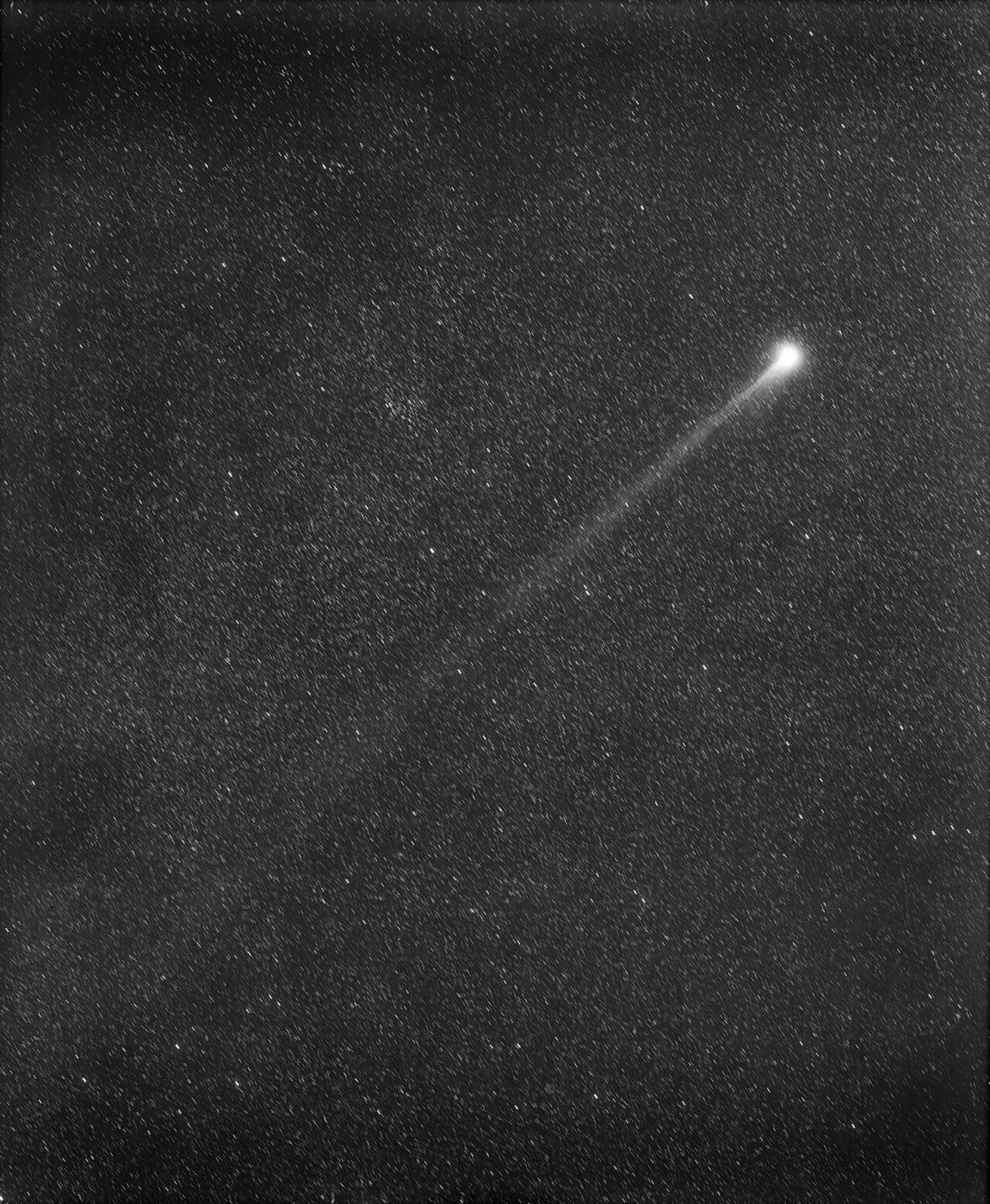
Comet Tempel–Tuttle was found independently by Wilhelm Tempel in December 1865 and Horace Tuttle in January 1866. It travels around the Sun backwards (retrograde) compared with the planets, once every 33 years. Earth crosses its debris every November, producing the Leonid meteor shower, which has produced meteor storms in some years. It last reached perihelion in 1998 and is next due in 2031.
The deep dive
Researched for the Atlas from Wikipedia — 55P/Tempel–Tuttle (4,378 characters read) · updated Nov 14, 2026
01 A Comet Rediscovered Across the Centuries
Although Wilhelm Tempel and Horace Parnell Tuttle independently spotted this comet within weeks of each other in late 1865 and early 1866, the comet itself had been making appearances long before anyone understood what they were seeing. The astronomer Gottfried Kirch observed it as far back as 1699 without realising it would return. More strikingly, in 1965 the astronomer S. Kanda's earlier deduction — later confirmed by Joachim Schubart — established that a comet recorded in 1366 was indeed Tempel–Tuttle. On 26 October of that year, it passed just 0.0229 AU from Earth, roughly 3.43 million kilometres, closer than most comets ever venture to our planet. Tantalising hints exist of even earlier sightings: a Japanese source from October 1234 offers a brief mention, and a Chinese record from January 1035 may also refer to it, though the comet would likely have been too faint to see with the naked eye unless it had undergone a major outburst. These ancient threads make Tempel–Tuttle one of the better-documented comets in pre-telescopic history.
02 The Spectrograph Moment of 1866
When Comet Tempel–Tuttle appeared in January 1866, the astronomer William Huggins turned a spectrograph toward it and recorded its light. This was only the second time in history that spectrographic observations of a comet had ever been obtained, placing Tempel–Tuttle at a genuine turning point in astronomical science. Spectroscopy — splitting light into its constituent wavelengths — would eventually become the primary tool for understanding the chemistry of comets, planets, and stars alike. Huggins's observations of Tempel–Tuttle helped open that door. Modern spectrometric work on the comet has since revealed the presence of diatomic carbon, NH₂, and atomic oxygen in its coma. Notably, the comet appears depleted in diatomic carbon relative to expectations, and its gas-to-dust ratio indicates it is gas-rich compared with the famous Halley's Comet. The infrared spectrum closely resembles that of a black body radiating at 330 K and conspicuously lacks the silicate emission features detected in many other comets, hinting at a surface chemistry that sets it apart from the broader comet population.
03 A Tiny, Dark, Slowly Spinning Nucleus Deeper
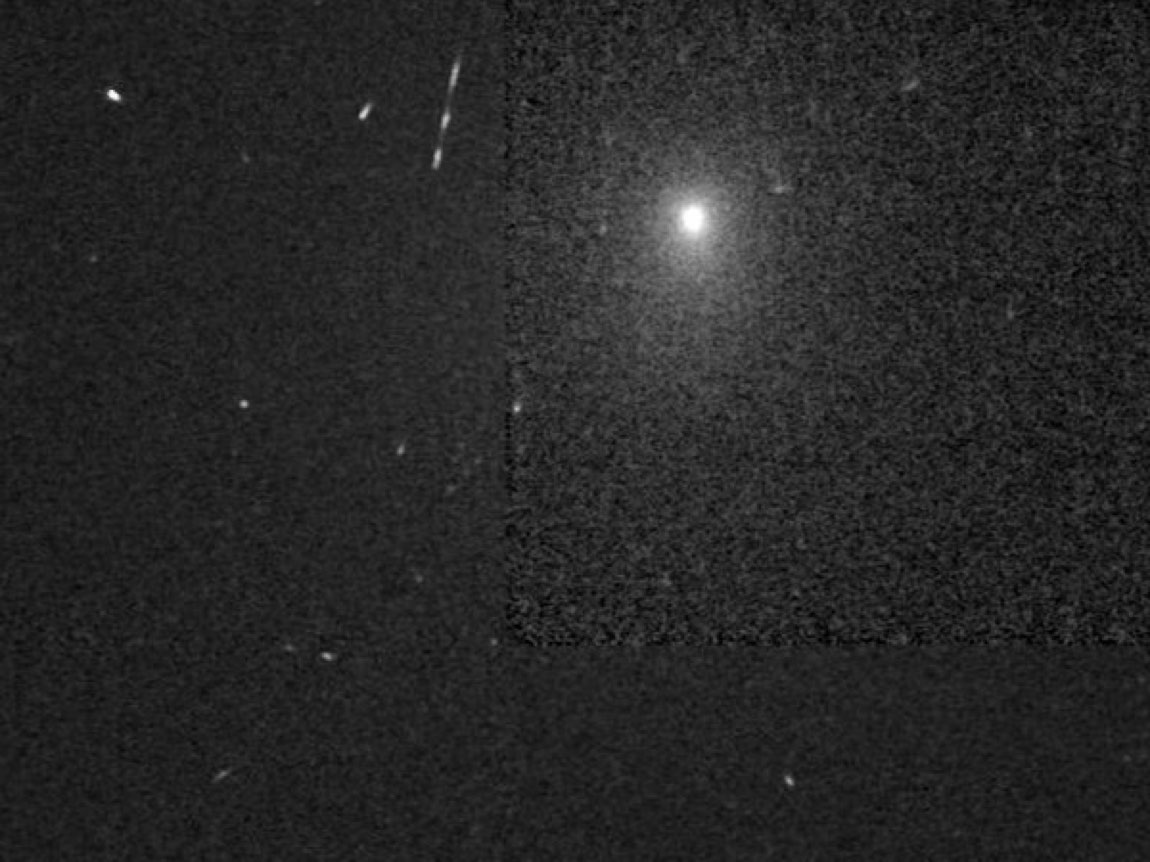
The Hubble Space Telescope observed the nucleus of Tempel–Tuttle during its 1998 apparition, providing the most detailed physical measurements available. Assuming an albedo of just 0.04 — meaning the surface reflects only four percent of incoming sunlight, darker than charcoal — the nucleus was estimated to have a mean radius of 1.8 kilometres. That is a small but not unusual size for a periodic comet. Its surface has a reddish tint, with colour indices measured as B−V of 0.75±0.05 and V−R of 0.51±0.05, consistent with the organic-rich, radiation-processed material seen on other short- to medium-period comets. A jet was observed streaming from the nucleus, and by tracking the jet's movement astronomers calculated a rotation period of between 14.79±0.02 and 15.31±0.03 hours — roughly comparable to a slow Earth day. The total nuclear mass is estimated at 1.2×10¹³ kilograms, while the meteoroid stream the comet has shed over its many perihelion passages carries a combined mass of around 5×10¹² kilograms — nearly half the nucleus's own estimated mass scattered across space.
04 How a Uranus Flyby Shaped Its Orbit Deeper
Tempel–Tuttle was not always a 33-year comet. Orbital calculations published in 2014 suggest that roughly 5,000 years before its discovery — so somewhere around 3100 BCE — the comet made a close gravitational encounter with Uranus. That encounter is thought to have dramatically shortened its orbital period, pulling it in from what had been a long-period orbit reaching out to the Kuiper Belt and bending it into the compact 33-year retrograde loop it follows today. This kind of planetary scattering is a well-understood mechanism by which the outer solar system feeds comets into the inner solar system, but pinpointing a specific historical flyby for a specific comet remains inherently difficult. The 2014 result is explicitly noted as unconfirmed, since orbital integrations run backward over millennia accumulate uncertainties and small errors can compound into large ones. If the scenario is correct, Tempel–Tuttle is a relatively recent arrival to the inner solar system in astronomical terms, still carrying the primitive composition it acquired far from the Sun.
05 Why Leonid Storms Happen Every 33 Years
Most meteor showers produce a steady, modest drizzle of meteors because their parent comet's debris has had time to spread widely around the orbit. The Leonids are different. Tempel–Tuttle's orbit intersects Earth's so precisely that material ejected during each perihelion passage does not need to spread out much to encounter our planet, meaning individual streams remain dense and compact when Earth flies through them. This geometry produces not just an annual shower but periodic storms — brief, violent episodes of thousands or even tens of thousands of meteors per hour. The 1833 Leonid storm, one of the most spectacular in recorded history, was caused by the dense stream laid down during the comet's 1800 perihelion passage. The cycle repeats roughly every 33 years, matching the comet's orbital period. Between 2021 and 2030, Earth will repeatedly pass through the stream deposited during the 1733 orbit, offering elevated Leonid activity during that decade. The meteors hit at 70 km/s — among the fastest of any annual shower — because the comet travels in a retrograde direction, meaning it moves against the flow of solar-system traffic.
06 Recovery in 1965: Finding a Lost Comet
After its celebrated 1866 apparition, Tempel–Tuttle slipped away and was not observed again for nearly a century. Its recovery in 1965 required deliberate, coordinated effort. J. Schubart predicted where the comet should be, and on 30 June 1965 Michiel John Bester captured it in images taken with the 10-inch telescope at Boyden Observatory in South Africa, finding the comet at an apparent magnitude of 16 — far too faint for the naked eye, roughly as bright as a distant galaxy in a small telescope. The same day, plates obtained at Palomar Observatory independently confirmed its presence. Those two observations were the only ones made during the entire 1965 apparition, illustrating how briefly and faintly the comet appeared even as it passed through the inner solar system. This recovery was scientifically important because it allowed astronomers to refine the comet's orbit and begin linking it rigorously to its historical apparitions, including the now-confirmed 1366 and 1699 sightings.
07 The 1997–1998 Return and Binocular Brightness
The most recent apparition of Tempel–Tuttle, in 1997 and 1998, was the best-observed in modern times. Recovery came on 4 March 1997 when Karen Meech, Olivier Hainaut, and James "Gerbs" Bauer, working at the University of Hawaiʻi, detected the comet at a magnitude of 22.5 — extraordinarily faint, near the limits of large telescope capability. That early detection confirmed the comet was returning on schedule and that its orbit was very well determined. As the comet rounded the Sun, it brightened significantly more than forecasts had predicted, reaching an apparent magnitude of 7.4 to 7.8 in late February 1998. At that brightness it was visible through ordinary binoculars, making it accessible to amateur astronomers for the first time since 1866. The Hubble Space Telescope was used during this apparition to study the nucleus directly. The comet was last observed on 5 July 1998, after which it receded into the outer solar system. The exceptional brightness during 1998 corresponded with heightened Leonid meteor activity in the years immediately following.
08 Its Place in the Halley-Type Comet Family Deeper
Tempel–Tuttle belongs to the category known as Halley-type comets, defined as periodic comets with orbital periods between 20 and 200 years. This classification is not merely a matter of timing — it carries implications about origin and dynamics. Halley-type comets are thought to originate in the scattered disc or Oort Cloud and to have been gravitationally perturbed into their current orbits by encounters with the giant planets, a history that may be directly reflected in Tempel–Tuttle's proposed encounter with Uranus approximately 5,000 years ago. Like Halley's Comet itself, Tempel–Tuttle travels in a retrograde direction — orbiting opposite to the planets — which is a hallmark of comets arriving from dynamically distant reservoirs. Its 33-year period places it squarely in the middle of the Halley-type range. The comparison with Halley's Comet is also chemically interesting: while Tempel–Tuttle is gas-rich relative to Halley, its infrared spectrum lacks silicate emission features seen in some other comets, indicating meaningful diversity even within this family of apparently similar objects.
09 How Close Does It Actually Come to Earth?
Although Tempel–Tuttle's orbit intersects Earth's orbit closely enough to produce the Leonid meteor shower, the comet itself does not necessarily pass near Earth during each return. The current Earth Minimum Orbit Intersection Distance — the closest the two orbits come to each other anywhere along their paths — is about 0.008 AU, or approximately 1.2 million kilometres. For comparison, the Moon orbits Earth at an average of about 0.0026 AU, so the closest orbital approach geometry is roughly three times the Earth–Moon distance. Whether the comet actually reaches that nearest point at the same time Earth does depends on orbital timing and shifts from one perihelion to the next. The 1366 close approach of 0.0229 AU remains the documented record for a historic near passage. While none of this poses any immediate collision threat, the orbit's proximity is precisely what makes the Leonid debris stream so effective at producing storms: the two paths are nearly co-planar and geometrically entangled in a way rarely seen with other shower-producing comets.
10 Open Questions and What We Still Don't Know Deeper
Despite centuries of observation, significant uncertainties surround Tempel–Tuttle. The proposed Uranus encounter 5,000 years ago that reshaped its orbit remains unconfirmed, and without direct verification it cannot be ruled out that other dynamical histories could explain the current orbit equally well. The possible 1234 Japanese sighting and the 1035 Chinese observation are unverified, leaving the full historical record incomplete. The comet's infrared spectrum is intriguing precisely because it lacks silicate emission features found in other comets — the reason for this absence is not explained in current literature and may reflect unusual surface processing, composition, or activity history. The rotation period is known only within a range of 14.79±0.02 to 15.31±0.03 hours, a spread wide enough to suggest the measurement remains somewhat uncertain. And while the meteoroid stream mass is estimated at 5×10¹² kilograms, understanding how that mass is distributed around the orbit — and therefore predicting future Leonid storm intensities precisely — remains an active area of research. The next close return will not occur until the 2030s, leaving time for new computational and observational tools to sharpen these answers.
 ⤢